
3D Printed Wearables Market Report 2026
Global Outlook – By Product Type (Prosthetics, Orthotics and Braces, Smart Wearable Housings and Structures, Fitness and Health Monitoring Wearables, Other Product Types), By Technology (Polymer-Based 3D Printing, Metal-Based 3D Printing, Multi-Material 3D Printing, Flexible and Elastomeric 3D Printing, Other Technologies), By Sales Channel (Online Retail Platforms, Offline Retail and Specialty Stores, Direct-to-Customer (DTC) Sales, Healthcare Provider Channels, Customization and Digital Design Platforms), By End User (Individual Consumers, Hospitals and Clinics, Rehabilitation Centers and Prosthetic Clinics, Academic and Research Institutes, Other End Users) - Market Size, Trends, Strategies, and Forecast to 2030
3D Printed Wearables Market Overview
• 3D Printed Wearables market size has reached to $4.37 billion in 2025 • Expected to grow to $6.17 billion in 2030 at a compound annual growth rate (CAGR) of 6.9% • Growth Driver: Rising Diabetes Prevalence Fuels Growth Of 3D-Printed Wearables MarketMarket • Market Trend: Innovations In 3D Printed Wearables Enhance Design Flexibility, Sustainability, And Manufacturing Efficiency • North America was the largest region in 2025 and Asia-Pacific is the fastest growing region.What Is Covered Under 3D Printed Wearables Market?
3D printed wearables refer to devices or accessories produced using additive manufacturing technology, commonly known as 3D printing, tailored to be worn on the body. They are designed to offer superior fit, enhanced functionality, and aesthetic appeal compared to traditionally manufactured counterparts. The main types of 3D printed wearable products include orthopedic implants, prosthetics, smart watches, surgical instruments, and fitness trackers. Orthopedic implants are specially designed medical devices used to support or replace damaged bones or joints in the human body, aiding in mobility and alleviating pain. These are sold through several sales channels, including online retail, offline retail, direct sales, healthcare providers, and customization platforms, to various end-users, such as pharma and biotech companies, hospitals, academic institutes, and others.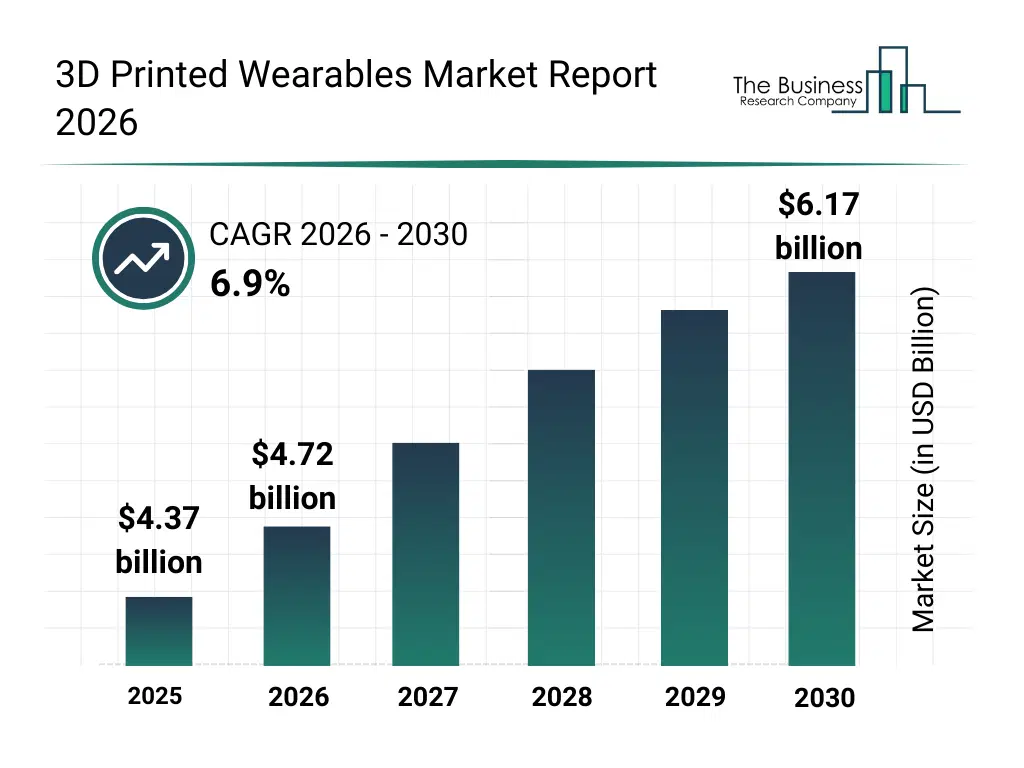
What Is The 3D Printed Wearables Market Size and Share 2026?
The 3d printed wearables market size has grown strongly in recent years. It will grow from $4.37 billion in 2025 to $4.72 billion in 2026 at a compound annual growth rate (CAGR) of 8.0%. The growth in the historic period can be attributed to early adoption of additive manufacturing technologies, increasing consumer interest in wearable devices, growth of fitness and health monitoring trends, expansion of prosthetics and orthopedic solutions, improvements in 3d printing materials.What Is The 3D Printed Wearables Market Growth Forecast?
The 3d printed wearables market size is expected to see strong growth in the next few years. It will grow to $6.17 billion in 2030 at a compound annual growth rate (CAGR) of 6.9%. The growth in the forecast period can be attributed to advancement in multi-material 3d printing, rising integration of sensors and electronics, increasing demand for patient-specific medical devices, growth of digital customization platforms, expansion of smart healthcare ecosystems. Major trends in the forecast period include growing demand for customized and personalized wearables, rising adoption of lightweight and ergonomic designs, increasing use of 3d printing for rapid prototyping, expansion of medical and healthcare wearable applications, improved aesthetic and design flexibility in wearables.
Global 3D Printed Wearables Market Segmentation
1) By Product Type: Prosthetics, Orthotics and Braces, Smart Wearable Housings and Structures, Fitness and Health Monitoring Wearables, Other Product Types 2) By Technology: Polymer-Based 3D Printing, Metal-Based 3D Printing, Multi-Material 3D Printing, Flexible and Elastomeric 3D Printing, Other Technologies 3) By Sales Channel: Online Retail Platforms, Offline Retail and Specialty Stores, Direct-to-Customer (DTC) Sales, Healthcare Provider Channels, Customization and Digital Design Platforms 4) By End User: Individual Consumers, Hospitals and Clinics, Rehabilitation Centers and Prosthetic Clinics, Academic and Research Institutes, Other End Users Subsegments: 1) By Prosthetics: Upper Limb Prosthetics, Lower Limb Prosthetics, Customized and Personalized Prosthetics, Lightweight and Modular Prosthetics 2) By Orthotics and Braces: Foot Orthotics and Insoles, Knee Ankle and Limb Braces, Spinal and Posture Support Devices, Customized Orthotic Wearables 3) By Smart Wearable Housings and Structures: Smartwatch Casings and Bands, Medical-Grade Wearable Enclosures, Modular and Customizable Wearable Frames 4) By Fitness and Health Monitoring Wearables: Fitness Bands and Activity Trackers, Health Monitoring Wearables, Customized Fitness Wearables 5) By Other Product Types: Fashion and Lifestyle Wearables, Protective and Ergonomic Wearables, Customized Sports WearablesWhat Is The Driver Of The 3D Printed Wearables Market?
The rising prevalence of diabetes is expected to propel the growth of the 3D-printed wearables market going forward. Diabetes is a chronic health condition defined by excessive blood glucose levels, which are generally caused by inadequate insulin synthesis or poor insulin usage. The rise in diabetes is largely driven by growing obesity, which disrupts insulin function and elevates blood sugar levels, increasing disease risk. 3D-printed wearables in diabetes management are custom-designed devices that use 3D printing technology to monitor and manage blood glucose levels, deliver insulin, and offer real-time health data to diabetics. For instance, in April 2025, according to the International Diabetes Federation (IDF), a Belgium-based non-profit organization, globally, approximately 589 million adults aged 20–79 are living with diabetes, accounting for 11.1% of the world’s population in this age group. This number is expected to increase to 853 million (13%) by 2050. Moreover, about 252 million adults with diabetes are estimated to be unaware of their condition. Therefore, the rising prevalence of diabetes is driving the growth of the 3D-printed wearables market.Key Players In The Global 3D Printed Wearables Market
Major companies operating in the 3D printed wearables market are Open Bionics Ltd., UNYQ Design Inc., Ottobock SE & Co. KGaA, Össur hf., LIM Innovations Pty Ltd., WillowWood Global LLC, Myomo Inc., Ekso Bionics Holdings Inc., ReWalk Robotics Ltd., Materialise NV, 3D Systems Corporation, Stratasys Ltd., EOS GmbH Electro Optical Systems, Carbon Inc., Desktop Metal Inc., Markforged Inc., Formlabs Inc., Cyfuse Biomedical K.K., Align Technology Inc., Limb-Art LLC, Alleles Design Studio Ltd., Aqua-Leg Inc.
This chart is for illustrative purposes; the full report includes a detailed competitor analysis and comprehensive overview of the top 10 companies in the market.
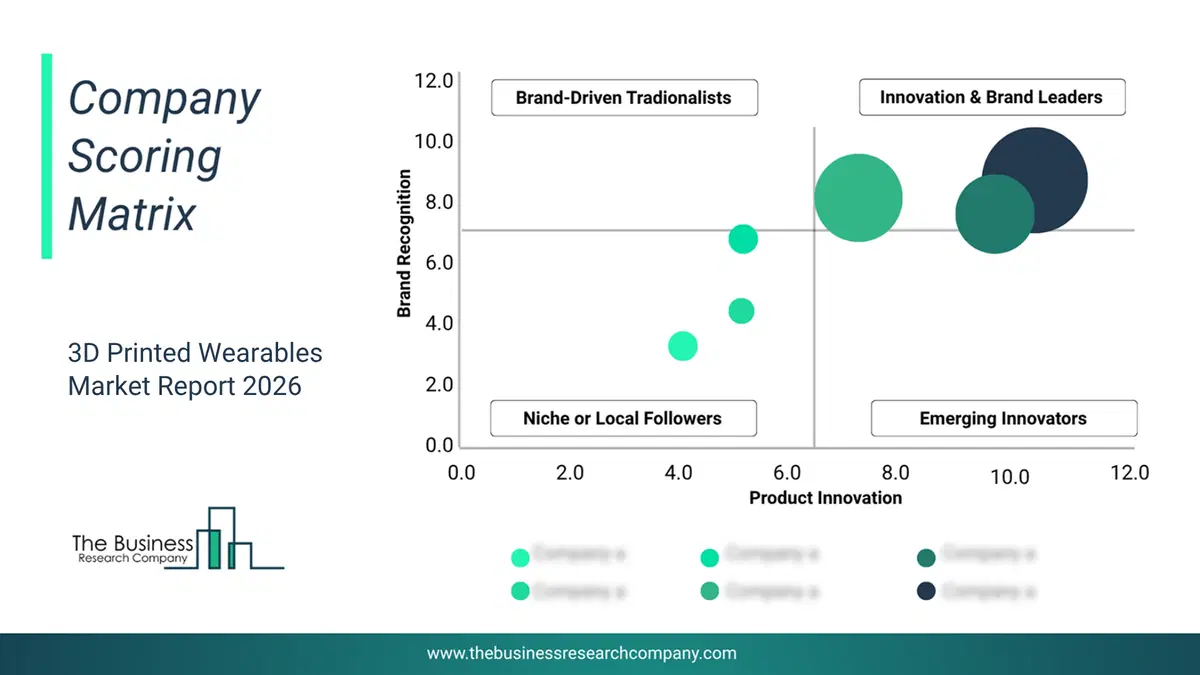
This chart maps companies by product innovation and brand strength, with bubble size indicating relative revenue, helping identify market leaders, challengers, and niche players. This is an illustrative chart; the full report provides a complete and accurate competitive analysis.
Global 3D Printed Wearables Market Trends and Insights
Major companies operating in the 3D printed wearables market are focusing on developing advanced solutions, such as additive manufacturing with recycled metals, to enhance product design, reduce material waste, and improve production scalability. Additive manufacturing with recycled metals refers to a 3D printing process that uses high-quality recycled metal powders to produce wearable device components, minimizing raw material usage while maintaining structural strength. For instance, in November 2025, Apple Inc., a US-based technology company, introduced 3D-printed titanium cases for the Apple Watch Ultra 3 and Apple Watch Series 11, marking the company’s first large-scale deployment of additive manufacturing for millions of wearable device enclosures. The new process utilizes aerospace-grade recycled titanium powder, reducing material usage by 50% compared to traditional subtractive machining. This advancement not only enhances durability and design flexibility but also supports Apple’s sustainability goals by saving more than 400 metric tons of raw titanium in 2025 alone.What Are Latest Mergers And Acquisitions In The 3D Printed Wearables Market?
In September 2025, ActivArmor, a US-based manufacturer of custom 3D-printed orthopedic wearables, partnered with Additive3D Asia to expand access to advanced personalized medical wearables in the Asia-Pacific region. Through this partnership, ActivArmor aimed to scale the availability of its customized 3D-printed splints and casts by leveraging Additive3D Asia’s production and distribution capabilities. Additive3D Asia is a Singapore-based company that specializes in delivering high-precision additive manufacturing solutions, including medical-grade 3D printing services.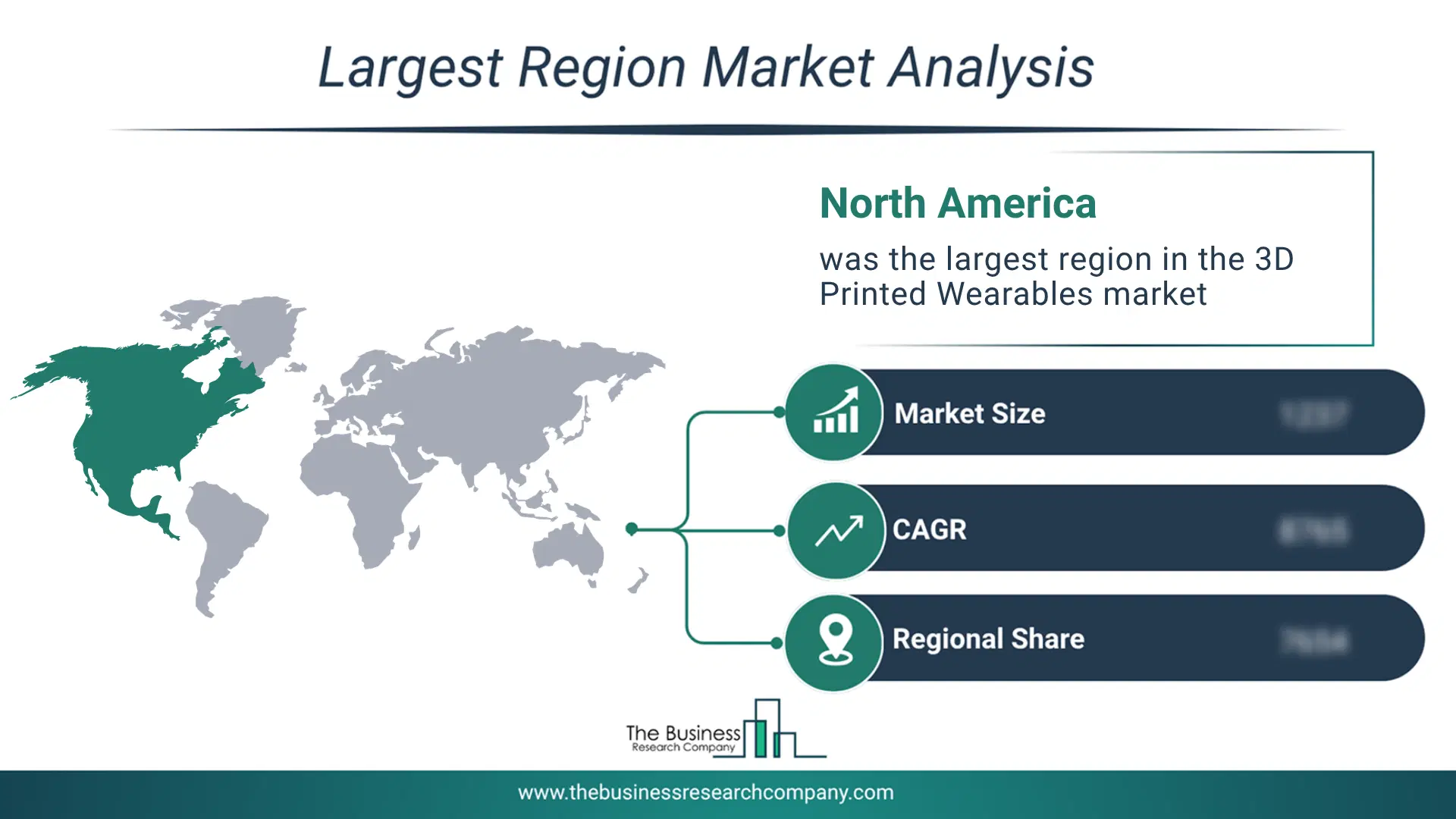
Regional Outlook
North America was the largest region in the 3D printed wearables market in 2025. Asia-Pacific is expected to be the fastest-growing region in the forecast period. The regions covered in this market report are Asia-Pacific, South East Asia, Western Europe, Eastern Europe, North America, South America, Middle East, Africa. The countries covered in this market report are Australia, Brazil, China, France, Germany, India, Indonesia, Japan, Taiwan, Russia, South Korea, UK, USA, Canada, Italy, Spain.What Defines the 3D Printed Wearables Market?
The 3D printed wearables market consists of sales of straps and bands, smart glasses or prosthetics, conductive inks and filaments, and biometric sensors. Values in this market are ‘factory gate’ values, that is the value of goods sold by the manufacturers or creators of the goods, whether to other entities (including downstream manufacturers, wholesalers, distributors, and retailers) or directly to end customers. The value of goods in this market includes related services sold by the creators of the goods.How is Market Value Defined and Measured?
The market value is defined as the revenues that enterprises gain from the sale of goods and/or services within the specified market and geography through sales, grants, or donations in terms of the currency (in USD unless otherwise specified). The revenues for a specified geography are consumption values that are revenues generated by organizations in the specified geography within the market, irrespective of where they are produced. It does not include revenues from resales along the supply chain, either further along the supply chain or as part of other products.
This chart presents market attractiveness based on a quantitative evaluation of growth, competition, strategic alignment, and risk, offering a clear view of opportunity areas for decision-making. This chart is for illustrative purposes; the full report contains the complete analysis.

This chart highlights the Total Addressable Market (TAM) by estimating the maximum revenue opportunity using an assumption-driven approach, supporting strategic planning and opportunity sizing across markets. The chart is illustrative; the full report provides a more comprehensive analysis.
What Key Data and Analysis Are Included in the 3D Printed Wearables Market Report 2026?
The 3d printed wearables market research report is one of a series of new reports from The Business Research Company that provides market statistics, including industry global market size, regional shares, competitors with the market share, detailed market segments, market trends and opportunities, and any further data you may need to thrive in the 3d printed wearables industry. The market research report delivers a complete perspective of everything you need, with an in-depth analysis of the current and future state of the industry.3D Printed Wearables Market Report Forecast Analysis
| Report Attribute | Details |
|---|---|
| Market Size Value In 2026 | $4.72 billion |
| Revenue Forecast In 2030 | $6.17 billion |
| Growth Rate | CAGR of 6.9% from 2026 to 2030 |
| Base Year For Estimation | 2025 |
| Actual Estimates/Historical Data | 2020-2025 |
| Forecast Period | 2026 - 2030 |
| Market Representation | Revenue in USD Billion and CAGR from 2026 to 2030 |
| Segments Covered | Product Type, Technology, Sales Channel, End User |
| Regional Scope | Asia-Pacific, Western Europe, Eastern Europe, North America, South America, Middle East, Africa |
| Country Scope | The countries covered in the report are Australia, Brazil, China, France, Germany, India, Indonesia, Japan, Taiwan, Russia, South Korea, UK, USA, Canada, Italy, Spain |
| Key Companies Profiled | Open Bionics Ltd., UNYQ Design Inc., Ottobock SE & Co. KGaA, Össur hf., LIM Innovations Pty Ltd., WillowWood Global LLC, Myomo Inc., Ekso Bionics Holdings Inc., ReWalk Robotics Ltd., Materialise NV, 3D Systems Corporation, Stratasys Ltd., EOS GmbH Electro Optical Systems, Carbon Inc., Desktop Metal Inc., Markforged Inc., Formlabs Inc., Cyfuse Biomedical K.K., Align Technology Inc., Limb-Art LLC, Alleles Design Studio Ltd., Aqua-Leg Inc. |
| Customization Scope | Request for Customization |
| Pricing And Purchase Options | Explore Purchase Options |