
3D Printing Cultured Meat Market Report 2026
Global Outlook – By Product Type (Beef, Poultry, Pork, Seafood, Exotic Or Novel Meats), By Cell Source (Animal Muscle Cells, Fat Cells, Stem Cells, Hybrid Cell Lines), By Technology (Extrusion-Based Printing, Laser-Assisted Printing, Inkjet Printing, Bioprinting), By Application (Food Industry, Research And Development, Animal Feed, Pharmaceuticals), By End-User (Restaurants, Retailers, Catering Services, Households) – Market Size, Trends, Strategies, and Forecast to 2030
3D Printing Cultured Meat Market Overview
• 3D Printing Cultured Meat market size has reached to $0.02 billion in 2025 • Expected to grow to $0.08 billion in 2030 at a compound annual growth rate (CAGR) of 28.8% • Growth Driver: Rising Demand For High-Protein Functional Foods Fueling The Growth Of The Market Due To Increasing Consumer Focus On Nutrient-Dense, Convenient, And Easily Digestible Protein Sources • Market Trend: Ready-To-Use Bio-Ink Enables Precise Layer-By-Layer 3D Printing • North America was the largest region in 2025 and Asia-Pacific is the fastest growing region.What Is Covered Under 3D Printing Cultured Meat Market?
3D printing cultured meat is an advanced food technology that combines bioprinting techniques with cultivated (lab-grown) animal cells to create meat products without raising or slaughtering animals. It uses bioink mixtures of living cells, growth factors, and edible scaffolds to build meat layer by layer, mimicking the texture, structure, and taste of conventional meat. It helps to enhance food sustainability, reduce environmental impact, ensure animal welfare, and improve the efficiency and personalization of meat production. The main product types of the 3D printing cultured meat market include beef, poultry, pork, seafood, and exotic or novel meats. Beef is a general term for the muscle tissue, fat, connective tissue, and associated components obtained from cattle that are used for human nutrition and culinary purposes and that vary widely by cut, fat content, and culinary preparation methods to deliver the characteristic flavor, texture, and nutritional profile associated with red meat. The various cell sources used in production include animal muscle cells, fat cells, stem cells, and hybrid cell lines, each selected to optimize taste, structure, and growth efficiency. Key technologies include extrusion-based printing, laser-assisted printing, inkjet printing, and bioprinting. The multiple applications span the food industry, research and development, animal feed, and pharmaceuticals, supporting innovation in sustainable protein production and biomedical research and are used by several end-users such as restaurants, retailers, catering services, and households.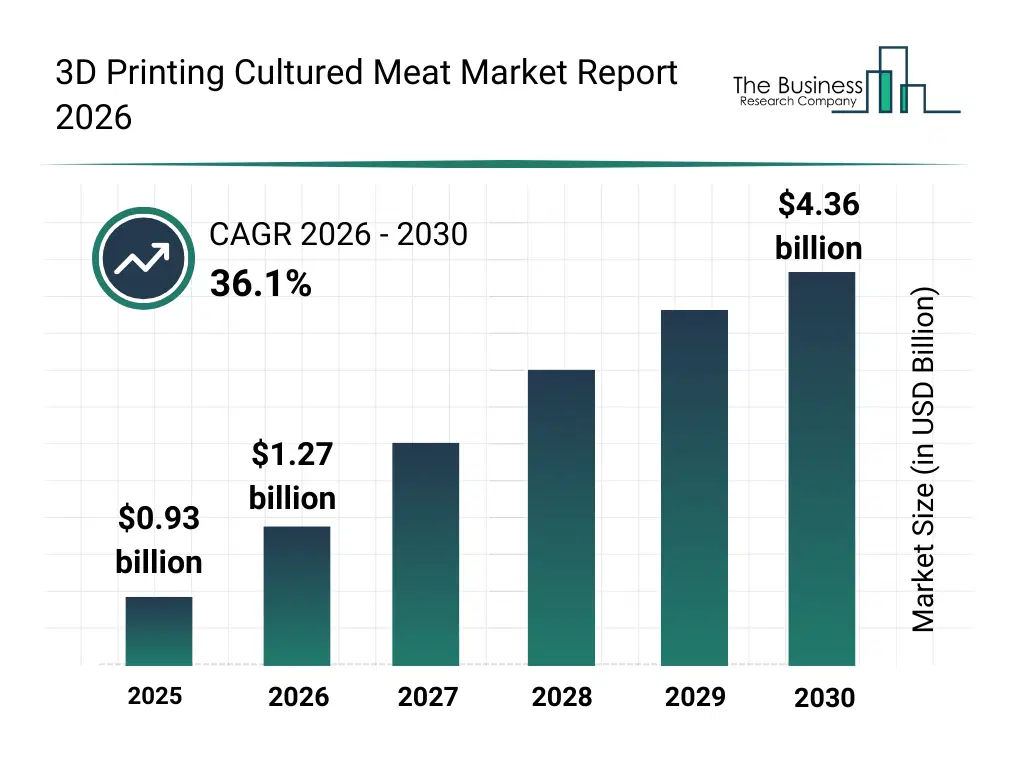
What Is The 3D Printing Cultured Meat Market Size and Share 2026?
The 3D printing cultured meat market size has grown exponentially in recent years. It will grow from $0.02 billion in 2025 to $0.03 billion in 2026 at a compound annual growth rate (CAGR) of 31.0%. The growth in the historic period can be attributed to increasing consumer demand for alternative proteins, rising interest from foodservice and restaurant operators in novel protein options, growing investment from venture capital and private equity into cultured meat ventures, increasing strategic partnerships between startups and established food companies, and rising government and public funding for sustainable food projects.What Is The 3D Printing Cultured Meat Market Growth Forecast?
The 3d printing cultured meat market size is expected to see exponential growth in the next few years. It will grow to $0.08 billion in 2030 at a compound annual growth rate (CAGR) of 28.8%. The growth in the forecast period can be attributed to increasing consumer willingness to pay a premium for cultured meat products, rising regulatory clarity and framework development by food safety authorities, growing expansion of manufacturing capacity through contract manufacturing and shared facilities, increasing private and institutional investment inflows into commercialization, and rising adoption by foodservice chains and institutional buyers. Major trends in the forecast period include bioreactor design improvements and scale up for large scale production as a technology advancement, cost reduction driven by alternative growth media formulation and process optimization as an innovation, automation and process control integration across production lines as a development, improvements in cell line robustness and yield through research and development, and integration of precision fermentation for flavour and texture enhancement as a technological development.
Global 3D Printing Cultured Meat Market Segmentation
2) By Cell Source: Animal Muscle Cells, Fat Cells, Stem Cells, Hybrid Cell Lines 3) By Technology: Extrusion-Based Printing, Laser-Assisted Printing, Inkjet Printing, Bioprinting 4) By Application: Food Industry, Research And Development, Animal Feed, Pharmaceuticals 5) By End-User: Restaurants, Retailers, Catering Services, Households Subsegments: 1) By Beef: Whole Cut Fillet, Ground And Minced Meat, Patties And Burgers, Marbled Steak Cuts 2) By Poultry: Chicken Nuggets And Strips, Ground Poultry Products, Whole Breast Analogs, Turkey Breast Products 3) By Pork: Ground Pork Sausage, Bacon Analogs, Loin Cut Products, Ham And Deli Slices 4) By Seafood: Salmon Fillet Analogs, Shrimp Scampi Analogs, Tuna Steak Products, Calamari Rings 5) By Exotic Or Novel Meats: Wagyu Beef Analogs, Duck Breast Products, Fowl Ground Products, Other Novel Species CutsWhat Are The Drivers Of The 3D Printing Cultured Meat Market?
The rising demand for high-protein functional foods is expected to propel the growth of 3D printing cultured meat market going forward. High-protein functional foods are products enriched with proteins and additional nutrients that support muscle development, weight management, and overall metabolic health. The rise in demand for high-protein functional foods is due to increasing consumer focus on healthier eating habits, as individuals seek nutrient-dense, convenient options that support active lifestyles, fitness goals, and daily energy needs. 3D printed cultured meat supports high-protein functional foods by providing customizable, nutrient-rich protein sources, making them ideal for health-conscious and fitness-focused consumers. It improves product functionality by delivering complete, easily digestible proteins with tailored nutritional profiles, enhancing dietary convenience and wellness benefits. For instance, in June 2024, according to the International Food Information Council, a US-based nonprofit organization, most Americans are increasingly focused on consuming more protein, rising from 59% in 2022 to 67% in 2023 and 71% in 2024. Additionally, about half of consumers aim to boost their intake of fresh foods, widely regarded as the healthiest option. Therefore, the rising demand for high-protein functional foods is driving the growth of the 3D printing cultured meat industry. The growing consumer demand for sustainable food is expected to propel the growth of the 3D printing cultured meat market going forward. Sustainable food refers to products that are produced, processed, and sourced in ways that minimize environmental impact, support biodiversity, promote ethical labor practices, and ensure long-term food system resilience. The growing consumer demand for sustainable food is due to increasing awareness of environmental and climate issues, as consumers seek to reduce their ecological footprint and support environmentally responsible food production. 3D printing cultured meat supports consumer demand for sustainable food by enabling the production of meat alternatives with significantly lower environmental impact compared to conventional livestock farming. It reduces resource consumption such as land and water while minimizing greenhouse gas emissions, improving the sustainability and efficiency of the global food system. For instance, in May 2024, according to PricewaterhouseCoopers (PwC), a UK-based professional services firm, more than 80 percent of consumers reported being willing to pay more for sustainably produced or sourced goods, with some consumers willing to pay an average premium of 9.7 percent for products that meet specific environmental criteria such as being locally sourced, made from recycled or eco-friendly materials, or produced in a supply chain with a lower carbon footprint. Therefore, the growing consumer demand for sustainable food is driving the growth of the 3D printing cultured meat industry.Key Players In The Global 3D Printing Cultured Meat Market
Major companies operating in the 3d printing cultured meat market are JBS S.A, Tyson Foods Inc., SIGMAXYZ Holdings Inc., TOPPAN Inc., Mosa Meat B.V., Shimadzu Corporation, Biokraft Foods, Upside Foods Inc., Novameat Tech S.L., Redefine Meat Ltd., BlueNalu Inc., Tender Food Inc., Aleph Farms Ltd., Steakholder Foods Ltd., CellX, Believer Meats Inc., Fork & Goode Inc., Avant Meats Company Limited, SavorEat Ltd., Revo Foods GmbH
This chart is for illustrative purposes; the full report includes a detailed competitor analysis and comprehensive overview of the top 10 companies in the market.
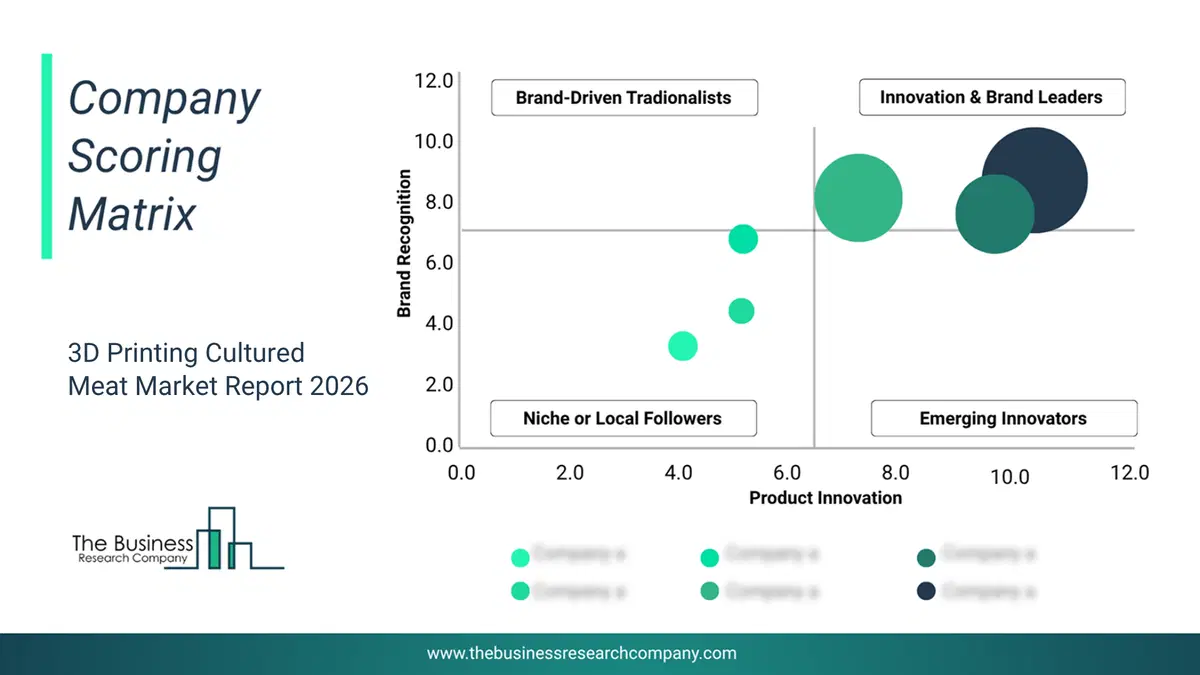
This chart maps companies by product innovation and brand strength, with bubble size indicating relative revenue, helping identify market leaders, challengers, and niche players. This is an illustrative chart; the full report provides a complete and accurate competitive analysis.
Global 3D Printing Cultured Meat Market Trends and Insights
Major companies operating in the 3D printed cultured meat market are focusing on developing advanced bio-materials, such as specialized bio-inks, to boost product authenticity, enhance structural integrity, and reduce production complexity. Specialized bio-inks refer to advanced, edible formulations containing cultured animal cells and other ingredients, designed for precise layer-by-layer deposition by 3D printers to create structured, whole-cut meat products. For instance, in September 2023, Steakholder Foods Ltd., an Israel-based deep-tech food company, launched the SH Beef Steak Ink. This is a ready-to-use, specialized bio-ink designed for 3D printing cultivated beef steaks. It is formulated to replicate the texture and mouthfeel of conventional beef, featuring a patented blend of cultivated beef cells and plant-based ingredients that provide the necessary support structure. It includes specialized rheological properties for precise printing and post-printing maturation, enabling the creation of complex marbled textures and fibrous consistency without requiring proprietary printing hardware from the company. It also incorporates a scalable formulation designed for manufacturing efficiency, supporting the commercial viability and market entry of whole-cut cultivated steaks for food service and retail partners.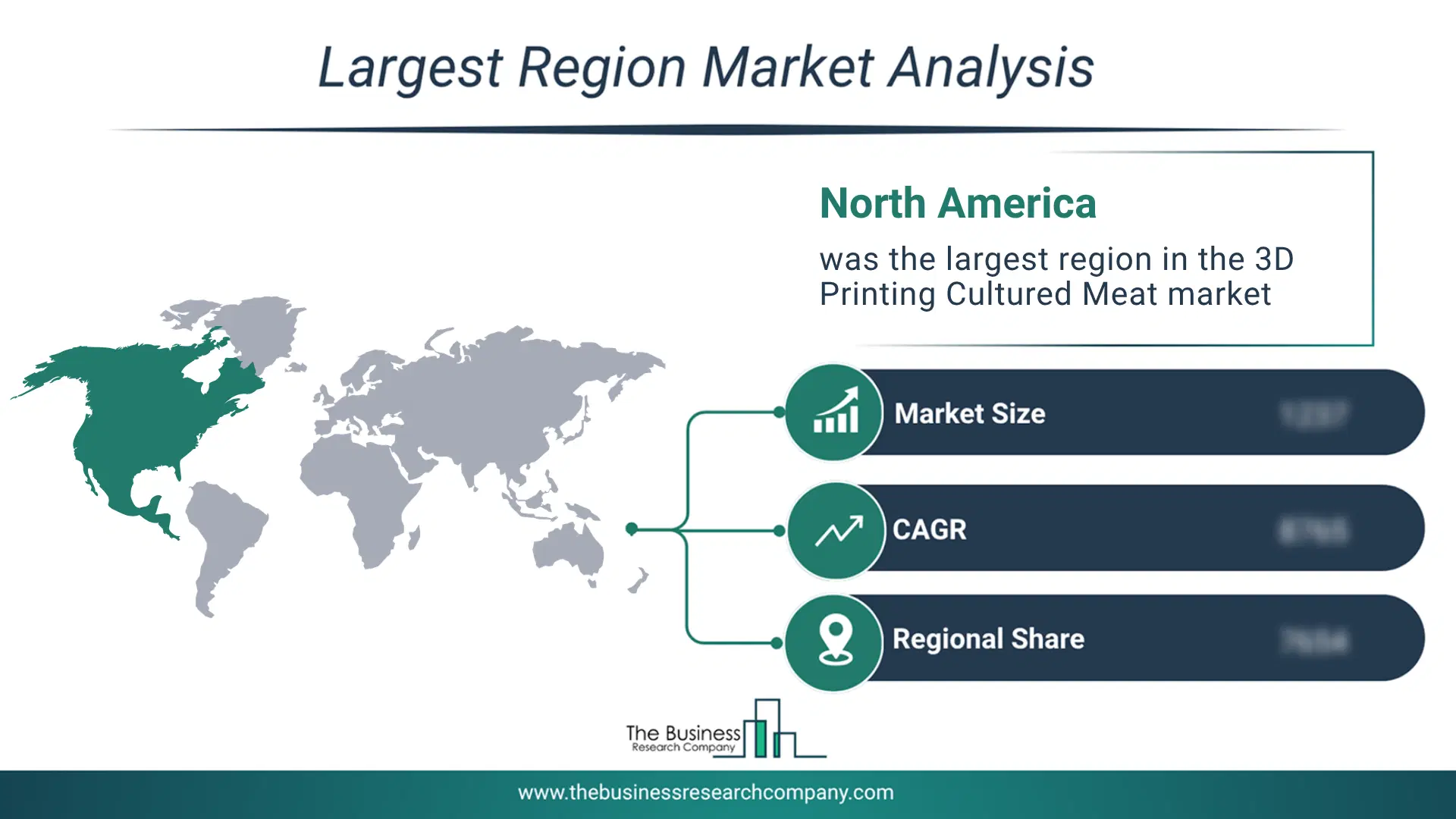
Regional Outlook
North America was the largest region in the 3D printing cultured meat market in 2025. Asia-Pacific is expected to be the fastest-growing region in the forecast period. The regions covered in this market report are Asia-Pacific, South East Asia, Western Europe, Eastern Europe, North America, South America, Middle East, Africa. The countries covered in this market report are Australia, Brazil, China, France, Germany, India, Indonesia, Japan, Taiwan, Russia, South Korea, UK, USA, Canada, Italy, Spain.What Defines the 3D Printing Cultured Meat Market?
The 3D printing cultured meat market consists of revenues earned by entities by providing services such as contract research and development (R&D) and tissue design, bioprinting-as-a-service (on-demand fabrication of prototypes and small batches), supply of scaffolds and bioinks (material formulation and sales), software and computer-aided design (CAD) for tissue architecture and slicer or print-job support, and pilot-scale contract development and manufacturing organization services (pilot production, process validation, and scale-up support). The market value includes the value of related goods sold by the service provider or included within the service offering. The 3D printing cultured meat market also includes sales of structured printed steaks and whole-muscle cuts, printed ground or minced and formed meat products, hybrid products combining cultured cells with plant matrices, finished ready-to-cook printed meat items, and specialized bioinks, scaffold materials, and formulated growth media. Values in this market are factory gate values, that is, the value of goods sold by the manufacturers or creators of the goods, whether to other entities (including downstream food manufacturers, distributors, and retailers) or directly to end consumers. The value of goods in this market includes related services sold by the creators of the goods.How is Market Value Defined and Measured?
The market value is defined as the revenues that enterprises gain from the sale of goods and/or services within the specified market and geography through sales, grants, or donations in terms of the currency (in USD unless otherwise specified). The revenues for a specified geography are consumption values that are revenues generated by organizations in the specified geography within the market, irrespective of where they are produced. It does not include revenues from resales along the supply chain, either further along the supply chain or as part of other products.
This chart presents market attractiveness based on a quantitative evaluation of growth, competition, strategic alignment, and risk, offering a clear view of opportunity areas for decision-making. This chart is for illustrative purposes; the full report contains the complete analysis.

This chart highlights the Total Addressable Market (TAM) by estimating the maximum revenue opportunity using an assumption-driven approach, supporting strategic planning and opportunity sizing across markets. The chart is illustrative; the full report provides a more comprehensive analysis.
What Key Data and Analysis Are Included in the 3D Printing Cultured Meat Market Report 2026?
The 3d printing cultured meat market research report is one of a series of new reports from The Business Research Company that provides market statistics, including industry global market size, regional shares, competitors with the market share, detailed market segments, market trends and opportunities, and any further data you may need to thrive in the 3d printing cultured meat industry. The market research report delivers a complete perspective of everything you need, with an in-depth analysis of the current and future state of the industry.3D Printing Cultured Meat Market Report Forecast Analysis
| Report Attribute | Details |
|---|---|
| Market Size Value In 2026 | $0.03 billion |
| Revenue Forecast In 2030 | $0.08 billion |
| Growth Rate | CAGR of 28.8% from 2026 to 2030 |
| Base Year For Estimation | 2025 |
| Actual Estimates/Historical Data | 2020-2025 |
| Forecast Period | 2026 - 2030 |
| Market Representation | Revenue in USD Billion and CAGR from 2026 to 2030 |
| Segments Covered | Product Type, Cell Source, Technology, Application, End-User |
| Regional Scope | Asia-Pacific, Western Europe, Eastern Europe, North America, South America, Middle East, Africa |
| Country Scope | The countries covered in the report are Australia, Brazil, China, France, Germany, India, Indonesia, Japan, Taiwan, Russia, South Korea, UK, USA, Canada, Italy, Spain. |
| Key Companies Profiled | JBS S.A, Tyson Foods Inc., SIGMAXYZ Holdings Inc., TOPPAN Inc., Mosa Meat B.V., Shimadzu Corporation, Biokraft Foods, Upside Foods Inc., Novameat Tech S.L., Redefine Meat Ltd., BlueNalu Inc., Tender Food Inc., Aleph Farms Ltd., Steakholder Foods Ltd., CellX, Believer Meats Inc., Fork & Goode Inc., Avant Meats Company Limited, SavorEat Ltd., Revo Foods GmbH |
| Customization Scope | Request for Customization |
| Pricing And Purchase Options | Explore Purchase Options |