
3D Printing Slicer Software Market Report 2026
Global Outlook – By Deployment (Desktop Or Standalone Software, Cloud-Based Or Web-Accessible Software, Embedded Or Integrated Slicing Software), By Application (Industrial 3D Printing, Desktop And Hobbyist 3D Printing, Educational And Research 3D Printing, Other Applications), By End-User (Healthcare, Automotive, Aerospace And Defense, Construction, Other End-Users) – Market Size, Trends, Strategies, and Forecast to 2030
3D Printing Slicer Software Market Overview
• 3D Printing Slicer Software market size has reached to $3.07 billion in 2025 • Expected to grow to $10.35 billion in 2030 at a compound annual growth rate (CAGR) of 27.4% • Growth Driver: Growing Investments In Manufacturing And Infrastructure Development Fueling The Growth Of The Market Boosting Enhanced Efficiency And Cost Reduction • Market Trend: Focus On Advanced Model Repair Tools For Enhanced Print Quality And Efficiency • North America was the largest region in 2025.What Is Covered Under 3D Printing Slicer Software Market?
3D printing slicer software refers to a tool that converts 3D models into instructions for 3D printers to follow. It optimizes print settings such as layer height, support structures, and print speed to ensure efficient and accurate printing. This software is essential for creating prototypes, customized products, and improving production efficiency across various industries. The main deployment types of 3D printing slicer software include desktop or standalone software, cloud-based or web-accessible software, and embedded or integrated slicing software. Desktop or standalone software refers to applications installed on a computer that operate independently of an internet connection, enabling offline processing of 3D models to generate print instructions. These software types are used in various applications, including industrial 3D printing, desktop and hobbyist 3D printing, educational and research 3D printing, and others, and are used by several end-users, such as healthcare, automotive, aerospace and defense, construction, and others.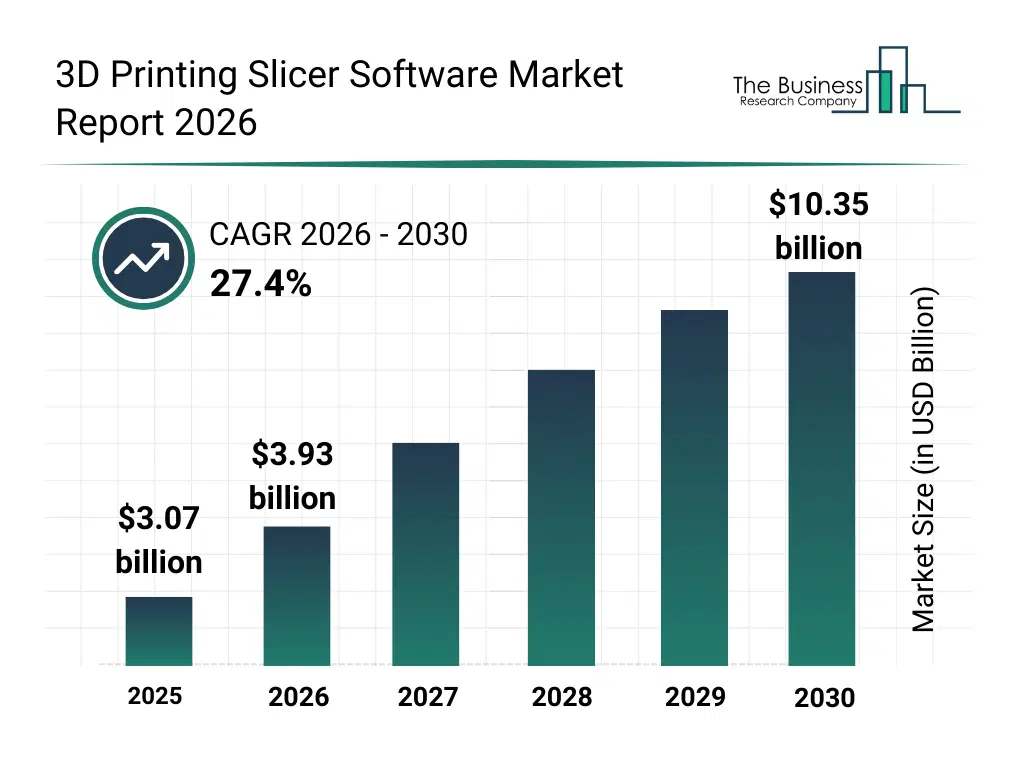
What Is The 3D Printing Slicer Software Market Size and Share 2026?
The 3D printing slicer software market size has grown exponentially in recent years. It will grow from $3.07 billion in 2025 to $3.93 billion in 2026 at a compound annual growth rate (CAGR) of 28.0%. The growth in the historic period can be attributed to growth of additive manufacturing adoption, early prototyping demand, expansion of desktop 3D printers, rise of maker communities, need for print accuracy improvement.What Is The 3D Printing Slicer Software Market Growth Forecast?
The 3D printing slicer software market size is expected to see exponential growth in the next few years. It will grow to $10.35 billion in 2030 at a compound annual growth rate (CAGR) of 27.4%. The growth in the forecast period can be attributed to industrial scale 3D printing adoption, demand for mass customization, sustainable material usage, automation of print workflows, integration with smart factories. Major trends in the forecast period include AI optimized print slicing, cloud based slicer platforms, material specific print optimization, integration with industrial printers, user friendly desktop slicing tools.
Global 3D Printing Slicer Software Market Segmentation
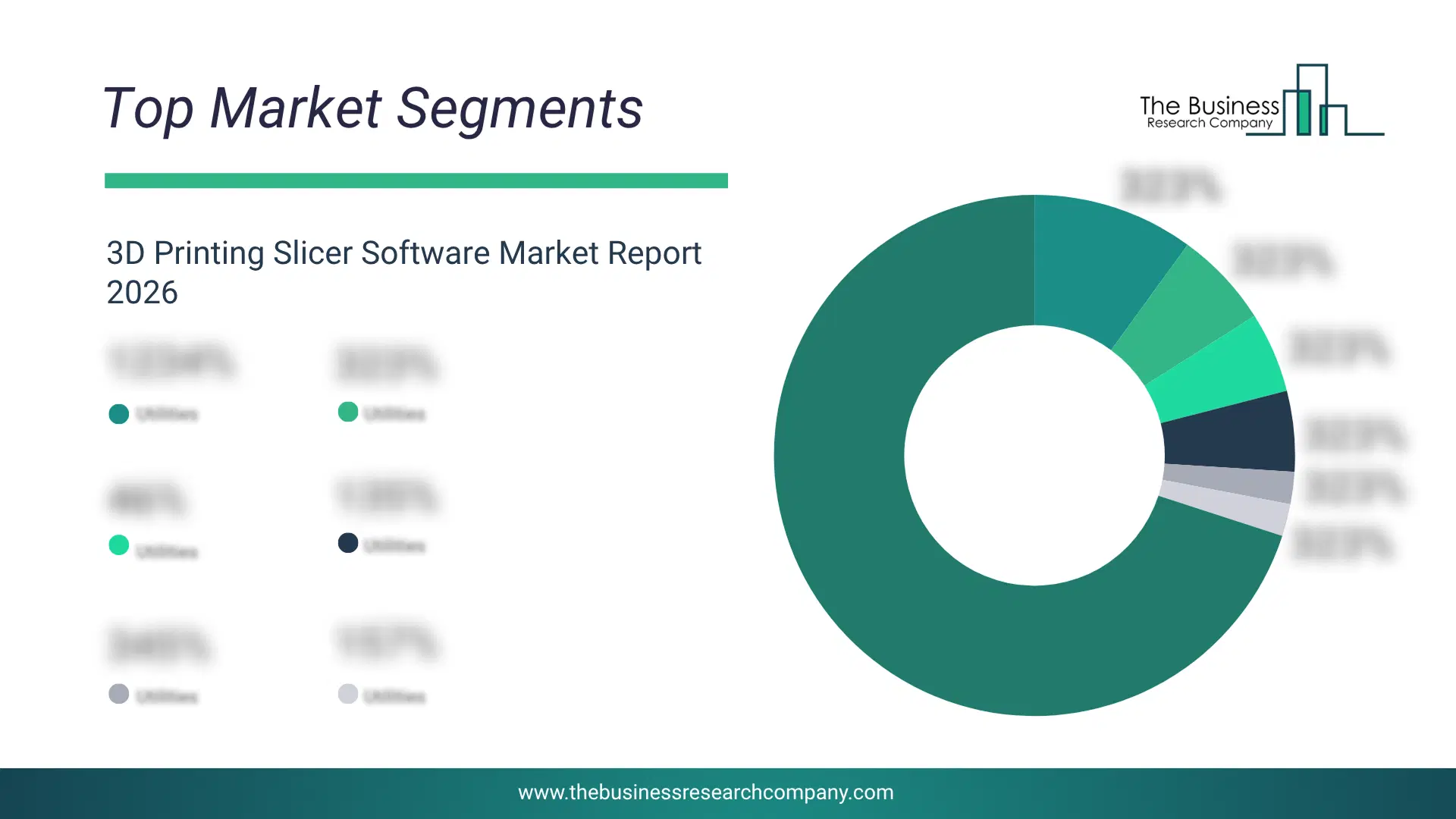
1) By Deployment: Desktop Or Standalone Software, Cloud-Based Or Web-Accessible Software, Embedded Or Integrated Slicing Software 2) By Application: Industrial 3D Printing, Desktop And Hobbyist 3D Printing, Educational And Research 3D Printing, Other Applications 3) By End-User: Healthcare, Automotive, Aerospace And Defense, Construction, Other End-Users Subsegments: 1) By Desktop Or Standalone Software: Windows-Based, macOS-Based, Linux-Based 2) By Cloud-Based Or Web-Accessible Software: Subscription-Based, Pay-Per-Use, Freeware 3) By Embedded Or Integrated Slicing Software: Firmware-Based Slicing, Hardware-Integrated Slicing, Integrated With 3D PrintersWhat Is The Driver Of The 3D Printing Slicer Software Market?
The growing investments in manufacturing and infrastructure development are expected to propel the growth of the 3D printing slicer software market going forward. Manufacturing and infrastructure development refer to the expansion and modernization of production facilities and essential infrastructure. Increasing investments in manufacturing and infrastructure development drives economic growth, creates jobs, enhances global competitiveness, and ensures long-term sustainability. 3D printing slicer software helps by optimizing designs for manufacturing, reducing material waste, speeding up production, and enabling cost-effective, customizable infrastructure components, all of which lower costs and improve efficiency in manufacturing and infrastructure development. For instance, in July 2024, according to the Office for National Statistics, a UK-based government department, in 2023 investment in infrastructure reached £13.8 billion ($17.25 billion) in constant prices, reflecting a 3.9% increase compared to 2022. Therefore, the growing investments in manufacturing and infrastructure development are driving the growth of the 3D printing slicer software industry.Key Players In The Global 3D Printing Slicer Software Market
Major companies operating in the 3D printing slicer software market are Autodesk Inc., Bambulab Limited, Ultimaker B.V., Prusa Research A.S., Roboze S.p.A, MatterHackers Inc., Zhejiang Flashforge 3D Technology Co. Ltd., Raise3D Technologies Inc., BigRep GmbH, Repetier, Zmorph S.A, Anker Innovations Co. Ltd., Anycubic Technology Co. Ltd., AstroPrint, BuildBee Pty Ltd., Shenzhen CBD Technology Co. Ltd., SelfCAD Inc., Simplify3D LLC, Mango3D SAS, Formlabs Inc., Markforged Inc.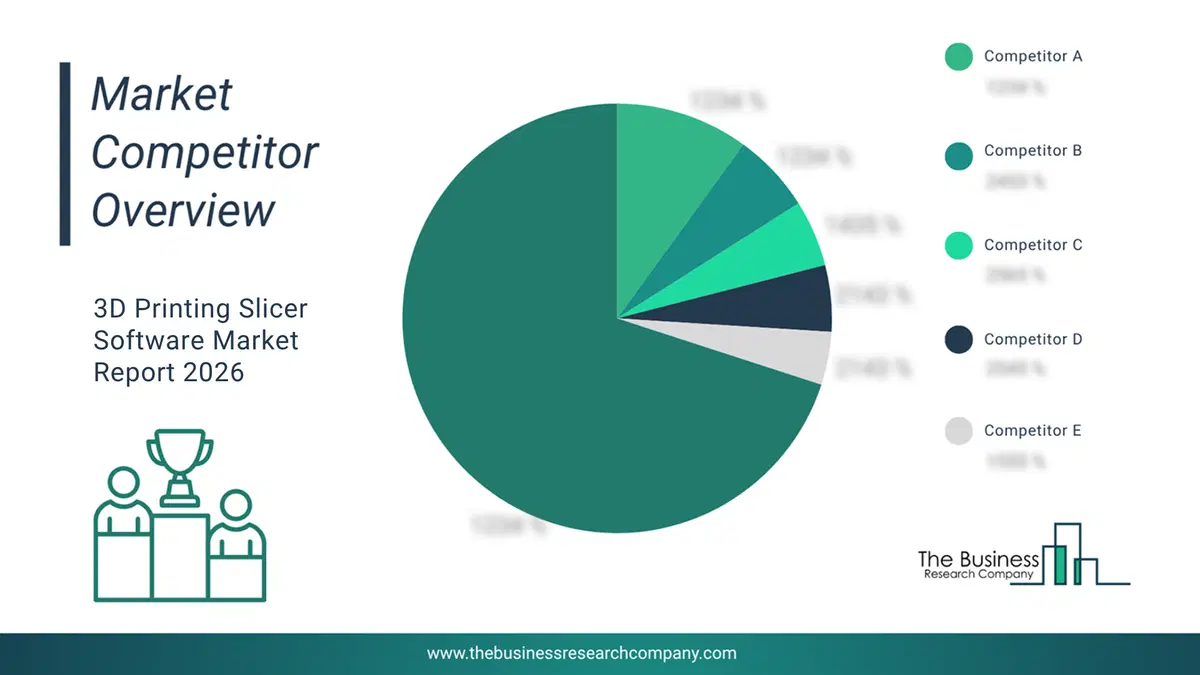
This chart is for illustrative purposes; the full report includes a detailed competitor analysis and comprehensive overview of the top 10 companies in the market.
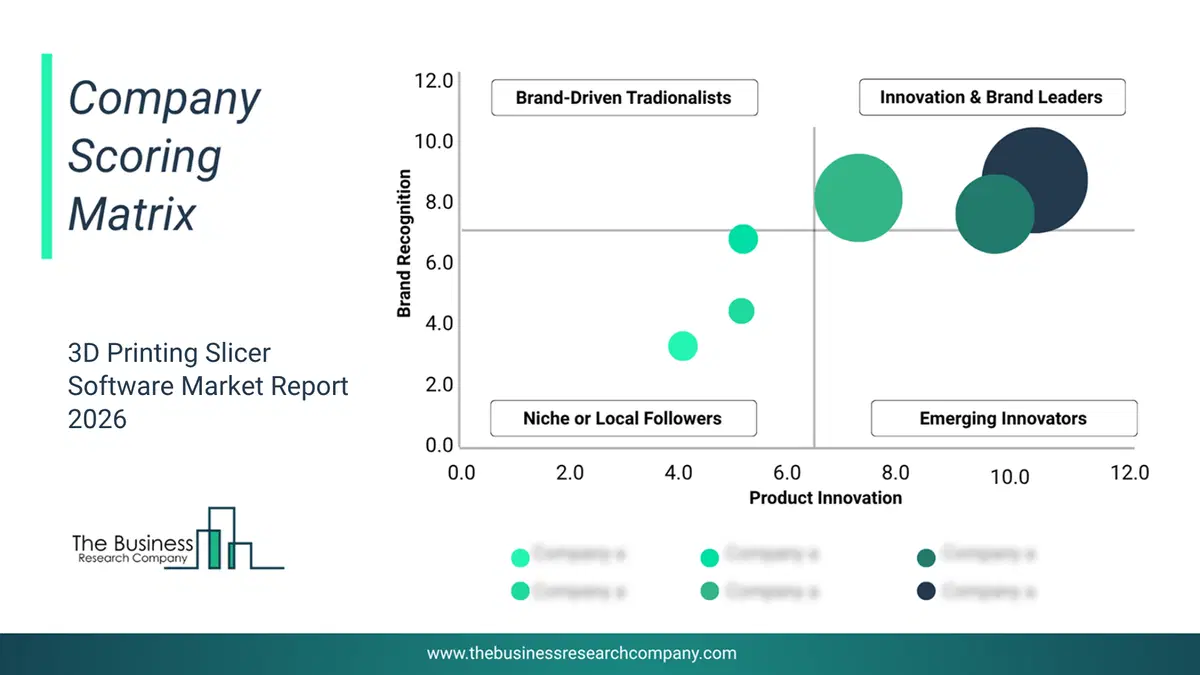
This chart maps companies by product innovation and brand strength, with bubble size indicating relative revenue, helping identify market leaders, challengers, and niche players. This is an illustrative chart; the full report provides a complete and accurate competitive analysis.
Global 3D Printing Slicer Software Market Trends and Insights
Major companies operating in the 3D printing slicer software market are focusing on developing innovative products, such as advanced model repair tools, to enhance print quality, reduce errors, and improve overall efficiency in the 3D printing process. Advanced model repair tools are specialized software and hardware solutions designed to detect, diagnose, and correct issues in complex models used across various industries. These tools help identify problems in digital blueprints, 3D models, or systems, offering automated or semi-automated repair solutions. For instance, in November 2024, Elegoo Inc., a China-based manufacturing company, launched the Elegoo SatelLite 3D Slicer, a specialized slicing software designed to enhance print quality. This satellite 3D slicer simplifies the 3D printing process with its user-friendly interface, advanced support system, and comprehensive material library, making it accessible for both beginners and experienced users. Its purpose is to enhance efficiency and quality in printing while providing versatile compatibility with various 3D printers.What Are Latest Mergers And Acquisitions In The 3D Printing Slicer Software Market?
In June 2023, Hexagon AB, a Sweden-based technology company, acquired CADS Additive GmbH for an undisclosed amount. With this acquisition, Hexagon AB aims to enhance its additive manufacturing solutions by integrating advanced software tools that streamline workflows, reduce waste, and improve efficiency across the entire manufacturing process. CADS Additive GmbH, an Austria-based company specializing in 3D printing slicer software, is particularly focused on metal additive manufacturing.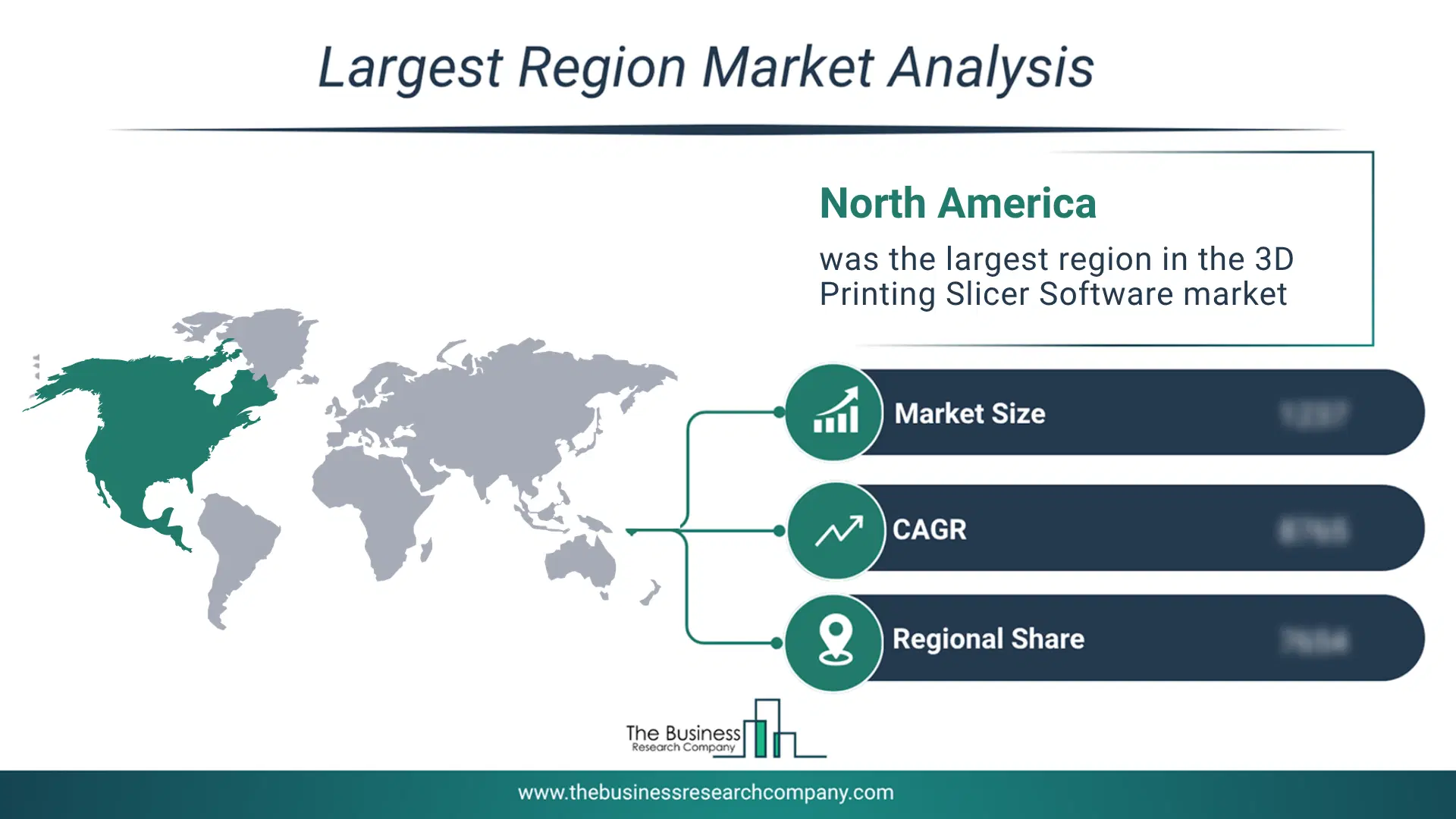
Regional Insights
North America was the largest region in the 3D printing slicer software market in 2025. The regions covered in this market report are Asia-Pacific, South East Asia, Western Europe, Eastern Europe, North America, South America, Middle East, Africa. The countries covered in this market report are Australia, Brazil, China, France, Germany, India, Indonesia, Japan, Taiwan, Russia, South Korea, UK, USA, Canada, Italy, Spain.What Defines the 3D Printing Slicer Software Market?
The 3D printing slicer software market consists of revenues earned by entities by providing services such as software licensing, slicing optimization, technical support, and training. The market value includes the value of related goods sold by the service provider or included within the service offering. The 3D printing slicer software market also includes sales of products including standalone slicing software, embedded slicing modules, AI-powered slicing tools, and enterprise slicing solutions. Values in this market are ‘factory gate’ values, that is, the value of goods sold by the manufacturers or creators of the goods, whether to other entities (including downstream manufacturers, wholesalers, distributors, and retailers) or directly to end customers. The value of goods in this market includes related services sold by the creators of the goods.How is Market Value Defined and Measured?
The market value is defined as the revenues that enterprises gain from the sale of goods and/or services within the specified market and geography through sales, grants, or donations in terms of the currency (in USD unless otherwise specified). The revenues for a specified geography are consumption values that are revenues generated by organizations in the specified geography within the market, irrespective of where they are produced. It does not include revenues from resales along the supply chain, either further along the supply chain or as part of other products.
This chart presents market attractiveness based on a quantitative evaluation of growth, competition, strategic alignment, and risk, offering a clear view of opportunity areas for decision-making. This chart is for illustrative purposes; the full report contains the complete analysis.

This chart highlights the Total Addressable Market (TAM) by estimating the maximum revenue opportunity using an assumption-driven approach, supporting strategic planning and opportunity sizing across markets. The chart is illustrative; the full report provides a more comprehensive analysis.
What Key Data and Analysis Are Included in the 3D Printing Slicer Software Market Report 2026?
The 3d printing slicer software market research report is one of a series of new reports from The Business Research Company that provides market statistics, including industry global market size, regional shares, competitors with the market share, detailed market segments, market trends and opportunities, and any further data you may need to thrive in the 3d printing slicer software industry. The market research report delivers a complete perspective of everything you need, with an in-depth analysis of the current and future state of the industry.3D Printing Slicer Software Market Report Forecast Analysis
| Report Attribute | Details |
|---|---|
| Market Size Value In 2026 | $3.93 billion |
| Revenue Forecast In 2030 | $10.35 billion |
| Growth Rate | CAGR of 27.4% from 2026 to 2030 |
| Base Year For Estimation | 2025 |
| Actual Estimates/Historical Data | 2020-2025 |
| Forecast Period | 2026 - 2030 |
| Market Representation | Revenue in USD Billion and CAGR from 2026 to 2030 |
| Segments Covered | Deployment, Application, End-User |
| Regional Scope | Asia-Pacific, Western Europe, Eastern Europe, North America, South America, Middle East, Africa |
| Country Scope | The Countries Covered In This Market Report Are Australia, Brazil, China, France, Germany, India, Indonesia, Japan, Taiwan, Russia, South Korea, Uk, Usa, Canada, Italy, Spain. |
| Key Companies Profiled | Autodesk Inc., Bambulab Limited, Ultimaker B.V., Prusa Research A.S., Roboze S.p.A, MatterHackers Inc., Zhejiang Flashforge 3D Technology Co. Ltd., Raise3D Technologies Inc., BigRep GmbH, Repetier, Zmorph S.A, Anker Innovations Co. Ltd., Anycubic Technology Co. Ltd., AstroPrint, BuildBee Pty Ltd., Shenzhen CBD Technology Co. Ltd., SelfCAD Inc., Simplify3D LLC, Mango3D SAS, Formlabs Inc., Markforged Inc. |
| Customization Scope | Request for Customization |
| Pricing And Purchase Options | Explore Purchase Options |