
3D Sensor Market Report 2026
Global Outlook – By Type ( Image Sensors, Position Sensors, Acoustic Sensors, Other Types), By Technology ( Stereo Vision, Structured Light, Time Of Flight, Ultrasound, Other Technologies), By Connectivity ( Wireless, Wired), By End-Use Industry ( Consumer Electronics, Healthcare, Aerospace And Defense, Industrial Robotics, Entertainment, Automotive, Security And Surveillance, Other End-User Industries) – Market Size, Trends, Strategies, and Forecast to 2030
3D Sensor Market Overview
• 3D Sensor market size has reached to $5.31 billion in 2025 • Expected to grow to $15.24 billion in 2030 at a compound annual growth rate (CAGR) of 23.3% • Growth Driver: Increasing Demand for Smartphones Boosts Market Growth Due To Wider Integration In Camera And Face Recognition Technologies • Market Trend: Advancements In Real-Time Depth-Sensing And On-Chip Processing Drive Intelligent Imaging Solutions • North America was the largest region in 2025 and Asia-Pacific is the fastest growing region.What Is Covered Under 3D Sensor Market?
Three-dimensional (3D) sensors are devices that electrically measure length, breadth, and depth and use this information to enhance the interfaces between humans, technologies, and the world. 3D sensing technology enables machines to view people and objects in a realistic, substantial manner by utilizing near-infrared light reflection, geometric concepts, photography, and advanced processing power. The main types of 3D sensors include image sensors, position sensors, acoustic sensors, accelerometers, and other types. An image sensor refers to a component of electronics that turns an optical picture into an electrical signal. The technologies used include stereo vision, structured light, time of flight, ultrasound and other technologies and are connected through wires or wireless for use in various end-user industries such as consumer electronics, healthcare, aerospace and defense, industrial robotics, entertainment, automotive, security and surveillance and other end-users.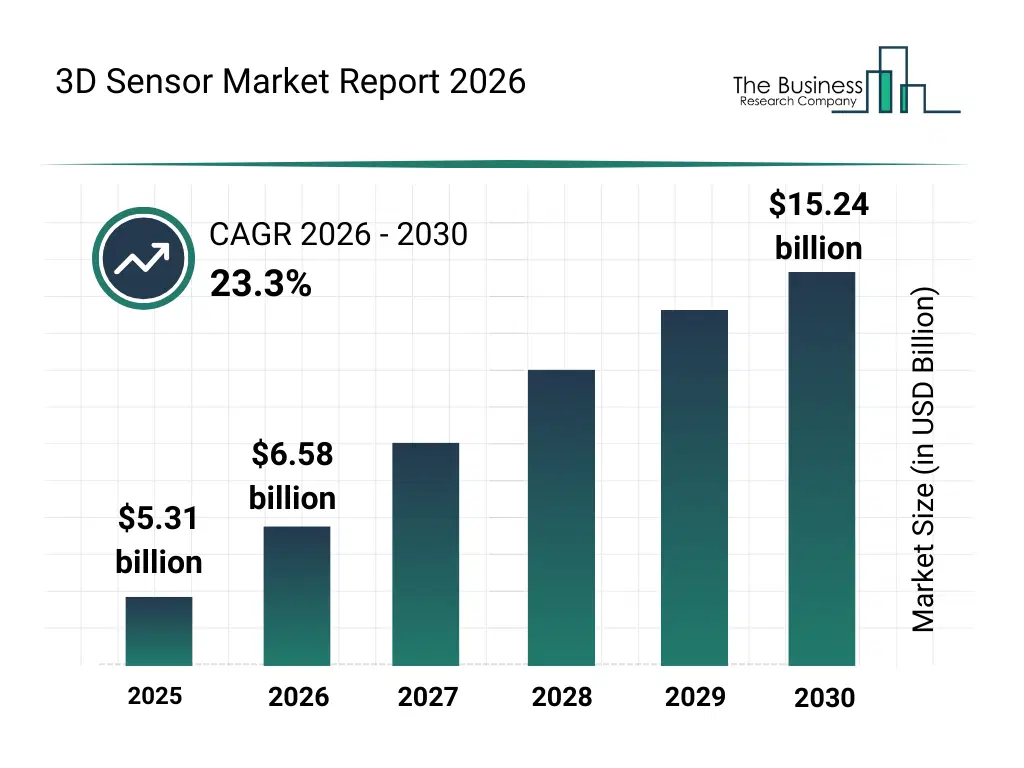
What Is The 3D Sensor Market Size 2026 And Growth Rate?
The 3D sensor market size has grown exponentially in recent years. It will grow from $5.31 billion in 2025 to $6.58 billion in 2026 at a compound annual growth rate (CAGR) of 24.0%. The growth in the historic period can be attributed to growth in early consumer electronics sensing, expansion of gaming and gesture recognition technologies, rising use in automotive safety systems, adoption in basic industrial automation, development of initial surveillance applications.What Is The 3D Sensor Market Growth Forecast?
The 3D sensor market size is expected to see exponential growth in the next few years. It will grow to $15.24 billion in 2030 at a compound annual growth rate (CAGR) of 23.3%. The growth in the forecast period can be attributed to increasing adoption in autonomous vehicles, rising deployment in robotics and automation, expansion of immersive digital experiences, growth in advanced security sensing, development of high-precision industrial 3D sensors. Major trends in the forecast period include adoption of AI-enhanced depth sensing systems, expansion of IoT-enabled 3D sensor networks, development of advanced ar/vr interaction sensors, integration of autonomous navigation sensing platforms, advancement of high-speed data-driven 3D processing technologies.
Global 3D Sensor Market Segmentation
1) By Type: Image Sensors, Position Sensors, Acoustic Sensors, Other Types 2) By Technology: Stereo Vision, Structured Light, Time Of Flight, Ultrasound, Other Technologies 3) By Connectivity: Wireless, Wired 4) By End-Use Industry: Consumer Electronics, Healthcare, Aerospace And Defense, Industrial Robotics, Entertainment, Automotive, Security And Surveillance, Other End-User Industries Subsegments: 1) By Image Sensors: Time-Of-Flight (ToF) Sensors, Stereo Vision Sensors, Structured Light Sensors 2) By Position Sensors: Optical Position Sensors, Magnetic Position Sensors 3) By Acoustic Sensors: Ultrasonic Sensors, Other Acoustic Sensing Technologies 4) By Other Types: Lidar Sensors, Radar Sensors, Hybrid SensorsWhat Is The Driver Of The 3D Sensor Market?
The increasing demand for smartphones is expected to propel the growth of the 3D sensor market going forward. A smartphone is a handheld phone with an embedded computer and other features not associated with telephones. It has an operating system, supports online surfing, and can run software programs. 3D sensors in smartphones are used for a variety of applications, including face recognition utilizing three-dimensional data, accurate augmented reality, photo enhancement for better background blur, and more accurate autofocus, and calibration, and hence increase in the use of smartphones is boosting the demand for 3D sensors. For instance, in February 2023, according to a report published by Uswitch Limited, a UK-based online and telephone comparison service provider, the UK had 71.8 million active mobile connections in 2022, and by 2025, the population is projected to reach 68.3 million, with 95% expected to own a smartphone. Therefore, the increasing demand for smartphones is driving the growth of the 3D sensor industry.Key Players In The Global 3D Sensor Market
Major companies operating in the 3D sensor market are Infineon Technologies AG, Microchip Technology Inc., OmniVision Technologies Inc., PMD Technologies AG, Sony Corporation, Keyence Corporation, Cognex Corporation, IFM Electronic GmbH, Intel Corporation, LMI Technologies Inc., Samsung Electronics Co. Ltd., Occipital Inc., Qualcomm Inc., Sick AG, ASUSTeK Computer Inc., Finisar Corporation, Microsoft Corporation, Panasonic Holdings Corporation, Leuze Electronic Pvt. Ltd., Softkinetic Systems S.A., Texas Instruments Incorporated, STMicroelectronics NV, AMS AG, Teledyne DALSA Inc., Velodyne Lidar Inc., Quanergy Systems Inc., FARO Technologies Inc., KandaoVR Inc., Mantis Vision Ltd., Orbbec 3D Technology International Inc., Stereolabs Inc., Vayyar Imaging Ltd., Zivid AS, Photoneo s.r.o., Luminar Technologies Inc., RealWear Inc., Xsens B.V., Creaform Inc.
This chart is for illustrative purposes; the full report includes a detailed competitor analysis and comprehensive overview of the top 10 companies in the market.
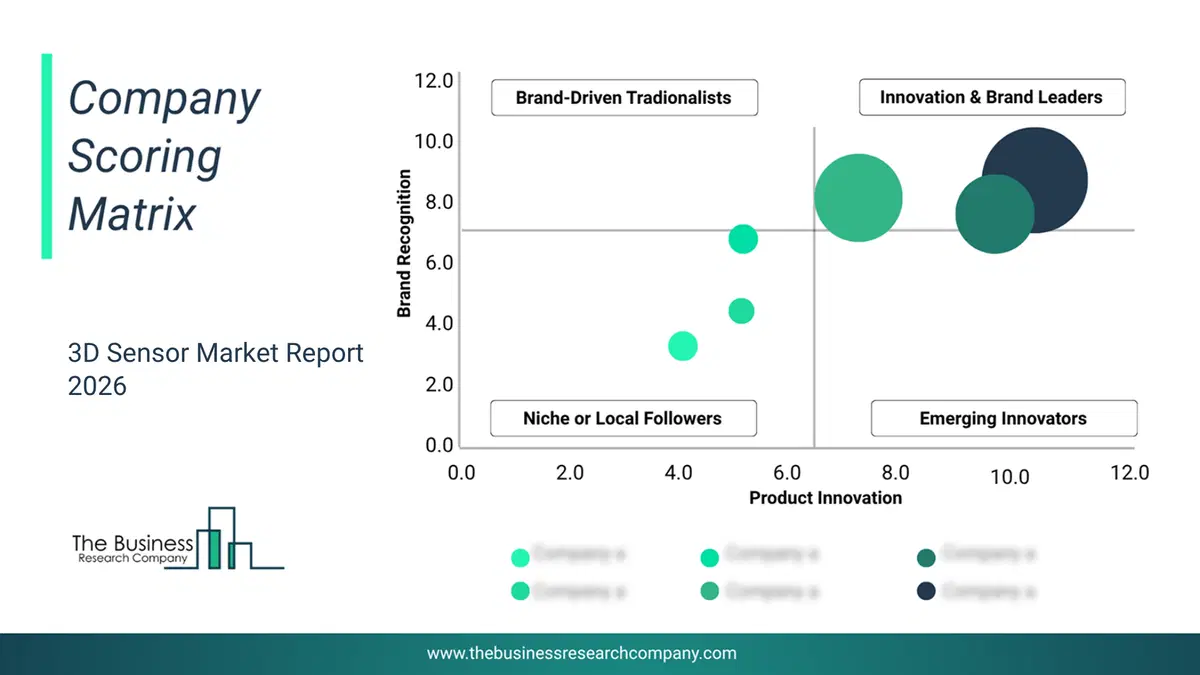
This chart maps companies by product innovation and brand strength, with bubble size indicating relative revenue, helping identify market leaders, challengers, and niche players. This is an illustrative chart; the full report provides a complete and accurate competitive analysis.
Global 3D Sensor Market Trends and Insights
Major companies operating in the 3D sensor market are focusing on advancing real-time depth-sensing and on-chip processing to enable faster, more accurate object and people recognition across automotive, consumer, and industrial applications. Real-time depth-sensing and on-chip processing refer to the ability of sensors to instantly capture three-dimensional spatial data and process it directly within the chip, enabling rapid analysis and response without relying on external processors. For instance, in July 2024, Nuvoton Technology Corporation Japan (NTCJ), a Japan-based semiconductor manufacturer, began mass production of a 1/4-inch VGA (640×480) resolution 3D TOF sensor that integrates a distance-calculation circuit and image-signal processor to output 3D and IR images at up to 120 fps. The sensor delivers accurate distance measurements even under very bright ambient light (up to 100,000 lux), significantly reduces motion blur by computing distance within a single frame, includes ASIL-B safety mechanisms for automotive use, and ships with reference circuits and an SDK to accelerate module development for applications such as occupant monitoring, smart locks, XR headsets, AMRs, and cargo measurement.What Are Latest Mergers And Acquisitions In The 3D Sensor Market?
In April 2025, Kraken Robotics Inc., a Canada-based marine technology company, acquired 3D at Depth Inc. for an undisclosed amount. The acquisition strengthens Kraken’s subsea intelligence capabilities by integrating 3D at Depth’s advanced subsea LiDAR imaging with Kraken’s synthetic aperture sonar and sub-bottom imaging technologies. 3D at Depth Inc. is a US-based manufacturer of 3D sensors.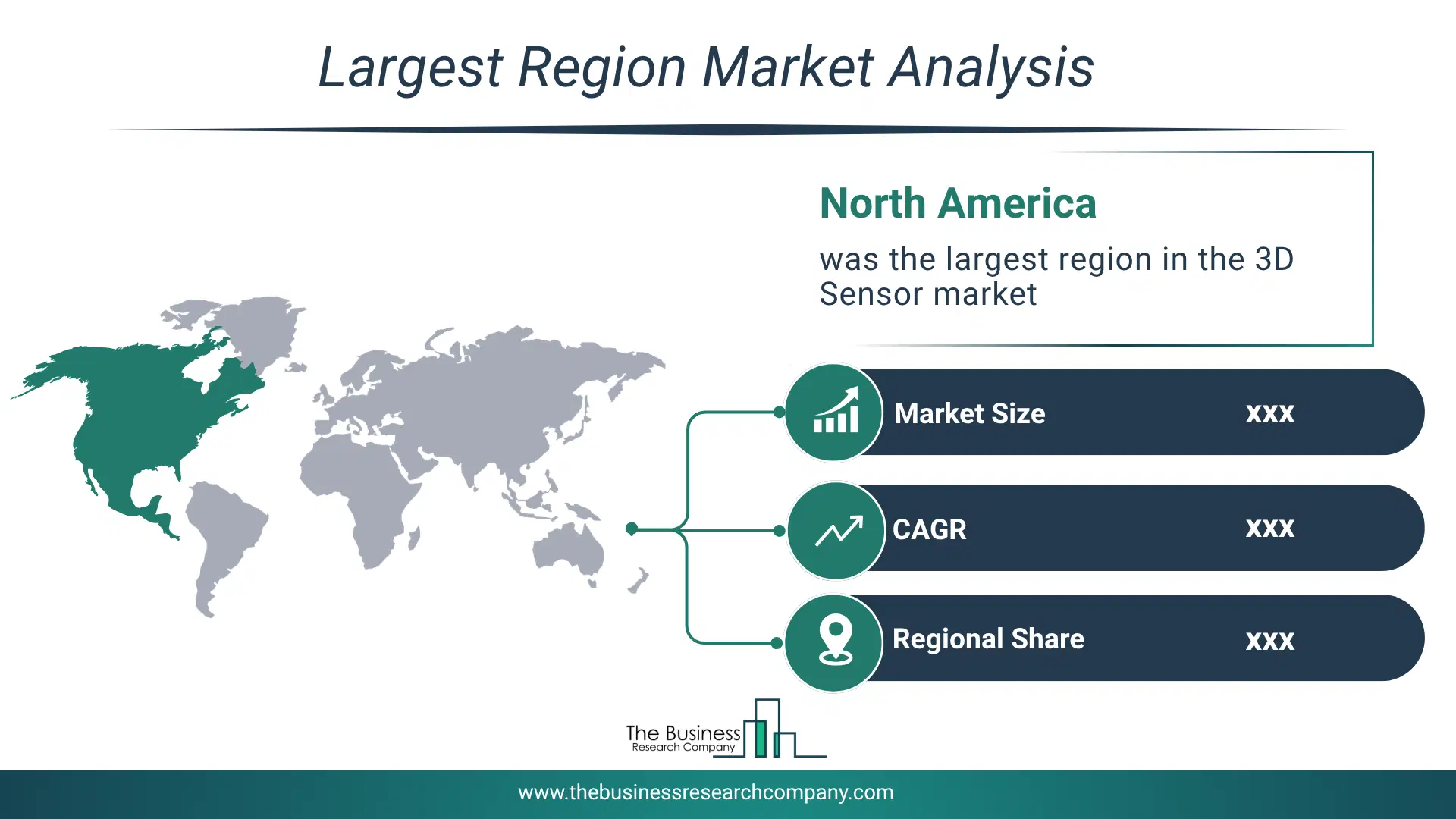
Regional Outlook
North America was the largest region in the 3D sensor market in 2025. Asia-Pacific is expected to be the fastest-growing region in the 3D sensor market report during the forecast period. The regions covered in this market report are Asia-Pacific, South East Asia, Western Europe, Eastern Europe, North America, South America, Middle East, Africa. The countries covered in this market report are Australia, Brazil, China, France, Germany, India, Indonesia, Japan, Taiwan, Russia, South Korea, UK, USA, Canada, Italy, Spain.What Defines the 3D Sensor Market?
The 3D sensor market consists of sales of infrared (IR) light sources, diffusers, controlling optics, depth cameras, and customized firmware. Values in this market are ‘factory gate’ values, that is the value of goods sold by the manufacturers or creators of the goods, whether to other entities (including downstream manufacturers, wholesalers, distributors, and retailers) or directly to end customers. The value of goods in this market includes related services sold by the creators of the goods.How is Market Value Defined and Measured?
The market value is defined as the revenues that enterprises gain from the sale of goods and/or services within the specified market and geography through sales, grants, or donations in terms of the currency (in USD unless otherwise specified). The revenues for a specified geography are consumption values that are revenues generated by organizations in the specified geography within the market, irrespective of where they are produced. It does not include revenues from resales along the supply chain, either further along the supply chain or as part of other products.
This chart presents market attractiveness based on a quantitative evaluation of growth, competition, strategic alignment, and risk, offering a clear view of opportunity areas for decision-making. This chart is for illustrative purposes; the full report contains the complete analysis.

This chart highlights the Total Addressable Market (TAM) by estimating the maximum revenue opportunity using an assumption-driven approach, supporting strategic planning and opportunity sizing across markets. The chart is illustrative; the full report provides a more comprehensive analysis.
What Key Data and Analysis Are Included in the 3D Sensor Market Report 2026?
The 3d sensor market research report is one of a series of new reports from The Business Research Company that provides market statistics, including industry global market size, regional shares, competitors with the market share, detailed market segments, market trends and opportunities, and any further data you may need to thrive in the 3d sensor industry. The market research report delivers a complete perspective of everything you need, with an in-depth analysis of the current and future state of the industry.3D Sensor Market Report Forecast Analysis
| Report Attribute | Details |
|---|---|
| Market Size Value In 2026 | $6.58 billion |
| Revenue Forecast In 2030 | $15.24 billion |
| Growth Rate | CAGR of 23.3% from 2026 to 2030 |
| Base Year For Estimation | 2025 |
| Actual Estimates/Historical Data | 2020-2025 |
| Forecast Period | 2026 - 2030 |
| Market Representation | Revenue in USD Billion and CAGR from 2026 to 2030 |
| Segments Covered | Type, Technology, Connectivity, End-Use Industry |
| Regional Scope | Asia-Pacific, Western Europe, Eastern Europe, North America, South America, Middle East, Africa |
| Country Scope | The countries covered in the report are Australia, Brazil, China, France, Germany, India, Indonesia, Japan, Taiwan, Russia, South Korea, UK, USA, Canada, Italy, Spain. |
| Key Companies Profiled | Infineon Technologies AG, Microchip Technology Inc., OmniVision Technologies Inc., PMD Technologies AG, Sony Corporation, Keyence Corporation, Cognex Corporation, IFM Electronic GmbH, Intel Corporation, LMI Technologies Inc., Samsung Electronics Co. Ltd., Occipital Inc., Qualcomm Inc., Sick AG, ASUSTeK Computer Inc., Finisar Corporation, Microsoft Corporation, Panasonic Holdings Corporation, Leuze Electronic Pvt. Ltd., Softkinetic Systems S.A., Texas Instruments Incorporated, STMicroelectronics NV, AMS AG, Teledyne DALSA Inc., Velodyne Lidar Inc., Quanergy Systems Inc., FARO Technologies Inc., KandaoVR Inc., Mantis Vision Ltd., Orbbec 3D Technology International Inc., Stereolabs Inc., Vayyar Imaging Ltd., Zivid AS, Photoneo s.r.o., Luminar Technologies Inc., RealWear Inc., Xsens B.V., Creaform Inc. |
| Customization Scope | Request for Customization |
| Pricing And Purchase Options | Explore Purchase Options |