
3D Simulation Software Market Report 2026
Global Outlook – By Type (Software, Services), By Deployment Mode (Cloud, On-Premises), By Application (Product Design, Training And Simulation, Virtual Prototyping And Testing, Process Optimization, Infrastructure Planning), By End-User (Aerospace And Defense, Automotive, Healthcare, Manufacturing, Architecture, Engineering, And Construction (AEC), Gaming And Entertainment, Education, Energy And Utilities, Retail And Consumer Goods, Other End-Users) – Market Size, Trends, Strategies, and Forecast to 2030
3D Simulation Software Market Overview
• 3D Simulation Software market size has reached to $19.05 billion in 2025 • Expected to grow to $40.35 billion in 2030 at a compound annual growth rate (CAGR) of 16.2% • Growth Driver: Growth of 3D Simulation Software Driven by Rising Demand for Virtual Learning • Market Trend: Advancements in Reality Digital Twin Technology • North America was the largest region in 2025.Market Gains By 2030 – Top Opportunities By Segment
Market Gain identifies the most promising market opportunities by highlighting the segments or products expected to generate the highest incremental revenue growth over the next five years.
What Is Covered Under 3D Simulation Software Market?
3D simulation software is a type of computer application that allows users to create, visualize, and analyze three-dimensional models of real-world systems or objects in a simulated environment. These simulations can mimic the physical behavior, performance, or dynamics of objects or systems, enabling users to study and interact with them without the need for physical prototypes or real-world experimentation. The main types in the 3D simulation software are software and services. Software in the 3D simulation market refers to computer programs that allow users to create, analyze, and manipulate 3D models in virtual environments. It is deployed based on cloud and on-premises modes to provide several applications including product design, training and simulation, virtual prototyping and testing, process optimization, and infrastructure planning. The end uses include aerospace and defense, automotive, healthcare, manufacturing, architecture, engineering, and construction (AEC), gaming and entertainment, education, energy and utilities, retail and consumer goods, and others.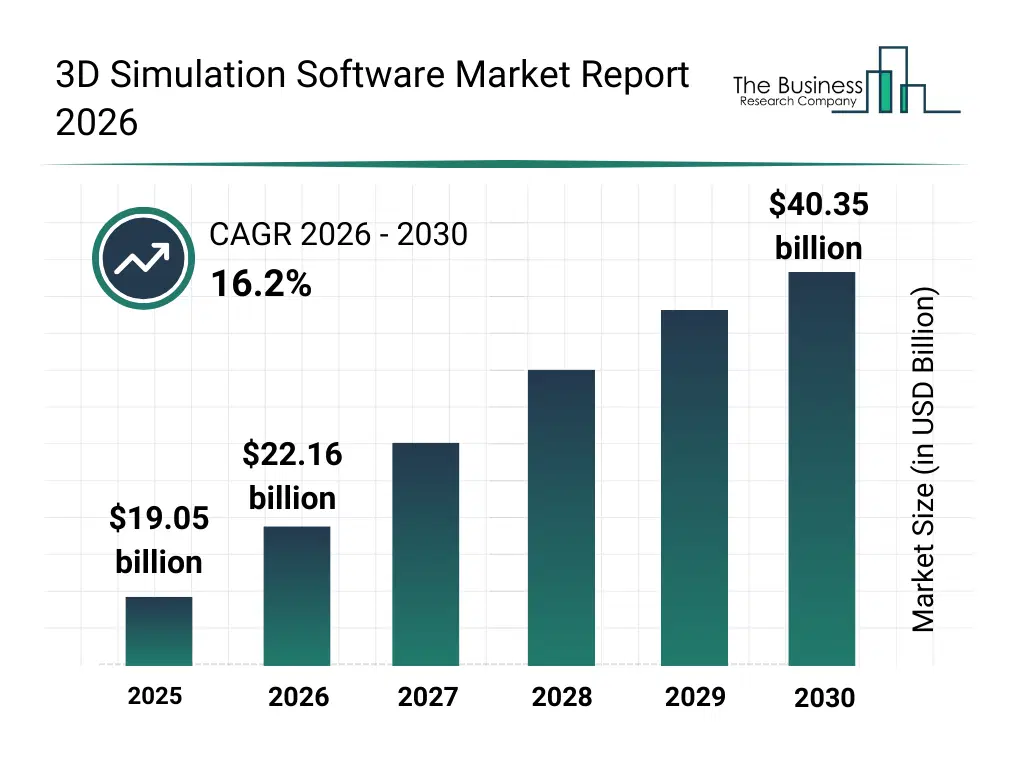
What Is The 3D Simulation Software Market Size and Share 2026?
The 3D simulation software market size has grown rapidly in recent years. It will grow from $19.05 billion in 2025 to $22.16 billion in 2026 at a compound annual growth rate (CAGR) of 16.3%. The growth in the historic period can be attributed to growth in complex product design requirements, expansion of simulation-driven engineering practices, increasing use of virtual testing environments, adoption of 3D visualization tools, rising demand for cost-efficient development cycles.What Is The 3D Simulation Software Market Growth Forecast?
The 3D simulation software market size is expected to see rapid growth in the next few years. It will grow to $40.35 billion in 2030 at a compound annual growth rate (CAGR) of 16.2%. The growth in the forecast period can be attributed to increasing investments in digital twin ecosystems, rising adoption in smart infrastructure planning, expansion of immersive simulation for training, growing use of AI-driven simulation analytics, increased reliance on cloud-based simulation environments. Major trends in the forecast period include increasing adoption of virtual prototyping solutions, rising demand for cloud-based simulation platforms, growing use of digital twin technologies, expansion of real-time physics simulation tools, enhanced focus on immersive training applications.
Global 3D Simulation Software Market Segmentation
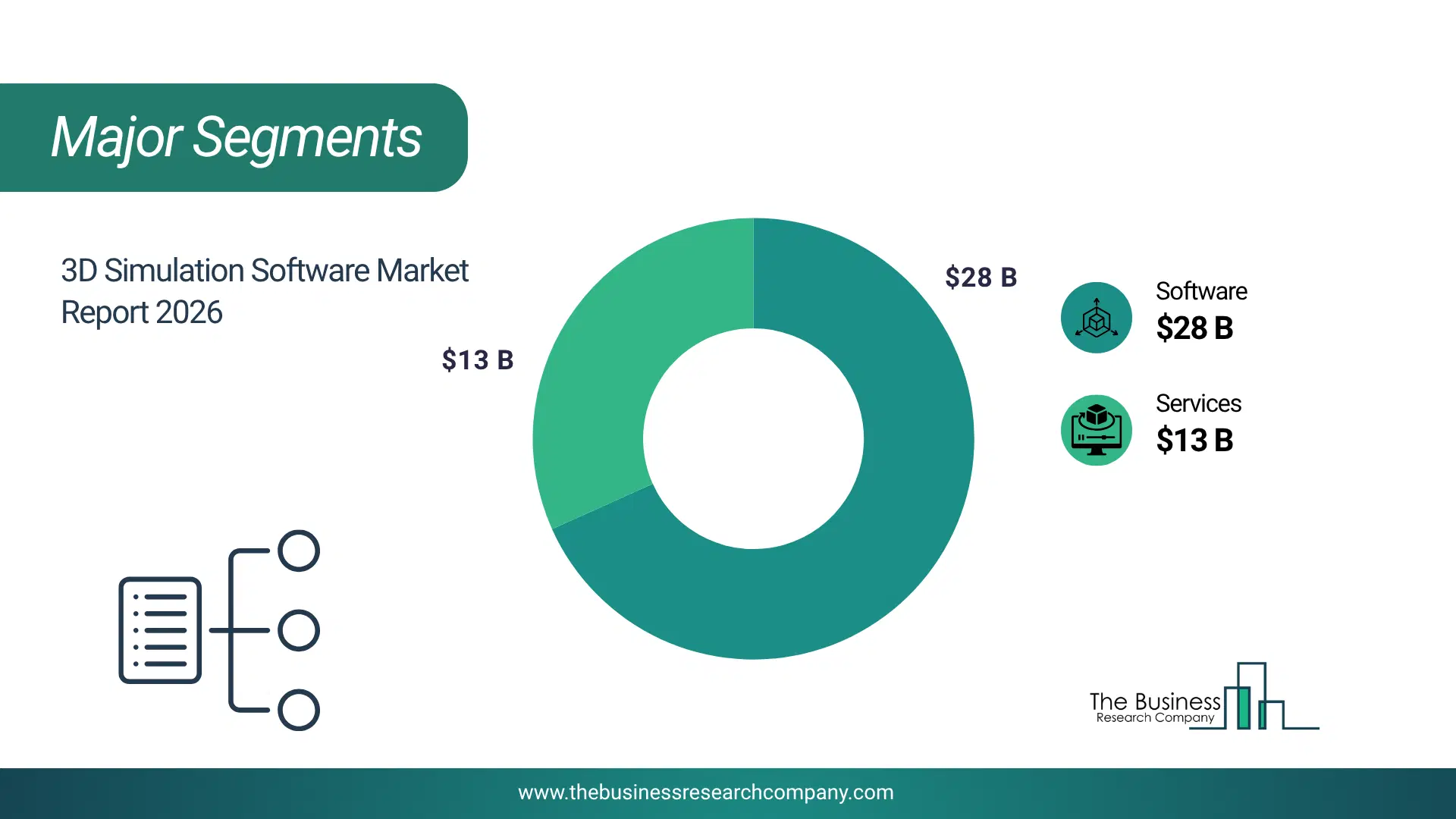
1) By Type: Software, Services 2) By Deployment Mode: Cloud, On-Premises 3) By Application: Product Design, Training And Simulation, Virtual Prototyping And Testing, Process Optimization, Infrastructure Planning 4) By End-User: Aerospace And Defense, Automotive, Healthcare, Manufacturing, Architecture, Engineering, And Construction (AEC), Gaming And Entertainment, Education, Energy And Utilities, Retail And Consumer Goods, Other End-Users Subsegments: 1) By Software: Standalone Software, Integrated Software, Cloud-based Software, Desktop Software 2) By Services: Consulting Services, Training And Support Services, Customization Services, Maintenance And Upgrades The top segments in the automotive artificial intelligence market will be: • Hardware will reach $15.21 Billion by 2030. • Software will reach $7.1 Billion by 2030. • Service will reach $1.94 Billion by 2030. The top segments in the 3d simulation software market will be: • Software will reach $27.64 Billion by 2030. • Services will reach $12.71 Billion by 2030.What Is The Driver Of The 3D Simulation Software Market?
The increasing demand for virtual learning is expected to propel the growth of the 3D simulation software market going forward. Virtual learning refers to digital platforms and tools designed to deliver education and training through interactive content, virtual classrooms, and collaborative features remotely via the internet. Virtual learning is growing due to the demand for flexible learning and accessible education across diverse geographies and demographics. 3D simulation software enhances virtual learning by providing immersive, interactive experiences replicating real-world scenarios, allowing learners to engage in practical exercises, visualize complex concepts, and develop problem-solving skills in risk-free environments. For instance, in January 2024, Eurostat, a Luxembourg-based government agency, reported that in 2023, 30% of internet users in Europe aged 16 to 74 had taken an online course or used online learning materials within the three months preceding the survey. This is a 2-percentage point (pp) increase compared with 2022 (28%). Therefore, the increasing demand for virtual learning drives the 3D simulation software industry.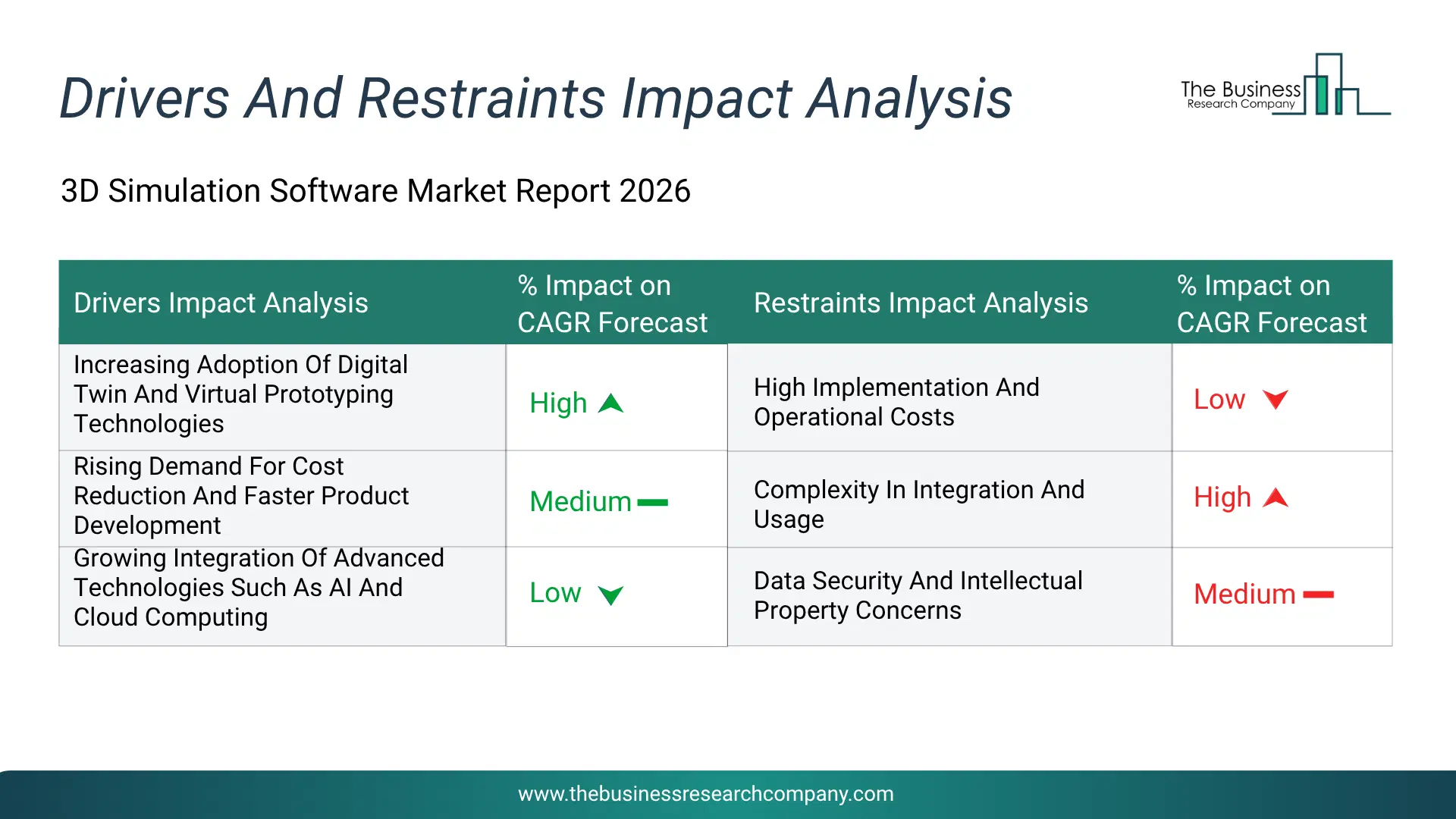
Infographic Chart Showing Key Market Drivers Analysis And Restraints For 3D Simulation Software Market
The chart presents an impact analysis of key drivers and restraints, quantifying their relative influence on the market's growth rate and helping assess the balance between growth enablers and limiting factors. This chart offers a high-level perspective; the full report contains more detailed insights.
How Will The Drivers Impact Growth In The Global 3D Simulation Software Market?
• Increasing Adoption Of Digital Twin And Virtual Prototyping Technologies (High) – During the forecast period, the increasing adoption of digital twin and virtual prototyping technologies is expected to become a key growth driver for the 3D simulation software market by 2030. Increasing adoption of digital twin and virtual prototyping technologies acts as a major driver for the 3D simulation software market because industries are increasingly shifting from physical testing to virtual environments to reduce development time and costs. These tools allow companies to replicate real-world systems digitally, enabling continuous monitoring, testing, and optimization without building physical prototypes. This improves product accuracy, minimizes errors, and accelerates innovation cycles across sectors such as automotive, aerospace, and manufacturing. • Rising Demand For Cost Reduction And Faster Product Development (Medium) – During the forecast period, the rising demand for cost reduction and faster product development is expected to emerge as a major factor driving the expansion of the 3D simulation software market by 2030. Companies aim to shorten design cycles while minimizing expenses associated with physical prototyping and testing. Simulation software enables engineers to test multiple design iterations virtually, identifying flaws early and reducing the need for costly redesigns. This leads to improved time-to-market and optimized resource utilization across industries. Businesses increasingly adopt these tools to stay competitive in fast-paced markets where innovation speed is critical. Consequently, the need for efficient and cost-effective development processes fuels the widespread adoption of 3D simulation software. • Growing Integration Of Advanced Technologies Such As AI And Cloud Computing (Low) – During the forecast period, the growing integration of advanced technologies such as AI and cloud computing is expected to act as a key growth catalyst for the 3D simulation software market by 2030. These technologies enhance simulation capabilities, scalability, and accessibility. Artificial intelligence improves predictive accuracy and automates complex simulation tasks, while cloud platforms enable real-time collaboration and remote access to high-performance computing resources. This reduces infrastructure limitations and allows even smaller organizations to utilize sophisticated simulation tools. The combination of AI and cloud also supports large-scale data processing and complex modeling scenarios.How Will The Restraints Impact Growth In The Global 3D Simulation Software Market?
• High Implementation And Operational Costs (High) – During the forecast period, the high implementation and operational costs act as a significant restraint in the 3D simulation software market by limiting adoption, especially among small and medium-sized enterprises. Advanced simulation tools require substantial upfront investment in software licenses, high-performance computing infrastructure, and skilled personnel. Ongoing expenses such as maintenance, upgrades, and training further increase the total cost of ownership. These financial barriers discourage organizations from transitioning from traditional methods to simulation-based approaches. As a result, market growth is restricted to enterprises with strong financial capabilities. • Complexity In Integration And Usage (Medium) – During the forecast period, the complexity in integration and usage restrains the market by making it difficult for organizations to seamlessly incorporate 3D simulation tools into existing workflows. These solutions often require compatibility with multiple systems such as CAD, PLM, and ERP platforms, which can be technically challenging. The need for specialized knowledge and expertise increases dependency on skilled professionals, leading to higher training costs and longer implementation timelines. This complexity can result in inefficiencies and delays in project execution. Consequently, organizations may hesitate to adopt such solutions, slowing overall market penetration. • Data Security And Intellectual Property Concerns (Low) – During the forecast period, the data security and intellectual property concerns act as a major restraint by creating hesitation among enterprises to adopt 3D simulation platforms, especially cloud-based solutions. Simulation models often involve sensitive product designs, engineering data, and proprietary information that are vulnerable to cyber threats. Risks related to data breaches, unauthorized access, and loss of confidential information discourage companies from fully leveraging these tools. Additionally, strict compliance requirements for data protection add complexity to deployment. This limits the widespread adoption of simulation technologies across industries handling critical data.Key Players In The Global 3D Simulation Software Market
Major companies operating in the 3D simulation software market are Siemens AG, Dassault Systèmes SE, Hexagon AB, Synopsys Inc., Autodesk Inc., Cadence Design Systems Inc., PTC Inc., MathWorks Inc., Unity Software Inc., Bentley Systems Incorporated, Altair Engineering Inc., Zuken Inc., ESI Group, COMSOL AB, Side Effects Software Inc., FlexSim Software Products Inc., Blender Foundation, The AnyLogic Company, Ansys Inc., Visual Components, Akselos SA, DiSTI Corporation, Modelon AB, Algoryx Simulation AB, AVL List GmbH, RoboDK Inc., Coppelia Robotics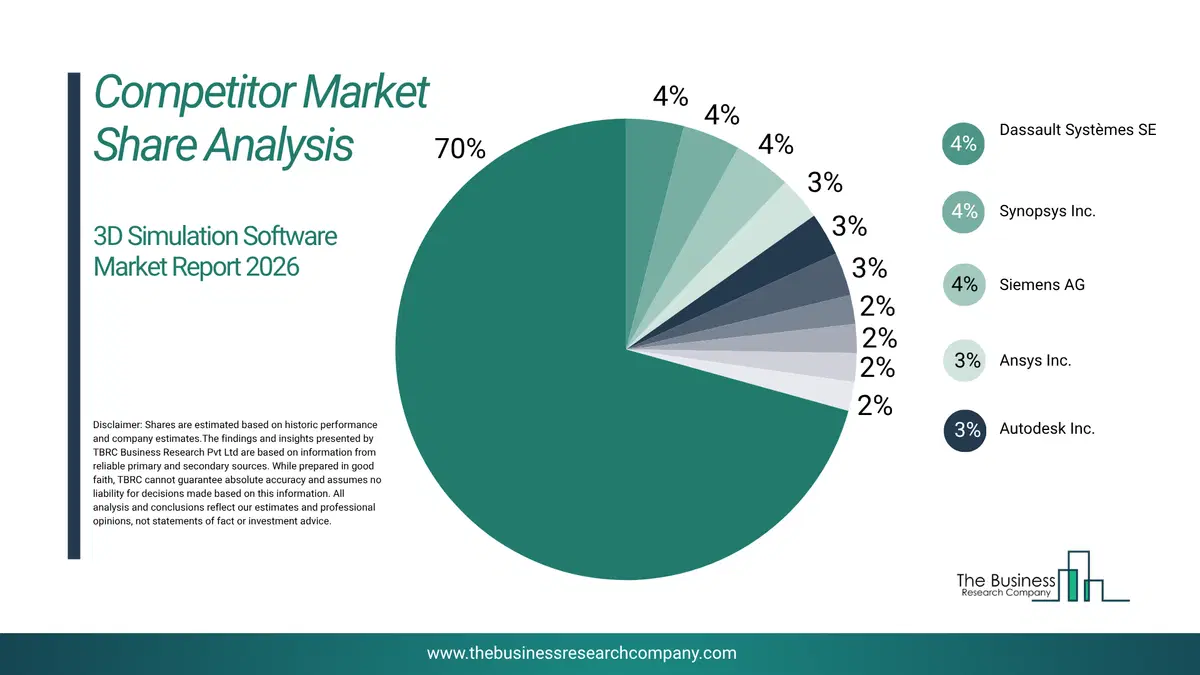
This chart is for illustrative purposes; the full report includes a detailed competitor analysis and comprehensive overview of the top 10 companies in the market.
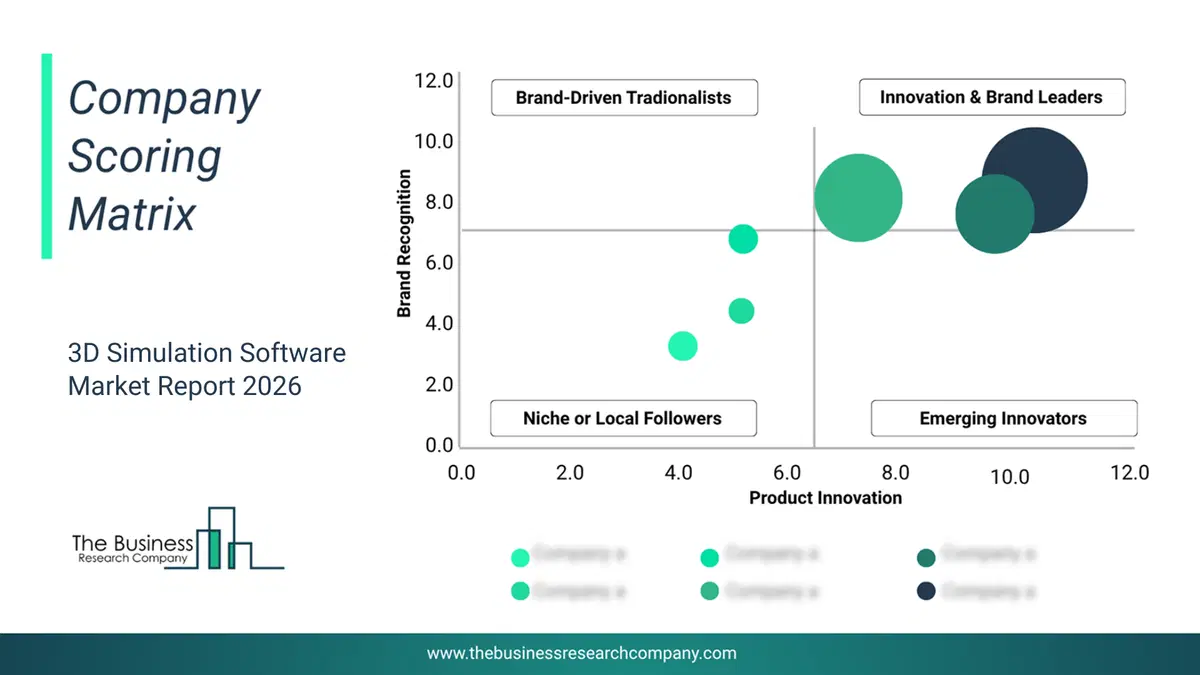
This chart maps companies by product innovation and brand strength, with bubble size indicating relative revenue, helping identify market leaders, challengers, and niche players. This is an illustrative chart; the full report provides a complete and accurate competitive analysis.
Global 3D Simulation Software Market Trends and Insights
Major companies operating in the 3D simulation software market are advancing reality digital twin technology, which creates virtual replicas of physical assets for real-time monitoring and optimization across industries. Reality digital twin technology refers to creating a virtual replica or model of a physical asset, system, or environment using real-time data. For instance, in February 2023, Esri, a US-based software development company, launched ArcGIS Reality. It is a new suite of tools designed for reality modeling that integrates 3D data, building information modeling (BIM), and geographic information system (GIS) information. ArcGIS Reality allows users to layer reality capture data with BIM and GIS, facilitating advanced analysis, asset monitoring, and predictive simulations. The new application focuses on generating reality maps from aerial imagery and is designed for high production efficiency. A cloud-based solution has also been developed to manage drone imagery and simplify data collection and processing.What Are Latest Mergers And Acquisitions In The 3D Simulation Software Market?
In January 2024, Synopsys, a US-based software development company, is set to acquire Ansys for $35 billion. The acquisition of Ansys by Synopsys is a strategic move aimed at enhancing the capabilities of both companies in the rapidly evolving technology landscape. This acquisition is set to create a powerhouse in the electronic design automation (EDA) and simulation software sectors, combining Synopsys' semiconductor design capabilities with Ansys' simulation and analysis tools. Ansys is a US-based company that develops and markets comprehensive engineering simulation software primarily used for 3D design and analysis.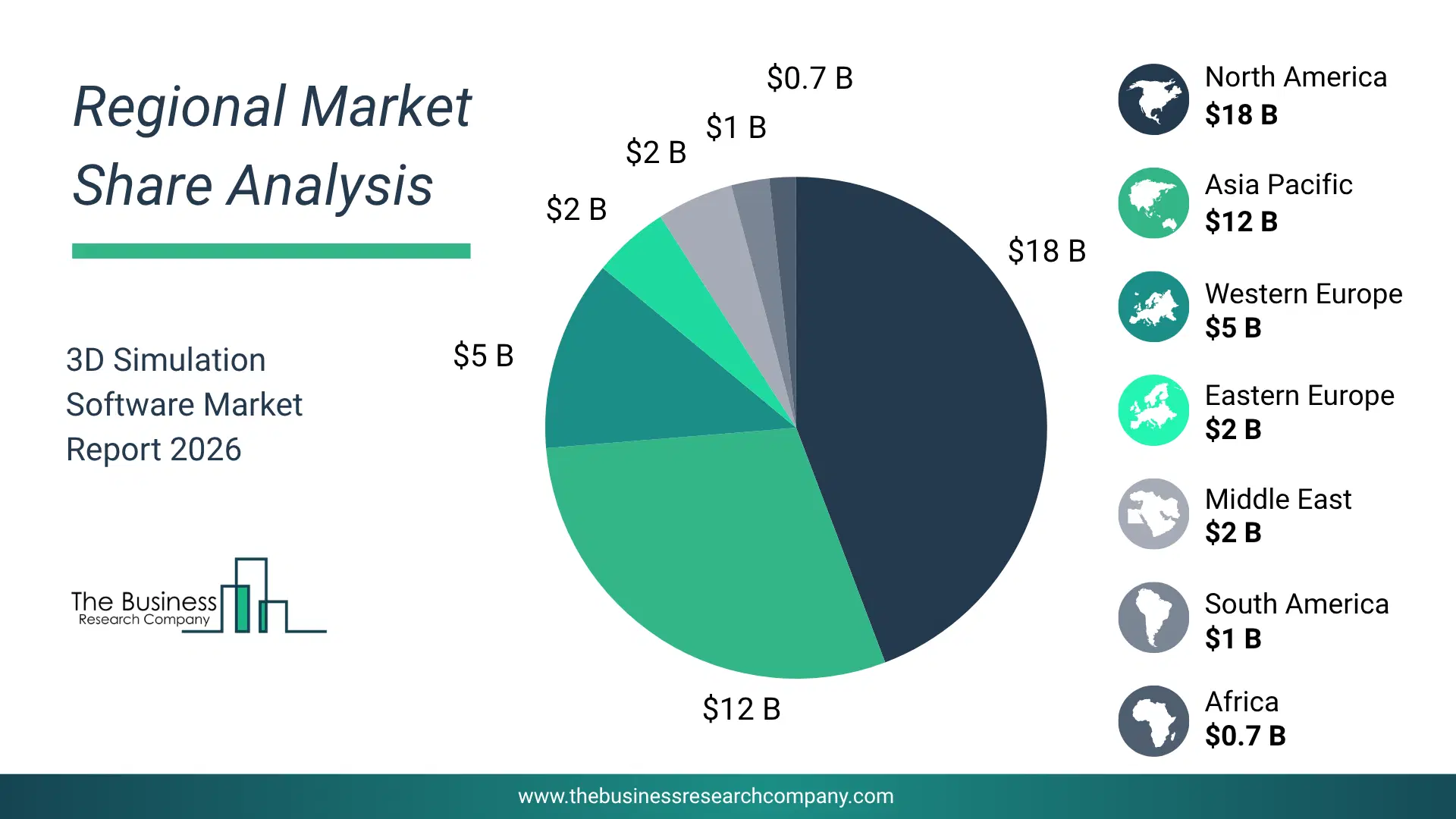
Regional Insights
North America was the largest region in the 3D simulation software market in 2025. The regions covered in this market report are Asia-Pacific, South East Asia, Western Europe, Eastern Europe, North America, South America, Middle East, Africa. The countries covered in this market report are Australia, Brazil, China, France, Germany, India, Indonesia, Japan, Taiwan, Russia, South Korea, UK, USA, Canada, Italy, Spain.What Defines the 3D Simulation Software Market?
The 3D simulation software market consists of revenues earned by entities by providing services such as consulting, implementation, training, technical support, and customizations. The market value includes the value of related goods sold by the service provider or included within the service offering. The 3D simulation software market also includes sales of computer-aided design (CAD) tools, virtual prototyping software, physics-based simulators, finite element analysis (FEA) tools, and digital twin platforms. Values in this market are ‘factory gate’ values, that is the value of goods sold by the manufacturers or creators of the goods, whether to other entities (including downstream manufacturers, wholesalers, distributors, and retailers) or directly to end customers. The value of goods in this market includes related services sold by the creators of the goods.How is Market Value Defined and Measured?
The market value is defined as the revenues that enterprises gain from the sale of goods and/or services within the specified market and geography through sales, grants, or donations in terms of the currency (in USD unless otherwise specified). The revenues for a specified geography are consumption values that are revenues generated by organizations in the specified geography within the market, irrespective of where they are produced. It does not include revenues from resales along the supply chain, either further along the supply chain or as part of other products.
This chart presents market attractiveness based on a quantitative evaluation of growth, competition, strategic alignment, and risk, offering a clear view of opportunity areas for decision-making. This chart is for illustrative purposes; the full report contains the complete analysis.

This chart highlights the Total Addressable Market (TAM) by estimating the maximum revenue opportunity using an assumption-driven approach, supporting strategic planning and opportunity sizing across markets. The chart is illustrative; the full report provides a more comprehensive analysis.
What Key Data and Analysis Are Included in the 3D Simulation Software Market Report 2026?
The 3d simulation software market research report is one of a series of new reports from The Business Research Company that provides market statistics, including industry global market size, regional shares, competitors with the market share, detailed market segments, market trends and opportunities, and any further data you may need to thrive in the 3d simulation software industry. The market research report delivers a complete perspective of everything you need, with an in-depth analysis of the current and future state of the industry.3D Simulation Software Market Report Forecast Analysis
| Report Attribute | Details |
|---|---|
| Market Size Value In 2026 | $22.16 billion |
| Revenue Forecast In 2030 | $40.35 billion |
| Growth Rate | CAGR of 16.3% from 2026 to 2030 |
| Base Year For Estimation | 2025 |
| Actual Estimates/Historical Data | 2020-2025 |
| Forecast Period | 2026 - 2030 |
| Market Representation | Revenue in USD Billion and CAGR from 2026 to 2030 |
| Segments Covered | Type, Deployment Mode, Application, End-User |
| Regional Scope | Asia-Pacific, Western Europe, Eastern Europe, North America, South America, Middle East, Africa |
| Country Scope | The countries covered in the report are Australia, Brazil, China, France, Germany, India, Indonesia, Japan, Taiwan, Russia, South Korea, UK, USA, Canada, Italy, Spain. |
| Key Companies Profiled | Siemens AG, Dassault Systèmes SE, Hexagon AB, Synopsys Inc., Autodesk Inc., Cadence Design Systems Inc., PTC Inc., MathWorks Inc., Unity Software Inc., Bentley Systems Incorporated, Altair Engineering Inc., Zuken Inc., ESI Group, COMSOL AB, Side Effects Software Inc., FlexSim Software Products Inc., Blender Foundation, The AnyLogic Company, Ansys Inc., Visual Components, Akselos SA, DiSTI Corporation, Modelon AB, Algoryx Simulation AB, AVL List GmbH, RoboDK Inc., Coppelia Robotics |
| Customization Scope | Request for Customization |
| Pricing And Purchase Options | Explore Purchase Options |