
4D Radiotherapy Equipment Market Report 2026
Global Outlook – By Product Type Or Component (4D Gating/RT Systems, Linear Accelerators (LINACs), 4D Imaging Modalities, SGRT Systems, Treatment Planning Software), By Motion Management Technique (Respiratory Gating, Real-Time Tumor Tracking, Breath-Hold Techniques, Adaptive Radiotherapy (ART)), By Application (Lung Cancer, Liver Cancers, Pancreatic Cancer, Breast Cancer, Lymphoma, Other Cancers), By End User (Hospitals, Cancer Treatment Centers, Specialty Radiotherapy Clinics, Research Institutions) – Market Size, Trends, Strategies, and Forecast to 2030
4D Radiotherapy Equipment Market Overview
• 4D Radiotherapy Equipment market size has reached to $1.91 billion in 2025 • Expected to grow to $2.99 billion in 2030 at a compound annual growth rate (CAGR) of 9.3% • Growth Driver: Rising Cancer Prevalence Fueling The Growth Of The Market Due To The Need For Optimized, Personalized, And Timely Radiation Treatment Planning • Market Trend: AI?Powered 4D?Radiotherapy Equipment To Enhance Treatment Precision And Enable Real-Time Adaptive Planning • North America was the largest region in 2025 and Asia-Pacific is the fastest growing region.What Is Covered Under 4D Radiotherapy Equipment Market?
4D Radiotherapy Equipment refers to advanced radiation therapy systems that account for tumor motion over time, typically due to patient breathing or organ movement. Its primary purpose is to deliver precise, targeted radiation doses to moving tumors while minimizing exposure to surrounding healthy tissues, thereby improving treatment efficacy and patient safety. The main product types or components of four-dimensional radiotherapy equipment are 4D gating or radiotherapy systems, linear accelerators, 4D imaging modalities, surface guided radiation therapy systems, and treatment planning software. 4D gating or radiotherapy systems are advanced motion-managed platforms designed to synchronize radiation delivery with patient or tumor movement to enhance targeting accuracy. These systems employ motion management techniques such as respiratory gating, real-time tumor tracking, breath-hold techniques, and adaptive radiotherapy, used in applications including lung cancer, liver cancers, pancreatic cancer, breast cancer, lymphoma, and other cancers, among end users such as hospitals, cancer treatment centers, specialty radiotherapy clinics, and research institutions.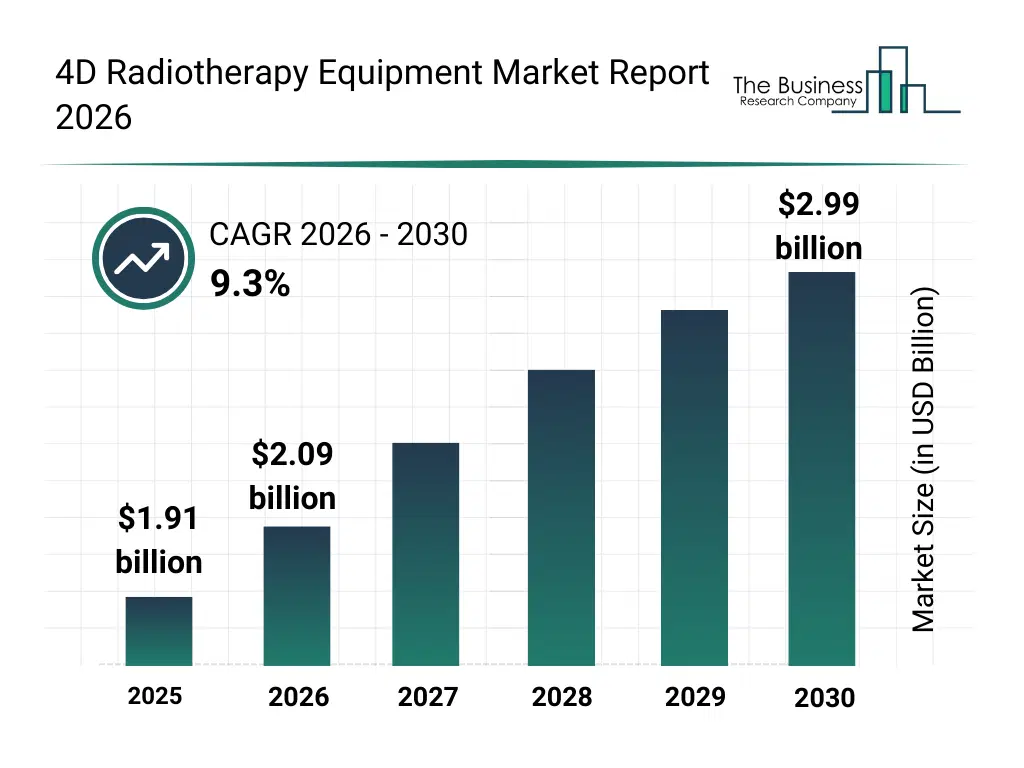
What Is The 4D Radiotherapy Equipment Market Size and Share 2026?
The 4D radiotherapy equipment market size has grown strongly in recent years. It will grow from $1.91 billion in 2025 to $2.09 billion in 2026 at a compound annual growth rate (CAGR) of 9.6%. The growth in the historic period can be attributed to increasing demand for motion-adaptive radiation therapy, growing adoption of advanced imaging systems, rising focus on minimizing treatment errors, expanding use of real-time patient monitoring, increasing preference for high-precision radiotherapy.What Is The 4D Radiotherapy Equipment Market Growth Forecast?
The 4D radiotherapy equipment market size is expected to see strong growth in the next few years. It will grow to $2.99 billion in 2030 at a compound annual growth rate (CAGR) of 9.3%. The growth in the forecast period can be attributed to growing investment in next-generation radiotherapy technologies, increasing adoption of 4D treatment systems, rising demand for accurate tumor-tracking solutions, expanding integration of ai-enabled motion management, increasing need for personalized radiation therapy. Major trends in the forecast period include technology advancements in motion-synchronized radiotherapy systems, innovations in real-time imaging capabilities, developments in adaptive treatment delivery platforms, research and development in tumor-tracking technologies, advancements in imaging-guided radiotherapy solutions.
Global 4D Radiotherapy Equipment Market Segmentation
1) By Product Type Or Component: 4D Gating/RT Systems, Linear Accelerators (LINACs), 4D Imaging Modalities, SGRT Systems, Treatment Planning Software 2) By Motion Management Technique: Respiratory Gating, Real-Time Tumor Tracking, Breath-Hold Techniques, Adaptive Radiotherapy (ART) 3) By Application: Lung Cancer, Liver Cancers, Pancreatic Cancer, Breast Cancer, Lymphoma, Other Cancers 4) By End User: Hospitals, Cancer Treatment Centers, Specialty Radiotherapy Clinics, Research Institutions Subsegments: 1) By 4D Gating / RT Systems: Respiratory Gating Systems, Real-Time Tumor Tracking Systems, Motion Management Platforms, Adaptive Radiation Delivery Systems 2) By Linear Accelerators: Standard Linear Accelerators, Image Guided Linear Accelerators, Motion Compensated Linear Accelerators, Stereotactic Body Radiation Therapy Linear Accelerators 3) By 4D Imaging Modalities: Four Dimensional Computed Tomography, Four Dimensional Magnetic Resonance Imaging, Four Dimensional Positron Emission Tomography, Four Dimensional Cone Beam Computed Tomography 4) By SGRT Systems: Surface Guided Patient Positioning Systems, Optical Surface Monitoring Systems, Real-Time Surface Tracking Systems, Motion Compensated Surface Imaging Systems 5) By Treatment Planning Software: Motion Adaptive Planning Software, Dose Calculation Software, Image Fusion Planning Software, Tumor Contouring And Delineation SoftwareWhat Are The Drivers Of The 4D Radiotherapy Equipment Market?
The rising prevalence of cancer is expected to propel the growth of the 4D radiotherapy equipment market going forward. Cancer is a disease characterized by the uncontrolled growth and spread of abnormal cells that can damage surrounding tissues and organs if not treated effectively. The prevalence of cancer is increasing due to lifestyle-related risks such as poor diet, smoking, alcohol consumption, and exposure to environmental pollutants, elevating the risk of developing various cancers. 4D radiotherapy equipment helps manage cancer by delivering highly precise, motion-adapted radiation treatments that account for tumor movement during breathing. It improves patient outcomes by maximizing tumor targeting, minimizing damage to healthy tissues, and enhancing treatment effectiveness. For instance, in October 2025, according to NHS Digital, a UK government organisation, there were 354,820 new cancer diagnoses recorded in England in 2023, averaging 972 diagnoses per day and representing an increase of 8,605 cases compared to 2022, with prostate cancer being the most commonly diagnosed cancer at 58,137 new cases, reflecting a 6% increase in registrations compared to the previous year. Therefore, the rising prevalence of cancer is driving the growth of the 4D radiotherapy equipment industry. The rising healthcare spending is expected to propel the growth of the 4D radiotherapy equipment market going forward. Healthcare spending in emerging markets refers to the investments made by governments, private institutions, and healthcare providers to improve medical infrastructure, access to advanced treatments, and patient care services. Healthcare spending in emerging markets is rising as growing middle-class populations experience higher incomes and longer lifespans which increases demand for better medical services hospital infrastructure and insurance coverage. 4D radiotherapy equipment helps support this trend by providing precise, image-guided radiation treatment that accounts for tumor motion, improving treatment outcomes while minimizing damage to surrounding healthy tissue. For instance, in June 2025, according to Statistics Austria, the national statistical office of Austria, total healthcare expenditure in Austria reached approximately $61.6 billion (€57 billion) in 2024 with contributions from both the public and private sectors, representing an increase of about $4.6 billion (€4.25 billion) compared to the previous year, while the share of healthcare spending as a proportion of gross domestic product rose from 11.2% in 2023 to 11.8% in 2024. Therefore, the rising healthcare spending in emerging markets is driving the growth of the 4D radiotherapy equipment industry.Key Players In The Global 4D Radiotherapy Equipment Market
Major companies operating in the 4D radiotherapy equipment market are Hitachi Ltd., Siemens Healthineers AG, GE HealthCare Technologies Inc., Koninklijke Philips N.V., Varian Medical Systems Inc., Elekta AB, Shanghai United Imaging Healthcare Co. Ltd., Accuray Incorporated, Brainlab AG, Canon Medical Systems Corporation, RefleXion Medical, Vision RT Ltd., C-Rad AB, MVision AI Ltd., Anzai Medical Co. Ltd., ViewRay Technologies Inc., DYN’R Medical Systems, Ion Beam Applications SA (IBA SA)
This chart is for illustrative purposes; the full report includes a detailed competitor analysis and comprehensive overview of the top 10 companies in the market.
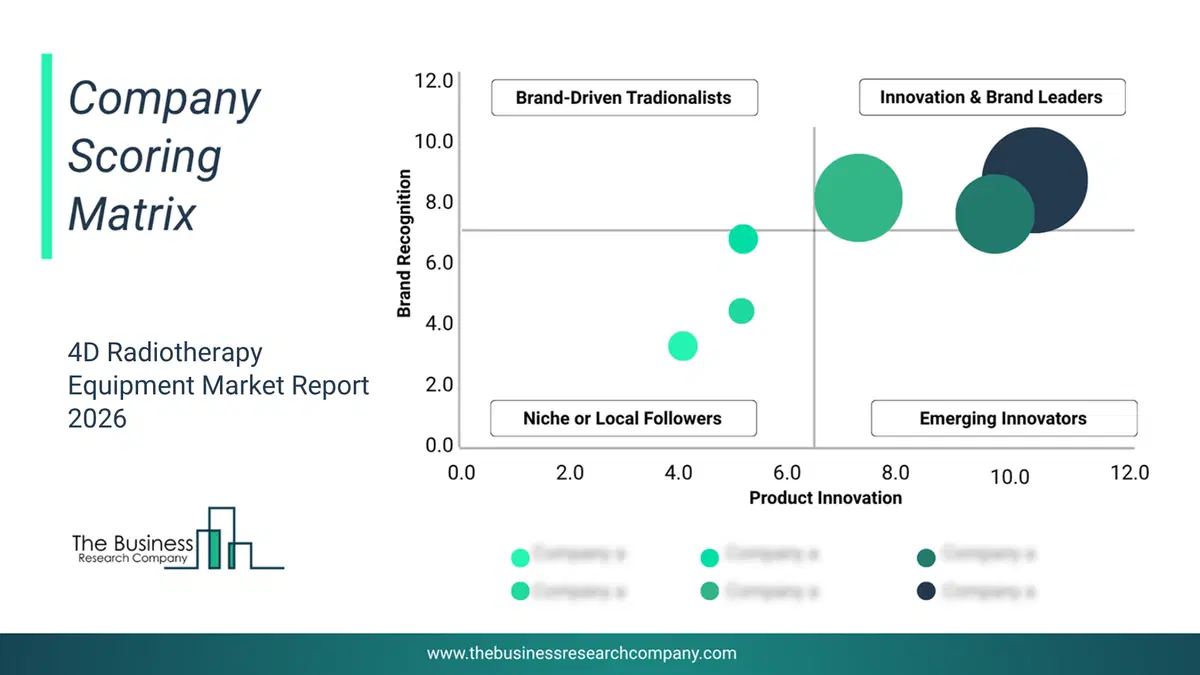
This chart maps companies by product innovation and brand strength, with bubble size indicating relative revenue, helping identify market leaders, challengers, and niche players. This is an illustrative chart; the full report provides a complete and accurate competitive analysis.
Global 4D Radiotherapy Equipment Market Trends and Insights
Major companies operating in the 4D radiotherapy equipment market are focusing on developing high-definition imaging systems, such as AI‑powered CT‑Linac platforms, to improve treatment precision, enable real-time plan adjustments, and enhance workflow efficiency. AI‑powered CT‑Linac platforms refer to integrated computed tomography–linear accelerator systems that use artificial intelligence for high‑definition imaging adaptive treatment planning and real‑time dose adjustment to deliver highly precise personalized radiation therapy for cancer patients. For instance, in May 2024, Elekta AB, a Sweden-based medical technology company, launched Elekta Evo, a CT‑Linac with AI-enhanced imaging and online/offline adaptive radiotherapy capabilities. This system enables clinicians to visualize target anatomy with clarity and adjust radiation delivery on a per-session basis to account for motion and anatomical changes. This launch represents a significant technological advancement by integrating high-precision imaging and adaptive therapy into routine clinical workflows, bridging traditional radiotherapy with AI-driven adaptive 4D planning, and providing clinicians with a scalable, efficient solution for improved patient outcomes.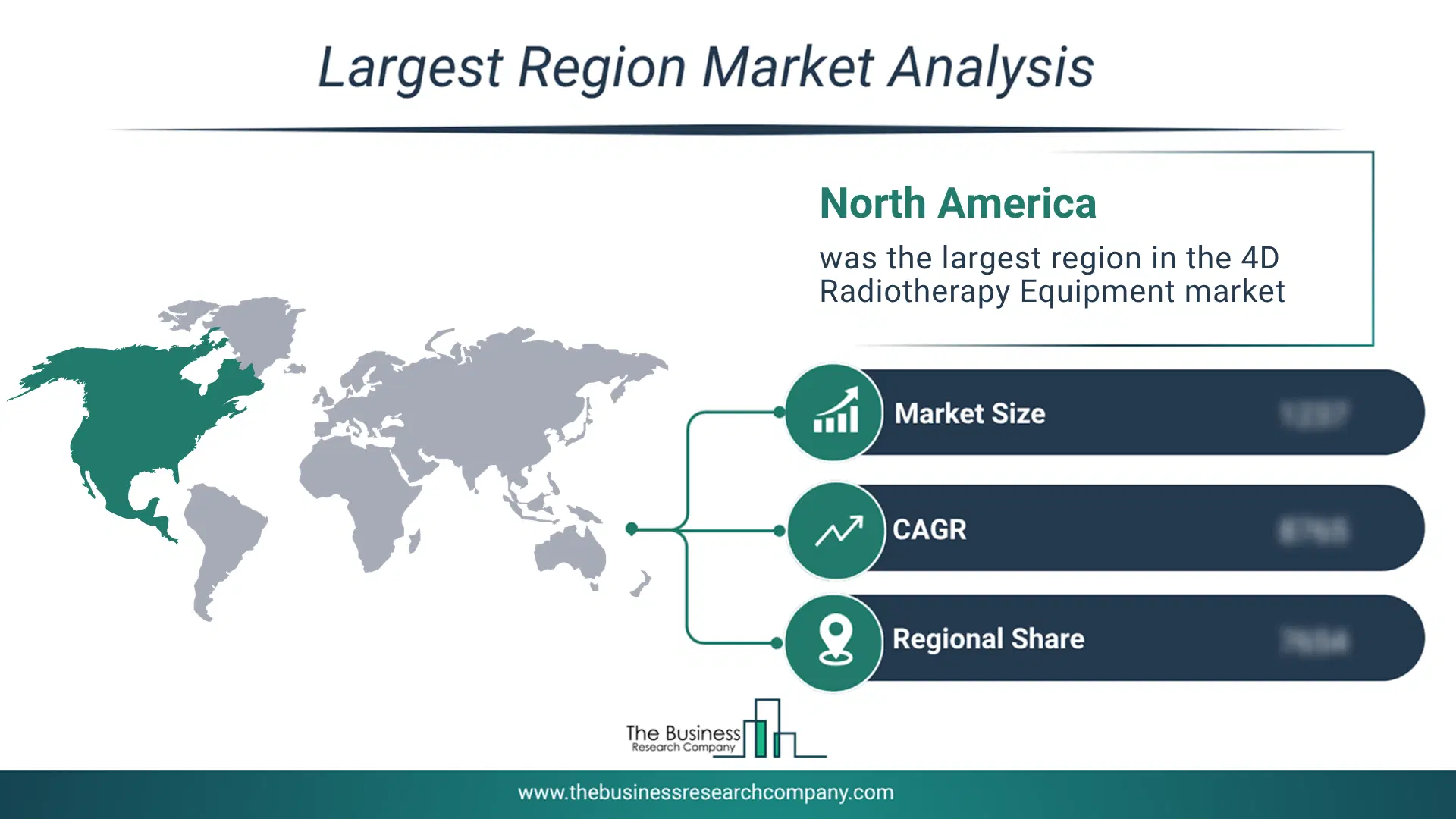
Regional Insights
North America was the largest region in the 4D radiotherapy equipment market in 2025. Asia-Pacific is expected to be the fastest-growing region in the forecast period. The regions covered in this market report are Asia-Pacific, South East Asia, Western Europe, Eastern Europe, North America, South America, Middle East, Africa. The countries covered in this market report are Australia, Brazil, China, France, Germany, India, Indonesia, Japan, Taiwan, Russia, South Korea, UK, USA, Canada, Italy, Spain.What Defines the 4D Radiotherapy Equipment Market?
The 4D radiotherapy equipment market consists of revenues earned by entities by providing services such as motion-managed treatment planning, real-time tumor tracking, respiratory-gated radiotherapy, treatment plan verification and optimization, patient-specific dose monitoring, and technical support and training. The market value includes the value of related goods sold by the equipment manufacturer or included within the equipment offering. The 4D radiotherapy equipment market also includes sales of 4D linear accelerators, motion-tracking imaging systems, respiratory-gated radiotherapy devices, treatment planning software, and patient positioning and immobilization systems. Values in this market are ‘factory gate’ values, meaning the value of goods sold by the manufacturers or creators of the equipment, whether to other entities or directly to end customers. The value of goods in this market includes related services sold by the creators of the equipment.How is Market Value Defined and Measured?
The market value is defined as the revenues that enterprises gain from the sale of goods and/or services within the specified market and geography through sales, grants, or donations in terms of the currency (in USD unless otherwise specified). The revenues for a specified geography are consumption values that are revenues generated by organizations in the specified geography within the market, irrespective of where they are produced. It does not include revenues from resales along the supply chain, either further along the supply chain or as part of other products.
This chart presents market attractiveness based on a quantitative evaluation of growth, competition, strategic alignment, and risk, offering a clear view of opportunity areas for decision-making. This chart is for illustrative purposes; the full report contains the complete analysis.

This chart highlights the Total Addressable Market (TAM) by estimating the maximum revenue opportunity using an assumption-driven approach, supporting strategic planning and opportunity sizing across markets. The chart is illustrative; the full report provides a more comprehensive analysis.
What Key Data and Analysis Are Included in the 4D Radiotherapy Equipment Market Report 2026?
The 4d radiotherapy equipment market research report is one of a series of new reports from The Business Research Company that provides market statistics, including industry global market size, regional shares, competitors with the market share, detailed market segments, market trends and opportunities, and any further data you may need to thrive in the 4d radiotherapy equipment industry. The market research report delivers a complete perspective of everything you need, with an in-depth analysis of the current and future state of the industry.4D Radiotherapy Equipment Market Report Forecast Analysis
| Report Attribute | Details |
|---|---|
| Market Size Value In 2026 | $2.09 billion |
| Revenue Forecast In 2030 | $2.99 billion |
| Growth Rate | CAGR of 9.3% from 2026 to 2030 |
| Base Year For Estimation | 2025 |
| Actual Estimates/Historical Data | 2020-2025 |
| Forecast Period | 2026 - 2030 |
| Market Representation | Revenue in USD Billion and CAGR from 2026 to 2030 |
| Segments Covered | Product Type Or Component, Motion Management Technique, Application, End User |
| Regional Scope | Asia-Pacific, Western Europe, Eastern Europe, North America, South America, Middle East, Africa |
| Country Scope | The countries covered in the report are Australia, Brazil, China, France, Germany, India, Indonesia, Japan, Taiwan, Russia, South Korea, UK, USA, Canada, Italy, Spain. |
| Key Companies Profiled | Hitachi Ltd., Siemens Healthineers AG, GE HealthCare Technologies Inc., Koninklijke Philips N.V., Varian Medical Systems Inc., Elekta AB, Shanghai United Imaging Healthcare Co. Ltd., Accuray Incorporated, Brainlab AG, Canon Medical Systems Corporation, RefleXion Medical, Vision RT Ltd., C-Rad AB, MVision AI Ltd., Anzai Medical Co. Ltd., ViewRay Technologies Inc., DYN’R Medical Systems, Ion Beam Applications SA (IBA SA) |
| Customization Scope | Request for Customization |
| Pricing And Purchase Options | Explore Purchase Options |