
5G Base Station Dielectric Filter Market Report 2026
Global Outlook – By Type of Filter ( Band Pass Filter, Low Pass Filter, High Pass Filter, Notch Filter), By Product Type ( Ceramic Filters, Cavity Filters, Dielectric Resonator Filters, Other Product Types), By Material Used ( Ceramic, Polytetrafluoroethylene (PTFE), Plastic, Metal), By Application Area ( Telecom Infrastructure, Smart Cities, Internet of Things (IoT), Public Safety Communications, Private Networks), By End User Industry ( Telecommunications, Automotive, Healthcare, Manufacturing, Transportation and Logistics) – Market Size, Trends, Strategies, and Forecast to 2030
5G Base Station Dielectric Filter Market Overview
• 5G Base Station Dielectric Filter market size has reached to $2.79 billion in 2025 • Expected to grow to $5.83 billion in 2030 at a compound annual growth rate (CAGR) of 15.8% • Growth Driver: Increasing High-Speed Internet Connectivity Fueling The Growth Of The Market Due To Rising Demand For Reliable, Low-Latency Networks • North America was the largest region in 2025 and Asia-Pacific is the fastest growing region.What Is Covered Under 5G Base Station Dielectric Filter Market?
A 5G base station dielectric filter is a high-frequency component that uses dielectric materials to selectively transmit desired radio signals while blocking unwanted frequencies. It provides low insertion loss, high selectivity, and stable performance across wide temperature ranges, making it suitable for 5G frequency bands. It is used to enhance signal quality and network performance by reducing interference and maintaining efficient spectrum utilization. The main types of filters of 5G base station dielectric filters are band pass filters, low pass filters, high pass filters, and notch filters. A band-pass filter is an electronic circuit or device that allows signals within a specific frequency range to pass through while attenuating signals outside that range. The various product types are ceramic filters, cavity filters, dielectric resonator filters, and others, and utilize different materials such as ceramic, polytetrafluoroethylene (PTFE), plastic, and metal. These filters find applications in telecom infrastructure, smart cities, Internet of Things (IoT), public safety communications, and private networks, serving end users such as telecommunications, automotive, healthcare, manufacturing, and transportation and logistics.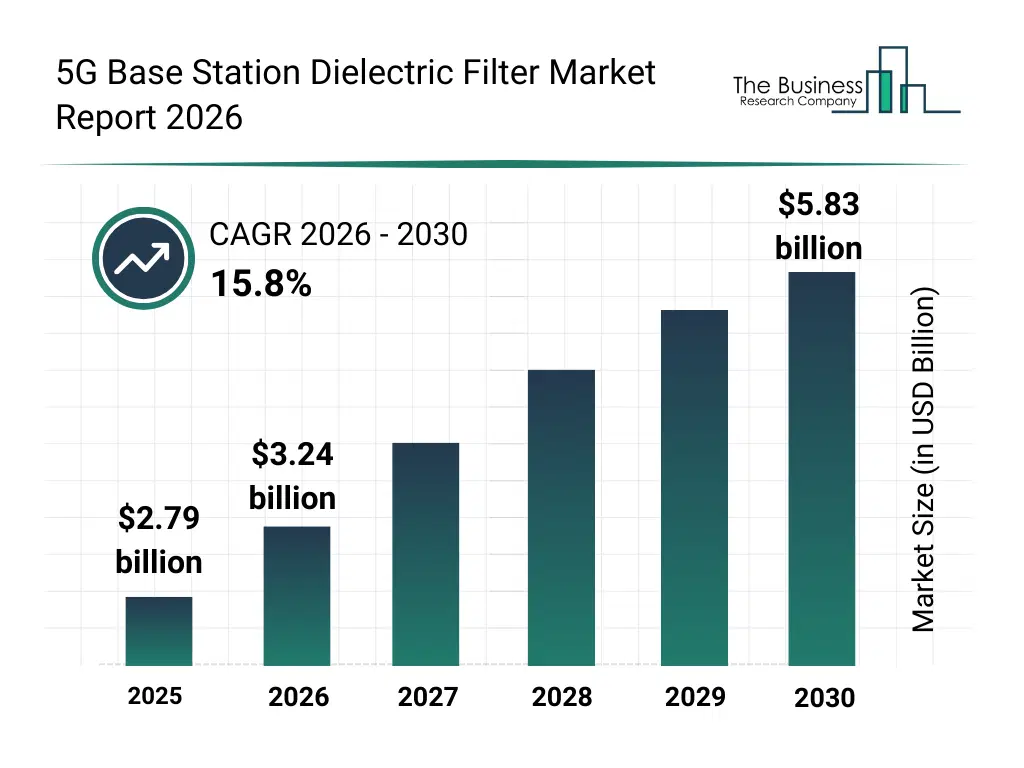
What Is The 5G Base Station Dielectric Filter Market Size 2026 And Growth Rate?
The 5G base station dielectric filter market size has grown rapidly in recent years. It will grow from $2.79 billion in 2025 to $3.24 billion in 2026 at a compound annual growth rate (CAGR) of 16.1%. The growth in the historic period can be attributed to rising demand for mobile broadband, expansion of 4g and early 5G networks, growth in telecom infrastructure investments, adoption of ceramic and dielectric materials, increasing interference in crowded frequency bands.What Is The 5G Base Station Dielectric Filter Market Growth Forecast?
The 5G base station dielectric filter market size is expected to see rapid growth in the next few years. It will grow to $5.83 billion in 2030 at a compound annual growth rate (CAGR) of 15.8%. The growth in the forecast period can be attributed to deployment of mmwave 5G networks, growth in private 5G networks, increasing iot device connectivity, expansion of smart city projects, adoption of energy-efficient telecom components. Major trends in the forecast period include 5G network optimization, low insertion loss components, high selectivity filters, temperature-stable rf components, spectrum efficiency enhancement.
Global 5G Base Station Dielectric Filter Market Segmentation
1) By Type of Filter: Band Pass Filter, Low Pass Filter, High Pass Filter, Notch Filter 2) By Product Type: Ceramic Filters, Cavity Filters, Dielectric Resonator Filters, Other Product Types 3) By Material Used: Ceramic, Polytetrafluoroethylene (PTFE), Plastic, Metal 4) By Application Area: Telecom Infrastructure, Smart Cities, Internet of Things (IoT), Public Safety Communications, Private Networks 5) By End User Industry: Telecommunications, Automotive, Healthcare, Manufacturing, Transportation and Logistics Subsegments: 1) By Band Pass Filter: Narrow Band Pass Filter, Wide Band Pass Filter, Dual Band Pass Filter, Tunable Band Pass Filter 2) By Low Pass Filter: Standard Low Pass Filter, Tunable Low Pass Filter, Elliptic Low Pass Filter, Butterworth Low Pass Filter 3) By High Pass Filter: Standard High Pass Filter, Tunable High Pass Filter, Elliptic High Pass Filter, Chebyshev High Pass Filter 4) By Notch Filter: Single Notch Filter, Dual Notch Filter, Tunable Notch Filter, High-Q Notch FilterWhat Is The Driver Of The 5G Base Station Dielectric Filter Market?
The increasing high-speed internet connectivity is expected to propel the growth of the 5G base station dielectric filter market going forward. High-speed wireless connectivity refers to the ability to transmit large volumes of data rapidly and reliably over wireless networks, enabling seamless communication, real-time applications, and enhanced user experiences across various regions. The increasing demand for high-speed wireless connectivity is due to the rapid expansion of data-intensive applications, such as video streaming and internet of things (IoT) devices, that require fast, reliable, and low-latency network performance in both urban and rural areas. High-speed wireless connectivity enhances 5G base station dielectric filters by enabling faster and more reliable signal transmission. They minimize interference by filtering unwanted frequencies, improving network efficiency and overall communication quality. For instance, in 2023, according to the International Telecommunication Union, a Switzerland-based specialized agency of the United Nations, the number of internet users rose from 5.1 billion (64% penetration) in 2022 to 5.4 billion (67% penetration) in 2023. Therefore, the increasing high-speed internet connectivity is driving the growth of the 5G base station dielectric filter industry.What Is The Driver Of The 5G Base Station Dielectric Filter Market?
The growing expansion of smart cities is expected to propel the growth of the 5G base station dielectric filter market going forward.Smart cities are urban areas that use digital technologies, data, and smart infrastructure to improve the quality of life, enhance service efficiency, and promote sustainability. The rising emphasis on smart cities is due to rapid urbanization, as cities seek innovative solutions to manage infrastructure, resources, and population growth efficiently. 5G base station dielectric filters support smart cities by ensuring clear and stable signal transmission, enabling seamless connectivity for internet of things (IoT) devices and urban infrastructure. They reduce network interference by filtering unwanted frequencies, improving the efficiency and reliability of smart city applications. For instance, in April 2025, according to the International Institute for Management Development (IMD), a Switzerland based business school, The Smart City Index 2025 assessed a total of 146 cities, reflecting an expansion in the study’s global city coverage. Therefore, the growing expansion of smart cities is driving the growth of the 5G base station dielectric filter industry.What Is The Driver Of The 5G Base Station Dielectric Filter Market?
The rising integration of internet of things (IoT) devices is expected to propel the growth of the 5G base station dielectric filter market going forward. Internet of Things (IoT) devices refer to physical objects embedded with sensors, software, and connectivity that enable them to collect and exchange data over the internet. The expansion of IoT integration is primarily due to the rapid advancement of wireless communication technologies, particularly 5G networks, which provide the necessary infrastructure for seamless connectivity and real-time data transmission across millions of connected devices. IoT integration directly supports the dielectric filter market by requiring advanced filtering components that can handle the increased frequency bands and reduce signal interference in densely connected networks. For instance, in February 2023, according to the BuildOps Inc., a US-based software-as-a-service (SaaS) company, the number of IoT connected devices grew by 28% from 2022 to 2023 and is expected to reach 16 billion by 2023. Therefore, the rising integration of internet of things (IoT) devices is driving the growth of the 5G base station dielectric filter industry.Key Players In The Global 5G Base Station Dielectric Filter Market
Major companies operating in the 5G base station dielectric filter market are Huawei Technologies Co. Ltd., Ube Electronics Ltd., Broadcom Inc., TDK Corporation, Kyocera Corporation, Murata Manufacturing Co. Ltd., Skyworks Solutions Inc., Suzhou Dongshan Precision Manufacturing Co. Ltd., Qorvo Inc., Rohde & Schwarz GmbH & Co. KG, Partron Co. Ltd., Fenghua Advanced Technology Holding Co. Ltd., Wuhan Fingu Electronic Technology Co. Ltd., Taoglas Group Holdings Limited, Tongyu Communication Inc., Samsung Electronics Co. Ltd., Tatfook Technology Co. Ltd., Beijing BDStar Navigation Co. Ltd., MCV Technologies Inc. (MCV Microwave), CaiQin Technology Co. Ltd.
This chart is for illustrative purposes; the full report includes a detailed competitor analysis and comprehensive overview of the top 10 companies in the market.
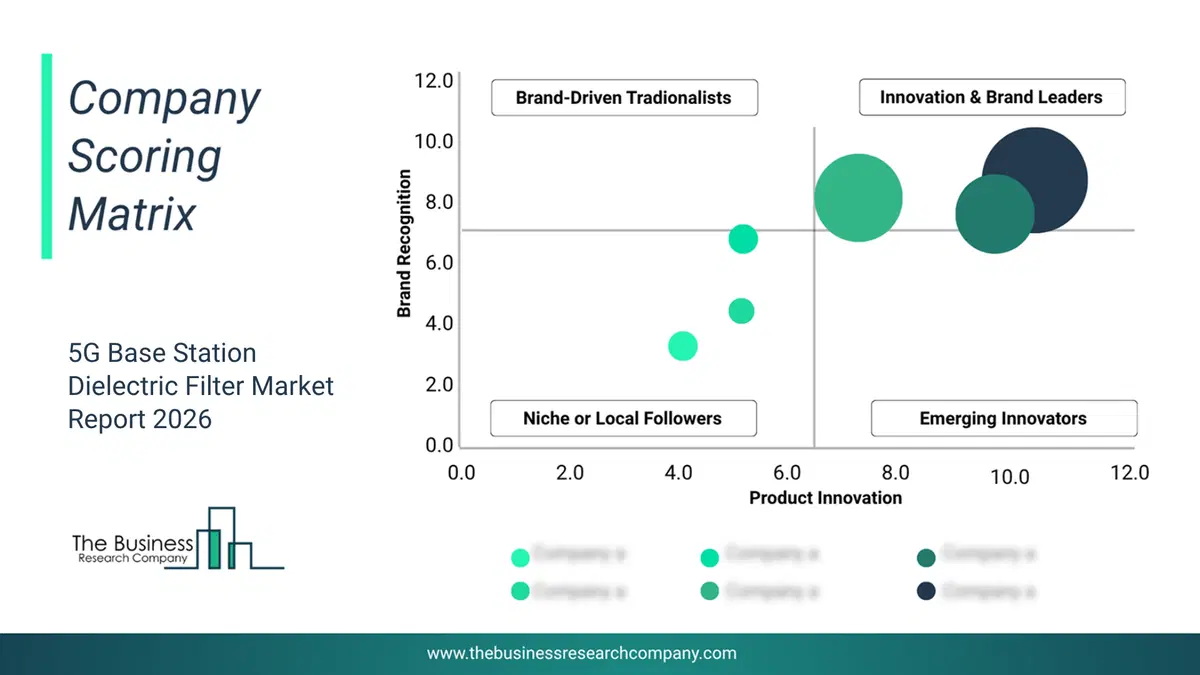
This chart maps companies by product innovation and brand strength, with bubble size indicating relative revenue, helping identify market leaders, challengers, and niche players. This is an illustrative chart; the full report provides a complete and accurate competitive analysis.
Regional Outlook
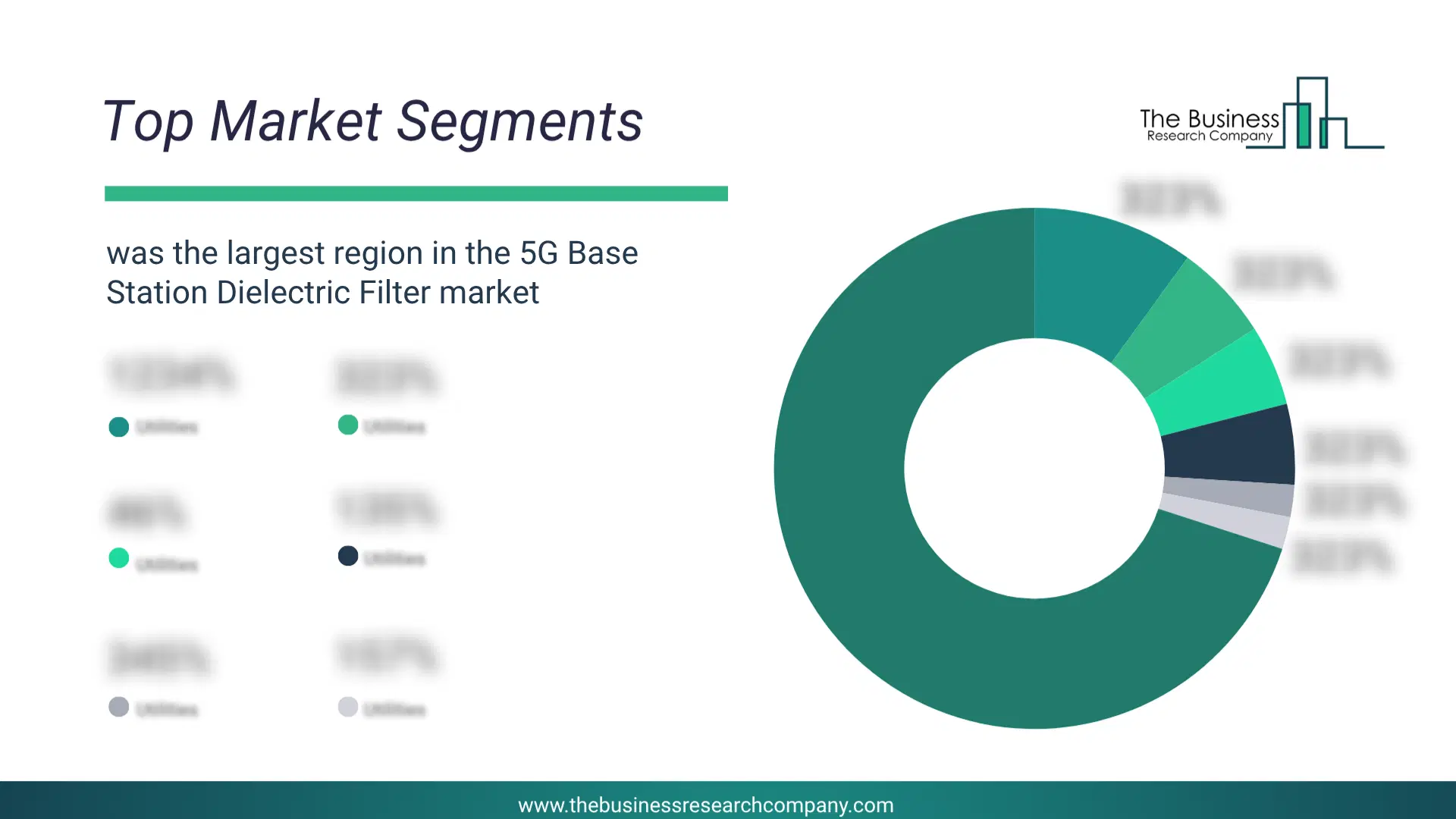
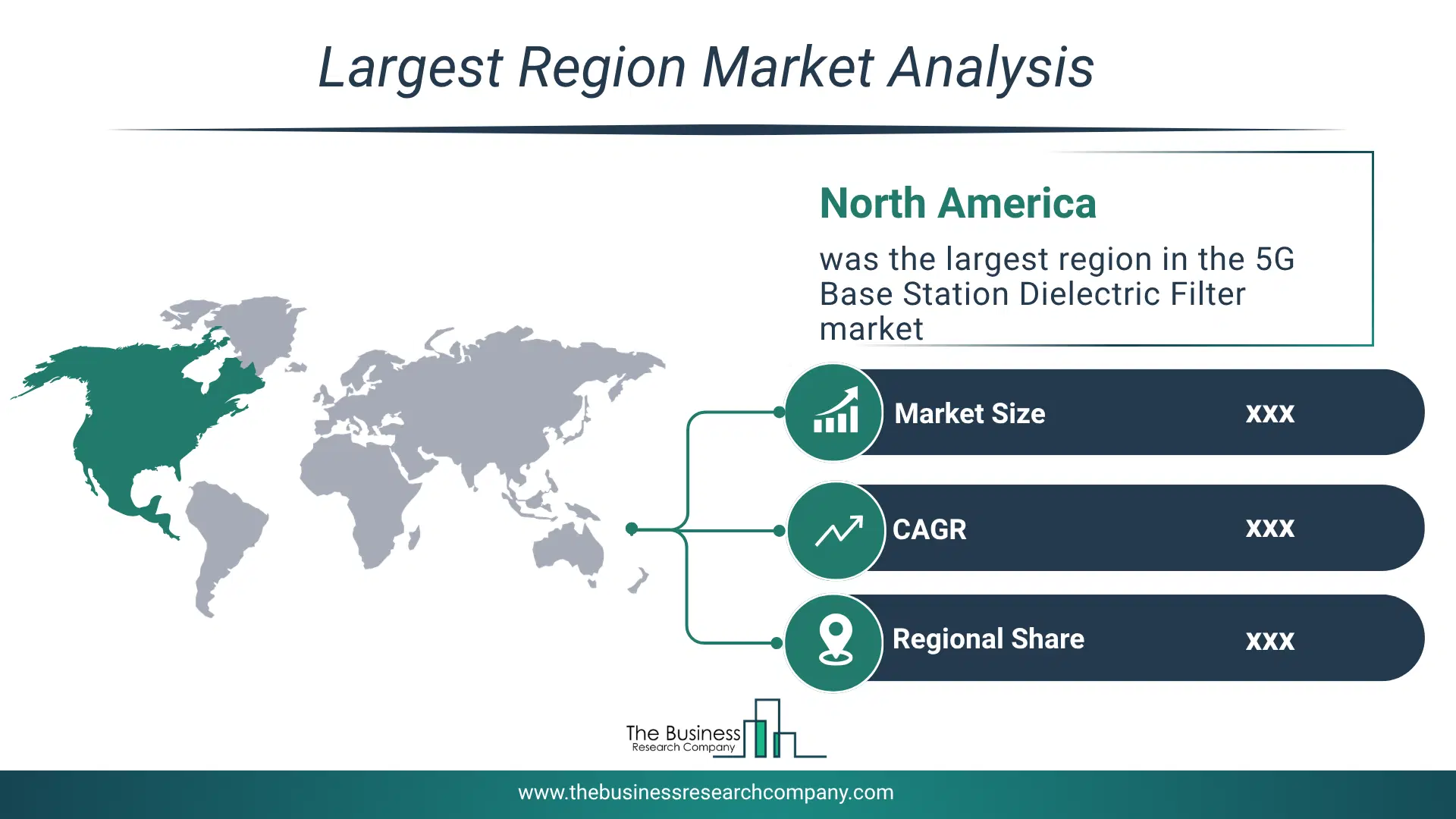
North America was the largest region in the 5G base station dielectric filter market in 2025. Asia-Pacific is expected to be the fastest-growing region in the forecast period. The regions covered in this market report are Asia-Pacific, South East Asia, Western Europe, Eastern Europe, North America, South America, Middle East, Africa. The countries covered in this market report are Australia, Brazil, China, France, Germany, India, Indonesia, Japan, Taiwan, Russia, South Korea, UK, USA, Canada, Italy, Spain.What Defines the 5G Base Station Dielectric Filter Market?
The 5G base station dielectric filter market consists of sales of duplexers, multiplexers, harmonic filters, tunable filters, diplexers, triplexers, isolators, and circulators. Values in this market are ‘factory gate’ values, that is, the value of goods sold by the manufacturers or creators of the goods, whether to other entities (including downstream manufacturers, wholesalers, distributors, and retailers) or directly to end customers. The value of goods in this market includes related services sold by the creators of the goods.How is Market Value Defined and Measured?
The market value is defined as the revenues that enterprises gain from the sale of goods and/or services within the specified market and geography through sales, grants, or donations in terms of the currency (in USD unless otherwise specified). The revenues for a specified geography are consumption values that are revenues generated by organizations in the specified geography within the market, irrespective of where they are produced. It does not include revenues from resales along the supply chain, either further along the supply chain or as part of other products.
This chart presents market attractiveness based on a quantitative evaluation of growth, competition, strategic alignment, and risk, offering a clear view of opportunity areas for decision-making. This chart is for illustrative purposes; the full report contains the complete analysis.

This chart highlights the Total Addressable Market (TAM) by estimating the maximum revenue opportunity using an assumption-driven approach, supporting strategic planning and opportunity sizing across markets. The chart is illustrative; the full report provides a more comprehensive analysis.
What Key Data and Analysis Are Included in the 5G Base Station Dielectric Filter Market Report 2026?
The 5g base station dielectric filter market research report is one of a series of new reports from The Business Research Company that provides market statistics, including industry global market size, regional shares, competitors with the market share, detailed market segments, market trends and opportunities, and any further data you may need to thrive in the 5g base station dielectric filter industry. The market research report delivers a complete perspective of everything you need, with an in-depth analysis of the current and future state of the industry.5G Base Station Dielectric Filter Market Report Forecast Analysis
| Report Attribute | Details |
|---|---|
| Market Size Value In 2026 | $3.24 billion |
| Revenue Forecast In 2030 | $5.83 billion |
| Growth Rate | CAGR of 15.8% from 2026 to 2030 |
| Base Year For Estimation | 2025 |
| Actual Estimates/Historical Data | 2020-2025 |
| Forecast Period | 2026 - 2030 |
| Market Representation | Revenue in USD Billion and CAGR from 2026 to 2030 |
| Segments Covered | Type of Filter, Product Type, Material Used, Application Area, End User Industry |
| Regional Scope | Asia-Pacific, Western Europe, Eastern Europe, North America, South America, Middle East, Africa |
| Country Scope | The countries covered in the report are Australia, Brazil, China, France, Germany, India, Indonesia, Japan, Taiwan, Russia, South Korea, UK, USA, Canada, Italy, Spain. |
| Key Companies Profiled | Huawei Technologies Co. Ltd., Ube Electronics Ltd., Broadcom Inc., TDK Corporation, Kyocera Corporation, Murata Manufacturing Co. Ltd., Skyworks Solutions Inc., Suzhou Dongshan Precision Manufacturing Co. Ltd., Qorvo Inc., Rohde & Schwarz GmbH & Co. KG, Partron Co. Ltd., Fenghua Advanced Technology Holding Co. Ltd., Wuhan Fingu Electronic Technology Co. Ltd., Taoglas Group Holdings Limited, Tongyu Communication Inc., Samsung Electronics Co. Ltd., Tatfook Technology Co. Ltd., Beijing BDStar Navigation Co. Ltd., MCV Technologies Inc. (MCV Microwave), CaiQin Technology Co. Ltd. |
| Customization Scope | Request for Customization |
| Pricing And Purchase Options | Explore Purchase Options |