
5G In Defense Market Report 2026
Global Outlook – By Communication Infrastructure (Small cell, Macro Cell, Radio Access Network (RAN)), By Core Network Technology (Software-defined Networking (SDN), Fog Computing (FC), Mobile Edge Computing (MEC), Network Functions Virtualization (NFV)), By Network Type (Enhanced Mobile Broadband (eMBB), Ultra-Reliable Low-Latency Communications (URLLC), Massive Machine Type Communications (MMTC)), By End Use (Military, Homeland Security) – Market Size, Trends, Strategies, and Forecast to 2030
5G In Defense Market Overview
• 5G In Defense market size has reached to $0.61 billion in 2025 • Expected to grow to $8.84 billion in 2030 at a compound annual growth rate (CAGR) of 70.7% • Growth Driver: Rising Autonomous Systems And Connected Devices Fuels 5G In Defense Market • Market Trend: Key Player Innovation Transforming Defense And Response Capabilities In 5G Defense Market • North America was the largest region in 2025 and Asia-Pacific is the fastest growing region.What Is Covered Under 5G In Defense Market?
5G in defense refers to providing the fifth generation of broadband or cellular technology (i.e., 5G ) designed to dramatically improve the speed and responsiveness of wireless networks for various military and defense uses. The main types of communication infrastructure for 5G in defense are small cell, macro cell, and radio access network (RAN). Small cell infrastructure uses wireless receivers and transmitters to provide network coverage to smaller areas. The macro cell provides radio coverage for cellular networks through large towers and antennas across a wider area. Radio Access Network (RAN) connects individual devices to other parts of a network through radio connections. The various network technology in 5G in defense include software-defined networking (SDN), fog computing (FC), mobile edge computing (MEC), and network functions virtualization (NFV). The different types of network used comprises enhanced mobile broadband (eMBB), ultra-reliable low-latency communications (URLLC), and massive machine type communications (MMTC). 5G in defense are used in areas such as military and homeland security.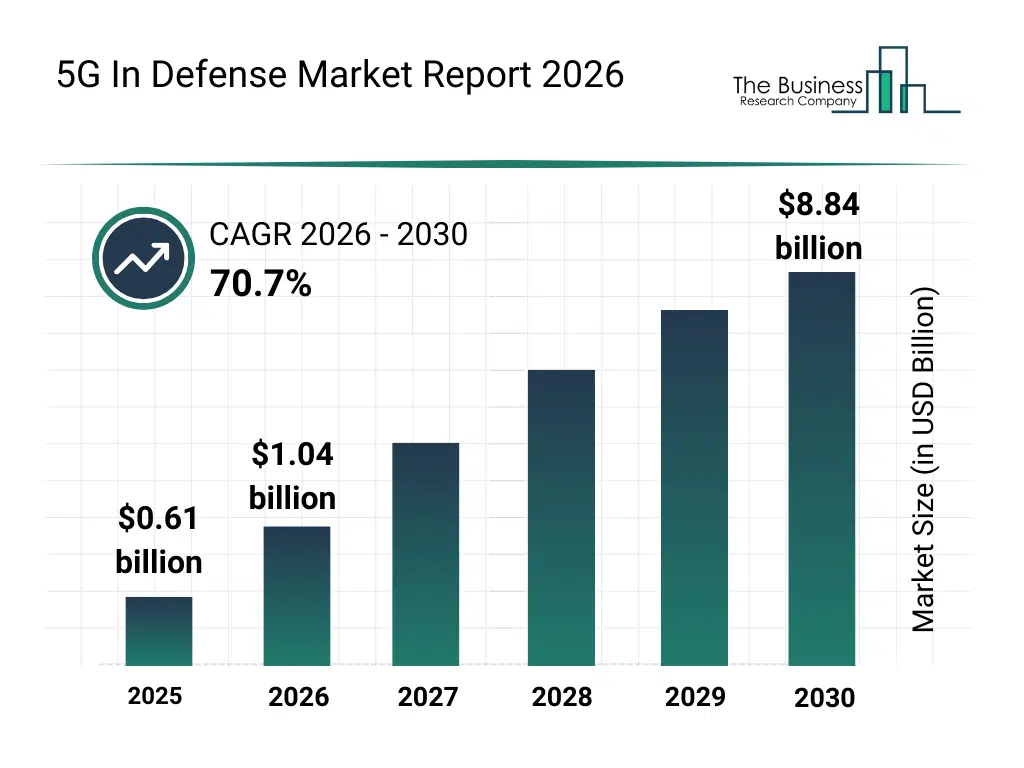
What Is The 5G In Defense Market Size and Share 2026?
The 5G in defense market size has grown exponentially in recent years. It will grow from $0.61 billion in 2025 to $1.04 billion in 2026 at a compound annual growth rate (CAGR) of 71.2%. The growth in the historic period can be attributed to need for secure communications, modernization of defense infrastructure, adoption of wireless battlefield systems, growth of network centric warfare, early lte defense trials.What Is The 5G In Defense Market Growth Forecast?
The 5G in defense market size is expected to see exponential growth in the next few years. It will grow to $8.84 billion in 2030 at a compound annual growth rate (CAGR) of 70.7%. The growth in the forecast period can be attributed to deployment of private 5G networks, integration of autonomous defense systems, demand for real time intelligence, growth of edge computing in defense, increased defense spending. Major trends in the forecast period include secure military communications, edge enabled tactical networks, low latency battlefield connectivity, private 5G defense networks, network virtualization adoption.
Global 5G In Defense Market Segmentation
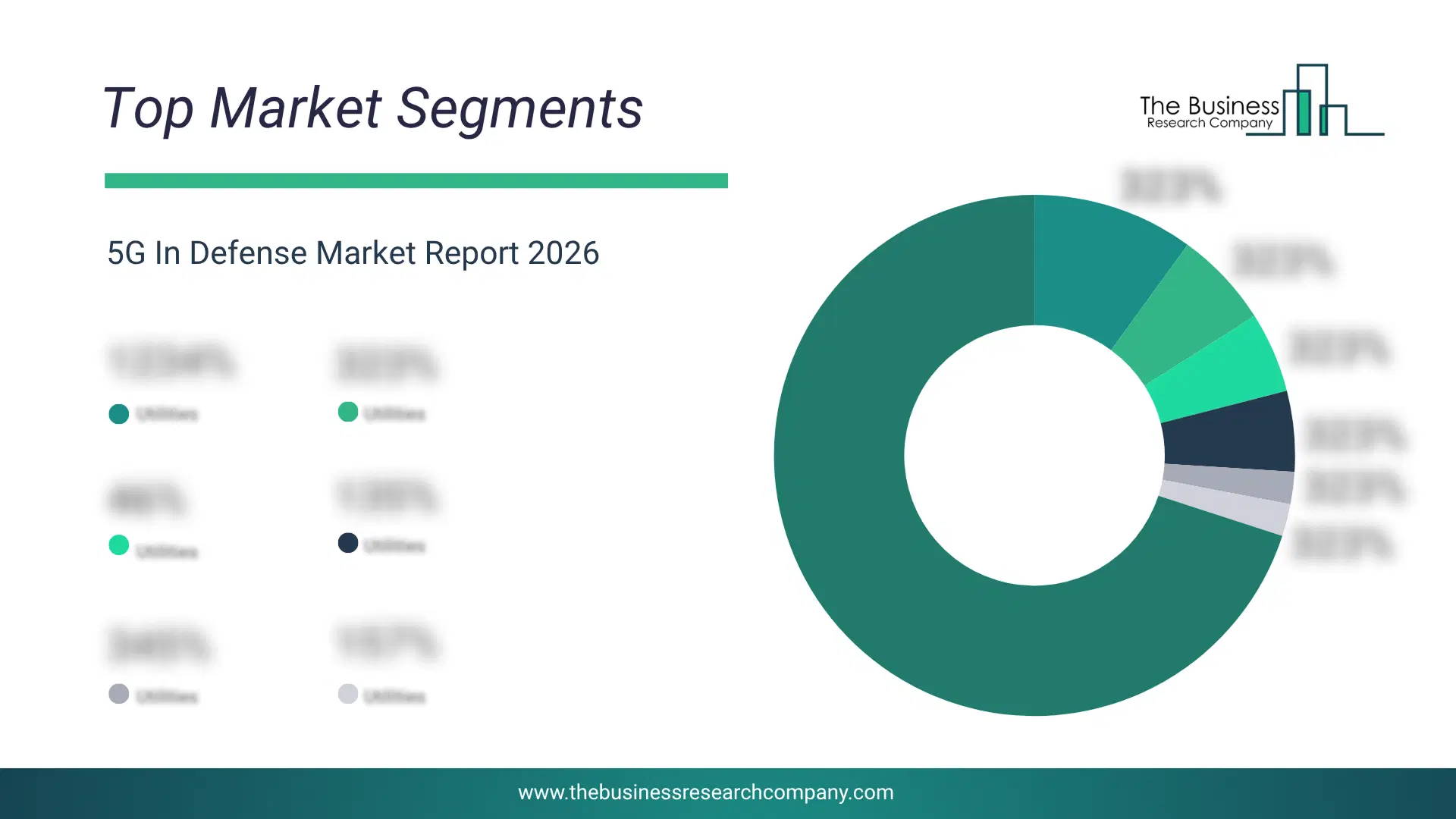
1) By Communication Infrastructure: Small cell, Macro Cell, Radio Access Network (RAN) 2) By Core Network Technology: Software-defined Networking (SDN), Fog Computing (FC), Mobile Edge Computing (MEC), Network Functions Virtualization (NFV) 3) By Network Type: Enhanced Mobile Broadband (eMBB), Ultra-Reliable Low-Latency Communications (URLLC), Massive Machine Type Communications (MMTC) 4) By End Use: Military, Homeland Security Subsegments: 1) By Small Cell: Indoor Small Cells, Outdoor Small Cells 2) By Macro Cell: Traditional Macro Cells, High-Power Macro Cells 3) By Radio Access Network (RAN): Centralized RAN, Distributed RAN, Virtualized RANWhat Is The Driver Of The 5G In Defense Market?
The increasing use of autonomous systems and connected devices is expected to propel the growth of 5G in the defense market during the forecast period. Autonomous systems and connected devices encompass self-operating technologies and interconnected hardware capable of communication and data exchange. Autonomous systems and connected devices enhance defense capabilities through rapid data transmission, real-time decision-making, and synchronized operations enabled by the high-speed, low-latency features of 5G networks. For instance, in October 2025, according to the IoT Analytics, a Germany-based, a leading global provider of market insights, the number of connected IoT devices is projected to grow by 14% in 2025, reaching 39 billion by 2030. Therefore, the increasing use of autonomous systems and connected devices will propel the 5G in the defense market.Key Players In The Global 5G In Defense Market
Major companies operating in the 5G in defense market are Samsung Electronics Co. Ltd.; Huawei Technologies Co. Ltd.; Raytheon Technologies Corporation; Lockheed Martin Corporation; Qualcomm Technologies Inc.; General Dynamics Corporation; Northrop Grumman Corporation; Honeywell International Inc.; Telefonaktiebolaget LM Ericsson; BAE Systems plc; Nokia Corporation; NEC Corporation; Thales Group Inc.; Leonardo S.p.A.; L3Harris Technologies Inc.; Elbit Systems Ltd.; Saab AB; Rohde & Schwarz GmbH & Co. KG; Curtiss-Wright Corporation; QinetiQ Group plc; LIG Nex1 Co. Ltd.; Ultra Electronics Holdings plc; Kratos Defense & Security Solutions Inc.; Comtech Telecommunications Corp.; Wind River Systems Inc.; Gilat Satellite Networks Ltd.; Ligado Networks LLC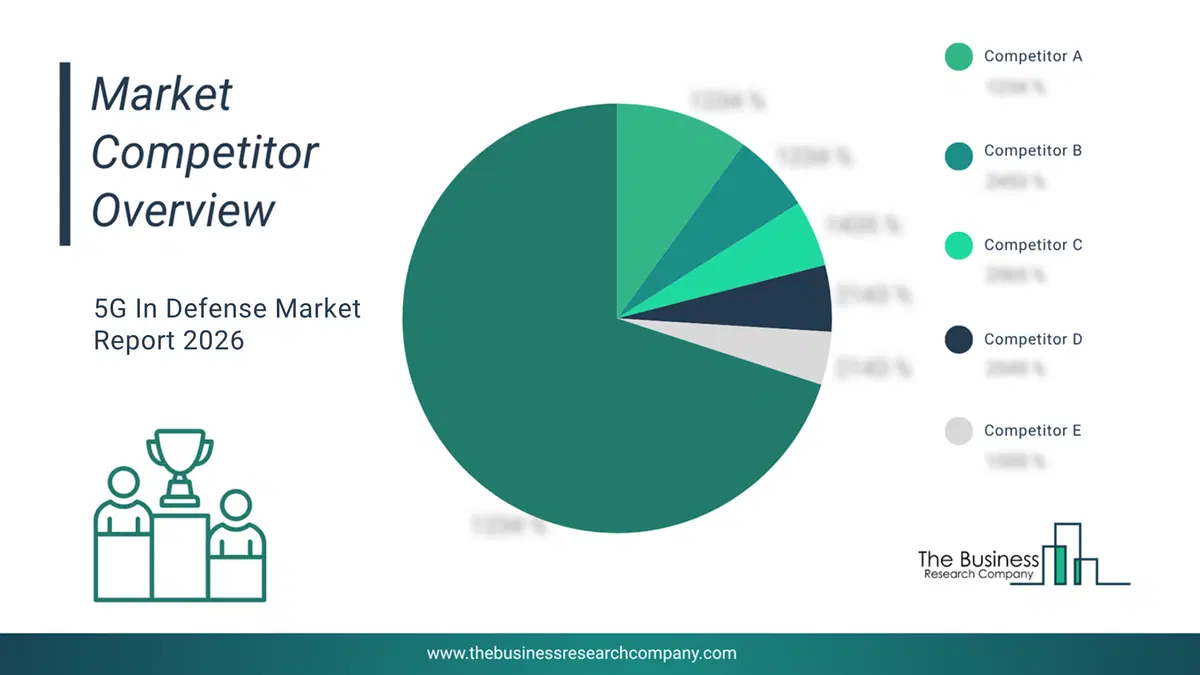
This chart is for illustrative purposes; the full report includes a detailed competitor analysis and comprehensive overview of the top 10 companies in the market.
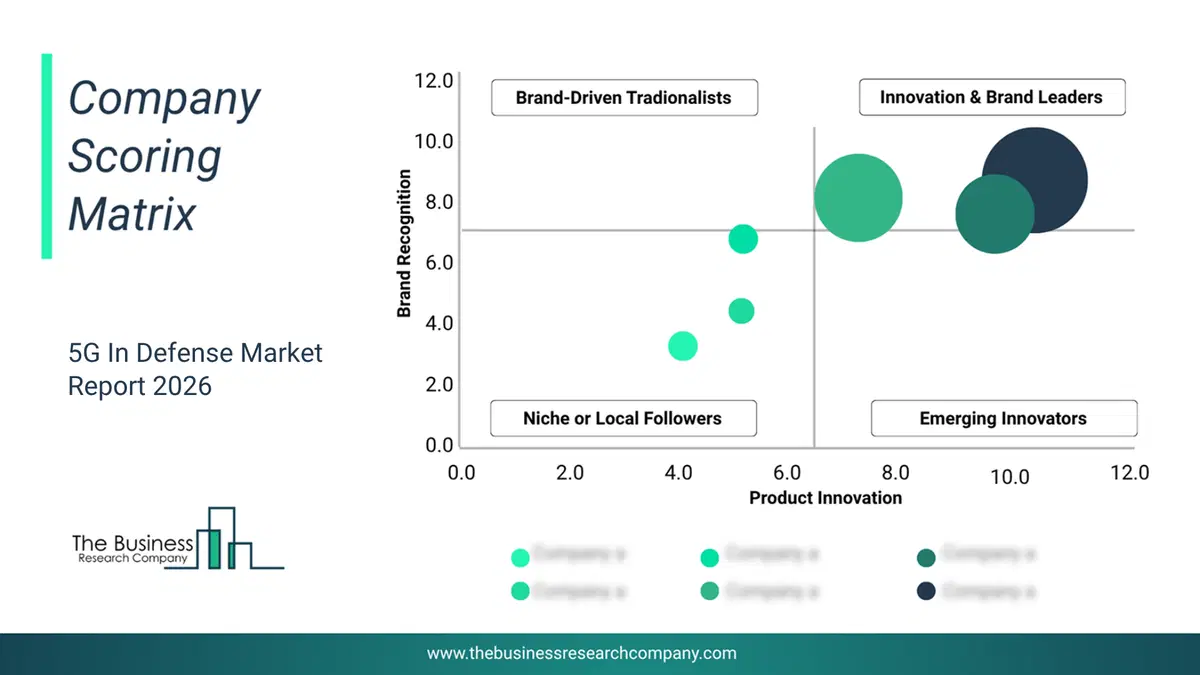
This chart maps companies by product innovation and brand strength, with bubble size indicating relative revenue, helping identify market leaders, challengers, and niche players. This is an illustrative chart; the full report provides a complete and accurate competitive analysis.
Global 5G In Defense Market Trends and Insights
Major companies operating in the 5G defense market are focusing on product innovation, such as real-time mobile data access, to meet evolving industry demands. Real-time mobile data access enables instantaneous retrieval and interaction with data on mobile devices. For instance, in October 2023, Getac Technology Corporation, a Taiwan-based technology company, launched 5G rugged devices tailored for defense, first responders, and resource industries in Australia and New Zealand. Among these devices are the V110 fully rugged laptop, the S410 semi-rugged laptop, the F110 fully rugged tablet, and the UX10 fully rugged tablet, all equipped with rapid 5G connectivity and built to withstand challenging field environments. The equipment is engineered to enable instant mobile data retrieval and acquisition, digital evidence collection, management of assets and components, examination of technical diagrams and infrastructure maps, as well as reporting. It facilitates connectivity and data accessibility for remote workers, conducts site surveys, offers precise GPS and mapping capabilities, records initial on-site events, supports mobile command functions, and ensures real-time situational awareness.What Are Latest Mergers And Acquisitions In The 5G In Defense Market?
In May 2024, Nokia Corp., a Finland-based telecommunications and network solutions company, acquired Fenix Group, for an undisclosed amount. With this acquisition, Nokia aims to strengthen its defense and mission-critical communications portfolio, accelerate the development of secure 5G-enabled battlefield technologies, expand its presence in the US defense market, and enhance the integration of advanced IoT and AI-driven operational capabilities across military applications. Fenix Group is a US-based specialist in Battlefield-of-Things solutions company that provides Battlefield-of-Things solutions, including secure communications, situational awareness, and connected operations technologies for defense forces.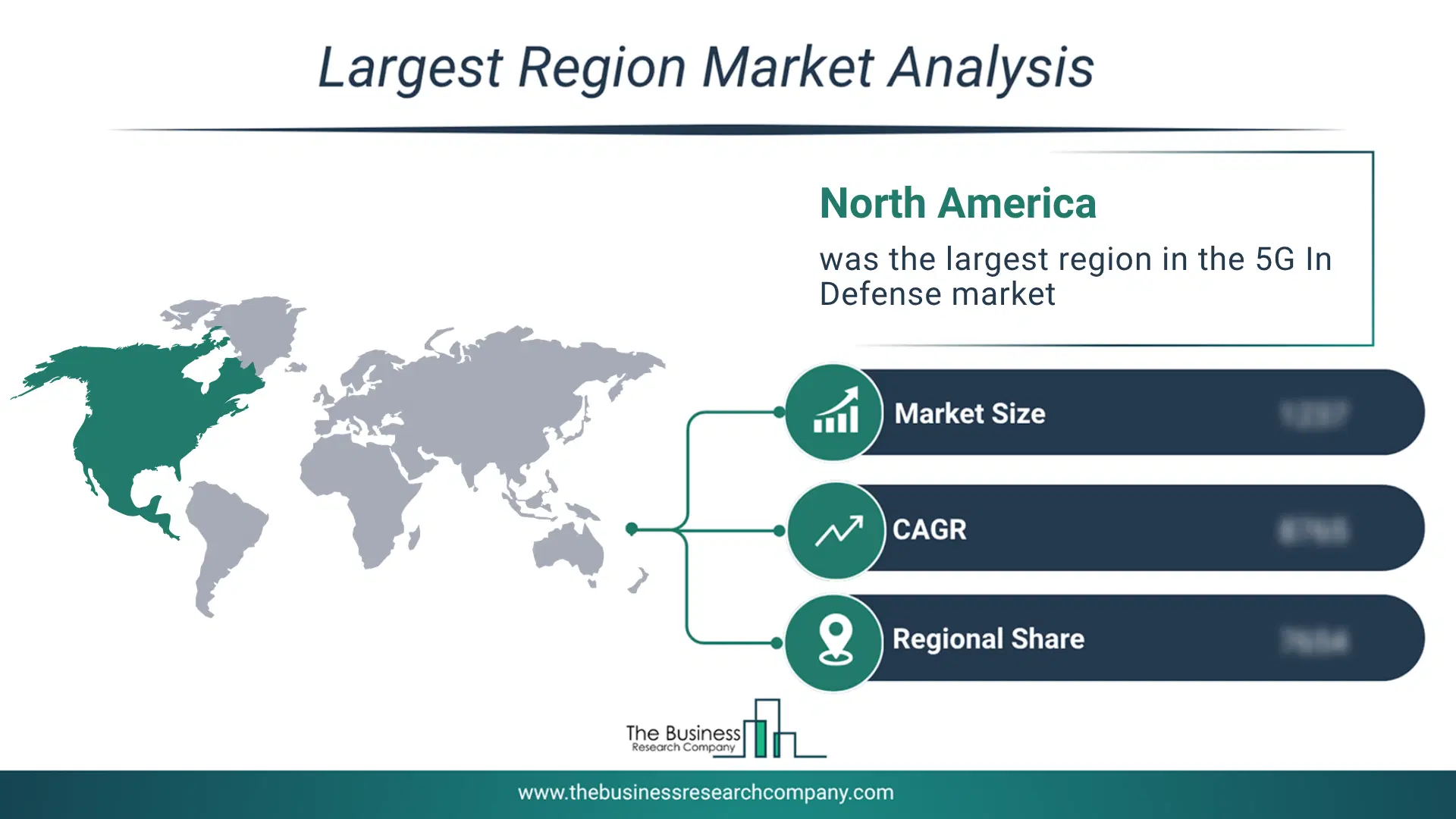
Regional Insights
North America was the largest region in the 5G in defense market in 2025. Asia-Pacific region is predicted to record the fastest growth over the forecast period. The regions covered in this market report are Asia-Pacific, South East Asia, Western Europe, Eastern Europe, North America, South America, Middle East, Africa. The countries covered in this market report are Australia, Brazil, China, France, Germany, India, Indonesia, Japan, Taiwan, Russia, South Korea, UK, USA, Canada, Italy, SpainWhat Defines the 5G In Defense Market?
The 5G in defense market includes revenues earned by entities by providing 5G technology and services for military and homeland security uses. 5G for defense is expected to improve reconnaissance, intelligence, and surveillance systems and processing, streamline logistics systems for increased efficiency and enable new methods of control and command. 5G in defense transfers video, text, image, and voice data with a faster bandwidth of 300 GHz to create data on demand for the battlefield. The market value includes the value of related goods sold by the service provider or included within the service offering. Only goods and services traded between entities or sold to end consumers are included.How is Market Value Defined and Measured?
The market value is defined as the revenues that enterprises gain from the sale of goods and/or services within the specified market and geography through sales, grants, or donations in terms of the currency (in USD unless otherwise specified). The revenues for a specified geography are consumption values that are revenues generated by organizations in the specified geography within the market, irrespective of where they are produced. It does not include revenues from resales along the supply chain, either further along the supply chain or as part of other products.
This chart presents market attractiveness based on a quantitative evaluation of growth, competition, strategic alignment, and risk, offering a clear view of opportunity areas for decision-making. This chart is for illustrative purposes; the full report contains the complete analysis.

This chart highlights the Total Addressable Market (TAM) by estimating the maximum revenue opportunity using an assumption-driven approach, supporting strategic planning and opportunity sizing across markets. The chart is illustrative; the full report provides a more comprehensive analysis.
What Key Data and Analysis Are Included in the 5G In Defense Market Report 2026?
The 5g in defense market research report is one of a series of new reports from The Business Research Company that provides market statistics, including industry global market size, regional shares, competitors with the market share, detailed market segments, market trends and opportunities, and any further data you may need to thrive in the 5g in defense industry. The market research report delivers a complete perspective of everything you need, with an in-depth analysis of the current and future state of the industry.5G In Defense Market Report Forecast Analysis
| Report Attribute | Details |
|---|---|
| Market Size Value In 2026 | $1.04 billion |
| Revenue Forecast In 2030 | $8.84 billion |
| Growth Rate | CAGR of 70.7% from 2026 to 2030 |
| Base Year For Estimation | 2025 |
| Actual Estimates/Historical Data | 2020-2025 |
| Forecast Period | 2026 - 2030 |
| Market Representation | Revenue in USD Billion and CAGR from 2026 to 2030 |
| Segments Covered | Communication Infrastructure, Core Network Technology, Network Type, End Use |
| Regional Scope | Asia-Pacific, Western Europe, Eastern Europe, North America, South America, Middle East, Africa |
| Country Scope | The Countries Covered In This Market Report Are Australia, Brazil, China, France, Germany, India, Indonesia, Japan, Taiwan, Russia, South Korea, Uk, Usa, Canada, Italy, Spain. |
| Key Companies Profiled | Samsung Electronics Co. Ltd., Huawei Technologies Co. Ltd., Raytheon Technologies Corporation, Lockheed Martin Corporation, Qualcomm Technologies Inc., General Dynamics Corporation, Northrop Grumman Corporation, Honeywell International Inc., Telefonaktiebolaget LM Ericsson, BAE Systems plc, Nokia Corporation, NEC Corporation, Thales Group Inc., Leonardo S.p.A., L3Harris Technologies Inc., Elbit Systems Ltd., Saab AB, Rohde & Schwarz GmbH & Co. KG, Curtiss-Wright Corporation, QinetiQ Group plc, LIG Nex1 Co. Ltd., Ultra Electronics Holdings plc, Kratos Defense & Security Solutions Inc., Comtech Telecommunications Corp., Wind River Systems Inc., Gilat Satellite Networks Ltd., Ligado Networks LLC |
| Customization Scope | Request for Customization |
| Pricing And Purchase Options | Explore Purchase Options |