
5G Policy Control Function Market Report 2026
Global Outlook – By Component (Solution, Services), By Network Type (Standalone, Non-Standalone), By Deployment Mode (On-Premises, Cloud), By Application (Mobile Broadband, IoT Connectivity, Mission-Critical Communications, Network Slicing, Other Applications), By End Users (Telecom Operators, Enterprises, Government, Other End Users) – Market Size, Trends, Strategies, and Forecast to 2030
5G Policy Control Function Market Overview
• 5G Policy Control Function market size has reached to $1.98 billion in 2025 • Expected to grow to $5.89 billion in 2030 at a compound annual growth rate (CAGR) of 24.3% • Growth Driver: Rise In Need For Efficient Network Resource Management Is Fueling The Growth Of The Market Due To Increasing Data Traffic And Demand For Optimized Network Performance • Market Trend: Advanced Solutions Boost Network Slicing And Operational Efficiency • North America was the largest region in 2025.What Is Covered Under 5G Policy Control Function Market?
5G policy control function (PCF) refers to a core network element within the 5G architecture responsible for managing and enforcing network policies related to quality of service (QoS), data usage, and subscriber behavior. It acts as the central policy decision point, providing dynamic control over network resources based on real-time conditions and user profiles. It ensures consistent service delivery, optimized network performance, and adherence to operator-defined rules. The main components of 5G policy control function are solutions and services. Solutions refer to software platforms and tools that manage, enforce, and automate network policies, QoS, and access control in 5G networks. The other network types include standalone and non-standalone, and are deployed through cloud and on-premises modes. It finds applications in mobile broadband, IoT connectivity, mission-critical communications, network slicing, and other applications and is used by various end-users, including telecom operators, enterprises, governments, and others.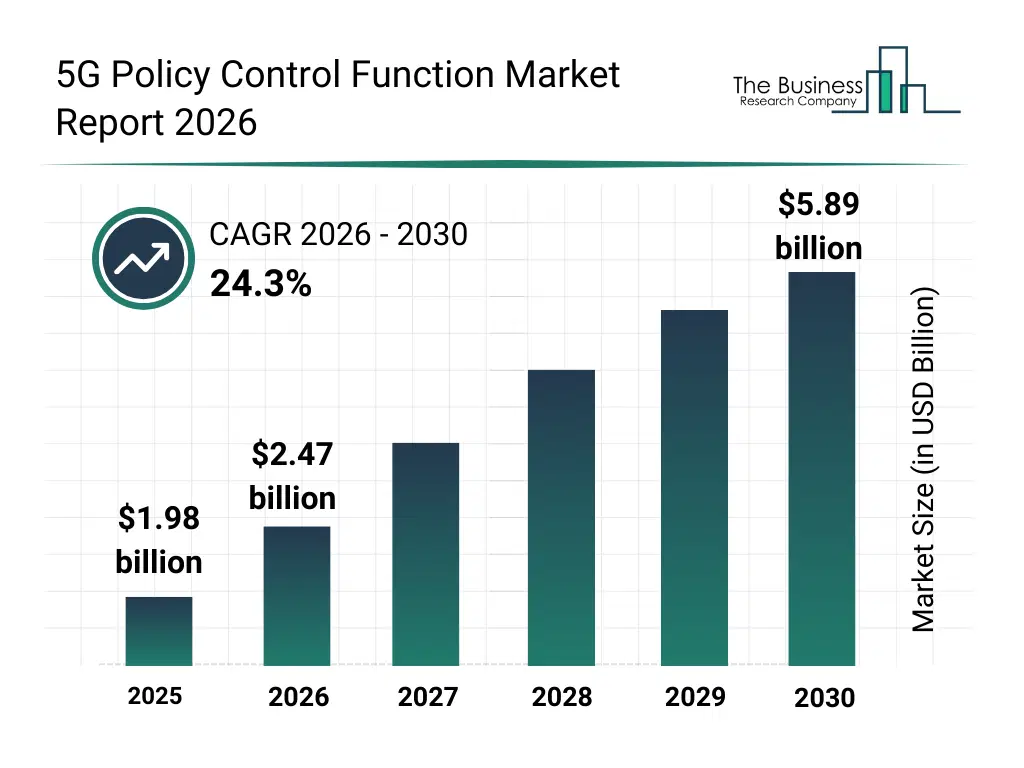
What Is The 5G Policy Control Function Market Size and Share 2026?
The 5G policy control function market size has grown exponentially in recent years. It will grow from $1.98 billion in 2025 to $2.47 billion in 2026 at a compound annual growth rate (CAGR) of 24.6%. The growth in the historic period can be attributed to growth of lte core network evolution, increasing subscriber data usage, need for qos management, expansion of telecom monetization models, rising demand for policy enforcement automation.What Is The 5G Policy Control Function Market Growth Forecast?
The 5G policy control function market size is expected to see exponential growth in the next few years. It will grow to $5.89 billion in 2030 at a compound annual growth rate (CAGR) of 24.3%. The growth in the forecast period can be attributed to growth of network slicing deployments, rise of cloud-native 5G core adoption, increasing demand for dynamic qos policies, expansion of iot and mission critical services, need for real-time charging and policy analytics. Major trends in the forecast period include cloud-native pcf deployment growth, dynamic qos policy enforcement adoption, policy automation for network slicing, subscriber data driven policy analytics, integration with charging and billing systems.
Global 5G Policy Control Function Market Segmentation
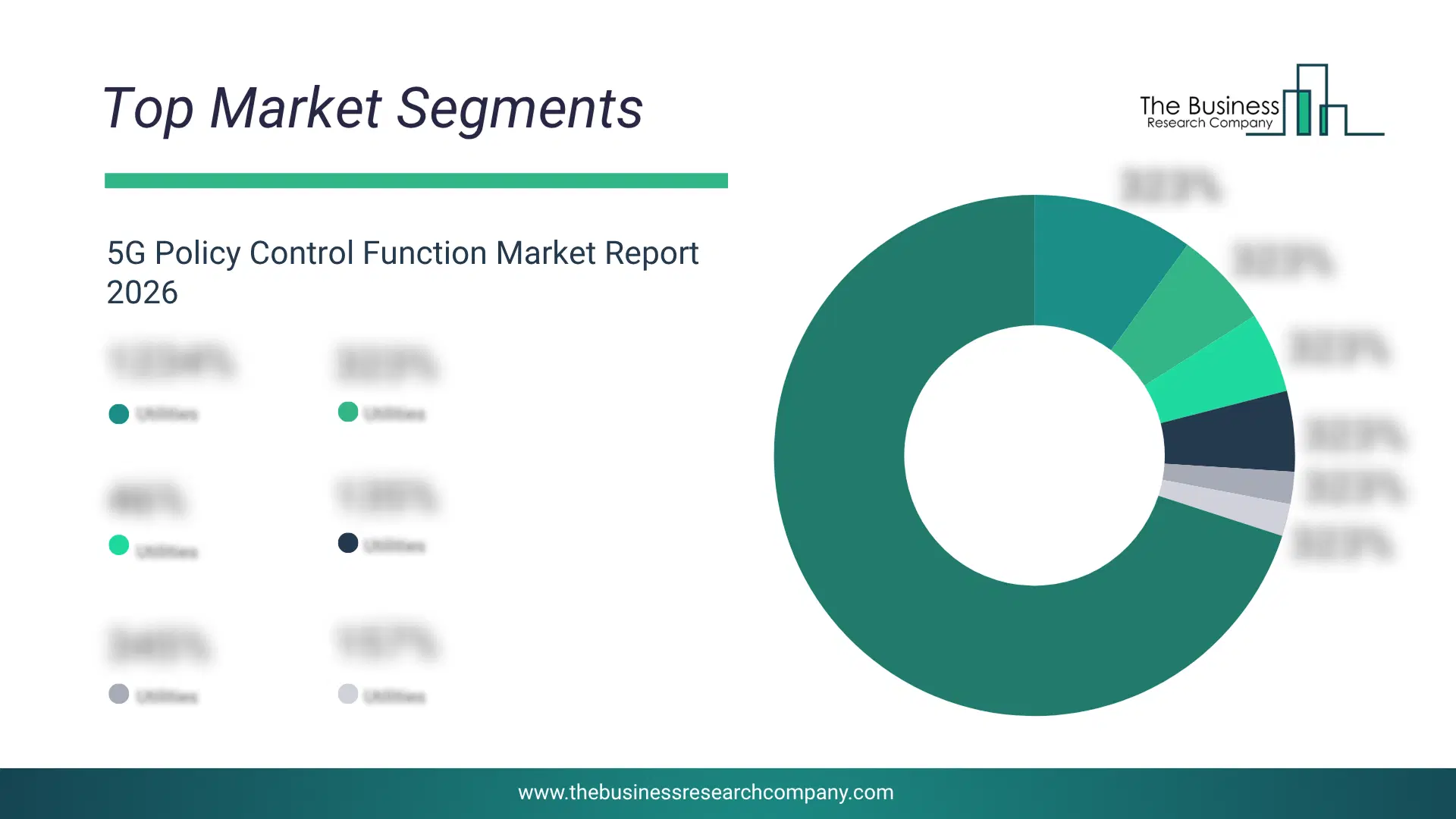
1) By Component: Solution, Services 2) By Network Type: Standalone, Non-Standalone 3) By Deployment Mode: On-Premises, Cloud 4) By Application: Mobile Broadband, IoT Connectivity, Mission-Critical Communications, Network Slicing, Other Applications 5) By End Users: Telecom Operators, Enterprises, Government, Other End Users Subsegments: 1) By Solution: Network Policy Management, Subscriber Data Management, Network Slicing Management, Quality Of Service Management, Traffic Management, Charging And Billing Management 2) By Services: Professional Services, Managed Services, Integration And Deployment Services, Support And Maintenance Services, Consulting ServicesWhat Is The Driver Of The 5G Policy Control Function Market?
The rise in need for efficient network resource management is expected to propel the growth of the 5G policy control function market going forward. Network resource management refers to the process of efficiently allocating, monitoring, and optimizing network resources such as bandwidth, connectivity, and data flow to ensure reliable performance, minimize congestion, and maintain quality of service across digital networks. The rise in need for efficient network resource management is driven by increasing data traffic from connected devices and digital services, demanding optimized allocation of network resources to ensure seamless connectivity and maintain service quality. 5G policy control function helps network resource management by dynamically allocating and prioritizing network resources based on real-time policies, ensuring optimal performance, efficient bandwidth utilization, and quality of service across diverse applications and user needs. For instance, in April 2024, according to a report published by the National Telecommunications and Information Administration (NTIA), a US-based government agency, approximately $65 billion was allocated under the Bipartisan Infrastructure Law through the Internet for All Initiative to enhance broadband access, including over $1.8 billion dedicated to Tribal communities. Therefore, the rise in need for efficient network resource management is driving the growth of the 5G policy control function industry.Key Players In The Global 5G Policy Control Function Market
Major companies operating in the 5G policy control function market are Huawei Technologies Co. Ltd., Cisco Systems Inc., Oracle Corporation, Hewlett Packard Enterprise Company, Telefonaktiebolaget LM Ericsson, NEC Corporation, Nokia Oyj, ZTE Corporation, HCL Technologies Limited, Amdocs Ltd., Mavenir Systems Inc., Radisys Corporation, Comarch SA, Nexign Joint Stock Company, Enea AB, MATRIXX Software Inc., Optiva Inc., Alepo Technologies Inc., IPLOOK NETWORKS CO. LTD., Summa Networks B.V.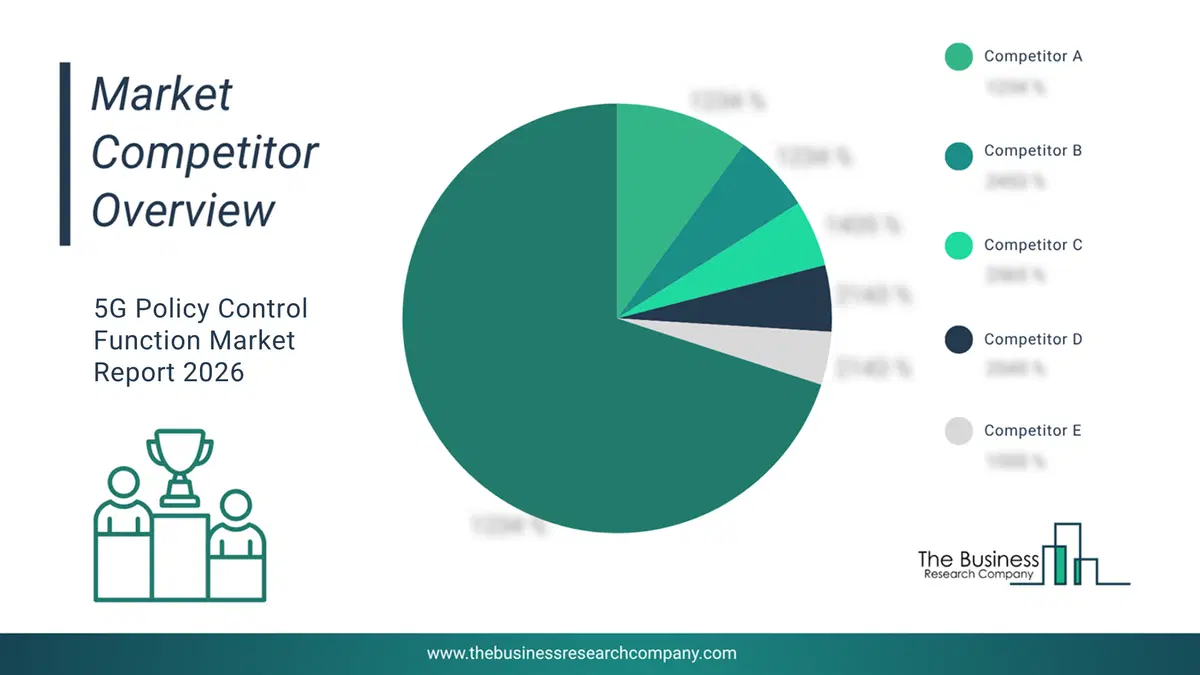
This chart is for illustrative purposes; the full report includes a detailed competitor analysis and comprehensive overview of the top 10 companies in the market.
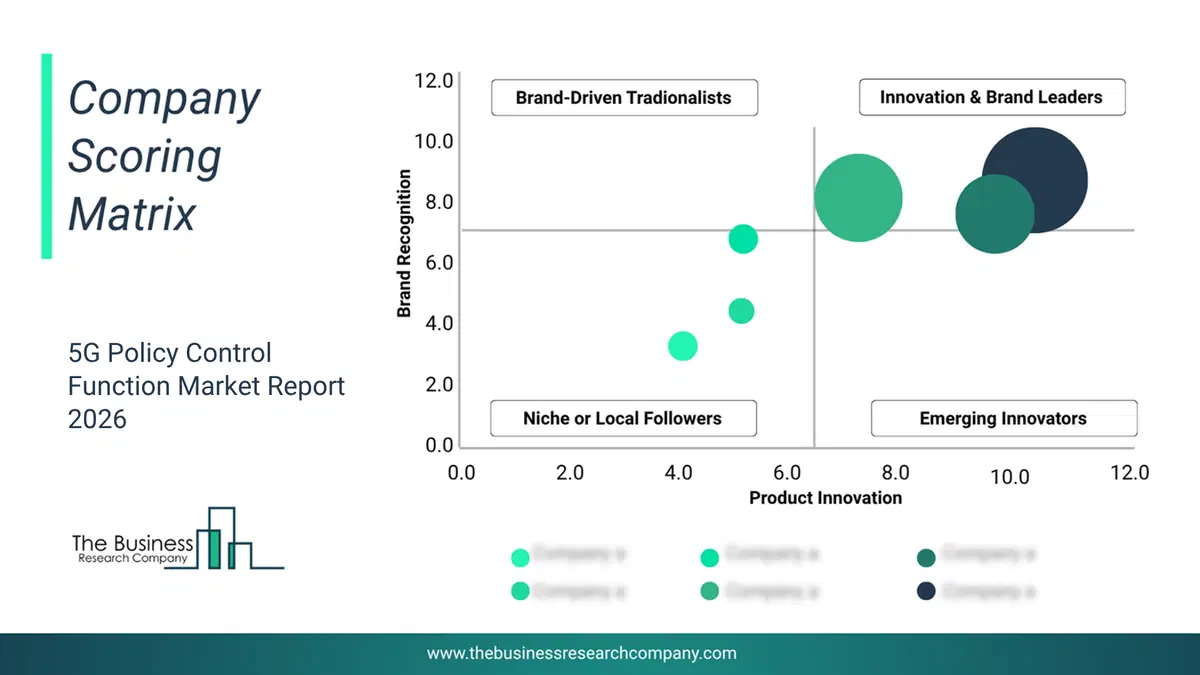
This chart maps companies by product innovation and brand strength, with bubble size indicating relative revenue, helping identify market leaders, challengers, and niche players. This is an illustrative chart; the full report provides a complete and accurate competitive analysis.
Global 5G Policy Control Function Market Trends and Insights
Major companies operating in the 5G policy control function market are focusing on developing advanced software solutions, such as dual-mode policy managers, to boost operational efficiency, enhance network slicing control, and streamline the convergence of 4G and 5G services. A dual-mode policy manager refers to a unified software component that provides policy control for both 4G evolved packet core (EPC) and 5G core (5GC) networks from a single platform. For instance, in March 2023, Enea AB, a Sweden-based telecommunications software company, launched the Enea Dual-Mode Policy Manager. This solution is designed for 5G core networks and data layers, providing a unified framework for policy and charging control. It enables Communication Service Providers (CSPs) to seamlessly manage subscribers across both 4G and 5G access, supports advanced network slicing, and automates policy decisions to optimize data layer interactions and service delivery.What Are Latest Mergers And Acquisitions In The 5G Policy Control Function Market?
In April 2024, Lumine Group Inc., a Canada-based software company, acquired Casa Systems Inc. for an undisclosed amount. Through this acquisition, Lumine Group Inc. aims to strengthen its portfolio of telecom and network solutions by integrating Casa Systems, Inc.’s advanced broadband access and cloud-native technologies to enhance service innovation and expand its global market presence. Casa Systems Inc., is a US-based telecommunications company that provides 5G policy control functions.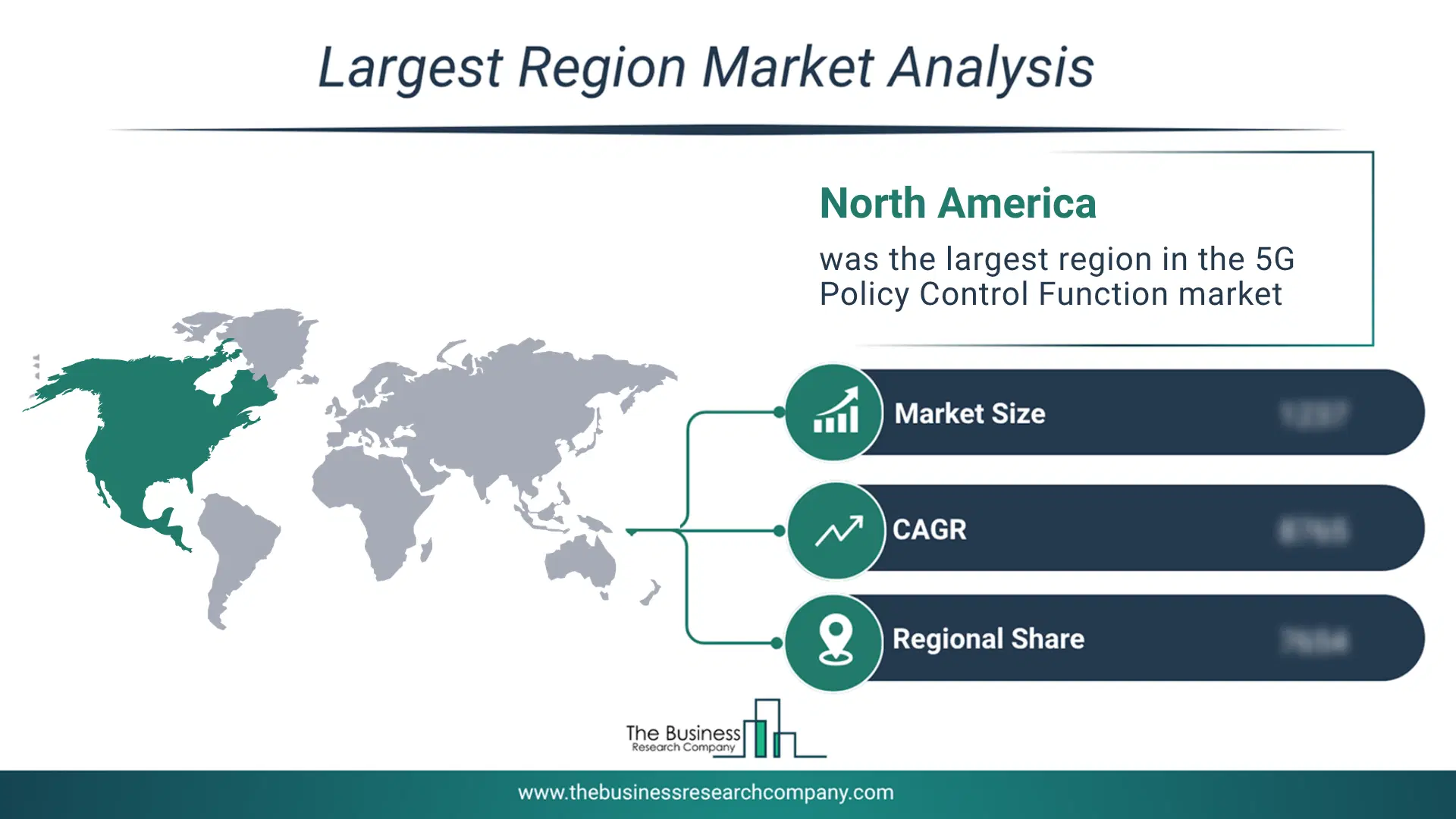
Regional Insights
North America was the largest region in the 5G policy control function market in 2025. The regions covered in this market report are Asia-Pacific, South East Asia, Western Europe, Eastern Europe, North America, South America, Middle East, Africa. The countries covered in this market report are Australia, Brazil, China, France, Germany, India, Indonesia, Japan, Taiwan, Russia, South Korea, UK, USA, Canada, Italy, Spain.What Defines the 5G Policy Control Function Market?
The 5G policy control function market includes revenues earned by entities through policy management, compliance policy services, subscriber data management, policy optimization, and routing services. The market value includes the value of related goods sold by the service provider or included within the service offering. Only goods and services traded between entities or sold to end consumers are included.How is Market Value Defined and Measured?
The market value is defined as the revenues that enterprises gain from the sale of goods and/or services within the specified market and geography through sales, grants, or donations in terms of the currency (in USD unless otherwise specified). The revenues for a specified geography are consumption values that are revenues generated by organizations in the specified geography within the market, irrespective of where they are produced. It does not include revenues from resales along the supply chain, either further along the supply chain or as part of other products.
This chart presents market attractiveness based on a quantitative evaluation of growth, competition, strategic alignment, and risk, offering a clear view of opportunity areas for decision-making. This chart is for illustrative purposes; the full report contains the complete analysis.

This chart highlights the Total Addressable Market (TAM) by estimating the maximum revenue opportunity using an assumption-driven approach, supporting strategic planning and opportunity sizing across markets. The chart is illustrative; the full report provides a more comprehensive analysis.
What Key Data and Analysis Are Included in the 5G Policy Control Function Market Report 2026?
The 5g policy control function market research report is one of a series of new reports from The Business Research Company that provides market statistics, including industry global market size, regional shares, competitors with the market share, detailed market segments, market trends and opportunities, and any further data you may need to thrive in the 5g policy control function industry. The market research report delivers a complete perspective of everything you need, with an in-depth analysis of the current and future state of the industry.5G Policy Control Function Market Report Forecast Analysis
| Report Attribute | Details |
|---|---|
| Market Size Value In 2026 | $2.47 billion |
| Revenue Forecast In 2030 | $5.89 billion |
| Growth Rate | CAGR of 24.3% from 2026 to 2030 |
| Base Year For Estimation | 2025 |
| Actual Estimates/Historical Data | 2020-2025 |
| Forecast Period | 2026 - 2030 |
| Market Representation | Revenue in USD Billion and CAGR from 2026 to 2030 |
| Segments Covered | Component, Network Type, Deployment Mode, Application, End Users |
| Regional Scope | Asia-Pacific, Western Europe, Eastern Europe, North America, South America, Middle East, Africa |
| Country Scope | The Countries Covered In This Market Report Are Australia, Brazil, China, France, Germany, India, Indonesia, Japan, Taiwan, Russia, South Korea, Uk, Usa, Canada, Italy, Spain. |
| Key Companies Profiled | Huawei Technologies Co. Ltd., Cisco Systems Inc., Oracle Corporation, Hewlett Packard Enterprise Company, Telefonaktiebolaget LM Ericsson, NEC Corporation, Nokia Oyj, ZTE Corporation, HCL Technologies Limited, Amdocs Ltd., Mavenir Systems Inc., Radisys Corporation, Comarch SA, Nexign Joint Stock Company, Enea AB, MATRIXX Software Inc., Optiva Inc., Alepo Technologies Inc., IPLOOK NETWORKS CO. LTD., Summa Networks B.V. |
| Customization Scope | Request for Customization |
| Pricing And Purchase Options | Explore Purchase Options |