
5G Sync Over IEEE 1914.3 Market Report 2026
Global Outlook – By Component (Hardware, Software, Services), By Deployment Mode (On-Premises, Cloud), By Application (Telecommunications, Data Centers, Enterprises, Industrial Automation, Other Applications), By End-User (Telecom Operators, Internet Service Providers, Enterprises, Other End-Users) – Market Size, Trends, Strategies, and Forecast to 2030
5G Sync Over IEEE 1914.3 Market Overview
• 5G Sync Over IEEE 1914.3 market size has reached to $1.21 billion in 2025 • Expected to grow to $3.28 billion in 2030 at a compound annual growth rate (CAGR) of 22% • Growth Driver: Rising Demand For Reliable 5G Services Driving Growth Of The Market Due To Increasing Need For Low-Latency, High-Performance Connectivity • North America was the largest region in 2025 and Asia-Pacific is the fastest growing region.What Is Covered Under 5G Sync Over IEEE 1914.3 Market?
5G Sync over IEEE 1914.3 refers to delivering precise timing and phase synchronization for 5G networks over a packet-based fronthaul using the IEEE 1914.3 standard. It enables accurate coordination between baseband units and remote radio units to support 5G features such as massive MIMO and low-latency communications. The main component types of 5G sync over IEEE 1914.3 are hardware, software, and services. Hardware encompasses the physical network equipment such as servers, switches, and timing devices. These are deployed through on-premises and cloud. Its applications span sectors such as telecommunications, data centers, enterprises, industrial automation, and others, serving end-users including telecom operators, internet service providers, enterprises, and others.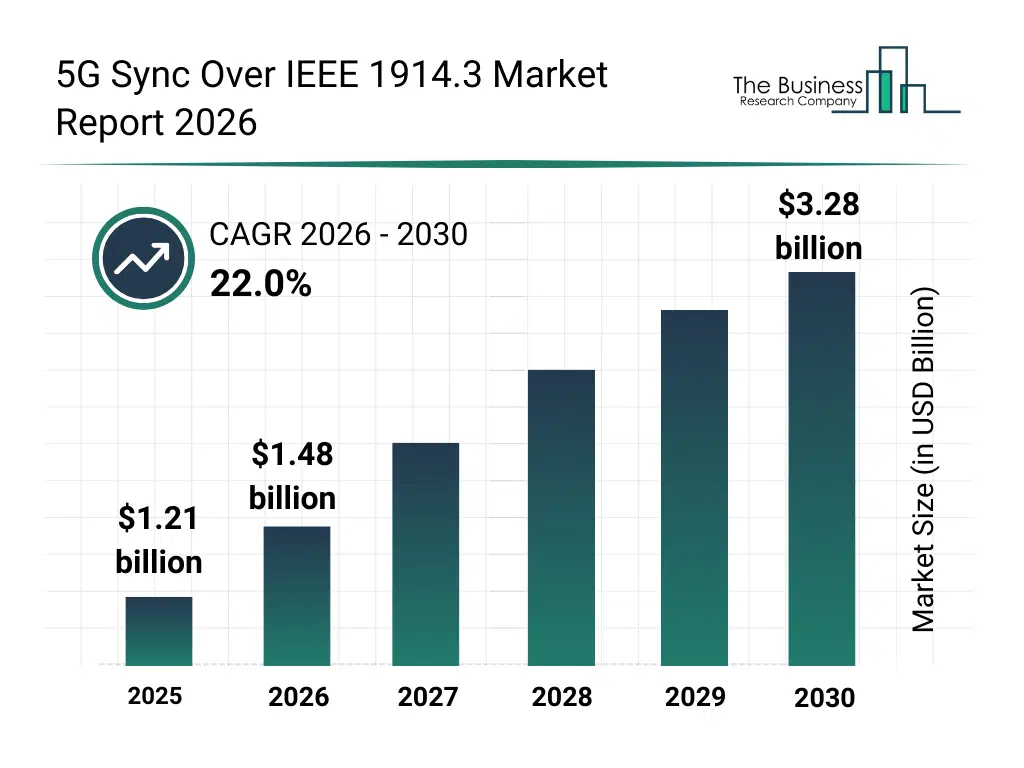
What Is The 5G Sync Over IEEE 1914.3 Market Size and Share 2026?
The 5G sync over ieee 1914.3 market size has grown exponentially in recent years. It will grow from $1.21 billion in 2025 to $1.48 billion in 2026 at a compound annual growth rate (CAGR) of 22.3%. The growth in the historic period can be attributed to growing deployment of 5G networks, need for accurate timing in telecom networks, adoption of ptp for synchronization, increasing demand for low-latency communication, expansion of data centers and cloud infrastructure.What Is The 5G Sync Over IEEE 1914.3 Market Growth Forecast?
The 5G sync over ieee 1914.3 market size is expected to see exponential growth in the next few years. It will grow to $3.28 billion in 2030 at a compound annual growth rate (CAGR) of 22.0%. The growth in the forecast period can be attributed to rising adoption of massive mimo, growth in industrial automation applications, integration with edge computing, demand for enhanced network reliability, expansion of cloud-based sync services. Major trends in the forecast period include low-latency network synchronization, AI-driven sync management, cloud-based time synchronization, edge computing integration, precision timing for industrial automation.
Global 5G Sync Over IEEE 1914.3 Market Segmentation
1) By Component: Hardware, Software, Services 2) By Deployment Mode: On-Premises, Cloud 3) By Application: Telecommunications, Data Centers, Enterprises, Industrial Automation, Other Applications 4) By End-User: Telecom Operators, Internet Service Providers, Enterprises, Other End-Users Subsegments: 1) By Hardware: Network Time Servers, Boundary Clocks, Grandmaster Clocks 2) By Software: PTP (Precision Time Protocol) Software, Sync Management Software, Monitoring And Analytics Software 3) By Services: Installation And Integration Services, Maintenance And Support Services, Consulting And Training ServicesWhat Are The Drivers Of The 5G Sync Over IEEE 1914.3 Market?
The growing demand for reliable 5G services is expected to propel the growth of the 5G sync over the IEEE 1914.3 market going forward. Reliable 5G services are defined as 5G networks that deliver consistent, low-latency, and highly available connectivity for critical and high-demand applications. The surge in reliable 5G services is driven by the increasing need for mission-critical applications that depend on uninterrupted, low-latency connections. 5G sync over IEEE 1914.3 supports reliable 5G services by enabling precise time and frequency synchronization throughout the network, ensuring stable, low-latency connectivity and consistent performance for essential applications. For instance, in December 2024, the Office of Communications (Ofcom), a UK-based government agency, reported that coverage expansion has been propelled by additional 5G deployments, with over 23,100 5G sites now operational across roughly 81,000 locations in the UK, up from approximately 18,500 in 2023, representing a growth of around 24%. Therefore, growing demand for reliable 5G services is driving the growth of the 5G sync over the IEEE 1914.3 market. The growing adoption of internet of things (IoT) is expected to propel the growth of the 5G sync over IEEE 1914.3 market going forward. The internet of things (IoT) refers to the system of interconnected devices that communicate and share data with each other through the internet, enabling automation, monitoring, and smart decision-making. The internet of things (IoT) is increasing due to the rise of data-driven decision-making because organizations are leveraging IoT devices to collect real-time data, enabling better operational efficiency, predictive maintenance, and informed business strategies. 5G Sync over IEEE 1914.3 helps the Internet of Things (IoT) by providing precise time and frequency synchronization across 5G networks, ensuring IoT devices have coordinated, low-latency communication. For instance, in September 2024, according to the IoT Analytics GmbH, a Germany-based non-governmental organization, by the end of 2023 there were 16.6 billion connected IoT devices, reflecting a 15% increase from 2022, with IoT Analytics projecting a further 13% growth to 18.8 billion by the end of 2024. Additionally, the number of connected IoT devices is projected to reach 40 billion by 2030, a significant increase from the last market update in 2023. Therefore, the growing adoption of the internet of things (IoT) is driving the growth of the 5G sync over IEEE 1914.3 industry. The increasing adoption of cloud-based solutions is expected to propel the growth of the 5G Sync Over IEEE 1914.3 market going forward. Cloud-based solutions are software or services delivered over the internet, allowing users to access computing resources without managing physical infrastructure. Cloud-based solutions are increasing due to the growing need for scalable IT resources that can adapt quickly to changing business demands. 5G Sync over IEEE 1914.3 supports cloud-based solutions by delivering precise timing and low-latency data transport essential for reliable cloud connectivity. For instance, in July 2025, according to the London Stock Exchange (LSEG), a UK-based publicly traded company, the LSEG global cloud survey reported that 87% of firms have boosted cloud spending in the past two years, 82% now use hybrid or multi-cloud setups, and 91% are accelerating AI adoption through cloud platforms. Therefore, the increasing adoption of cloud-based solutions is driving the growth of the 5G Sync Over IEEE 1914.3 industry.Key Players In The Global 5G Sync Over IEEE 1914.3 Market
Major companies operating in the 5G sync over ieee 1914.3 market are Cisco Systems Inc., Fujitsu Limited, Telefonaktiebolaget LM Ericsson, NEC Corporation, Nokia Corporation, Renesas Electronics Corporation, Microchip Technology, Juniper Networks Inc., Ciena Corporation, Xilinx Inc., Radisys Corporation, Ribbon Communications Inc., Anritsu Corporation, Spirent Communications plc, Tejas Networks Limited, IP Infusion Inc., Viavi Solutions Inc., Oscilloquartz SA, Calnex Solutions plc, Fibrolan Ltd., Comcores ApS
This chart is for illustrative purposes; the full report includes a detailed competitor analysis and comprehensive overview of the top 10 companies in the market.
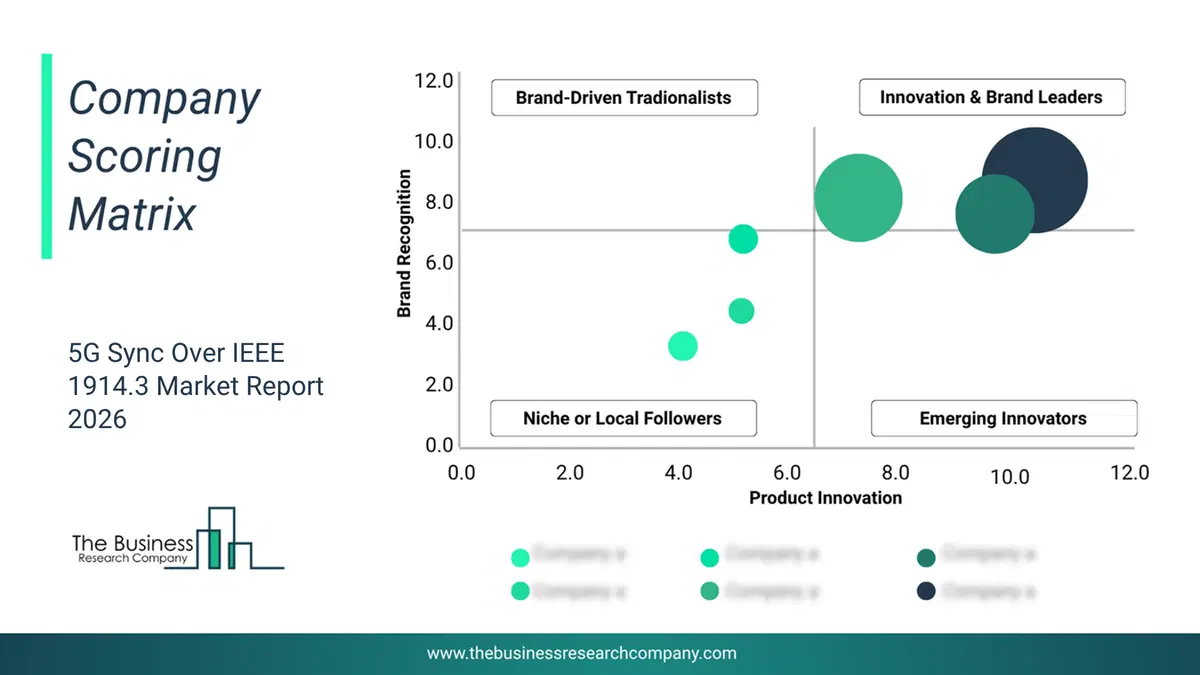
This chart maps companies by product innovation and brand strength, with bubble size indicating relative revenue, helping identify market leaders, challengers, and niche players. This is an illustrative chart; the full report provides a complete and accurate competitive analysis.
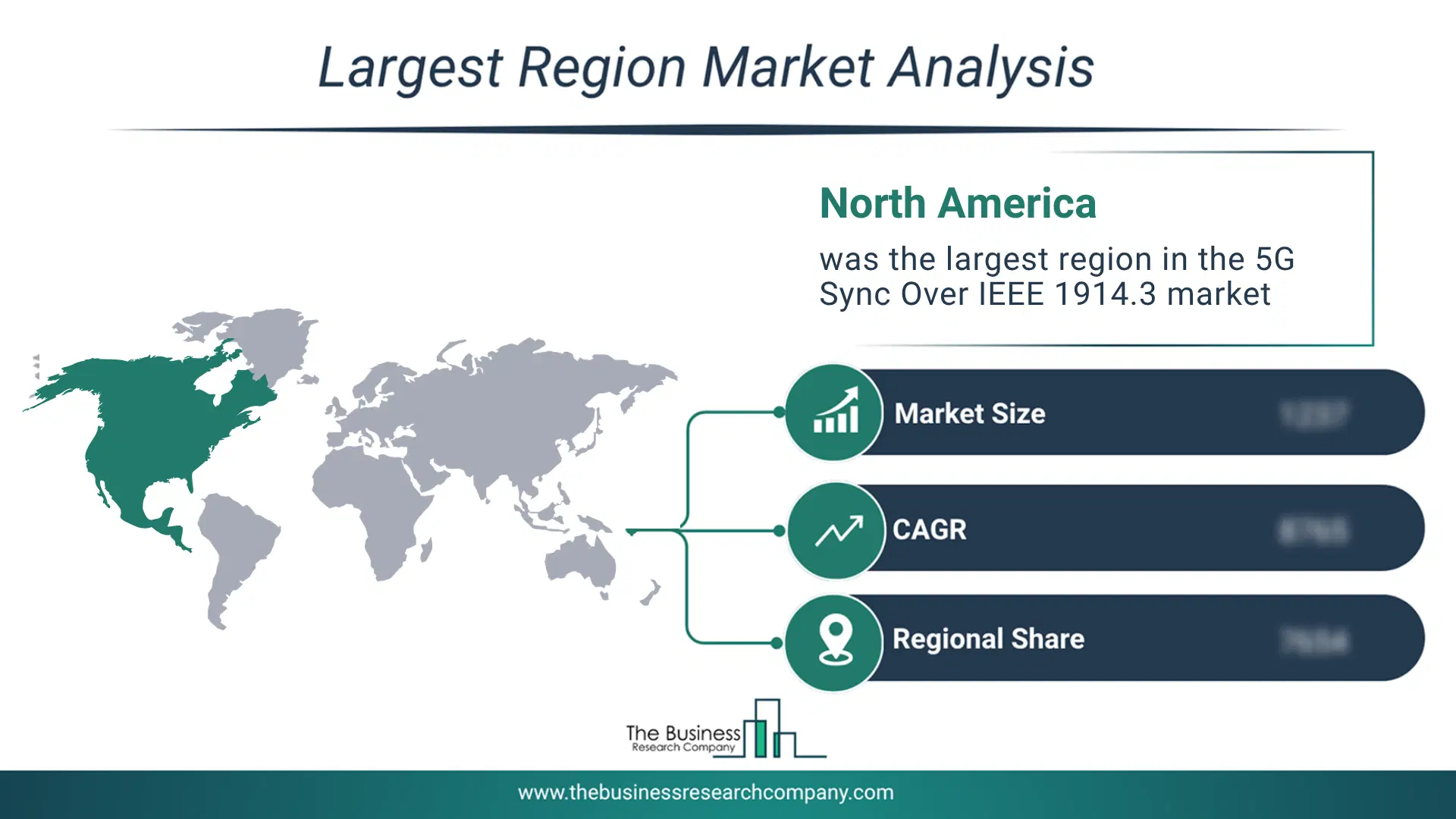
Regional Insights
North America was the largest region in the 5G sync over IEEE 1914.4 market in 2025. Asia-Pacific is expected to be the fastest-growing region in the forecast period. The regions covered in this market report are Asia-Pacific, South East Asia, Western Europe, Eastern Europe, North America, South America, Middle East, Africa. The countries covered in this market report are Australia, Brazil, China, France, Germany, India, Indonesia, Japan, Taiwan, Russia, South Korea, UK, USA, Canada, Italy, Spain.What Defines the 5G Sync Over IEEE 1914.3 Market?
The 5G sync over IEEE 1914.3 market consists of revenues earned by entities by providing services such as time-sensitive data transport solutions, network synchronization management, multi-vendor interoperability support, and real-time traffic coordination for telecom infrastructure. The market value includes the value of related goods sold by the service provider or included within the service offering. The 5G Sync over IEEE 1914.3 market also includes sales of precision timing modules, synchronization-enabled Ethernet switches, packet-based timing devices, and time-sensitive networking routers. Values in this market are ‘factory gate’ values, that is, the value of goods sold by the manufacturers or creators of the goods, whether to other entities (including downstream manufacturers, wholesalers, distributors, and retailers) or directly to end customers. The value of goods in this market includes related services sold by the creators of the goods.How is Market Value Defined and Measured?
The market value is defined as the revenues that enterprises gain from the sale of goods and/or services within the specified market and geography through sales, grants, or donations in terms of the currency (in USD unless otherwise specified). The revenues for a specified geography are consumption values that are revenues generated by organizations in the specified geography within the market, irrespective of where they are produced. It does not include revenues from resales along the supply chain, either further along the supply chain or as part of other products.
This chart presents market attractiveness based on a quantitative evaluation of growth, competition, strategic alignment, and risk, offering a clear view of opportunity areas for decision-making. This chart is for illustrative purposes; the full report contains the complete analysis.

This chart highlights the Total Addressable Market (TAM) by estimating the maximum revenue opportunity using an assumption-driven approach, supporting strategic planning and opportunity sizing across markets. The chart is illustrative; the full report provides a more comprehensive analysis.
What Key Data and Analysis Are Included in the 5G Sync Over IEEE 1914.3 Market Report 2026?
The 5g sync over ieee 1914.3 market research report is one of a series of new reports from The Business Research Company that provides market statistics, including industry global market size, regional shares, competitors with the market share, detailed market segments, market trends and opportunities, and any further data you may need to thrive in the 5g sync over ieee 1914.3 industry. The market research report delivers a complete perspective of everything you need, with an in-depth analysis of the current and future state of the industry.5G Sync Over IEEE 1914.3 Market Report Forecast Analysis
| Report Attribute | Details |
|---|---|
| Market Size Value In 2026 | $1.48 billion |
| Revenue Forecast In 2030 | $3.28 billion |
| Growth Rate | CAGR of 22% from 2026 to 2030 |
| Base Year For Estimation | 2025 |
| Actual Estimates/Historical Data | 2020-2025 |
| Forecast Period | 2026 - 2030 |
| Market Representation | Revenue in USD Billion and CAGR from 2026 to 2030 |
| Segments Covered | Component, Deployment Mode, Application, End-User |
| Regional Scope | Asia-Pacific, Western Europe, Eastern Europe, North America, South America, Middle East, Africa |
| Country Scope | The Countries Covered In This Market Report Are Australia, Brazil, China, France, Germany, India, Indonesia, Japan, Taiwan, Russia, South Korea, Uk, Usa, Canada, Italy, Spain. |
| Key Companies Profiled | Cisco Systems Inc., Fujitsu Limited, Telefonaktiebolaget LM Ericsson, NEC Corporation, Nokia Corporation, Renesas Electronics Corporation, Microchip Technology, Juniper Networks Inc., Ciena Corporation, Xilinx Inc., Radisys Corporation, Ribbon Communications Inc., Anritsu Corporation, Spirent Communications plc, Tejas Networks Limited, IP Infusion Inc., Viavi Solutions Inc., Oscilloquartz SA, Calnex Solutions plc, Fibrolan Ltd., Comcores ApS |
| Customization Scope | Request for Customization |
| Pricing And Purchase Options | Explore Purchase Options |