
Air Quality Monitoring System Market Report 2026
Global Outlook – By Product Type (Indoor, Outdoor ), By Component (Hardware, Software), By Pollutant (Chemical, Physical ), By End User (Industrial, Commercial, Residential) – Market Size, Trends, Strategies, and Forecast to 2030
Air Quality Monitoring System Market Overview
• Air Quality Monitoring System market size has reached to $6.98 billion in 2025 • Expected to grow to $11.25 billion in 2030 at a compound annual growth rate (CAGR) of 10.1% • Growth Driver: Increasing Levels Of Air Pollution Propel Growth Of Air Quality Monitoring System Market • Market Trend: Technological Advancements In Multi-Sensor Modules Strengthen Accuracy And Efficiency In Air Quality Monitoring Systems • North America was the largest region in 2025.What Is Covered Under Air Quality Monitoring System Market?
Air quality monitoring systems are devices that assess the pollution levels of a particular area in accordance to ambient air quality standards. The air quality monitoring system are used to measure the levels of air pollutants. Air quality monitoring systems are used in outdoor ambient applications. The main types of products in air quality monitoring systems are indoor and outdoor. Indoor air quality monitoring systems describe the relationship between the risks and IAF exposure. These systems are used for the development of real-time monitoring systems and system designing and challenges. The different components include hardware and software. The various types of pollutants present in the market are chemical, physical and is used by several verticals such as industrial, commercial, residential.
What Is The Air Quality Monitoring System Market Size and Share 2026?
The air quality monitoring system market size has grown strongly in recent years. It will grow from $6.98 billion in 2025 to $7.66 billion in 2026 at a compound annual growth rate (CAGR) of 9.8%. The growth in the historic period can be attributed to increasing industrial emission monitoring needs, expansion of urban environmental monitoring programs, rising government focus on pollution control, wider deployment of fixed monitoring stations, improvements in sensor accuracy and reliability.What Is The Air Quality Monitoring System Market Growth Forecast?
The air quality monitoring system market size is expected to see rapid growth in the next few years. It will grow to $11.25 billion in 2030 at a compound annual growth rate (CAGR) of 10.1%. The growth in the forecast period can be attributed to increasing investments in smart city infrastructure, rising adoption of iot-enabled environmental monitoring, expansion of real-time air quality data platforms, growing demand for predictive pollution analytics, increasing integration with regulatory reporting systems. Major trends in the forecast period include increasing deployment of networked air quality sensor systems, rising use of real-time pollution monitoring platforms, growing adoption of cloud-based air quality analytics, expansion of mobile and remote sensing monitoring solutions, enhanced focus on regulatory compliance and data accuracy.Tariff Impact On Air Quality Monitoring System Market
Tariffs are influencing the air quality monitoring system market by increasing costs of imported sensors, semiconductors, communication modules, and precision calibration components used in indoor and outdoor monitoring devices. Industrial and government-led monitoring projects in North America and Europe are most affected due to reliance on advanced imported electronics, while Asia-Pacific faces cost pressure on large-scale deployment programs. These tariffs are increasing system installation costs and extending procurement cycles. At the same time, they are supporting domestic sensor manufacturing, localized system integration, and regional software development for air quality monitoring solutions.
Global Air Quality Monitoring System Market Segmentation
1) By Product Type: Indoor, Outdoor 2) By Component: Hardware, Software 3) By Pollutant: Chemical, Physical 4) By End User: Industrial, Commercial, Residential Subsegments: 1) By Indoor: Fixed Indoor Air Quality Monitors, Portable Indoor Air Quality Monitors, Smart Indoor Air Quality Monitors, Integrated HVAC Air Quality Monitors 2) By Outdoor: Fixed Outdoor Air Quality Monitors, Mobile Outdoor Air Quality Monitors, Remote Sensing Outdoor Air Quality Monitors, Air Quality Monitoring StationsWhat Are The Drivers Of The Air Quality Monitoring System Market?
The increase in levels of air pollution is expected to propel the growth of the air quality monitoring system market in the coming years. Air pollution is defined as the introduction of pollutants into the atmosphere, which can be in the form of carbon dioxide, methane gases, or other gases containing chemicals. The rise in air pollution drives the growth of air quality monitoring systems, as this system measures the pollutant levels. For instance, in November 2024, according to the Global Carbon Budget, a Japan-based annual scientific assessment, fossil carbon dioxide emissions climbed to 37.4 billion tonnes, an increase of 0.8% over the previous year. Therefore, the increasing levels of air pollution drive the growth of the air quality monitoring system industry. The growing number of smart homes is expected to boost the growth of the air quality monitoring system market going forward. A smart home refers to a convenient home setup where appliances and devices can be automatically controlled remotely from anywhere with an internet connection using a mobile or other networked device. Smart homes are equipped with various sensors and devices that can be controlled remotely, and air quality monitoring systems can be integrated into these systems to provide real-time information about the air quality inside the home. For instance, in 2023, according to an article published in Oberlo, a dropshipping app, over 60.4 million households in the US will be actively using smart home devices. This is 3% more than in 2022, when 57.4 million households were using smart home devices. In 2023, the number of households using smart home devices will represent 46.5% of the total number of households. Therefore, the growing number of smart homes is driving the growth of the air quality monitoring system industry.Key Players In The Global Air Quality Monitoring System Market
Major companies operating in the air quality monitoring system market are Thermo Fisher Scientific Inc., Emerson Electric Co., General Electric Company, Siemens Aktiengesellschaft, Teledyne Technologies Incorporated, PerkinElmer Inc., Agilent Technologies Inc., TE Connectivity Ltd., 3M Company, Honeywell International Inc., Horiba Ltd., Merck KGaA, TSI Incorporated, Tisch Environmental Inc., Testo SE & Co. KGaA, Plume Labs SAS, Aeroqual Limited, Forbes Marshall Private Limited, Hawa Dawa GmbH, Kaiterra Inc., AirVisual Limited, IQAir North America Inc., BreezoMeter Ltd., AirNow Technologies Inc., PurpleAir LLC., Sensirion AG, Alphasense Limited, GDS Technologies Ltd., Ecotech Pty Ltd.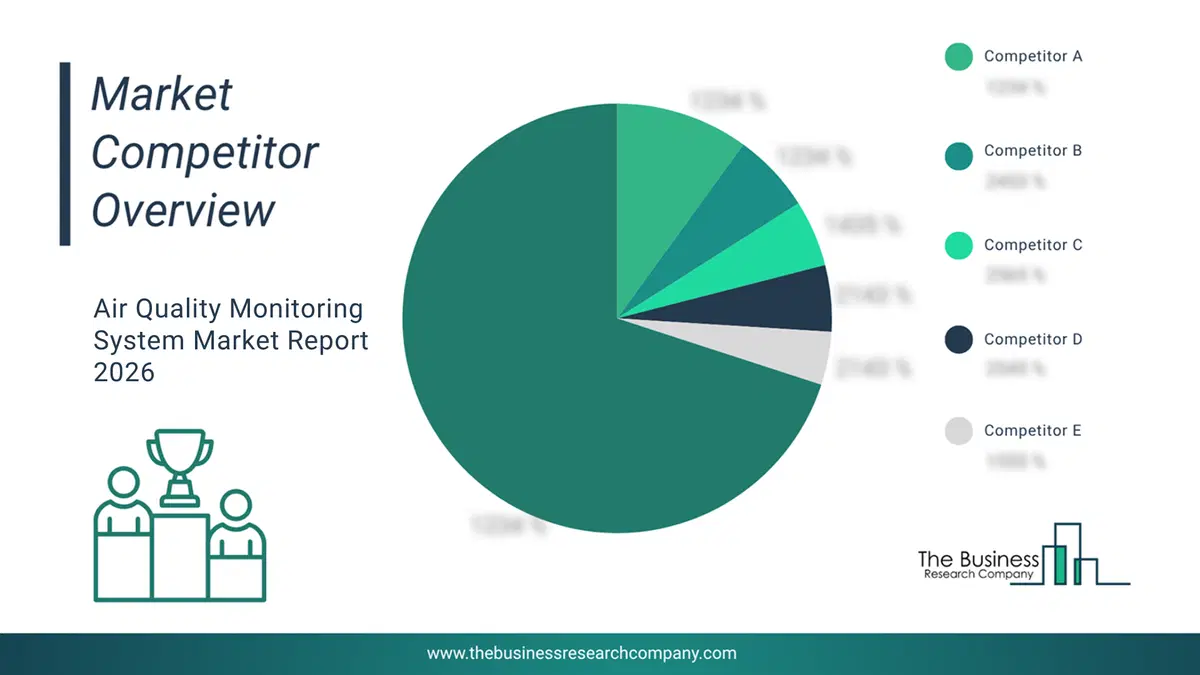
This chart is for illustrative purposes; the full report includes a detailed competitor analysis and comprehensive overview of the top 10 companies in the market.
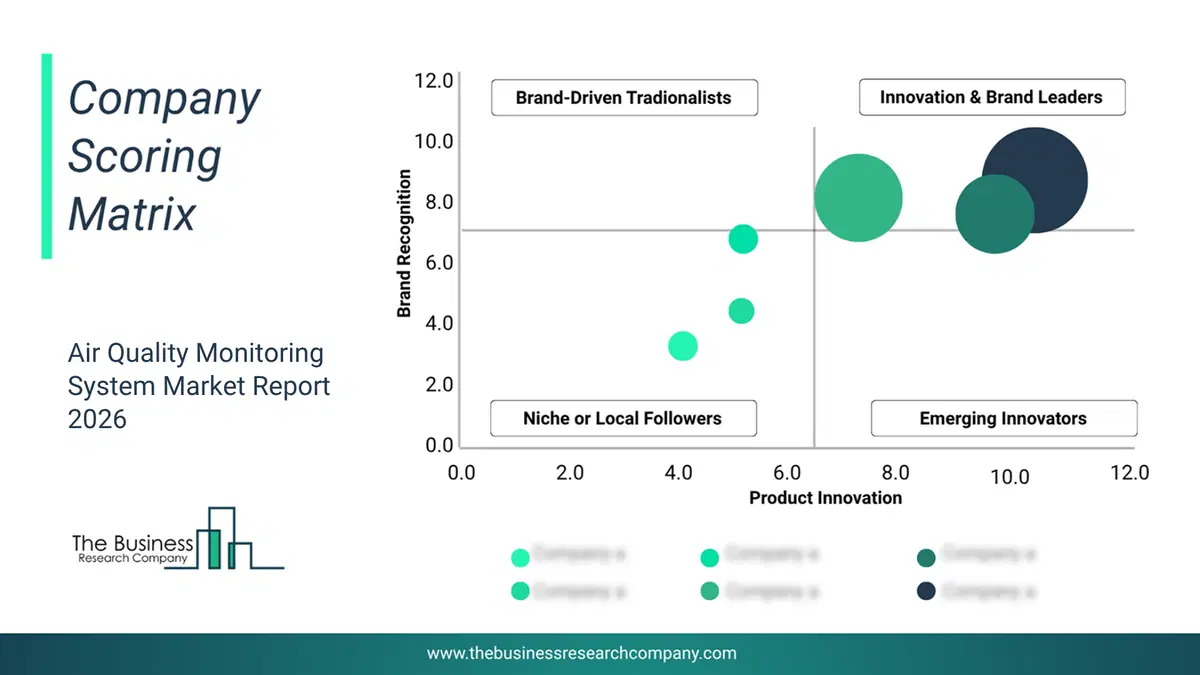
This chart maps companies by product innovation and brand strength, with bubble size indicating relative revenue, helping identify market leaders, challengers, and niche players. This is an illustrative chart; the full report provides a complete and accurate competitive analysis.
Global Air Quality Monitoring System Market Trends and Insights
Major companies operating in the air quality monitoring system market are focusing on developing advanced technological solutions to enhance detection accuracy, support compliance with global standards, and meet the rising demand for intelligent monitoring capabilities. Multi-sensor integration refers to the incorporation of multiple air quality parameters such as particulate matter, volatile organic compounds (VOCs), and various harmful gases into a single compact module to deliver comprehensive and precise environmental measurements. For instance, in August 2024, Renesas Electronics Corporation, a Japan-based semiconductor solutions company, launched the RRH62000, a multi-sensor air quality module engineered to provide accurate, real-time monitoring across multiple applications. Equipped with a Renesas microcontroller (MCU), the module intelligently manages sensor operations and supports use in air purifiers, smoke detectors, HVAC systems, weather stations, and smart home devices. Its robust firmware further ensures that customer products comply with global air quality standards, helping manufacturers deliver more reliable and efficient air quality monitoring solutions.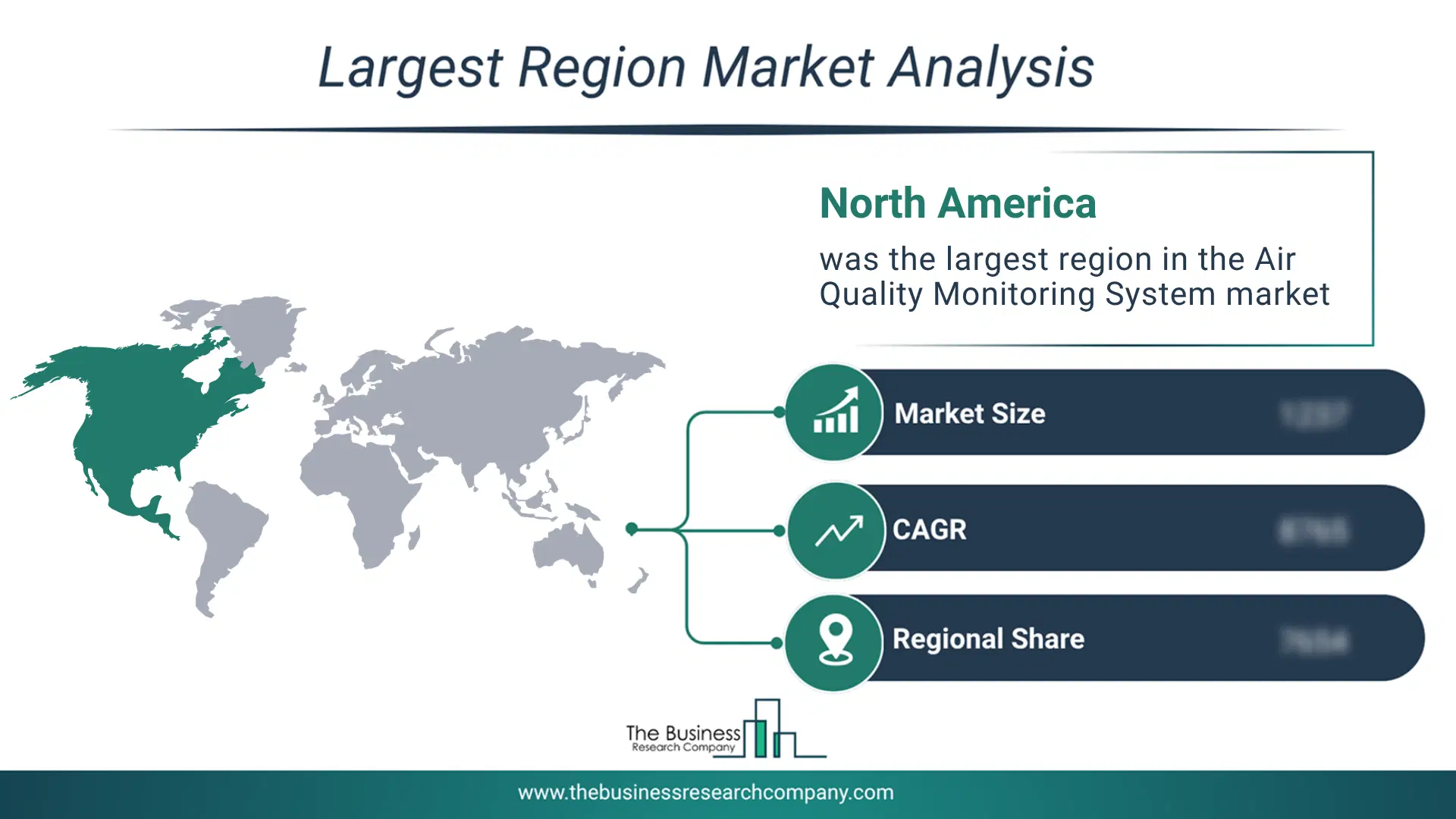
Regional Outlook
North America was the largest region in the air quality monitoring system market in 2025. The regions covered in this market report are Asia-Pacific, South East Asia, Western Europe, Eastern Europe, North America, South America, Middle East, Africa The countries covered in this market report are Australia, Brazil, China, France, Germany, India, Indonesia, Japan, Taiwan, Russia, South Korea, UK, USA, Canada, Italy, Spain.What Defines the Air Quality Monitoring System Market?
The air quality monitoring system market consists of sales of air quality monitoring system, emissions and ambient monitoring. Values in this market are ‘factory gate’ values, that is the value of goods sold by the manufacturers or creators of the goods, whether to other entities (including downstream manufacturers, wholesalers, distributors, and retailers) or directly to end customers. The value of goods in this market includes related services sold by the creators of the goods.How is Market Value Defined and Measured?
The market value is defined as the revenues that enterprises gain from the sale of goods and/or services within the specified market and geography through sales, grants, or donations in terms of the currency (in USD unless otherwise specified). The revenues for a specified geography are consumption values that are revenues generated by organizations in the specified geography within the market, irrespective of where they are produced. It does not include revenues from resales along the supply chain, either further along the supply chain or as part of other products.
This chart presents market attractiveness based on a quantitative evaluation of growth, competition, strategic alignment, and risk, offering a clear view of opportunity areas for decision-making. This chart is for illustrative purposes; the full report contains the complete analysis.

This chart highlights the Total Addressable Market (TAM) by estimating the maximum revenue opportunity using an assumption-driven approach, supporting strategic planning and opportunity sizing across markets. The chart is illustrative; the full report provides a more comprehensive analysis.
What Key Data and Analysis Are Included in the Air Quality Monitoring System Market Report 2026?
The air quality monitoring system market research report is one of a series of new reports from The Business Research Company that provides market statistics, including industry global market size, regional shares, competitors with the market share, detailed market segments, market trends and opportunities, and any further data you may need to thrive in the air quality monitoring system industry. The market research report delivers a complete perspective of everything you need, with an in-depth analysis of the current and future state of the industry.Air Quality Monitoring System Market Report Forecast Analysis
| Report Attribute | Details |
|---|---|
| Market Size Value In 2026 | $7.66 billion |
| Revenue Forecast In 2030 | $11.25 billion |
| Growth Rate | CAGR of 10.1% from 2026 to 2030 |
| Base Year For Estimation | 2025 |
| Actual Estimates/Historical Data | 2020-2025 |
| Forecast Period | 2026 - 2030 |
| Market Representation | Revenue in USD Billion and CAGR from 2026 to 2030 |
| Segments Covered | Product Type, Component, Pollutant, End User |
| Regional Scope | Asia-Pacific, Western Europe, Eastern Europe, North America, South America, Middle East, Africa |
| Key Companies Profiled | Thermo Fisher Scientific Inc., Emerson Electric Co., General Electric Company, Siemens Aktiengesellschaft, Teledyne Technologies Incorporated, PerkinElmer Inc., Agilent Technologies Inc., TE Connectivity Ltd., 3M Company, Honeywell International Inc., Horiba Ltd., Merck KGaA, TSI Incorporated, Tisch Environmental Inc., Testo SE & Co. KGaA, Plume Labs SAS, Aeroqual Limited, Forbes Marshall Private Limited, Hawa Dawa GmbH, Kaiterra Inc., AirVisual Limited, IQAir North America Inc., BreezoMeter Ltd., AirNow Technologies Inc., PurpleAir LLC., Sensirion AG, Alphasense Limited, GDS Technologies Ltd., Ecotech Pty Ltd. |
| Customization Scope | Request for Customization |
| Pricing And Purchase Options | Explore Purchase Options |