Contact Us
  Search
The Business Research Company Logo
Online Travel Agent Market 2025
Published :May 2025
Pages :341
Format :PDF
Delivery Time :2-3 Business Days
Why 2-3 days? We update the report with the latest data and news before delivery. Let us know if you need us to expedite.
Report Price :$4,490.00

Online Travel Agent Market 2025

By Service Type (Vacation Packages, Transportation, Accommodation, Other Service Types), By Platform (Mobile/Tablet Based, Desktop/Laptop Based), By Mode Of Booking (Hotel Bookings, Tickets, Other Categories), And By Region, Opportunities And Strategies – Global Forecast To 2035

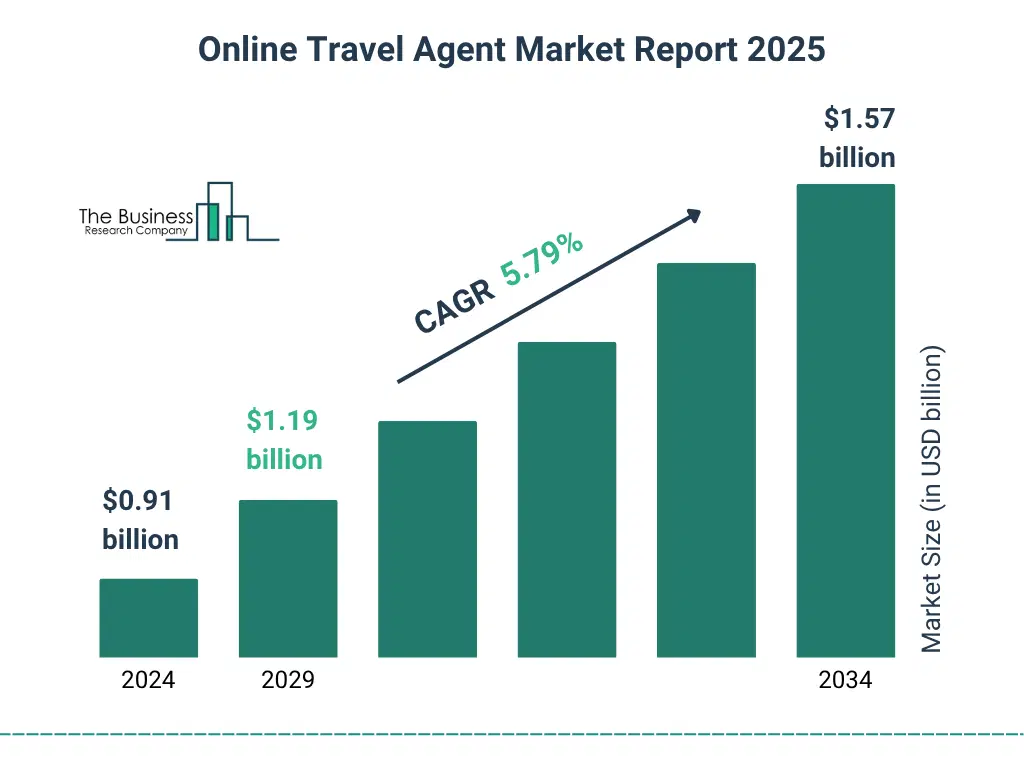
Online Travel Agent Market Size and growth rate 2025 to 2029: Graph

Online Travel Agent Market Definition

An online travel agent (OTA) is an individual or a company that provides a web-based marketplace, which allows consumers to research and book travel products and services, such as hotels, flights, cars, tours and cruises, among other travel-related services, directly with travel suppliers. The online travel agent market consists of sales, by entities (organizations, sole traders or partnerships), of travel services through online channels. Online travel agents or agencies are those individuals or companies that have websites that allow consumers to book various travel related services via the internet. Travel agents are engaged in the sales of travel services such as flights, buses, vacation packages, hotels and rental cars, via online networks.
Research Expert

Book your 30 minutes free consultation with our research experts

Online Travel Agent Market Size

The global online travel agent market reached a value of nearly $907.69 billion in 2024, having grown at a compound annual growth rate (CAGR) of 4.04% since 2019. The market is expected to grow from $907.69 billion in 2024 to $1,188.07 billion in 2029 at a rate of 5.53%. The market is then expected to grow at a CAGR of 5.79% from 2029 and reach $1,573.92 billion in 2034. Growth in the historic period resulted from increasing internet penetration and the rising number of smartphone users, surge in last minute booking, increase in solo travelers and expansion of tourism industry. Factors that negatively affected growth in the historic period were the high taxes on air travel and dependence on third-party suppliers. Going forward, rise in e-commerce, surge in wellness and medical tourism, expansion of the hospitality sector and favorable government initiatives support will drive growth. Factor that could hinder the growth of the online travel agent market in the future include limited availability of Impact of regulatory constraints and cybersecurity threats.

Online Travel Agent Market Drivers

The key drivers of the online travel agent market include: Expansion Of The Hospitality Sector The expansion of the hospitality sector is expected to propel the growth of the online travel agent market in the coming future. The hospitality sector is a broad industry that provides lodging, food and beverage, entertainment, and tourism services. It includes businesses such as hotels, resorts, restaurants, cafes, bars, event venues, travel agencies, and cruise lines, all aimed at enhancing customer experiences. The growth of the hospitality sector directly supports the online travel agent (OTA) market by driving demand for travel-related services such as hotel bookings, restaurant reservations, and vacation packages. As the hospitality sector expands with new hotels, resorts, and other accommodations, OTAs gain access to a broader range of properties to offer travelers, increasing the variety and appeal of their platforms. Additionally, with the rise in leisure and business travel, OTAs facilitate easy and convenient bookings for lodging, dining, and experiences. For instance, according to the American Hotel & Lodging Association (AHLA), a trade organization representing the U.S. lodging industry, U.S. hotel occupancy is projected to reach 63.38% in 2025, slightly up from 63.01% in 2024 and 60.2% in 2022. Therefore, the expansion of the hospitality sector propels the growth of the online travel agents market.

Online Travel Agent Market Restraints

The key restraints on the online travel agent market include: Impact of Regulatory Constraints Regulatory constraints are expected to pose a significant challenge to the online travel agent (OTA) market growth during the forecast period. Regulatory constraints pose significant challenges for online travel agents, requiring them to invest resources in compliance efforts, while navigating a complex and evolving regulatory landscape. For instance, in 2024, according to Trend Micro Incorporated, a Japan-based IT security company, the European Union will regulate compliance with the General Data Protection Regulation (GDPR). This necessitates substantial investments in data security measures and compliance procedures. These regulatory burdens not only increase operational costs but also limit the scope of expansion into new markets, thereby hindering market growth.

Need data on a specific region in this market?

Opportunities And Recommendations In The Online Travel Agent Market

Opportunities – The top opportunities in the online travel agent market segmented by service type will arise in the accommodation segment, which will gain $121.84 billion of global annual sales by 2029. The top opportunities in the online travel agent market segmented by platform will arise in the desktop/laptop-based segment, which will gain $172.81 billion of global annual sales by 2029. The top opportunities in the online travel agent market segmented by mode of delivery will arise in the hotel bookings segment, which will gain $138.65 billion of global annual sales by 2029. The online travel agent market size will gain the most in the USA at $70.48 billion. Recommendations- To take advantage of the opportunities, The Business Research Company recommends the online travel agent market companies to focus on building social-first platforms to enhance personalization and engagement, focus on proprietary online booking tools to streamline services and boost customer retention, focus on digital travel tools to enhance customer experience and expand market reach, focus on embracing technological innovation to enhance service delivery, focus on AI integration to enhance customer experience, expand in emerging markets, continue to focus on developed markets, focus on expanding distribution channels through strategic partnerships, focus on developing competitive pricing strategies, focus on targeted digital marketing channels, focus on influencer partnerships, focus on personalization to attract and retain digital travelers.
Chat with us