
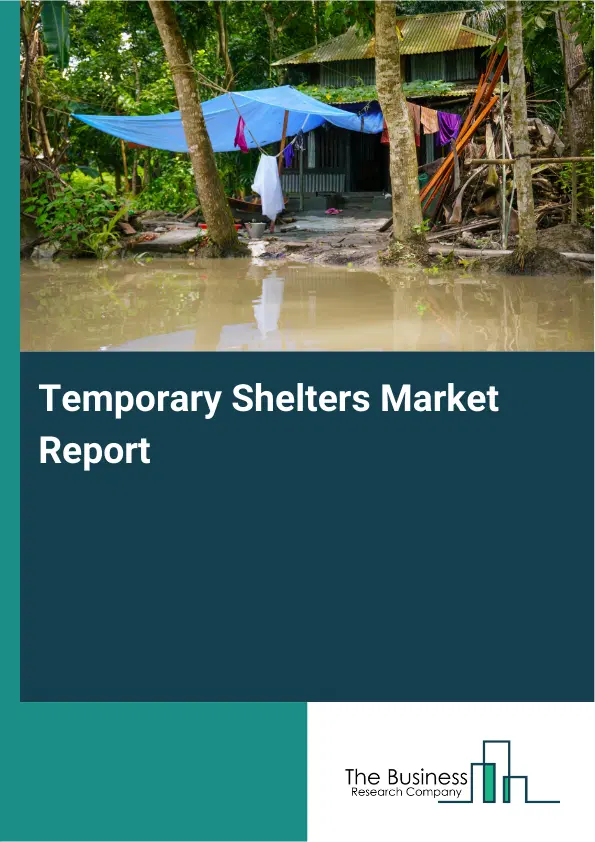
Temporary Shelters Market Report 2026
Global Outlook – By Type (Homeless Shelter, Emergency Shelter), By Deployment Duration (Short-Term Shelters, Medium-Term Shelters, Extended-Stay Shelters), By End-User Group (Homeless Individuals And Families, Disaster-Affected Populations, Refugees And Displaced Persons, Vulnerable Groups) – Market Size, Trends, Strategies, and Forecast to 2030
Temporary Shelters Market Overview
• Temporary Shelters market size has reached to $42.97 billion in 2025 • Expected to grow to $55.71 billion in 2030 at a compound annual growth rate (CAGR) of 5.4% • Growth Driver: Government Funds Drive Growth In Temporary Housing Market • Market Trend: Innovation In Rapid‑Deploy Temporary Shelter Solutions • Western Europe was the largest region in 2025 and Asia-Pacific is the fastest growing region.What Is Covered Under Temporary Shelters Market?
A temporary shelter is a temporary structure that protects a person experiencing homelessness. Temporary shelters help homeless to build their way back to a normal life. Many of these shelters are site and consumer-specific which creates a customized way of living. The main types of temporary shelters are homeless shelters and emergency shelters. Homeless shelters are a type of homeless service agency that provides homeless individuals and families with temporary housing. The different sizes include small, medium and large and are used in various applications such as personnel, vehicle mounted, medical facility base, aircraft base, command post, and others.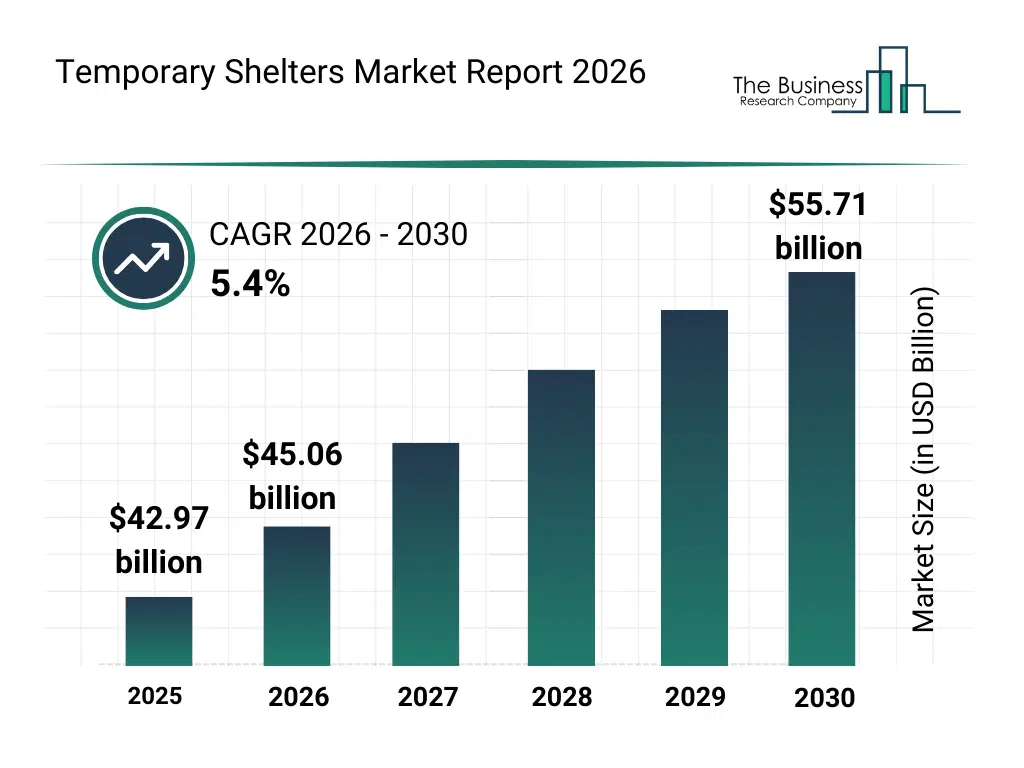
What Is The Temporary Shelters Market Size and Share 2026?
The temporary shelters market size has grown steadily in recent years. It will grow from $42.97 billion in 2025 to $45.06 billion in 2026 at a compound annual growth rate (CAGR) of 4.9%. The growth in the historic period can be attributed to increase in homelessness rates, rising frequency of natural disasters, expansion of refugee and displacement crises, growth of emergency response programs, development of humanitarian shelter standards.What Is The Temporary Shelters Market Growth Forecast?
The temporary shelters market size is expected to see strong growth in the next few years. It will grow to $55.71 billion in 2030 at a compound annual growth rate (CAGR) of 5.4%. The growth in the forecast period can be attributed to increasing investments in disaster preparedness infrastructure, rising focus on sustainable shelter materials, expansion of smart shelter monitoring solutions, growing demand for rapid response housing, increasing collaboration with humanitarian organizations. Major trends in the forecast period include increasing use of modular and rapid-deployment shelter designs, rising demand for climate-resilient temporary housing, growing adoption of prefabricated shelter solutions, expansion of customized shelter configurations, enhanced focus on occupant safety and comfort.
Global Temporary Shelters Market Segmentation
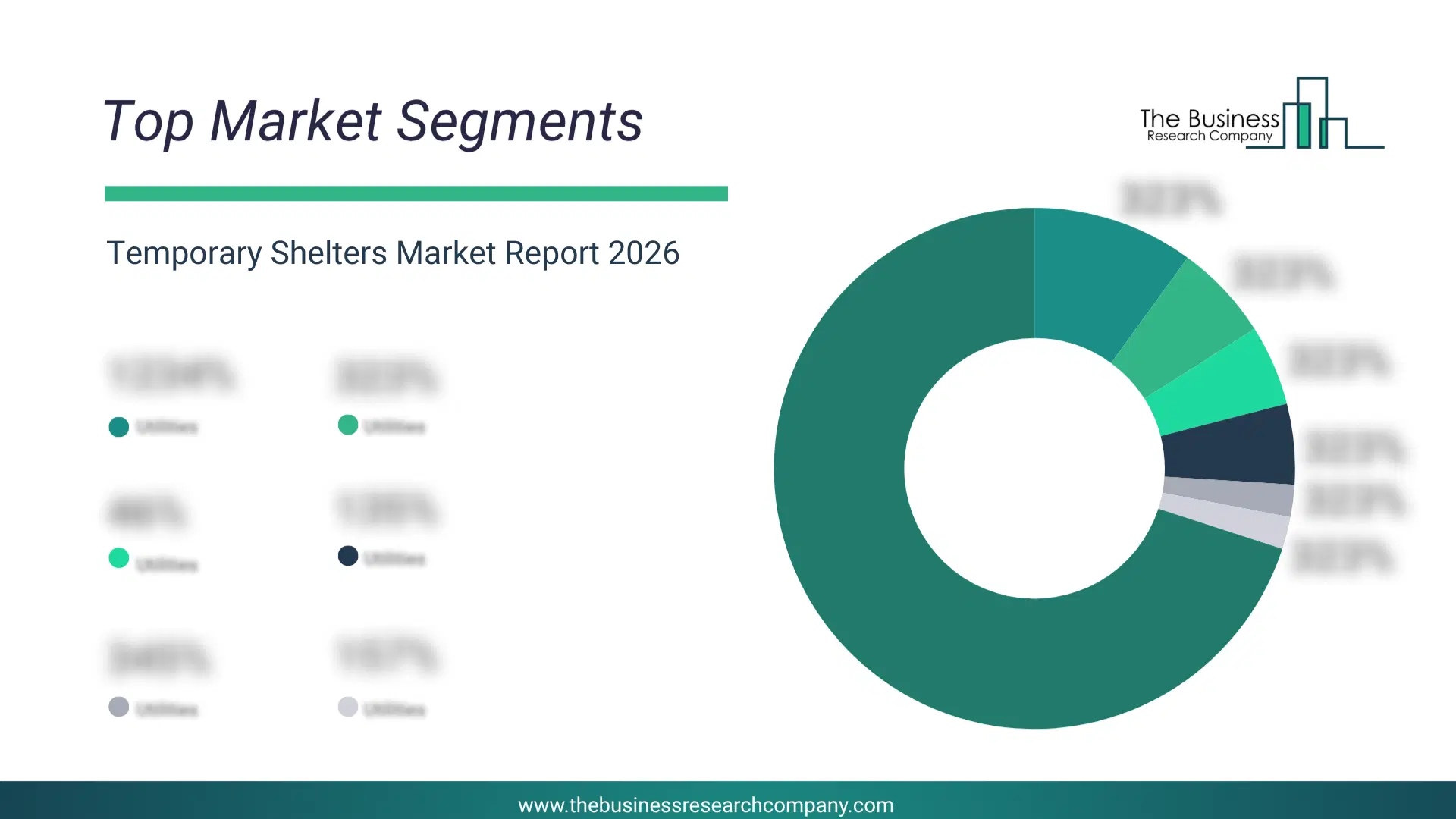
1) By Type: Homeless Shelter, Emergency Shelter 2) By Deployment Duration: Short-Term Shelters, Medium-Term Shelters, Extended-Stay Shelters 3) By End-User Group: Homeless Individuals And Families, Disaster-Affected Populations, Refugees And Displaced Persons, Vulnerable Groups Subsegments: 1) By Homeless Shelter: Outdoor Tents, Temporary Housing Units, Transitional Shelters 2) By Emergency Shelter: Disaster Relief Shelters, Refugee Shelters, Temporary Evacuation SheltersWhat Is The Driver Of The Temporary Shelters Market?
The increase in government funds for temporary housing contributed to the growth of the market. For instance, the federal government of Canada announced plans to give $15 million for temporary housing in Toronto. These funds will be utilized to solve capacity issues at local shelters and respite centers. For instance, In July 2023, according to Canada's Immigration office, a Canada-based government agency, $212 million in funding into the Interim Housing Assistance Program (IHAP), which will be extended until March 31, 2024.What Is The Driver Of The Temporary Shelters Market?
The increase in occurrences of natural disaster are expected to propel the growth of the temporary shelter market going forward. A natural disaster is a catastrophic event that occurs as a result of natural processes of the Earth, often with little to no human intervention. An increase in natural disasters underscores the importance of having well-organized and efficient systems for the establishment of temporary shelters. These shelters are critical for the safety, well-being, and recovery of disaster-affected populations, and they are an integral part of disaster response and recovery efforts. For instance, in January 2024, according to NOAA/NCEI, a U.S.-based government agency, the United States experienced 28 separate weather and climate disasters in 2023, each causing at least US $1 billion in damages.Therefore, the increase in occurrences of natural disasters drives the temporary shelter industry.Key Players In The Global Temporary Shelters Market
Major companies operating in the temporary shelters market are The American Red Cross, The Salvation Army, UNICEF, The Emergency Food and Shelter Program, ShelterBox Trust, National Alliance to End Homlessness, The National Coalition for the Homeless, Covenant House, The Bowery Mission, The Midnight Mission, The Rescue Mission, The Union Rescue Mission, The City Mission, The Samaritan Inn, The Mustard Seed, The Road Home, The House of Charity, The Open Door Mission, The Denver Rescue Mission, The Nashville Rescue Mission, The Atlanta Mission, The Seattle's Union Gospel Mission, The Portland Rescue Mission, The San Francisco City Impact, The Los Angeles Mission, The Good Shepherd Center, The St. Vincent de Paul Society, The Catholic Charities, The Homeless Prenatal Program, The Homeless Children's Education Fund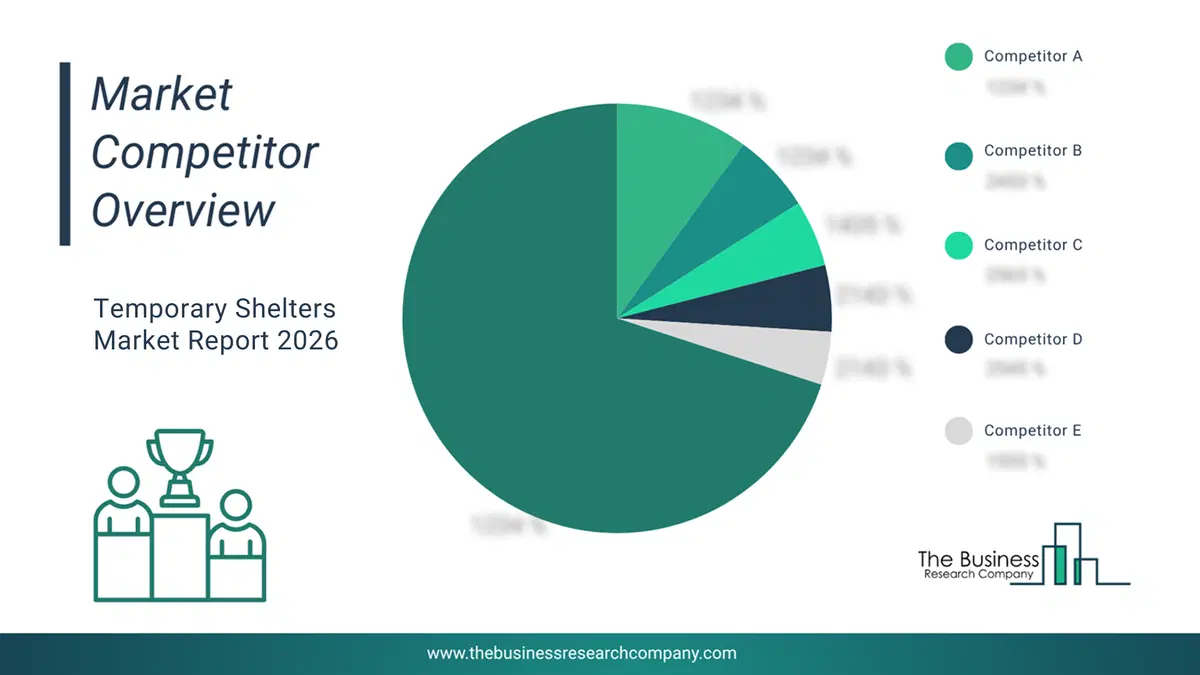
This chart is for illustrative purposes; the full report includes a detailed competitor analysis and comprehensive overview of the top 10 companies in the market.
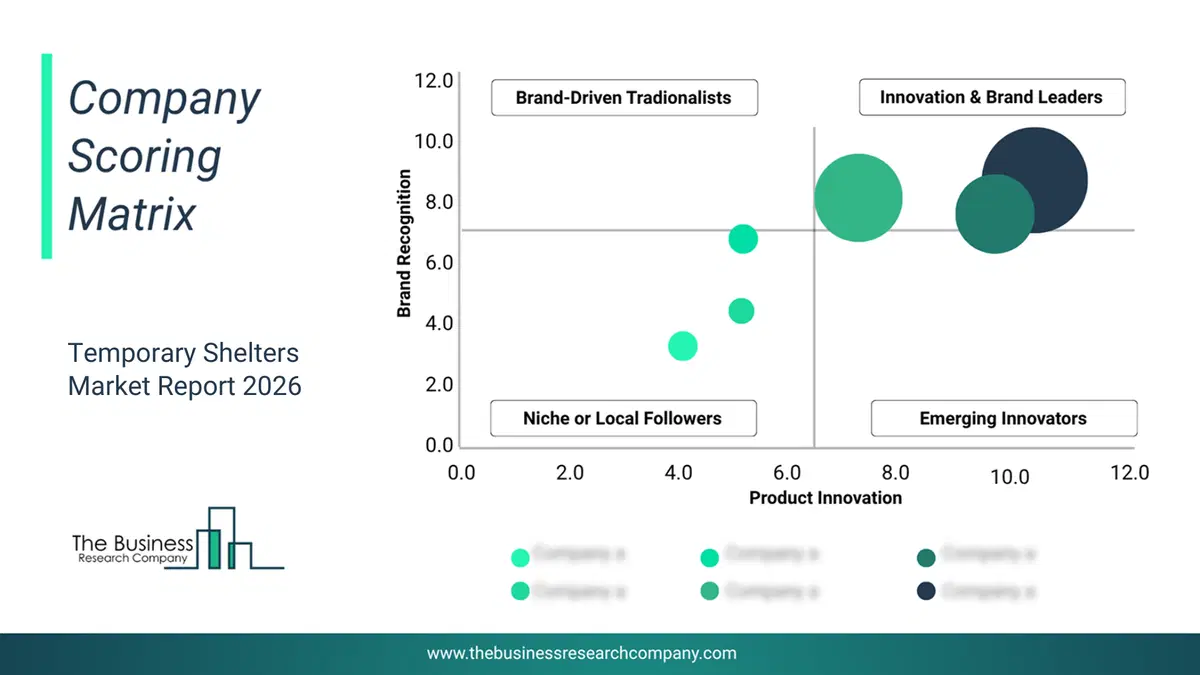
This chart maps companies by product innovation and brand strength, with bubble size indicating relative revenue, helping identify market leaders, challengers, and niche players. This is an illustrative chart; the full report provides a complete and accurate competitive analysis.
Global Temporary Shelters Market Trends and Insights
Major companies operating in the temporary shelters market are increasingly focusing on developing innovative rapid‑deployment and highly adaptable shelter solutions, such as inflatable modular emergency shelters, to meet the rising demand for scalable, durable, and easy‑to‑assemble relief housing driven by the increasing frequency of natural disasters, humanitarian crises, forced displacement, and homelessness. Inflatable modular emergency shelters are designed with integrated structural supports and high‑performance materials that allow them to be rapidly erected with minimal labour, offer improved weather resistance and internal space utilization compared with conventional tent systems, and can be configured for uses ranging from temporary housing and medical facilities to command centres in crisis zones. For instance, in April 2024, NRS Relief, a humanitarian shelter solutions provider, unveiled Huggy Air at the Dubai International Humanitarian Aid & Development (DIHAD) Conference & Exhibition, an innovative inflatable shelter designed for fast deployment in emergency and disaster response scenarios. Huggy Air features an integrated inflatable frame that enables rapid setup and tear‑down, vertical side walls that maximize usable interior space, premium materials for durability and longevity, and compatibility with other modular shelter systems to support multifunctional operational needs such as medical triage zones, accommodation units, or logistical hubs, outperforming traditional fabric tents in both speed and adaptability. Available in multiple sizes to support small to large‑scale interventions, the launch of Huggy Air reflects a broader market trend toward enhanced modularity, operational flexibility, and readiness in temporary shelter design that helps humanitarian agencies and governments respond more effectively to urgent housing needs. The Temporary Shelters market continues to grow as stakeholders adopt advanced materials, prefab and sustainable designs, and connected shelter technologies to improve comfort, resilience, and rapid response capabilities.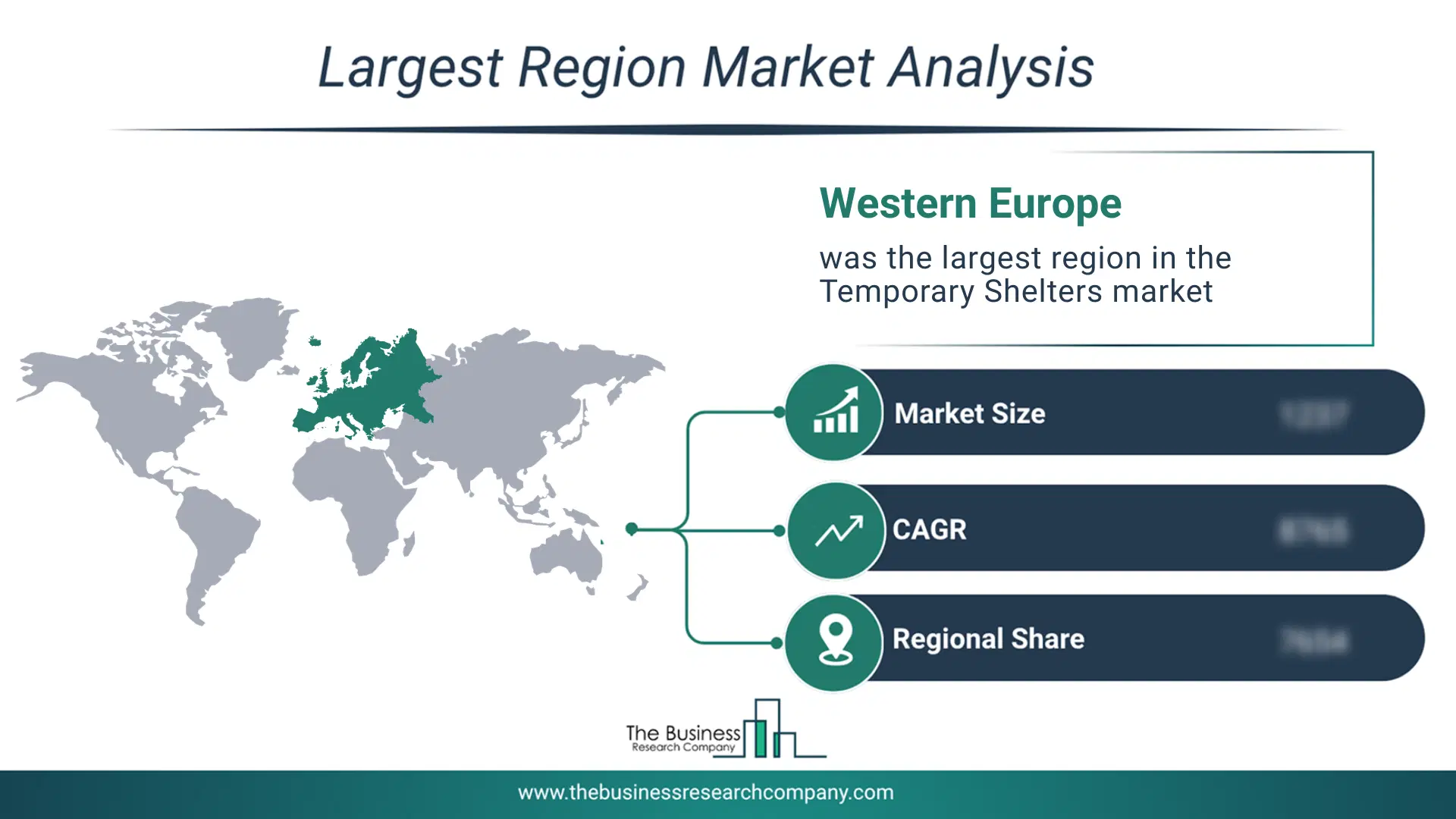
Regional Outlook
Western Europe was the largest region in the temporary shelters market in 2025. Asia-Pacific was the second-largest region in the temporary shelters market. The regions covered in this market report are Asia-Pacific, South East Asia, Western Europe, Eastern Europe, North America, South America, Middle East, Africa. The countries covered in this market report are Australia, Brazil, China, France, Germany, India, Indonesia, Japan, Taiwan, Russia, South Korea, UK, USA, Canada, Italy, Spain.What Defines the Temporary Shelters Market?
The temporary shelter market consists of revenues earned by entities that provide short-term shelter for victims of domestic violence, sexual assault or child abuse, temporary residential shelter for the homeless, runaway youths, and patients and families caught in medical crisis. These establishments may operate their own shelters or may subsidize housing using existing homes, apartments, hotels, or motels. The temporary shelter market also includes establishments such as battered women’s shelters, emergency shelters, homeless shelters. The market value includes the value of related goods sold by the service provider or included within the service offering. Only goods and services traded between entities or sold to end consumers are included.How is Market Value Defined and Measured?
The market value is defined as the revenues that enterprises gain from the sale of goods and/or services within the specified market and geography through sales, grants, or donations in terms of the currency (in USD unless otherwise specified). The revenues for a specified geography are consumption values that are revenues generated by organizations in the specified geography within the market, irrespective of where they are produced. It does not include revenues from resales along the supply chain, either further along the supply chain or as part of other products.
This chart presents market attractiveness based on a quantitative evaluation of growth, competition, strategic alignment, and risk, offering a clear view of opportunity areas for decision-making. This chart is for illustrative purposes; the full report contains the complete analysis.

This chart highlights the Total Addressable Market (TAM) by estimating the maximum revenue opportunity using an assumption-driven approach, supporting strategic planning and opportunity sizing across markets. The chart is illustrative; the full report provides a more comprehensive analysis.
What Key Data and Analysis Are Included in the Temporary Shelters Market Report 2026?
The temporary shelters market research report is one of a series of new reports from The Business Research Company that provides market statistics, including industry global market size, regional shares, competitors with the market share, detailed market segments, market trends and opportunities, and any further data you may need to thrive in the temporary shelters industry. The market research report delivers a complete perspective of everything you need, with an in-depth analysis of the current and future state of the industry.Temporary Shelters Market Report Forecast Analysis
| Report Attribute | Details |
|---|---|
| Market Size Value In 2026 | $45.06 billion |
| Revenue Forecast In 2030 | $55.71 billion |
| Growth Rate | CAGR of 5.4% from 2026 to 2030 |
| Base Year For Estimation | 2025 |
| Actual Estimates/Historical Data | 2020-2025 |
| Forecast Period | 2026 - 2030 - 2030 |
| Market Representation | Revenue in USD Billion and CAGR from 2026 to 2030 |
| Segments Covered | Type, Deployment Duration, End-User Group |
| Regional Scope | Asia-Pacific, Western Europe, Eastern Europe, North America, South America, Middle East, Africa |
| Country Scope | The countries covered in the report are Australia, Brazil, China, France, Germany, India, Indonesia, Japan, Taiwan, Russia, South Korea, UK, USA, Canada, Italy, Spain. |
| Key Companies Profiled | The American Red Cross, The Salvation Army, UNICEF, The Emergency Food and Shelter Program, ShelterBox Trust, National Alliance to End Homlessness, The National Coalition for the Homeless, Covenant House, The Bowery Mission, The Midnight Mission, The Rescue Mission, The Union Rescue Mission, The City Mission, The Samaritan Inn, The Mustard Seed, The Road Home, The House of Charity, The Open Door Mission, The Denver Rescue Mission, The Nashville Rescue Mission, The Atlanta Mission, The Seattle's Union Gospel Mission, The Portland Rescue Mission, The San Francisco City Impact, The Los Angeles Mission, The Good Shepherd Center, The St. Vincent de Paul Society, The Catholic Charities, The Homeless Prenatal Program, The Homeless Children's Education Fund |
| Customization Scope | Request for Customization |
| Pricing And Purchase Options | Explore Purchase Options |