

Academic Scheduling Software Market Report 2026
Global Outlook – By Component (Software, Services), By Institution Type (K-12 Schools, Higher Education Institutions, Vocational Training Centers, Online Education Platforms, Corporate Training Departments), By Deployment Mode (On-Premises, Cloud) – Market Size, Trends, Strategies, and Forecast to 2030
Academic Scheduling Software Market Overview
• Academic Scheduling Software market size has reached to $1.82 billion in 2025 • Expected to grow to $3.25 billion in 2030 at a compound annual growth rate (CAGR) of 12.2% • Growth Driver: Rising Student Enrollment Across Educational Institutions Driving The Growth Of The Market Due To Increasing Demand For Efficient Academic Planning • Market Trend: Curriculum Planning And Scheduling Solutions Streamlining Academic Resource Management • North America was the largest region in 2025 and Asia-Pacific is the fastest growing region.What Is Covered Under Academic Scheduling Software Market?
Academic scheduling software is a digital solution that automates the planning and management of class timetables, faculty assignments, room allocations, and exam schedules for educational institutions. The primary purpose is to streamline academic scheduling by efficiently assigning courses, instructors, classrooms, and time slots, minimizing scheduling conflicts and improving institutional productivity. The main components in the academic scheduling software market include software and services. Software refers to digital solutions designed to support the management, delivery, tracking, and administration of educational and training activities. These solutions are used across K-12 schools, higher education institutions, vocational training centers, online education platforms, and corporate training departments. They are deployed through on-premises and cloud models.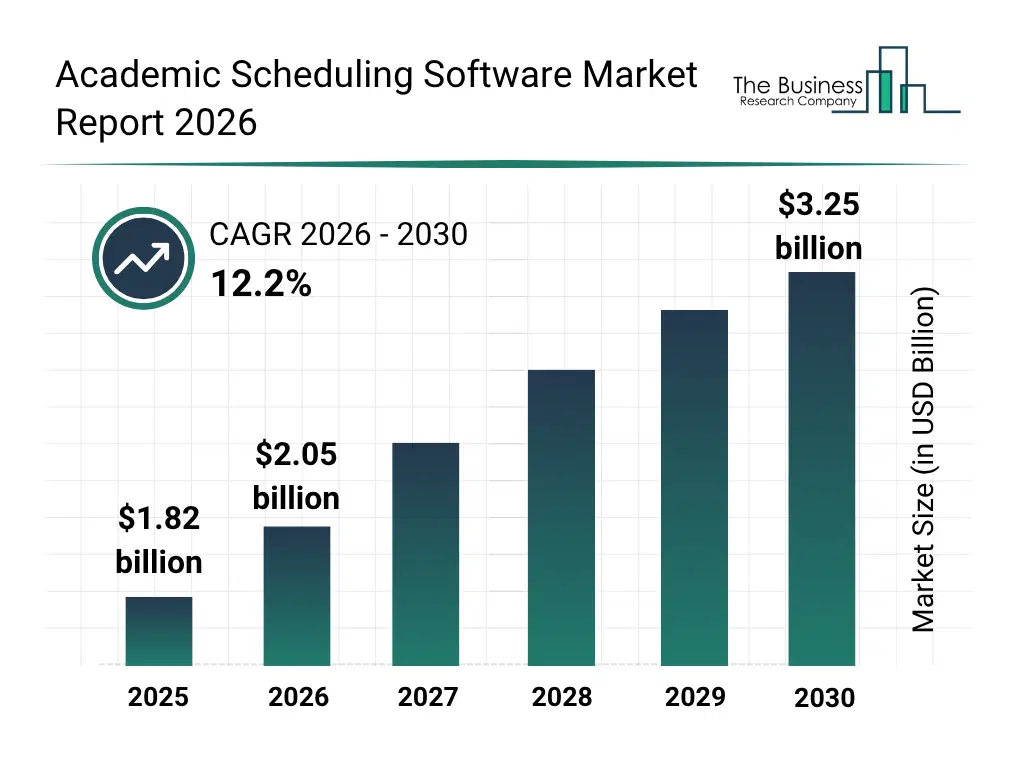
What Is The Academic Scheduling Software Market Size and Share 2026?
The academic scheduling software market size has grown rapidly in recent years. It will grow from $1.82 billion in 2025 to $2.05 billion in 2026 at a compound annual growth rate (CAGR) of 12.6%. The growth in the historic period can be attributed to increasing adoption of digital administrative systems, growing complexity of academic scheduling, rising number of educational institutions and courses, increasing demand for efficient classroom utilization, growing need to reduce scheduling conflicts.What Is The Academic Scheduling Software Market Growth Forecast?
The academic scheduling software market size is expected to see rapid growth in the next few years. It will grow to $3.25 billion in 2030 at a compound annual growth rate (CAGR) of 12.2%. The growth in the forecast period can be attributed to expansion of hybrid and flexible learning models, increasing demand for personalized academic planning, growing adoption of mobile scheduling applications, rising need for multi-campus scheduling coordination, increasing emphasis on faculty workload optimization. Major trends in the forecast period include real-time timetable adjustment and updates, personalized student timetable planning, automated faculty workload balancing, multi-campus academic schedule coordination, integrated examination and event scheduling.Tariff Impact On Academic Scheduling Software Market
Tariffs are impacting the academic scheduling software market by increasing the cost of imported servers, networking equipment, computers, and other hardware required for on-premises software deployment and institutional IT infrastructure. This is increasing deployment costs for on-premises solutions and hardware-dependent educational institutions, particularly in regions reliant on imported technology such as North America and Asia-Pacific. Hardware-intensive segments such as on-premises deployment and resource-intensive institutional infrastructure are most affected due to their dependence on imported IT equipment. However, tariffs are also encouraging cloud adoption, local technology sourcing, and subscription-based software models, creating opportunities for cloud-based academic scheduling software providers.
Global Academic Scheduling Software Market Segmentation
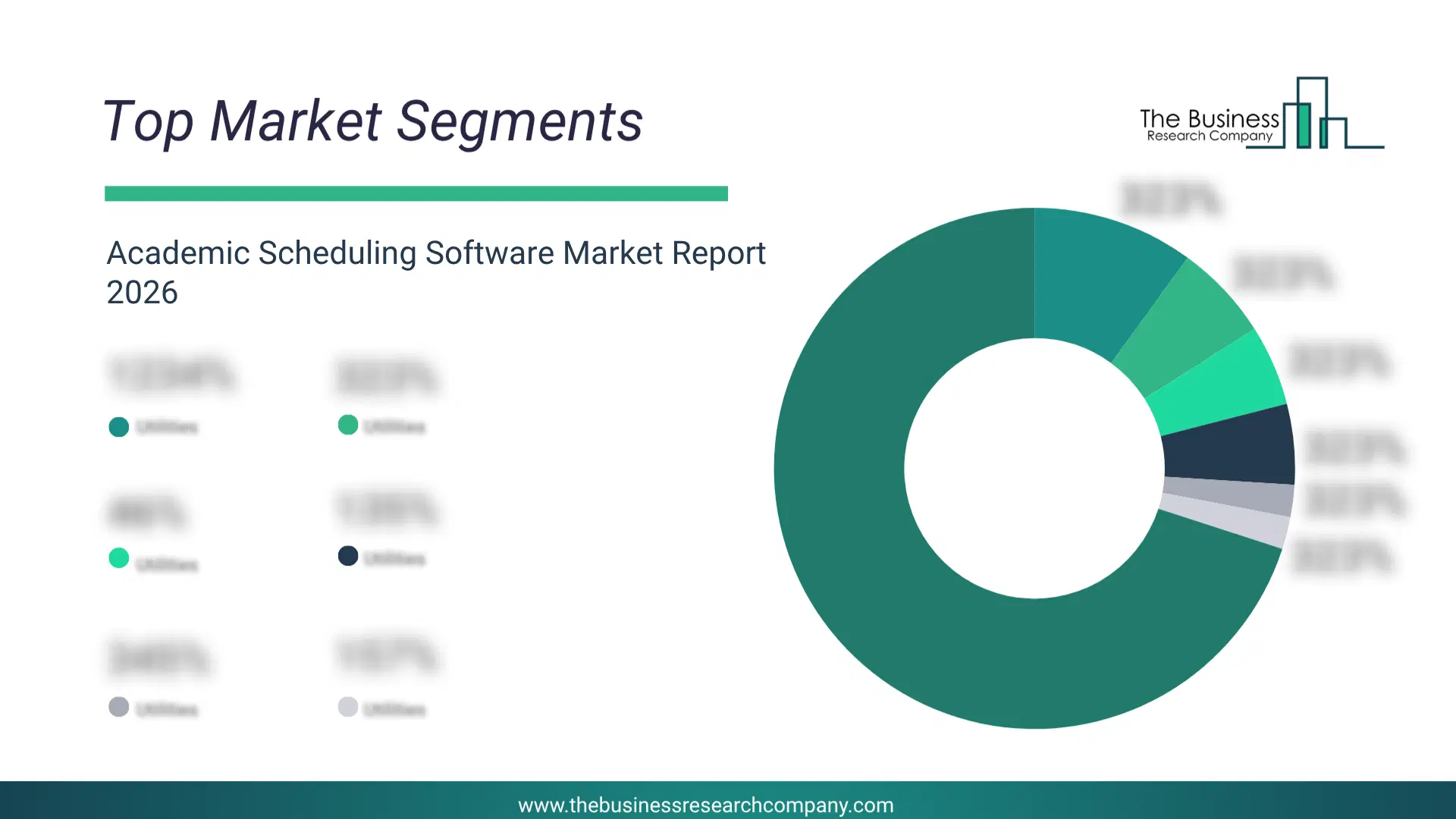
1) By Component: Software, Services 2) By Institution Type: K-12 Schools, Higher Education Institutions, Vocational Training Centers, Online Education Platforms, Corporate Training Departments 3) By Deployment Mode: On-Premises, Cloud Subsegments: 1) By Software: Course Scheduling Software, Faculty Scheduling Software, Classroom And Resource Scheduling Software, Examination Scheduling Software, Event And Activity Scheduling Software, Academic Planning Software 2) By Services: Implementation Services, Integration Services, Consulting Services, Customization Services, Training Services, Support And Maintenance Services, Managed ServicesWhat Is The Driver Of The Academic Scheduling Software Market?
The rising student enrollment across educational institutions is expected to propel the growth of the academic scheduling software market going forward. Student enrollment refers to the total number of students registered in schools, colleges, and universities for academic programs. The increase in student enrollment is driven by expanding access to higher education, as more institutions, online programs, and government initiatives make education accessible to a larger population. Academic scheduling software helps institutions efficiently manage complex timetables, optimize resource allocation, reduce scheduling conflicts, and improve overall administrative efficiency in handling large student volumes. For instance, in June 2026, according to the National Student Clearinghouse Research Center, a US-based education research organization, postsecondary enrollment demonstrated steady growth, reaching 18.6 million students in spring 2026, reflecting a 1.0% year-over-year increase (+192,000), while undergraduate enrollment rose to 15.5 million, marking a 1.3% growth compared to the previous year. Therefore, the rising student enrollment across educational institutions is driving the growth of the academic scheduling software industry.Key Players In The Global Academic Scheduling Software Market
Major companies operating in the academic scheduling software market are Oracle Corporation, SAP SE, Workday Inc, Ellucian Company LP, Blackbaud Inc, Accruent LLC, Anthology Inc, Unit4 NV, Jenzabar Inc, Skyward Inc, Veracross LLC, CollegeNET Inc, Kuali Inc, Coursedog Inc, Ad Astra Information Systems LLC, TimeEdit AB, Leepfrog Technologies Inc, Alma Technologies Inc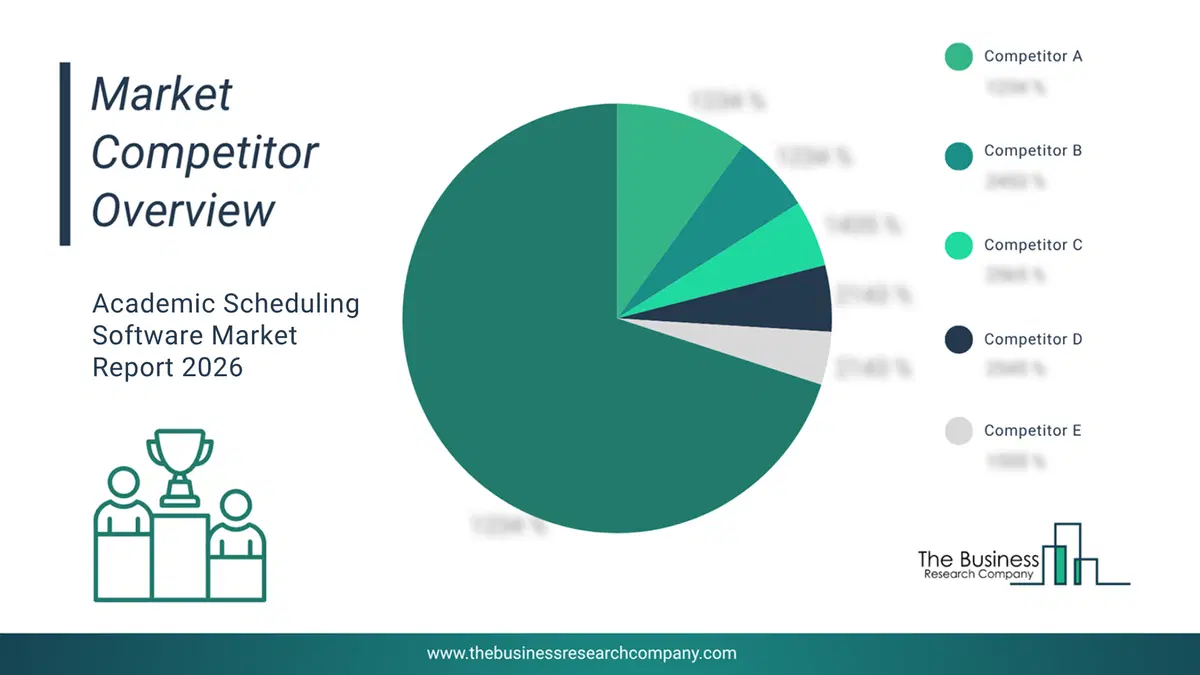
This chart is for illustrative purposes; the full report includes a detailed competitor analysis and comprehensive overview of the top 10 companies in the market.
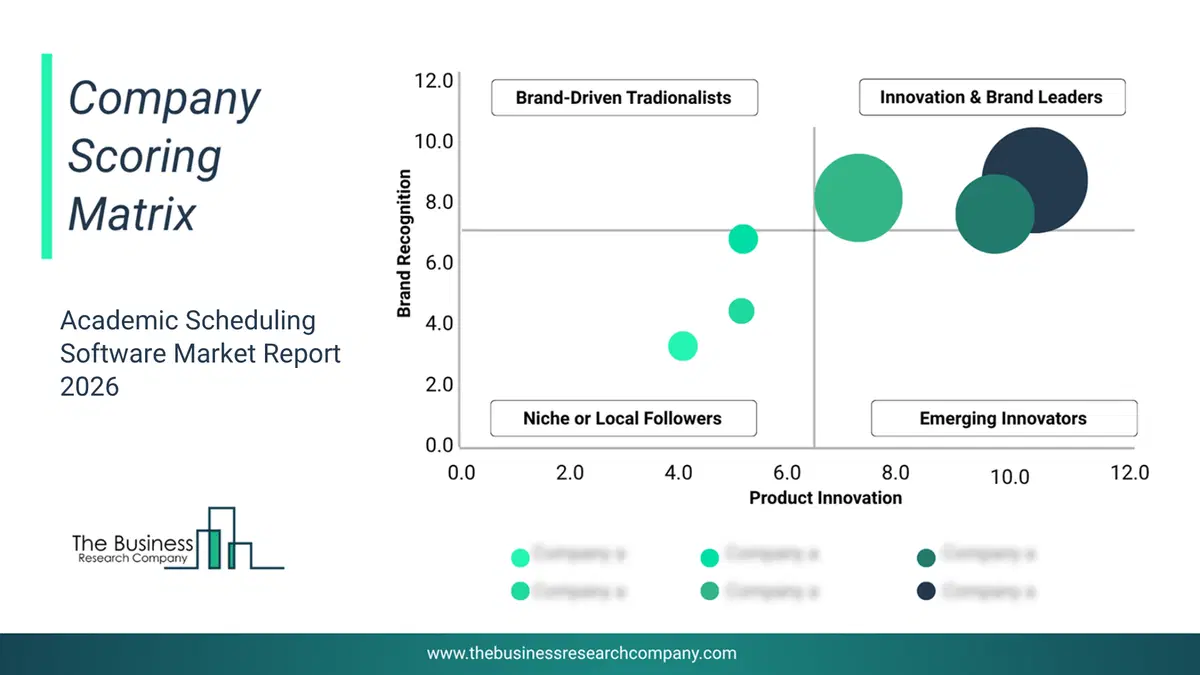
This chart maps companies by product innovation and brand strength, with bubble size indicating relative revenue, helping identify market leaders, challengers, and niche players. This is an illustrative chart; the full report provides a complete and accurate competitive analysis.
Global Academic Scheduling Software Market Trends and Insights
Major companies operating in the academic scheduling software market are focusing on integrated academic scheduling platforms, such as curriculum planning and scheduling solutions, to improve curriculum planning, resource scheduling, and student allocation. Curriculum planning and scheduling solutions are software platforms that integrate curriculum management, course scheduling, room allocation, faculty workload planning, and student scheduling into a unified system to improve operational efficiency, resource utilization, and data accuracy across educational institutions. For instance, in July 2025, Ellucian, a US-based higher education technology company, partnered with TimeEdit AB, a Sweden-based academic operations software provider, to launch an integrated curriculum planning and scheduling solution within Ellucian Student powered by Banner. The solution combines TimeEdit's Academic Operations Platform with Ellucian Student to streamline curriculum planning, resource scheduling, student allocation, and workload management while reducing manual administrative processes and improving scheduling accuracy.What Are Latest Mergers And Acquisitions In The Academic Scheduling Software Market?
In March 2025, CollegeNET, Inc., a US-based provider of academic scheduling and higher education software, partnered with Rubicon Technology Partners, to accelerate the company's growth and drive continued product innovation across its higher education software portfolio. The partnership aims to expand CollegeNET's technology capabilities, strengthen its academic scheduling and administrative software offerings, and support long-term business growth. Rubicon Technology Partners is a US-based private equity firm focused on investing in and scaling enterprise software companies.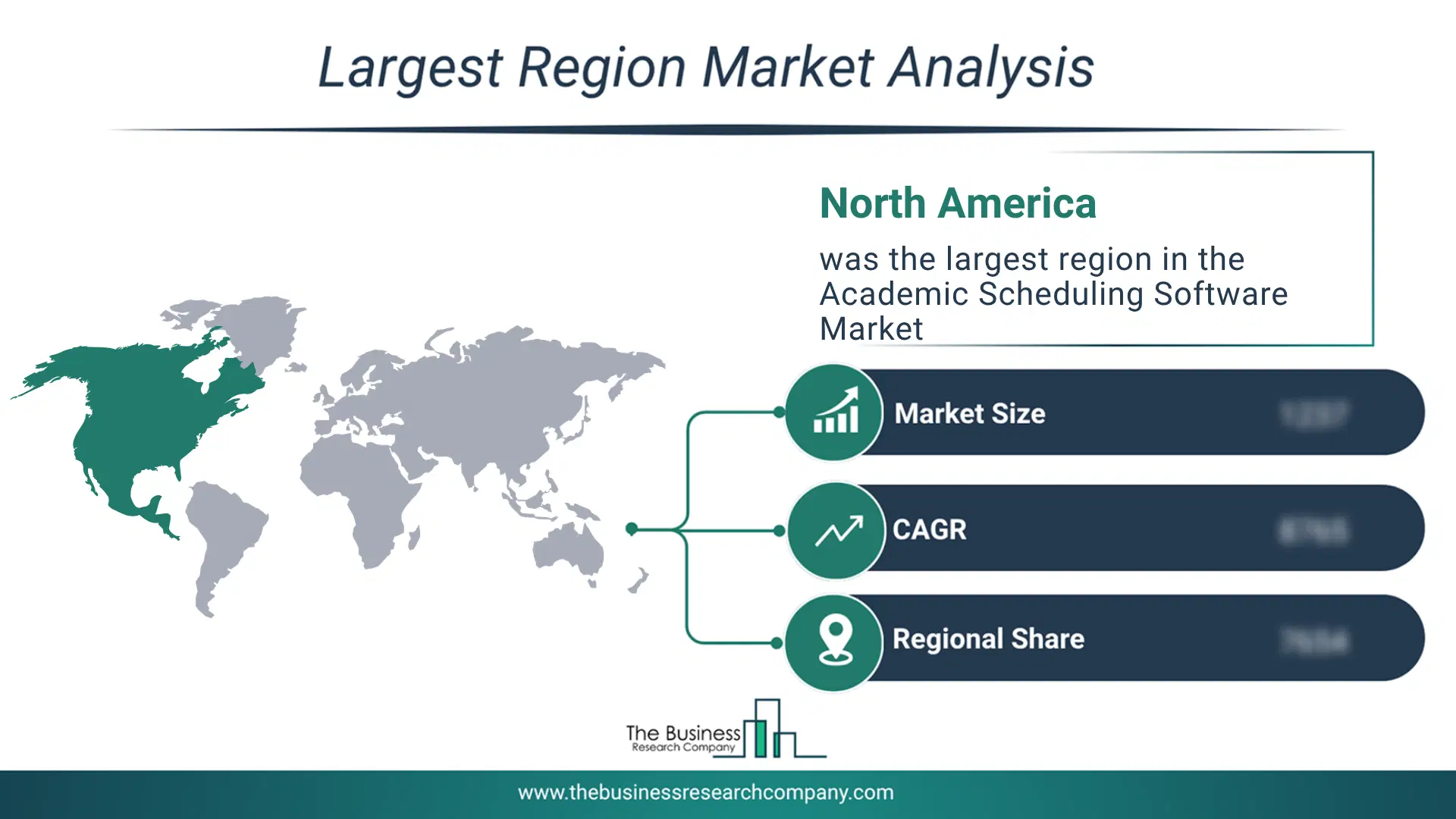
Regional Outlook
North America was the largest region in the academic scheduling software market in 2025. Asia-Pacific is expected to be the fastest-growing region in the forecast period. The regions covered in this market report are Asia-Pacific, South East Asia, Western Europe, Eastern Europe, North America, South America, Middle East, Africa. The countries covered in this market report are Australia, Brazil, China, France, Germany, India, Indonesia, Japan, Taiwan, Russia, South Korea, UK, USA, Canada, Italy, Spain.What Defines the Academic Scheduling Software Market?
The academic scheduling software market consists of revenues earned by entities by providing services such as class timetable scheduling, course scheduling, examination scheduling, faculty workload planning, classroom and resource allocation, student registration scheduling, academic calendar management, timetable optimization, conflict detection and resolution, and schedule reporting and analytics. The market value includes the value of related goods sold by the service provider or included within the service offering. Only goods and services traded between entities or sold to end consumers are included.How is Market Value Defined and Measured?
The market value is defined as the revenues that enterprises gain from the sale of goods and/or services within the specified market and geography through sales, grants, or donations in terms of the currency (in USD unless otherwise specified). The revenues for a specified geography are consumption values that are revenues generated by organizations in the specified geography within the market, irrespective of where they are produced. It does not include revenues from resales along the supply chain, either further along the supply chain or as part of other products.
This chart presents market attractiveness based on a quantitative evaluation of growth, competition, strategic alignment, and risk, offering a clear view of opportunity areas for decision-making. This chart is for illustrative purposes; the full report contains the complete analysis.

This chart highlights the Total Addressable Market (TAM) by estimating the maximum revenue opportunity using an assumption-driven approach, supporting strategic planning and opportunity sizing across markets. The chart is illustrative; the full report provides a more comprehensive analysis.
What Key Data and Analysis Are Included in the Academic Scheduling Software Market Report 2026?
The academic scheduling software market research report is one of a series of new reports from The Business Research Company that provides market statistics, including industry global market size, regional shares, competitors with the market share, detailed market segments, market trends and opportunities, and any further data you may need to thrive in the academic scheduling software industry. The market research report delivers a complete perspective of everything you need, with an in-depth analysis of the current and future state of the industry.Academic Scheduling Software Market Report Forecast Analysis
| Report Attribute | Details |
|---|---|
| Market Size Value In 2026 | $2.05 billion |
| Revenue Forecast In 2030 | $3.25 billion |
| Growth Rate | CAGR of 12.2% from 2026 to 2030 |
| Base Year For Estimation | 2025 |
| Actual Estimates/Historical Data | 2020-2025 |
| Forecast Period | 2026 - 2030 |
| Market Representation | Revenue in USD Billion and CAGR from 2026 to 2030 |
| Segments Covered | Component, Institution Type, Deployment Mode |
| Regional Scope | Asia-Pacific, Western Europe, Eastern Europe, North America, South America, Middle East, Africa |
| Country Scope | The countries covered in the report are Australia, Brazil, China, France, Germany, India, Indonesia, Japan, Taiwan, Russia, South Korea, UK, USA, Canada, Italy, Spain. |
| Key Companies Profiled | Oracle Corporation, SAP SE, Workday Inc, Ellucian Company LP, Blackbaud Inc, Accruent LLC, Anthology Inc, Unit4 NV, Jenzabar Inc, Skyward Inc, Veracross LLC, CollegeNET Inc, Kuali Inc, Coursedog Inc, Ad Astra Information Systems LLC, TimeEdit AB, Leepfrog Technologies Inc, Alma Technologies Inc |
| Customization Scope | Request for Customization |
| Pricing And Purchase Options | Explore Purchase Options |