
Acoustic Wave Sensor Market Report 2026
Global Outlook – By Type ( Bulk Acoustic Wave, Surface Acoustic Wave, Other Types), By Sensing Parameter ( Temperature Sensors, Pressure Sensors, Viscosity Sensors, Other Sensing Parameter), By Device ( Resonator, Delay Line, Other Devices), By Application ( Industrial Process Monitoring, Environmental Monitoring, Healthcare Monitoring, Wireless Sensing Networks, Other Application), By End User ( Healthcare, Automobile, Industrial, Food And Beverages, Environment, Defense, Other End Users) – Market Size, Trends, Strategies, and Forecast to 2030
Acoustic Wave Sensor Market Overview
• Acoustic Wave Sensor market size has reached to $1.51 billion in 2025 • Expected to grow to $2.77 billion in 2030 at a compound annual growth rate (CAGR) of 12.8% • Growth Driver: Rising Production Of Long Term Evolution 4G And 5G Devices Fueling The Growth Of The Market Due To Increasing Demand For High-Speed, Reliable Wireless Communication • Market Trend: Integration Of Advanced Physics Concepts Boosts Sensor Sensitivity And Reliability • North America was the largest region in 2025 and Asia-Pacific is the fastest growing region.What Is Covered Under Acoustic Wave Sensor Market?
An acoustic wave sensor is a device that uses acoustic waves, typically surface or bulk waves, to detect changes in a material or environment. It converts physical, chemical, or biological changes on its surface into measurable electrical signals. Its main purpose is to detect parameters such as pressure, temperature, humidity, or chemical concentrations with high sensitivity and precision. The main types of acoustic wave sensors are bulk acoustic wave, surface acoustic wave, and other types. Bulk acoustic wave (BAW) refers to a technology that uses acoustic waves traveling through the interior of a material to filter and manage high-frequency signals, commonly used in radio frequency (RF) components. Based on sensing parameters, they are categorized into temperature sensors, pressure sensors, viscosity sensors, and others and are also available in various devices such as resonators, delay lines, holographic television, holographic telepresence, and other devices. Acoustic wave sensors are applied in industrial process monitoring, environmental monitoring, healthcare monitoring, wireless sensing networks, and others, with key end users including healthcare, automobile, industrial, food and beverages, environment, defense, and others.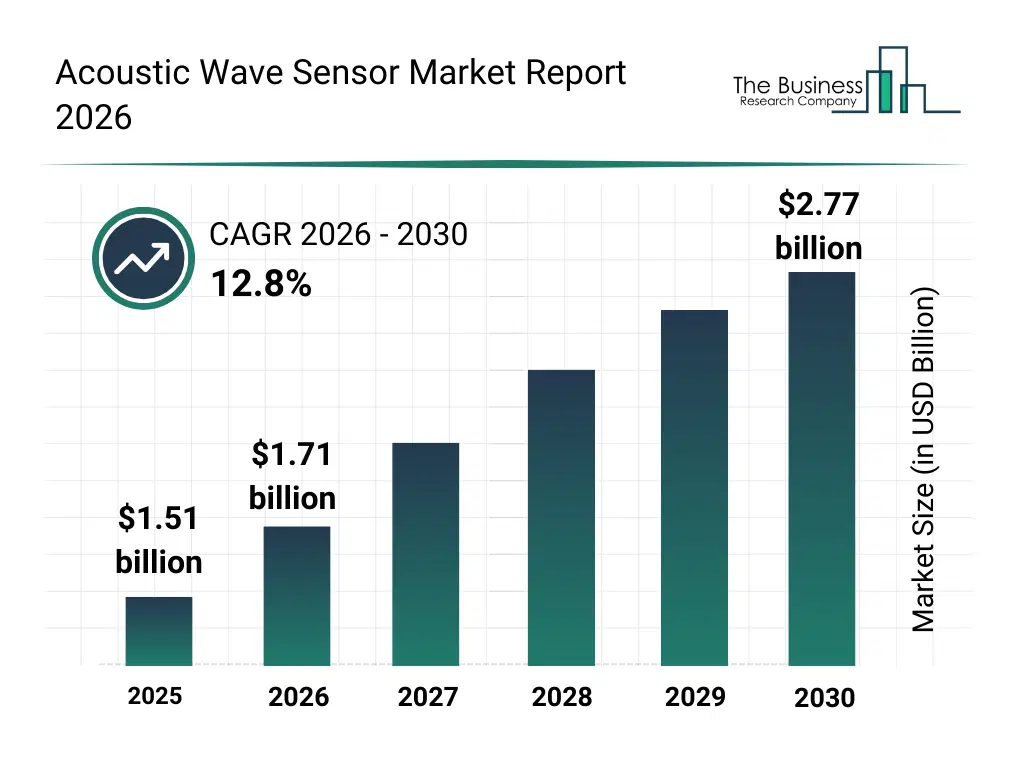
What Is The Acoustic Wave Sensor Market Size 2026 And Growth Rate?
The acoustic wave sensor market size has grown rapidly in recent years. It will grow from $1.51 billion in 2025 to $1.71 billion in 2026 at a compound annual growth rate (CAGR) of 13.1%. The growth in the historic period can be attributed to growing industrial automation, increasing environmental monitoring needs, rising healthcare diagnostic applications, demand for precision pressure and temperature sensors, adoption of wireless sensing networks.What Is The Acoustic Wave Sensor Market Growth Forecast?
The acoustic wave sensor market size is expected to see rapid growth in the next few years. It will grow to $2.77 billion in 2030 at a compound annual growth rate (CAGR) of 12.8%. The growth in the forecast period can be attributed to advancements in smart wearable devices, integration with AI and iot ecosystems, rising demand in automotive sensing applications, development of multifunctional acoustic sensors, expansion in healthcare monitoring and remote diagnostics. Major trends in the forecast period include miniaturized sensor designs, high-sensitivity acoustic sensors, multi-parameter sensing solutions, integration with wearable & portable devices, wireless and remote sensing capabilities.
Global Acoustic Wave Sensor Market Segmentation
1) By Type: Bulk Acoustic Wave, Surface Acoustic Wave, Other Types 2) By Sensing Parameter: Temperature Sensors, Pressure Sensors, Viscosity Sensors, Other Sensing Parameter 3) By Device: Resonator, Delay Line, Other Devices 4) By Application: Industrial Process Monitoring, Environmental Monitoring, Healthcare Monitoring, Wireless Sensing Networks, Other Application 5) By End User: Healthcare, Automobile, Industrial, Food And Beverages, Environment, Defense, Other End Users Subsegments: 1) By Bulk Acoustic Wave: Thickness Shear Mode Sensors, Longitudinal Mode Sensors, Composite Bulk Acoustic Wave Sensors 2) By Surface Acoustic Wave: Rayleigh Wave Sensors, Love Wave Sensors, Shear Horizontal Surface Acoustic Wave Sensors 3) By Other Types: Lamb Wave Sensors, Flexural Plate Wave Sensors, Bleustein–Gulyaev Wave SensorsWhat Is The Driver Of The Acoustic Wave Sensor Market?
The rising production of long term evolution, 4G and 5G devices is expected to propel the growth of the acoustic wave sensor market going forward. Long-term evolution, 4G and 5G devices are wireless technologies that deliver high-speed data, greater network capacity, and low latency for smooth, enhanced mobile connectivity. The rising production of long term evolution, 4G and 5G devices is due to the growing consumer demand for faster, more reliable wireless communication and the proliferation of connected smart devices. Acoustic wave sensors enhance long term evolution, 4G and 5G devices by enabling precise signal filtering and frequency control, ensuring faster and more reliable wireless communication. They improve network performance and reduce interference, supporting seamless connectivity in advanced mobile networks. For instance, in March 2024, according to 5G Americas, a US-based nonprofit trade organization, the global 5G connections reached $1.76 billion in 2023, an increase of 66%, and are projected to reach $7.9 billion by 2028. Therefore, the rising production of long-term evolution, 4G and 5G devices is driving the growth of the acoustic wave sensor industry.Key Players In The Global Acoustic Wave Sensor Market
Major companies operating in the acoustic wave sensor market are Broadcom Inc., Texas Instruments Incorporated, STMicoelectronics N.V., TDK Corporation, Infineon Technologies AG, NXP Semiconductors N.V., Analog Devices Inc., Skyworks Solutions Inc., Qorvo Inc., BeStar Technologies Inc., AIRMAR Technology Corporation, NanoTemper Technologies GmbH, JASCO Applied Sciences, Abracon LLC, Hawk Measurement Systems, Automation Products Group Inc., Sensor Technology Ltd., SAW Components Dresden GmbH, Senix Corporation, A D Metro Inc., DJB Instruments Ltd., Precision Acoustics Ltd., Sonair, Transense Technologies, AWSensors, H. Heinz Meßwiderstände GmbH, Vectron International Inc.
This chart is for illustrative purposes; the full report includes a detailed competitor analysis and comprehensive overview of the top 10 companies in the market.
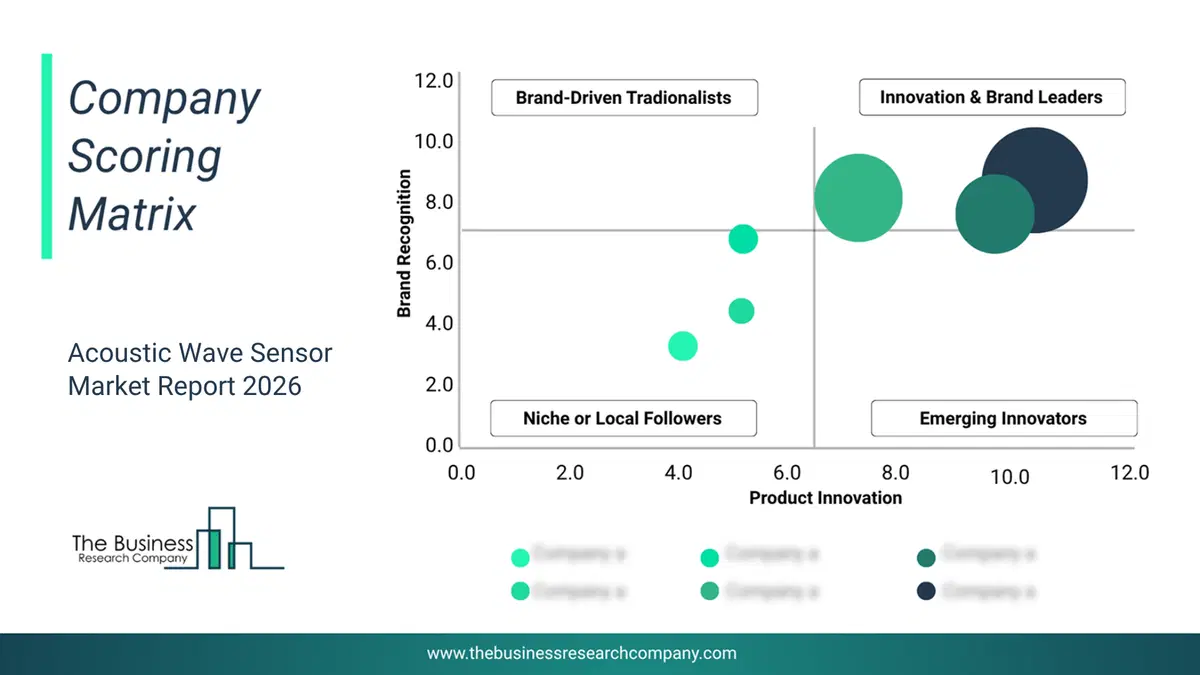
This chart maps companies by product innovation and brand strength, with bubble size indicating relative revenue, helping identify market leaders, challengers, and niche players. This is an illustrative chart; the full report provides a complete and accurate competitive analysis.
Global Acoustic Wave Sensor Market Trends and Insights
Major companies operating in the acoustic wave sensor market are focusing on the integration of advanced physics concepts, such as passive parity-time (PT) symmetry, to enhance sensor sensitivity, improve signal-to-noise ratios, and enable more precise detection capabilities in complex environments. Passive parity-time (PT) symmetry is a design concept in physics where a system balances energy loss and gain without external energy input, enabling enhanced signal sensitivity and stability. For instance, in April 2025, Huazhong University of Science and Technology (HUST), a China-based national university, developed a novel surface acoustic wave sensor using exceptional points in a passive parity-time symmetric system. This advancement significantly amplifies sensor sensitivity and speed, enabling ultra-precise and rapid detection of gases such as hydrogen sulfide at very low concentrations with strong resistance to environmental interference.What Are Latest Mergers And Acquisitions In The Acoustic Wave Sensor Market?
In February 2024, Sandvik AB, a Sweden based manufacturing technology company, acquired pro micron GmbH for an undisclosed amount. With this acquisition, Sandvik aims to enhance its technological capabilities and strengthen its position in the high growth sensorised tools and automation segment. Pro micron GmbH is a Germany based technology company that provides a acoustic wave sensors.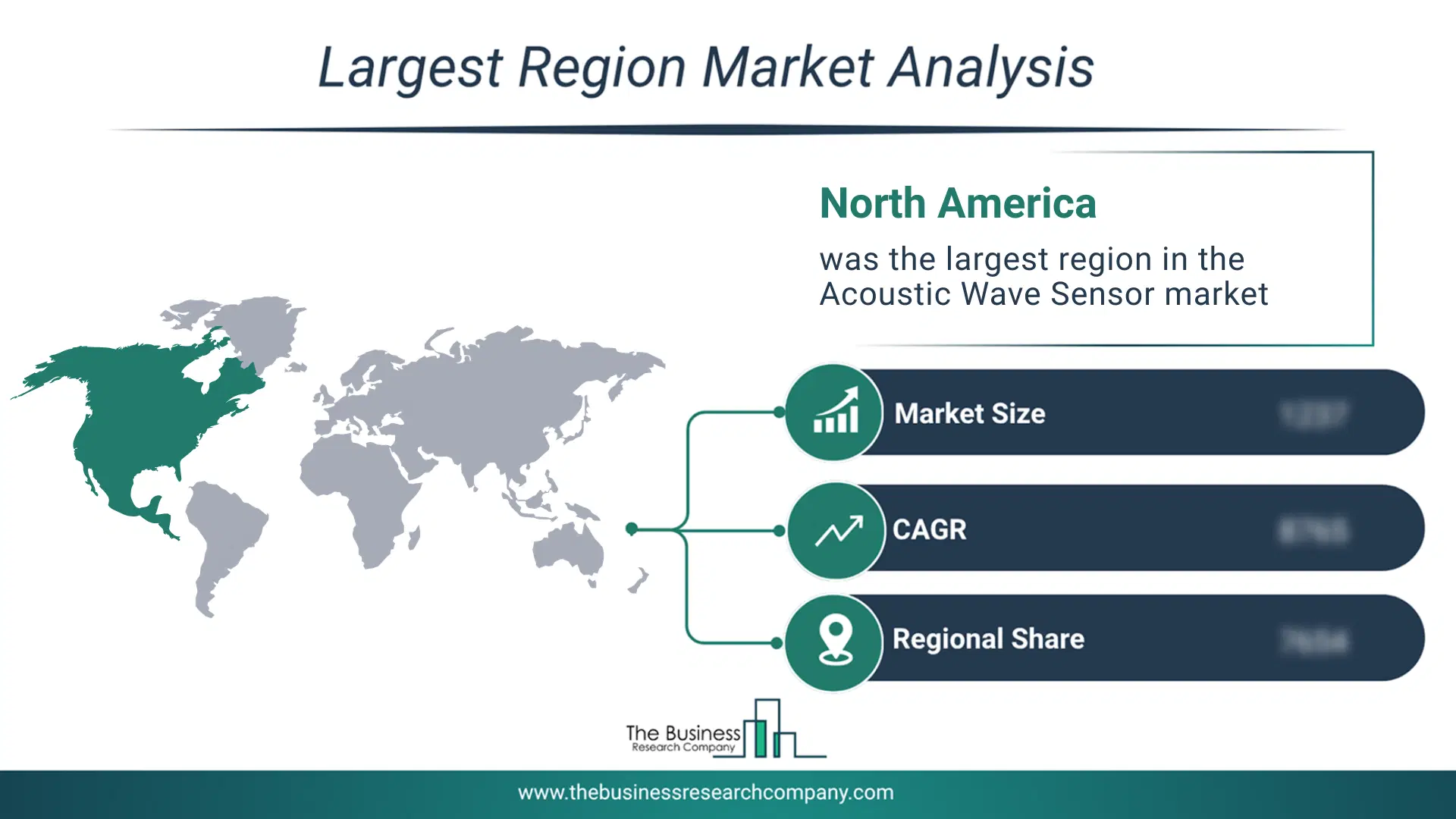
Regional Outlook
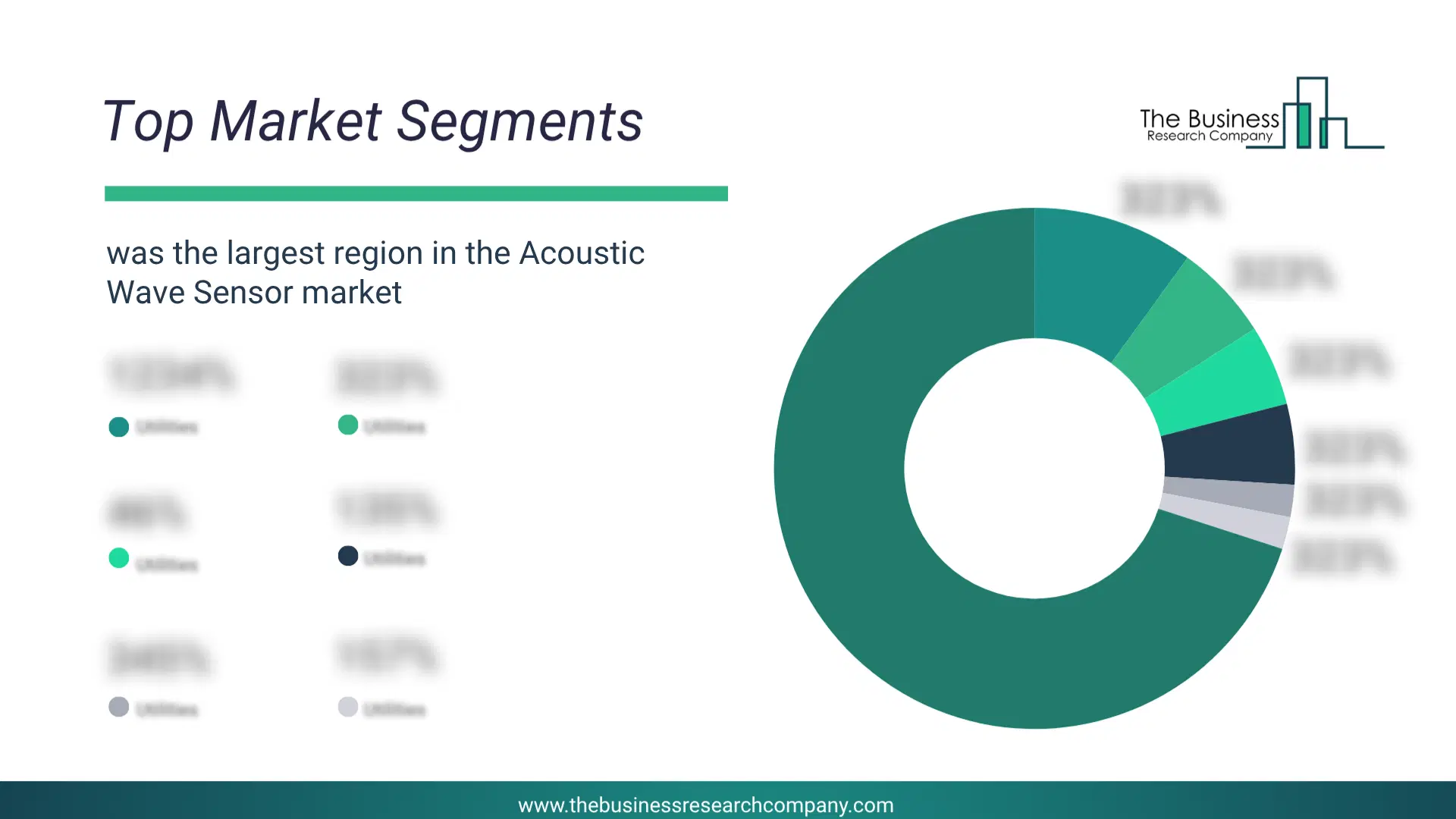
North America was the largest region in the acoustic wave sensor market in 2025. Asia-Pacific is expected to be the fastest-growing region in the forecast period. The regions covered in this market report are Asia-Pacific, South East Asia, Western Europe, Eastern Europe, North America, South America, Middle East, Africa. The countries covered in this market report are Australia, Brazil, China, France, Germany, India, Indonesia, Japan, Taiwan, Russia, South Korea, UK, USA, Canada, Italy, Spain.What Defines the Acoustic Wave Sensor Market?
The acoustic wave sensor market consists of sales of piezoelectric substrates, interdigital transducers, oscillator circuits, and protective casings. Values in this market are ‘factory gate’ values, that is, the value of goods sold by the manufacturers or creators of the goods, whether to other entities (including downstream manufacturers, wholesalers, distributors, and retailers) or directly to end customers. The value of goods in this market includes related services sold by the creators of the goods.How is Market Value Defined and Measured?
The market value is defined as the revenues that enterprises gain from the sale of goods and/or services within the specified market and geography through sales, grants, or donations in terms of the currency (in USD unless otherwise specified). The revenues for a specified geography are consumption values that are revenues generated by organizations in the specified geography within the market, irrespective of where they are produced. It does not include revenues from resales along the supply chain, either further along the supply chain or as part of other products.
This chart presents market attractiveness based on a quantitative evaluation of growth, competition, strategic alignment, and risk, offering a clear view of opportunity areas for decision-making. This chart is for illustrative purposes; the full report contains the complete analysis.

This chart highlights the Total Addressable Market (TAM) by estimating the maximum revenue opportunity using an assumption-driven approach, supporting strategic planning and opportunity sizing across markets. The chart is illustrative; the full report provides a more comprehensive analysis.
What Key Data and Analysis Are Included in the Acoustic Wave Sensor Market Report 2026?
The acoustic wave sensor market research report is one of a series of new reports from The Business Research Company that provides market statistics, including industry global market size, regional shares, competitors with the market share, detailed market segments, market trends and opportunities, and any further data you may need to thrive in the acoustic wave sensor industry. The market research report delivers a complete perspective of everything you need, with an in-depth analysis of the current and future state of the industry.Acoustic Wave Sensor Market Report Forecast Analysis
| Report Attribute | Details |
|---|---|
| Market Size Value In 2026 | $1.71 billion |
| Revenue Forecast In 2030 | $2.77 billion |
| Growth Rate | CAGR of 12.8% from 2026 to 2030 |
| Base Year For Estimation | 2025 |
| Actual Estimates/Historical Data | 2020-2025 |
| Forecast Period | 2026 - 2030 |
| Market Representation | Revenue in USD Billion and CAGR from 2026 to 2030 |
| Segments Covered | Type, Sensing Parameter, Device, Application, End User |
| Regional Scope | Asia-Pacific, Western Europe, Eastern Europe, North America, South America, Middle East, Africa |
| Country Scope | The countries covered in the report are Australia, Brazil, China, France, Germany, India, Indonesia, Japan, Taiwan, Russia, South Korea, UK, USA, Canada, Italy, Spain. |
| Key Companies Profiled | Broadcom Inc., Texas Instruments Incorporated, STMicoelectronics N.V., TDK Corporation, Infineon Technologies AG, NXP Semiconductors N.V., Analog Devices Inc., Skyworks Solutions Inc., Qorvo Inc., BeStar Technologies Inc., AIRMAR Technology Corporation, NanoTemper Technologies GmbH, JASCO Applied Sciences, Abracon LLC, Hawk Measurement Systems, Automation Products Group Inc., Sensor Technology Ltd., SAW Components Dresden GmbH, Senix Corporation, A D Metro Inc., DJB Instruments Ltd., Precision Acoustics Ltd., Sonair, Transense Technologies, AWSensors, H. Heinz Meßwiderstände GmbH, Vectron International Inc. |
| Customization Scope | Request for Customization |
| Pricing And Purchase Options | Explore Purchase Options |