
Acrylic Elastomers Market Report 2026
Global Outlook – By Type (Acrylic Co Monomer Elastomer, Ethylene Acrylic Elastomers), By Processing Method (Injection Molding, Compression Molding, Transfer Molding, Extrusion), By Form (Solid, Liquid, Compound Or Pre Mixed Rubber), By Distribution Channel (Direct Sales to Original Equipment Manufacturers, Distributors And Dealers, Online Sales), By Application (Automotive, Construction, Industrial, Other Applications) – Market Size, Trends, Strategies, and Forecast to 2035
Acrylic Elastomers Market Overview
• Acrylic Elastomers market size has reached to $79.77 billion in 2025 • Expected to grow to $125.41 billion in 2030 at a compound annual growth rate (CAGR) of 9.4% • Growth Driver: Expansion Of The Automotive Industry Fueling The Growth Of The Market Due To Rising Demand For High-Performance Automotive Components • Market Trend: Manufacturing Footprint Optimization Enhances Acrylic Elastomer Production Efficiency • North America was the largest region in 2025 and Asia-Pacific is the fastest growing region.What Is Covered Under Acrylic Elastomers Market?
Acrylic elastomers are high-performance synthetic rubbers produced from acrylic ester monomers that offer outstanding resistance to heat, oils, oxidation, and weathering. They maintain their flexibility, elasticity, and mechanical strength even under prolonged exposure to elevated temperatures and lubricants. These properties make them ideal for manufacturing durable automotive and industrial components, including seals, gaskets, hoses, and O-rings used in demanding operating conditions. The main types of acrylic elastomers include acrylic co monomer elastomers and ethylene acrylic elastomers. Acrylic co monomer elastomers refer to synthetic elastomeric materials formed by copolymerizing acrylic monomers to provide flexibility, durability, and resistance to heat, oils, and weathering. These elastomers are processed through injection molding, compression molding, transfer molding, and extrusion and are available in solid, liquid, and compound or pre mixed rubber forms. They are distributed through direct sales to original equipment manufacturers, distributors and dealers, and online sales and find application in automotive, construction, industrial, and others.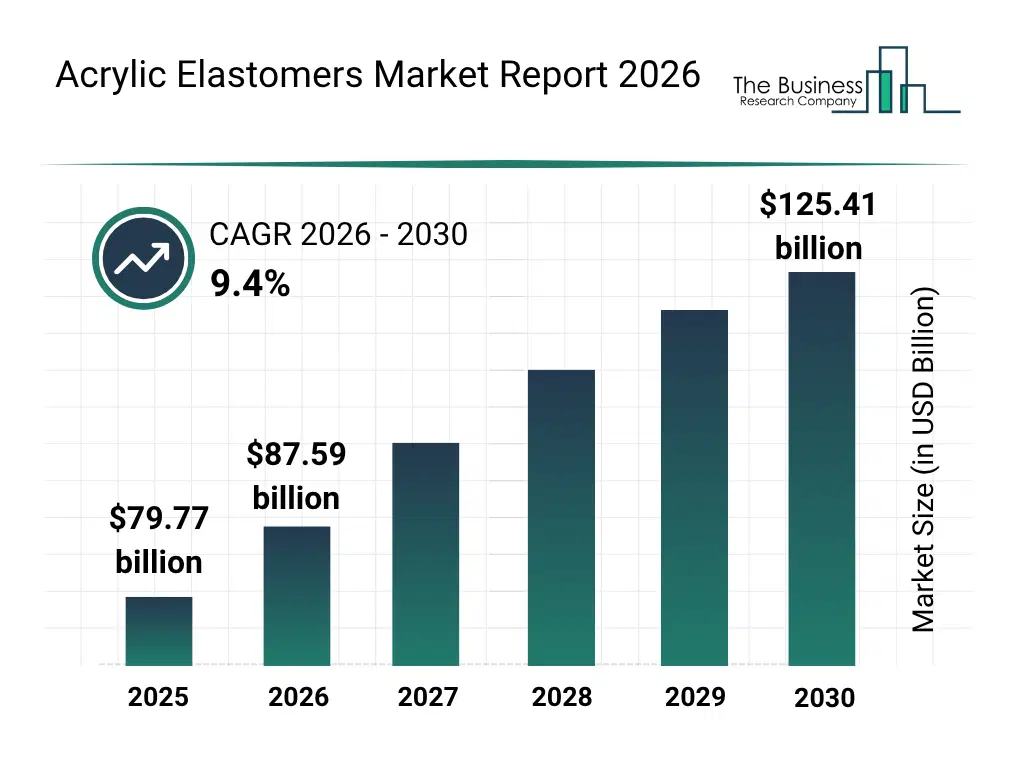
What Is The Acrylic Elastomers Market Size and Share 2026?
The acrylic elastomers market size has grown strongly in recent years. It will grow from $79.77 billion in 2025 to $87.59 billion in 2026 at a compound annual growth rate (CAGR) of 9.8%. The growth in the historic period can be attributed to increasing automotive production, rising demand for automotive seals and gaskets, growing industrial equipment manufacturing, expanding use of high-temperature rubber components, increasing demand for oil-resistant hoses and O-rings.What Is The Acrylic Elastomers Market Growth Forecast?
The acrylic elastomers market size is expected to see strong growth in the next few years. It will grow to $125.41 billion in 2030 at a compound annual growth rate (CAGR) of 9.4%. The growth in the forecast period can be attributed to growing adoption of electric vehicles, rising demand for lightweight automotive components, increasing use of high-performance sealing materials, expanding industrial automation equipment, growing demand for long-life elastomer components. Major trends in the forecast period include increasing demand for heat-resistant acrylic elastomers, rising adoption of oil-resistant rubber components, growing use of high-flexibility elastomers in automotive applications, expanding demand for durable sealing components, increasing preference for weather-resistant synthetic rubber materials.Tariff Impact On Acrylic Elastomers Market
Tariffs are impacting the acrylic elastomers market by increasing the cost of imported acrylic ester monomers, specialty rubber compounds, processing equipment, and finished elastomer products used in automotive and industrial manufacturing. This is raising production costs and creating supply-chain pressures, particularly in major automotive and manufacturing regions such as Asia-Pacific, North America, and Europe. Acrylic Co Monomer Elastomer and Ethylene Acrylic Elastomer segments, along with injection molding, compression molding, and extrusion applications, are most affected because of their dependence on globally sourced raw materials and components. However, tariffs are also encouraging regional sourcing, domestic elastomer production, supplier diversification, and investment in localized manufacturing capabilities, strengthening long-term supply resilience.
Global Acrylic Elastomers Market Segmentation
2) By Processing Method: Injection Molding, Compression Molding, Transfer Molding, Extrusion 3) By Form: Solid, Liquid, Compound Or Pre Mixed Rubber 4) By Distribution Channel: Direct Sales to Original Equipment Manufacturers, Distributors And Dealers, Online Sales 5) By Application: Automotive, Construction, Industrial, Other Applications Subsegments: 1) By Acrylic Co Monomer Elastomer: Low Temperature Resistance Acrylic Co Monomer Elastomer Type, General Purpose Acrylic Co Monomer Elastomer Type, High Heat Resistance Acrylic Co Monomer Elastomer Type, Oil Resistant Acrylic Co Monomer Elastomer Type 2) By Ethylene Acrylic Elastomers: Standard Ethylene Acrylic Elastomer Type, High Heat Resistance Ethylene Acrylic Elastomer Type, High Oil Resistance Ethylene Acrylic Elastomer Type, High Flexibility Ethylene Acrylic Elastomer TypeWhat Are The Drivers Of The Acrylic Elastomers Market?
The expansion of the automotive industry is expected to propel the growth of the acrylic elastomers market going forward. The automotive industry refers to the sector involved in the design, manufacturing, sale, and maintenance of passenger vehicles, commercial vehicles, and other motor vehicles that require a wide range of engineered materials and components. The automotive industry is expanding due to rising vehicle production, increasing demand for passenger and commercial vehicles, and growing adoption of advanced vehicle technologies. The expansion of the automotive industry helps acrylic elastomers by increasing demand for durable seals, gaskets, hoses, O-rings, and other automotive components that require excellent resistance to heat, oils, fuels, ozone, and weathering. For instance, in April 2026, according to the International Organization of Motor Vehicle Manufacturers (OICA), a France-based international automotive industry organization, global vehicle production increased from 92.7 million units in 2024 to 96.4 million units in 2025, representing a 3.9% increase. In addition, global vehicle sales increased from 95.3 million units in 2024 to 99.8 million units in 2025, representing a 4.7% increase during the same period. Therefore, the expansion of the automotive industry is driving the growth of the acrylic elastomers industry. The increasing adoption of gasoline turbocharged engines is expected to propel the growth of the acrylic elastomers market going forward. Gasoline turbocharged engines use exhaust-driven turbochargers to force additional air into the engine, enabling smaller engines to deliver higher power and improved fuel efficiency. The adoption of turbocharged gasoline engines is increasing as automakers use engine downsizing and advanced combustion technologies to improve vehicle performance and fuel economy. Acrylic elastomers support adoption of gasoline turbocharged engines by providing heat-, oil-, oxidation-, and weather-resistant sealing materials for engine components exposed to elevated temperatures, lubricants, and demanding operating conditions. In February 2026, the U.S. Environmental Protection Agency (EPA), a US-based environmental agency, reported preliminary 2025 vehicle technology data showing that gasoline turbocharged engines accounted for 44.8% of new vehicle production with gasoline engines, compared with 44.4% in 2024. Therefore, the increasing adoption of gasoline turbocharged engines is driving the growth of the acrylic elastomers industry.Key Players In The Global Acrylic Elastomers Market
Major companies operating in the acrylic elastomers market are BASF SE, Celanese Corporation, Dow Inc., Mitsui Chemicals Inc., Kuraray Co. Ltd., ZEON CORPORATION, Avient Corporation, Arkema S.A., NOK CORPORATION, Trelleborg AB, Denka Company Limited, HEXPOL AB, DER-GOM s.r.l., GE MAO RUBBER INDUSTRIAL CO. LTD., CLWYD COMPOUNDERS LTD., Lopigom S.p.A., Kremer Technology GmbH, ZORGE Rubber Solutions GmbH, Polmann India Ltd, Chengdu Dowhon Industry Co. Ltd., Rubbermex S.A. de C.V., CHANG HORING RUBBER CO. LTD, Unique Autorubber Udyog Pvt. Ltd.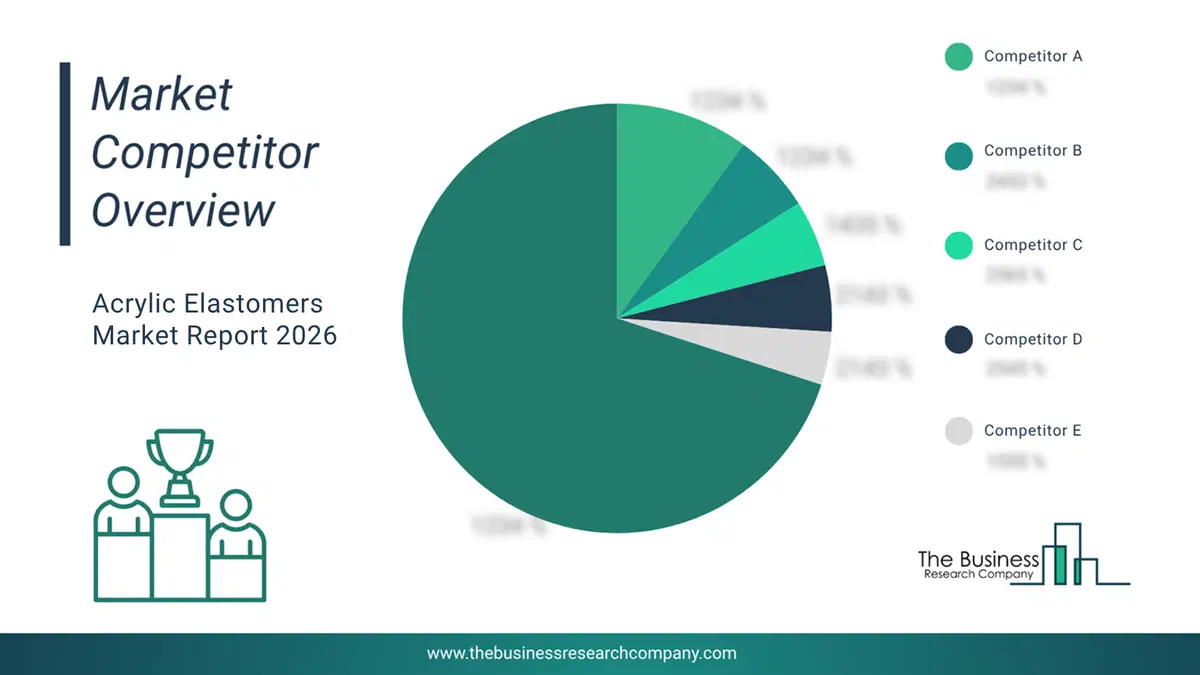
This chart is for illustrative purposes; the full report includes a detailed competitor analysis and comprehensive overview of the top 10 companies in the market.
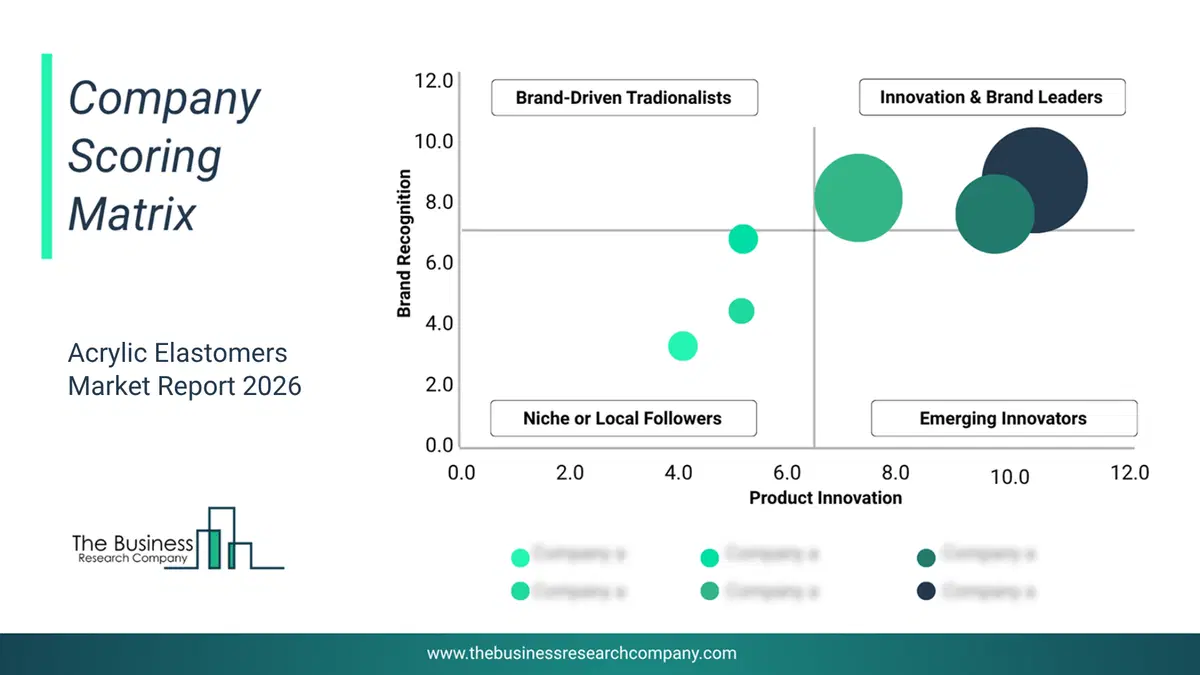
This chart maps companies by product innovation and brand strength, with bubble size indicating relative revenue, helping identify market leaders, challengers, and niche players. This is an illustrative chart; the full report provides a complete and accurate competitive analysis.
Global Acrylic Elastomers Market Trends and Insights
Major companies operating in the acrylic elastomers market are focusing on optimizing acrylic elastomer manufacturing footprints, such as consolidating production activities into existing infrastructure, to improve operational efficiency and reduce manufacturing costs. Manufacturing footprint optimization refers to the strategic consolidation or restructuring of production facilities and operations to improve capacity utilization, streamline manufacturing processes, and achieve cost efficiencies. For instance, in August 2025, Celanese Corporation, a US-based specialty materials manufacturer, announced plans to exit its Vamac® elastomer manufacturing location in Sarnia, Ontario, Canada, as part of its manufacturing footprint optimization strategy. The production activities are expected to be absorbed into Celanese’s existing infrastructure, with the initiative anticipated to generate approximately $5 million to $10 million in cost savings in 2026. These initiatives enable acrylic elastomer manufacturers to streamline production operations, optimize manufacturing resources, and improve cost efficiency.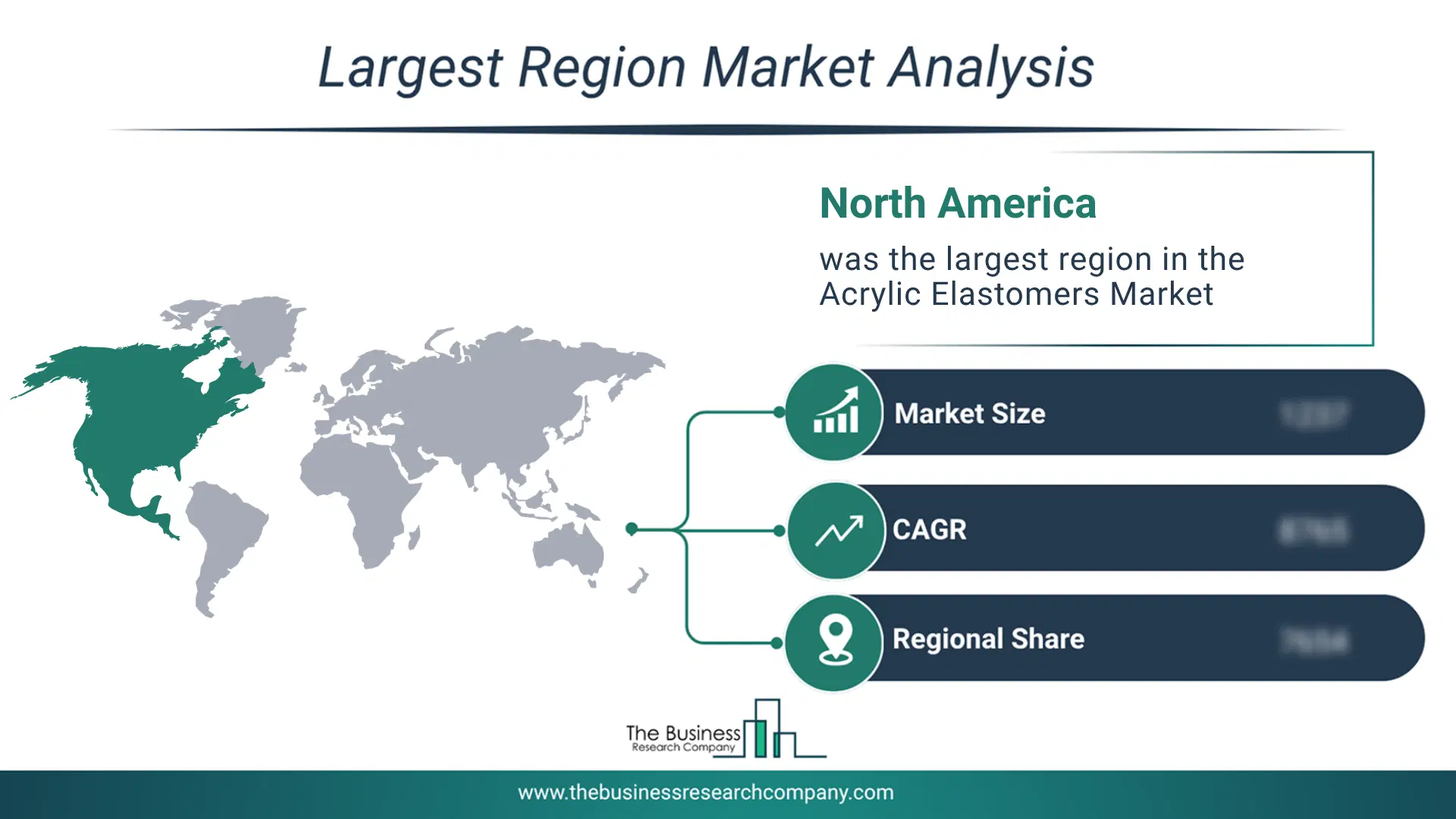
Regional Outlook/Insights
North America was the largest region in the acrylic elastomers market in 2025. Asia-Pacific is expected to be the fastest-growing region in the forecast period. The regions covered in this market report are Asia-Pacific, South East Asia, Western Europe, Eastern Europe, North America, South America, Middle East, Africa. The countries covered in this market report are Australia, Brazil, China, France, Germany, India, Indonesia, Japan, Taiwan, Russia, South Korea, UK, USA, Canada, Italy, Spain.What Defines the Acrylic Elastomers Market?
The acrylic elastomers market consists of sales of acrylic elastomer materials and products, including acrylic rubber blends and acrylic elastomer-based components such as transmission seals, vibration dampers, and gasket materials. Values in this market are ‘factory gate’ values, that is, the value of goods sold by the manufacturers or creators of the goods, whether to other entities (including downstream manufacturers, wholesalers, distributors, and retailers) or directly to end customers. The value of goods in this market includes related services sold by the creators of the goods.How is Market Value Defined and Measured?
The market value is defined as the revenues that enterprises gain from the sale of goods and/or services within the specified market and geography through sales, grants, or donations in terms of the currency (in USD unless otherwise specified). The revenues for a specified geography are consumption values that are revenues generated by organizations in the specified geography within the market, irrespective of where they are produced. It does not include revenues from resales along the supply chain, either further along the supply chain or as part of other products.
This chart presents market attractiveness based on a quantitative evaluation of growth, competition, strategic alignment, and risk, offering a clear view of opportunity areas for decision-making. This chart is for illustrative purposes; the full report contains the complete analysis.

This chart highlights the Total Addressable Market (TAM) by estimating the maximum revenue opportunity using an assumption-driven approach, supporting strategic planning and opportunity sizing across markets. The chart is illustrative; the full report provides a more comprehensive analysis.
What Key Data and Analysis Are Included in the Acrylic Elastomers Market Report 2026?
The acrylic elastomers market research report is one of a series of new reports from The Business Research Company that provides market statistics, including industry global market size, regional shares, competitors with the market share, detailed market segments, market trends and opportunities, and any further data you may need to thrive in the acrylic elastomers industry. The market research report delivers a complete perspective of everything you need, with an in-depth analysis of the current and future state of the industry.Acrylic Elastomers Market Report Forecast Analysis
| Report Attribute | Details |
|---|---|
| Market Size Value In 2026 | $87.59 billion |
| Revenue Forecast In 2030 | $125.41 billion |
| Growth Rate | CAGR of 9.4% from 2026 to 2035 |
| Base Year For Estimation | 2025 |
| Actual Estimates/Historical Data | 2020-2025 |
| Forecast Period | 2026 - 2030 |
| Market Representation | Revenue in USD Billion and CAGR from 2026 to 2030 |
| Segments Covered | Type, Processing Method, Form, Distribution Channel, Application |
| Regional Scope | Asia-Pacific, Western Europe, Eastern Europe, North America, South America, Middle East, Africa |
| Country Scope | The countries covered in the report are Australia, Brazil, China, France, Germany, India, Indonesia, Japan, Taiwan, Russia, South Korea, UK, USA, Canada, Italy, Spain. |
| Customization Scope | Request for Customization |
| Pricing And Purchase Options | Explore Purchase Options |