
Advanced Authentication In Defense Market Report 2026
Global Outlook – By Component (Hardware Components, Software Solutions, Services), By Technology Type (Biometric Authentication, Multi-Factor Authentication (MFA), Public Key Infrastructure (PKI), Behavioral Biometrics), By Deployment Mode (On-Premises Authentication, Cloud-based Authentication), By Application Area (Identity Management, Access Control, Secure Communications, Data Protection), By User Type (Military Personnel, Government Agencies, Defense Contractors, Cybersecurity Professionals) – Market Size, Trends, Strategies, and Forecast to 2030
Advanced Authentication In Defense Market Overview
• Advanced Authentication In Defense market size has reached to $1.43 billion in 2025 • Expected to grow to $2.4 billion in 2030 at a compound annual growth rate (CAGR) of 10.8% • Growth Driver: The Increasing Cybersecurity Threats Is Fueling The Market Growth Due To Rising Vulnerabilities In Defense Systems • Market Trend: SOFTwarfare Launches Multimodal Biometric Authentication Platform To Strengthen Advanced Defense Security Systems • North America was the largest region in 2025 and Asia-Pacific is the fastest growing region.What Is Covered Under Advanced Authentication In Defense Market?
Advanced authentication in defense refers to the use of sophisticated, multi-layered security methods to verify the identity of users, devices, or systems accessing classified or mission-critical defense networks, systems, or facilities. These methods are essential in defense environments to protect sensitive military data, ensure secure communications, and support cybersecurity resilience against evolving threats such as cyber espionage, insider attacks, and foreign adversary infiltration. The main components of advanced authentication in defense are hardware components, software solutions, and services. Hardware components refer to physical devices such as biometric scanners and smart cards that enable secure identity verification and access control. The various technologies involved are biometric authentication, multi-factor authentication (MFA), public key infrastructure (PKI), and behavioral biometrics, and they can be deployed through on-premises or cloud-based authentication models. They are used across several application areas, including identity management, access control, secure communications, and data protection, and serve a range of user types, such as military personnel, government agencies, defense contractors, and cybersecurity professionals.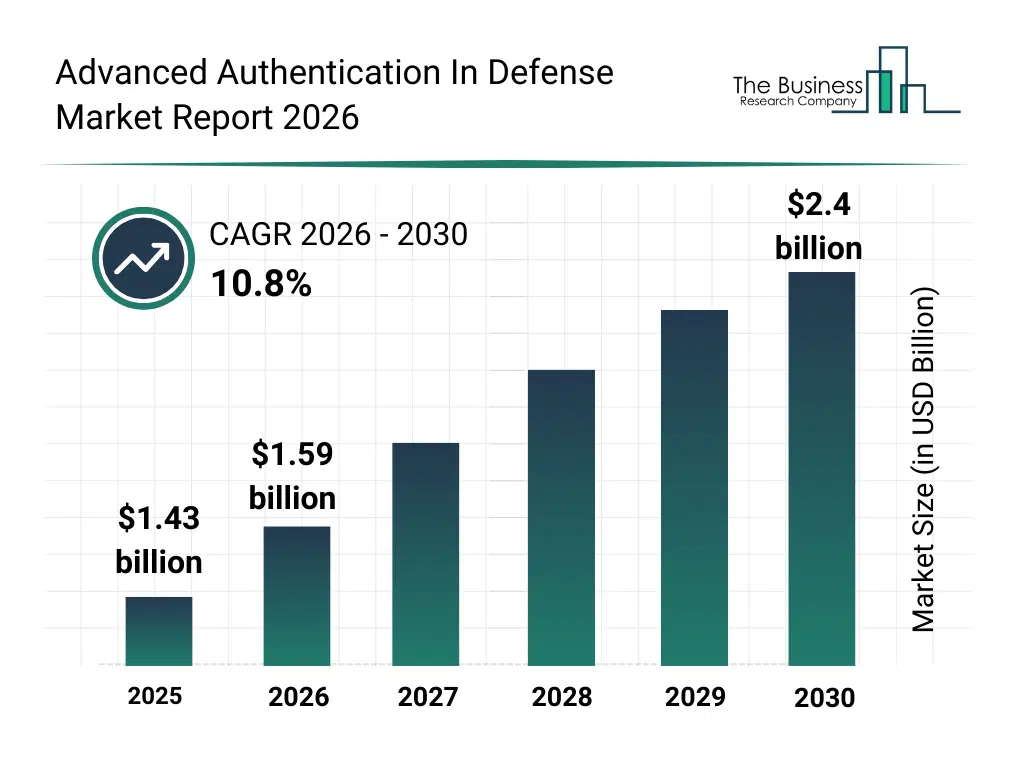
What Is The Advanced Authentication In Defense Market Size and Share 2026?
The advanced authentication in defense market size has grown rapidly in recent years. It will grow from $1.43 billion in 2025 to $1.59 billion in 2026 at a compound annual growth rate (CAGR) of 11.2%. The growth in the historic period can be attributed to increasing cyber threats targeting defense networks, adoption of token-based and hardware authentication solutions, implementation of identity and access management systems in military organizations, deployment of smart cards and common access cards for personnel, integration of single sign-on (SSO) solutions to streamline secure access.What Is The Advanced Authentication In Defense Market Growth Forecast?
The advanced authentication in defense market size is expected to see rapid growth in the next few years. It will grow to $2.4 billion in 2030 at a compound annual growth rate (CAGR) of 10.8%. The growth in the forecast period can be attributed to growing adoption of risk-based and behavioral analytics authentication methods, expansion of cloud-based authentication solutions in defense, rising demand for mobile device authentication in operational environments, advancements in public key infrastructure (PKI) technologies, increasing focus on multi-layered and adaptive authentication to counter sophisticated cyber threats. Major trends in the forecast period include increasing reliance on multi-layered defense authentication frameworks, rising demand for secure identity verification for classified missions, greater adoption of token-based and card-based access solutions, growing usage of authentication tools to combat insider threats, expansion of authentication requirements across joint military operations.
Global Advanced Authentication In Defense Market Segmentation
1) By Component: Hardware Components, Software Solutions, Services 2) By Technology Type: Biometric Authentication, Multi-Factor Authentication (MFA), Public Key Infrastructure (PKI), Behavioral Biometrics 3) By Deployment Mode: On-Premises Authentication, Cloud-based Authentication 4) By Application Area: Identity Management, Access Control, Secure Communications, Data Protection 5) By User Type: Military Personnel, Government Agencies, Defense Contractors, Cybersecurity Professionals Subsegments: 1) By Hardware Components: Biometric Scanners, Smart Cards, Security Tokens, Authentication Readers, Hardware Security Modules (HSMs) 2) By Software Solutions: Identity And Access Management (IAM) Software, Multi-Factor Authentication (MFA) Software, Public Key Infrastructure (PKI) Software, Biometric Authentication Software, Risk-Based Authentication Software 3) By Services: Consulting Services, Integration And Deployment Services, Support And Maintenance Services, Managed Authentication Services, Training And Education ServicesWhat Is Driver Of The Advanced Authentication In Defense Market?
The increasing cybersecurity threats are expected to propel the growth of advanced authentication in the defense market going forward. Cybersecurity threats refer to potential malicious attacks or unauthorized actions that target computer systems, networks, or data, aiming to steal, damage, or disrupt digital operations. The increasing cybersecurity threats in defense are primarily due to the growing reliance on interconnected digital systems, which expand the attack surface and create more entry points for potential cyber intrusions, data breaches, and system disruptions. Advanced authentication in defense enhances cybersecurity by ensuring that only verified and authorized personnel can access sensitive military systems and networks, reducing the risk of data breaches and cyberattacks. For instance, in November 2024, according to the report published by the Department of Defence, an Australia-based government department, the Australian Signals Directorate (ASD) received more than 36,700 cybercrime calls to its Australian Cyber Security Hotline in 2023–24, marking a 12% increase from the previous financial year. Therefore, the increasing cybersecurity threats are driving the growth of the advanced authentication in defense industry.Key Players In The Global Advanced Authentication In Defense Market
Major companies operating in the advanced authentication in defense market are Dell Technologies Inc., Broadcom Inc., Fujitsu Limited, NEC Corporation, Thales Group S.A., Atos SE, Booz Allen Hamilton Inc., General Dynamics Information Technology Inc., IDEMIA Group, Ping Identity Holding Corp., OneSpan Inc., ForgeRock Inc., Accops Systems Pvt. Ltd., iProov Ltd., Sekoia.io SAS, Aware Inc., Secret Double Octopus Ltd., Veridium Ltd., SurePassID Corporation, Biometric Signature ID LLC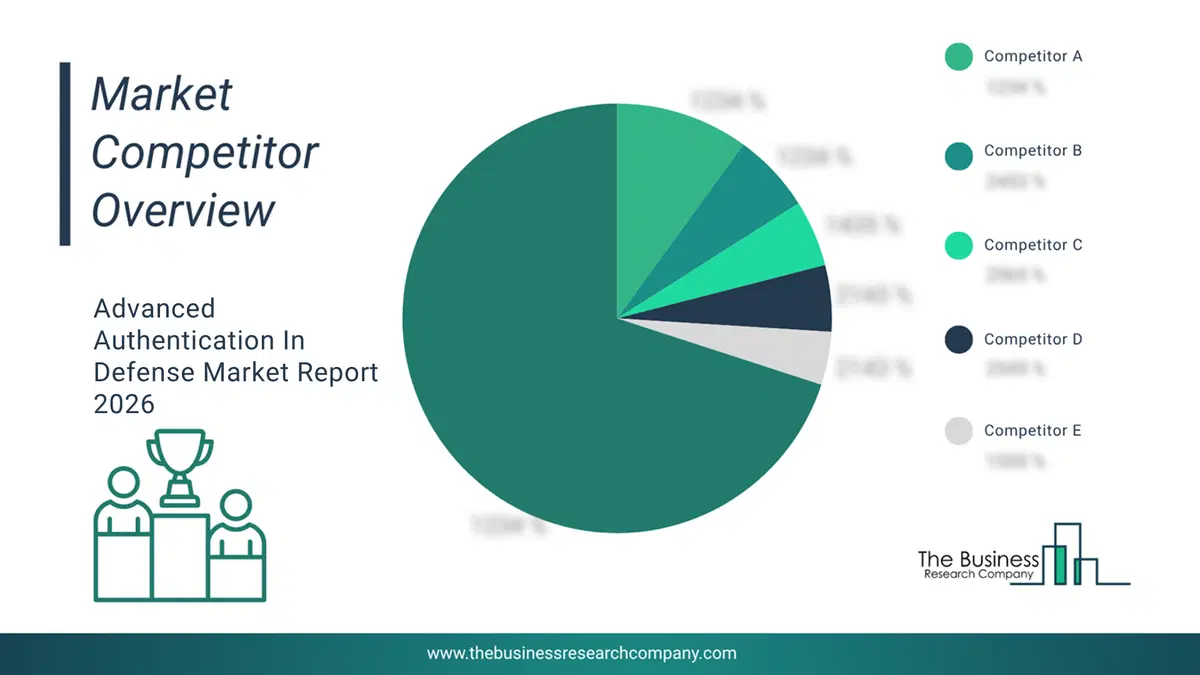
This chart is for illustrative purposes; the full report includes a detailed competitor analysis and comprehensive overview of the top 10 companies in the market.
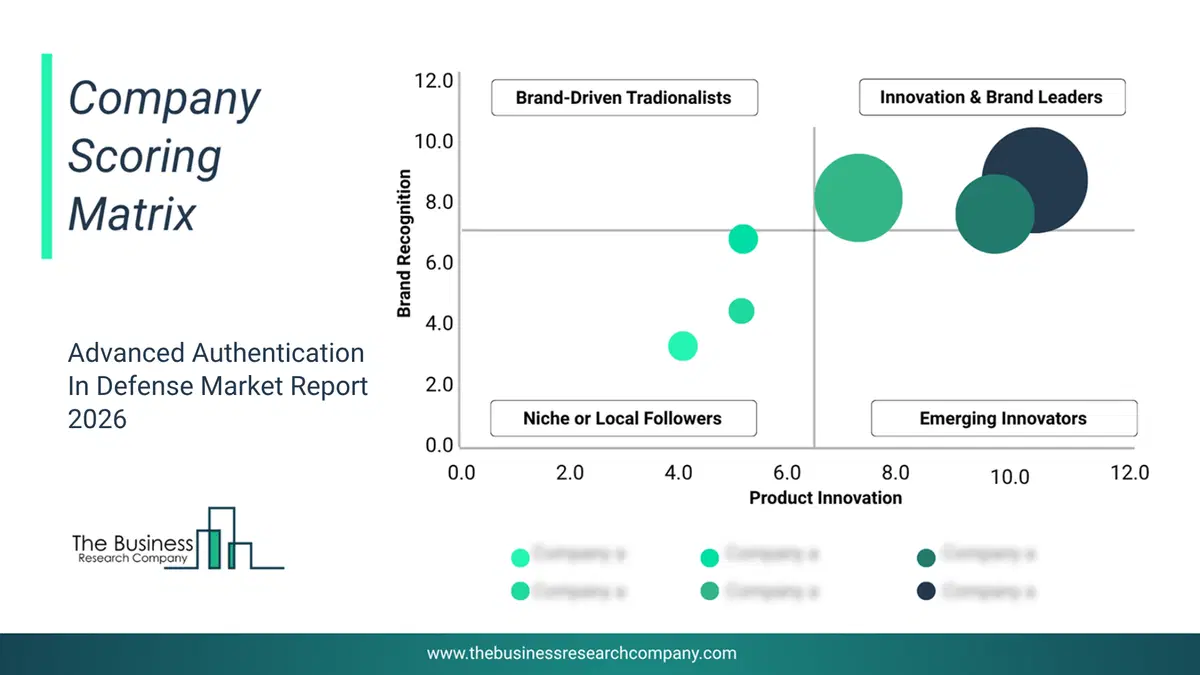
This chart maps companies by product innovation and brand strength, with bubble size indicating relative revenue, helping identify market leaders, challengers, and niche players. This is an illustrative chart; the full report provides a complete and accurate competitive analysis.
Global Advanced Authentication In Defense Market Trends and Insights
Major companies operating in the advanced authentication in defense market are focusing on developing innovative solutions, such as multimodal biometric authentication, to enhance security, improve identity verification accuracy, and prevent unauthorized access. Multimodal biometric authentication is a security system that verifies a user's identity using two or more biometric traits, such as fingerprint, facial recognition, iris scan, or voice. It helps improve security and accuracy by reducing the risk of spoofing or false matches when relying on a single biometric factor. For instance, in October 2024, SOFTwarfare LLC, a US-based provider of Zero Trust Identity solutions, unveiled a revolutionary multimodal biometric authentication platform tailored for Joint All-Domain Command and Control (JADC2) environments at the AUSA Annual Meeting & Exposition, aiming to enhance security, improve identity verification accuracy, and prevent unauthorized access within Department of Defense operations. The platform integrates multiple biometric modalities, such as fingerprint, facial recognition, and voice authentication, into a unified system, significantly reducing the likelihood of identity spoofing or false positives. Additionally, it incorporates advanced features such as User and Entity Behavioral Analytics (UEBA) for real-time risk assessment and supports deployment in air-gapped, cloud, and hybrid defense infrastructures.What Are Latest Mergers And Acquisitions In The Advanced Authentication In Defense Market? SAIC Acquired Silveredge Government Solutions To Strengthen National Security And Cybersecurity Capabilities
In October 2025, SAIC (Science Applications International Corp), a US-based technology integrator and government services company, acquired SilverEdge Government Solutions for an undisclosed amount. With this acquisition, SAIC (Science Applications International Corp.) aims to advance SAIC’s strategy of providing mission-focused, commercial-grade technology solutions for national security, including the integration of SilverEdge’s agile, low-risk, and customizable SaaS offerings. SilverEdge Government Solutions is a US-based defense and intelligence technology company that offers advanced authentication within its cybersecurity solutions for the defense and intelligence sectors.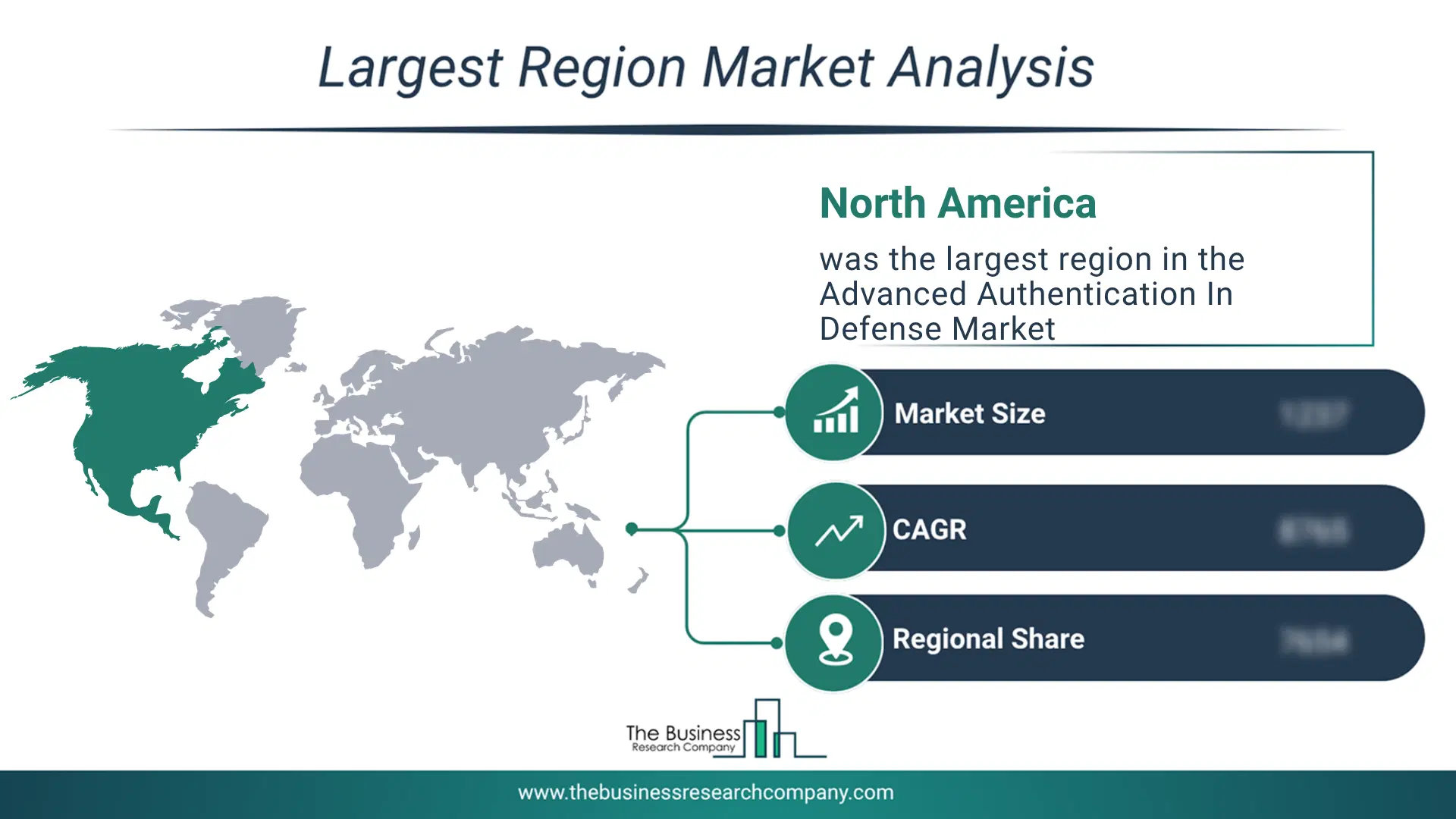
Regional Insights
North America was the largest region in the advanced authentication in defense market in 2025. Asia-Pacific is expected to be the fastest-growing region in the forecast period. The regions covered in this market report are Asia-Pacific, South East Asia, Western Europe, Eastern Europe, North America, South America, Middle East, Africa. The countries covered in this market report are Australia, Brazil, China, France, Germany, India, Indonesia, Japan, Taiwan, Russia, South Korea, UK, USA, Canada, Italy, SpainWhat Defines the Advanced Authentication In Defense Market?
The advanced authentication in defense market consists of revenues earned by entities by providing services such as token-based authentication, single sign-on (SSO), identity and access management (IAM), risk-based authentication, and cloud authentication. The market value includes the value of related goods sold by the service provider or included within the service offering. The advanced authentication in defense market also includes sales of public key infrastructure (PKI) systems, smart cards and common access cards (CACs), one-time password (OTP) generators, behavioral analytics tools, and mobile device authentication solutions. Values in this market are ‘factory gate’ values, that is the value of goods sold by the manufacturers or creators of the goods, whether to other entities (including downstream manufacturers, wholesalers, distributors and retailers) or directly to end customers. The value of goods in this market includes related services sold by the creators of the goods.How is Market Value Defined and Measured?
The market value is defined as the revenues that enterprises gain from the sale of goods and/or services within the specified market and geography through sales, grants, or donations in terms of the currency (in USD unless otherwise specified). The revenues for a specified geography are consumption values that are revenues generated by organizations in the specified geography within the market, irrespective of where they are produced. It does not include revenues from resales along the supply chain, either further along the supply chain or as part of other products.
This chart presents market attractiveness based on a quantitative evaluation of growth, competition, strategic alignment, and risk, offering a clear view of opportunity areas for decision-making. This chart is for illustrative purposes; the full report contains the complete analysis.

This chart highlights the Total Addressable Market (TAM) by estimating the maximum revenue opportunity using an assumption-driven approach, supporting strategic planning and opportunity sizing across markets. The chart is illustrative; the full report provides a more comprehensive analysis.
What Key Data and Analysis Are Included in the Advanced Authentication In Defense Market Report 2026?
The advanced authentication in defense market research report is one of a series of new reports from The Business Research Company that provides market statistics, including industry global market size, regional shares, competitors with the market share, detailed market segments, market trends and opportunities, and any further data you may need to thrive in the advanced authentication in defense industry. The market research report delivers a complete perspective of everything you need, with an in-depth analysis of the current and future state of the industry.Advanced Authentication In Defense Market Report Forecast Analysis
| Report Attribute | Details |
|---|---|
| Market Size Value In 2026 | $1.59 billion |
| Revenue Forecast In 2030 | $2.4 billion |
| Growth Rate | CAGR of 10.8% from 2026 to 2030 |
| Base Year For Estimation | 2025 |
| Actual Estimates/Historical Data | 2020-2025 |
| Forecast Period | 2026 - 2030 |
| Market Representation | Revenue in USD Billion and CAGR from 2026 to 2030 |
| Segments Covered | Component, Technology Type, Deployment Mode, Application Area, User Type |
| Regional Scope | Asia-Pacific, Western Europe, Eastern Europe, North America, South America, Middle East, Africa |
| Country Scope | The countries covered in the advanced authentication in defense market report are Australia, Brazil, China, France, Germany, India, Indonesia, Japan, Taiwan, Russia, South Korea, UK, USA, Canada, Italy, Spain |
| Key Companies Profiled | Dell Technologies Inc., Broadcom Inc., Fujitsu Limited, NEC Corporation, Thales Group S.A., Atos SE, Booz Allen Hamilton Inc., General Dynamics Information Technology Inc., IDEMIA Group, Ping Identity Holding Corp., OneSpan Inc., ForgeRock Inc., Accops Systems Pvt. Ltd., iProov Ltd., Sekoia.io SAS, Aware Inc., Secret Double Octopus Ltd., Veridium Ltd., SurePassID Corporation, Biometric Signature ID LLC |
| Customization Scope | Request for Customization |
| Pricing And Purchase Options | Explore Purchase Options |