
Advanced Biofuels Market Report 2026
Global Outlook – By Fuel Type (Cellulosic Ethanol, Biofuel, Biobutanol, BioDME, Other Fuel Types), By Processing Technology (Thermochemical, Biochemical), By Raw Material (Jatropha, Camelina, Algae, Simple Lignocellulose, Other Raw Materials) – Market Size, Trends, Strategies, and Forecast to 2030
Advanced Biofuels Market Overview
• Advanced Biofuels market size has reached to $163.89 billion in 2025 • Expected to grow to $923.84 billion in 2030 at a compound annual growth rate (CAGR) of 41.6% • Growth Driver: Surging Aerospace Industry's Role In Driving Growth For Advanced Biofuels • Market Trend: Technological Breakthroughs In Advanced Biofuels Market • North America was the largest region in 2025 and Asia-Pacific is the fastest growing region.Market Gains By 2030 – Top Opportunities By Segment
Market Gain identifies the most promising market opportunities by highlighting the segments or products expected to generate the highest incremental revenue growth over the next five years.
What Is Covered Under Advanced Biofuels Market?
Advanced biofuels are liquid fuels that, when compared to fossil fuels, have a lifecycle greenhouse gas emissions reduction of at least 50%. They are often sourced from non-food-based feedstocks. Biofuels are made from regenerative organic materials and serve as alternatives to liquid petroleum fuels. The main types of advanced biofuels are cellulosic ethanol, biofuel, biobutanol, bio DME, and others, which are processed by various types of technology, such as thermochemical and biochemical. Cellulosic ethanol refers to a second-generation biofuel that is produced by turning vegetation unfit for human consumption into ethyl alcohol (ethanol). Several raw materials involved are jatropha, camelina, algae, simple lignocellulose, and others.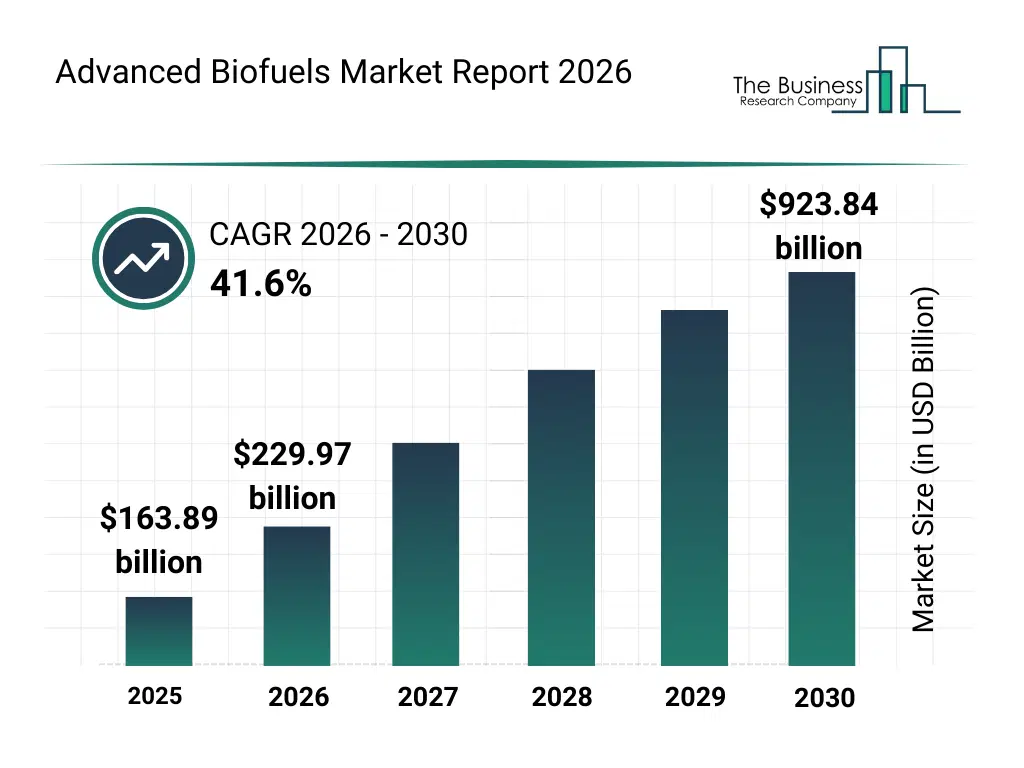
What Is The Advanced Biofuels Market Size and Share 2026?
The advanced biofuels market size has grown exponentially in recent years. It will grow from $163.89 billion in 2025 to $229.97 billion in 2026 at a compound annual growth rate (CAGR) of 40.3%. The growth in the historic period can be attributed to biofuel blending mandates, fossil fuel price volatility, climate policy initiatives, agricultural residue availability, early biofuel investments.What Is The Advanced Biofuels Market Growth Forecast?
The advanced biofuels market size is expected to see exponential growth in the next few years. It will grow to $923.84 billion in 2030 at a compound annual growth rate (CAGR) of 41.6%. The growth in the forecast period can be attributed to net zero commitments, airline decarbonization targets, advanced refinery investments, carbon credit markets, demand for low-carbon fuels. Major trends in the forecast period include non-food feedstock utilization, scaling of sustainable aviation fuels, second-generation biofuel commercialization, advanced conversion technologies, carbon intensity reduction strategies.
Global Advanced Biofuels Market Segmentation
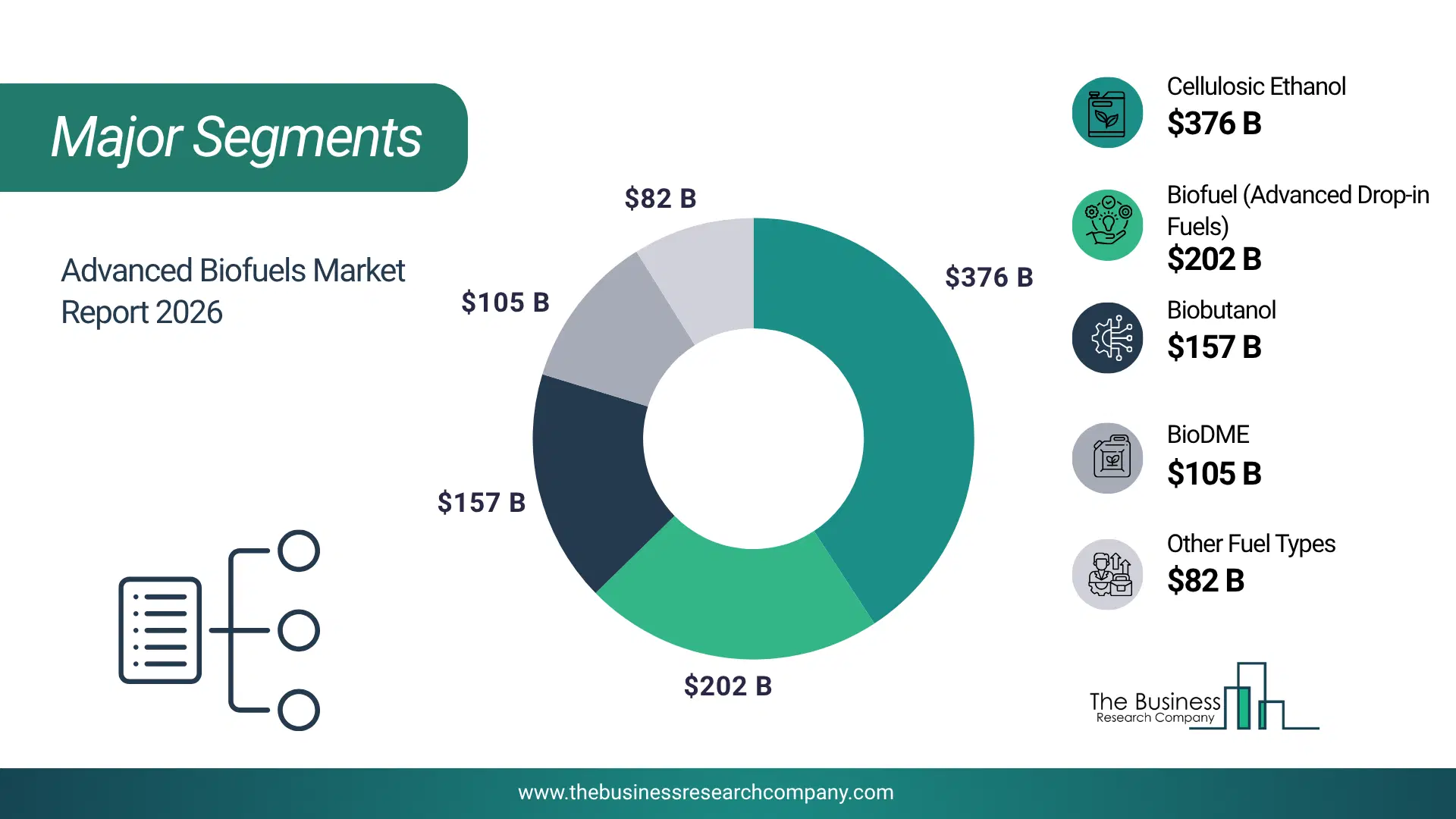
1) By Fuel Type: Cellulosic Ethanol, Biofuel, Biobutanol, BioDME, Other Fuel Types 2) By Processing Technology: Thermochemical, Biochemical 3) By Raw Material: Jatropha, Camelina, Algae, Simple Lignocellulose, Other Raw Materials Subsegments: 1) By Cellulosic Ethanol: Corn Stover, Sugarcane Bagasse, Wood Chips, Other Biomass Feedstocks 2) By Biofuel: Biodiesel, Renewable Diesel, HVO (Hydrotreated Vegetable Oil) 3) By Biobutanol: A-Biobutanol, B-Biobutanol, Other Butanol Types 4) By BioDME: Produced from Biomass, Produced from Methanol 5) By Other Fuel Types: Biogas, Renewable Jet Fuel, Synthetic Fuels The top segments in the advanced biofuels market will be: • Cellulosic Ethanol will reach $375.78 Billion by 2030. • Biofuel (Advanced Drop-in Fuels) will reach $202.16 Billion by 2030. • Biobutanol will reach $156.92 Billion by 2030. • BioDME will reach $104.99 Billion by 2030. • Other Fuel Types will reach $81.63 Billion by 2030.What Is The Driver Of The Advanced Biofuels Market?
The growing aerospace industry is expected to propel the growth of the advanced biofuels market going forward. The aerospace industry refers to the vast and complex sector that includes designing and manufacturing aircraft, launching satellites, and exploring space. The growth of the aerospace industry is driven by increasing global air travel demand and expanding space exploration initiatives. Advanced biofuels, by offering sustainable, high-energy, and low-carbon alternatives to conventional jet fuels, directly support the growing aerospace industry by enabling airlines and manufacturers to meet stringent environmental regulations, reduce greenhouse gas emissions, enhance energy security, and drive innovation in next-generation aircraft technologies. For instance, in June 2023, according to the International Air Transport Association (IATA), a Canada-based international trade organization, the global airline net profit is expected to reach $9.8 billion in 2023, up from $4.7 billion in 2022, and approximately 4.35 billion passengers are expected to travel in 2023. Therefore, the growing aerospace industry is expected to drive the growth of the advanced biofuels industry.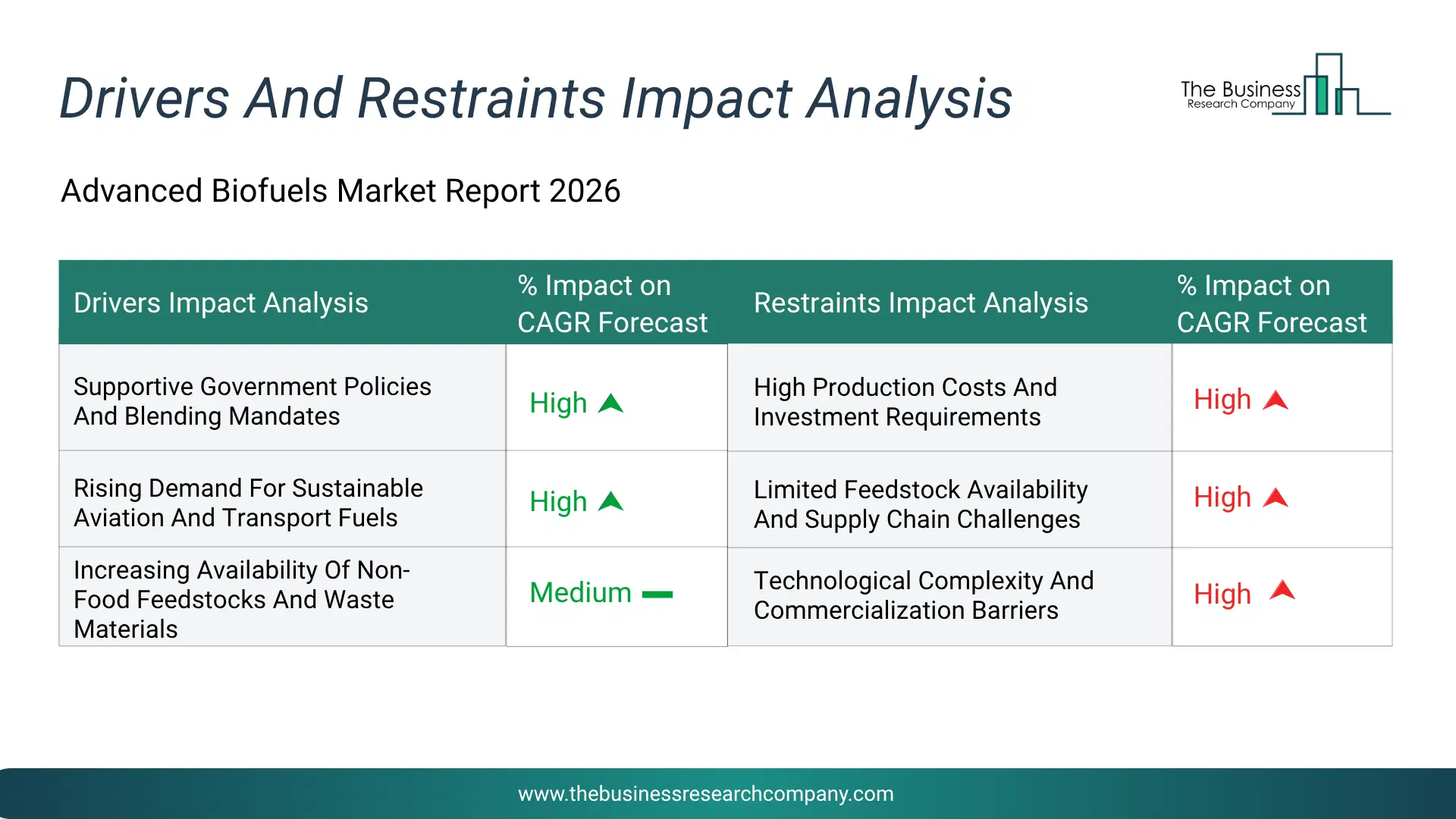
Infographic Chart Showing Key Market Drivers Analysis And Restraints For Advanced Biofuels Market
The chart presents an impact analysis of key drivers and restraints, quantifying their relative influence on the market's growth rate and helping assess the balance between growth enablers and limiting factors. This chart offers a high-level perspective; the full report contains more detailed insights.
How Will The Drivers Impact Growth In The Global Advanced Biofuels Market?
• Supportive Government Policies And Blending Mandates (High) – During the forecast period, the supportive government policies and blending mandates is expected to become a key growth driver for the advanced biofuels market by 2030. Supportive government policies and blending mandates acts as a major driver for the advanced biofuels market because many countries are enforcing regulations that require a certain percentage of biofuels to be mixed with conventional fuels. These mandates create a stable and guaranteed demand for advanced biofuels across transportation and energy sectors. Financial incentives such as tax credits, subsidies, and grants further encourage producers to invest in production capacity and innovation. Regulatory backing also reduces market uncertainty and improves investor confidence. • Rising Demand For Sustainable Aviation And Transport Fuels (High) – During the forecast period, the rising demand for sustainable aviation and transport fuels is expected to emerge as a major factor driving the expansion of the advanced biofuels market by 2030. Rising demand for sustainable aviation and transport fuels acts as a major driver for the advanced biofuels market because the aviation, shipping, and heavy transport sectors are actively seeking low-emission alternatives to conventional fossil fuels. Advanced biofuels provide a practical solution as they can be used with existing engines and infrastructure with minimal modifications. Airlines and logistics companies are increasingly committing to carbon reduction targets, boosting demand for sustainable fuel options. This transition is further supported by international climate agreements and emission reduction goals. • Increasing Availability Of Non-Food Feedstocks And Waste Materials (Medium) – During the forecast period, the increasing availability of non-food feedstocks and waste materials is expected to act as a key growth catalyst for the advanced biofuels market by 2030. Increasing availability of non-food feedstocks and waste materials acts as a major driver for the advanced biofuels market because it enables production without competing with food supply chains. Materials such as agricultural residues, forestry waste, and industrial by-products provide cost-effective and sustainable raw material sources. This reduces dependency on traditional feedstocks and improves the overall economics of biofuel production. Technological advancements have also enhanced the efficiency of converting these materials into usable fuels.How Will The Restraints Impact Growth In The Global Advanced Biofuels Market?
• High Production Costs And Investment Requirements (High) – During the forecast period, the high production costs and investment requirements act as a major restraint in the advanced biofuels market by limiting large-scale commercialization. Advanced biofuels rely on complex conversion technologies and specialized feedstocks, which significantly increase capital expenditure. The need for advanced processing facilities and continuous R&D further raises operational costs for producers. This makes advanced biofuels less price-competitive compared to conventional fossil fuels and even first-generation biofuels. As a result, many investors and companies hesitate to enter or expand in this market, slowing overall growth. • Limited Feedstock Availability And Supply Chain Challenges (High) – During the forecast period, the limited feedstock availability and supply chain challenges restrain the market by creating inconsistencies in raw material supply. Advanced biofuels depend on non-food biomass such as agricultural residues and waste, which are often region-specific and not uniformly available. Seasonal variations and logistical difficulties in collecting, storing, and transporting feedstock increase supply chain complexity. This leads to unstable production volumes and higher procurement costs for manufacturers. Consequently, these constraints hinder continuous production and limit the scalability of advanced biofuel operations. • Technological Complexity And Commercialization Barriers (Medium) – During the forecast period, the technological complexity and commercialization barriers act as restraints by slowing the transition from pilot projects to full-scale production. Many advanced biofuel technologies are still in developmental or early commercialization stages, requiring further validation and optimization. The lack of proven, cost-efficient technologies increases financial risks for stakeholders and delays project approvals. In addition, integration of new technologies into existing fuel infrastructure poses technical and compatibility challenges. These factors collectively restrict widespread adoption and delay market maturity.Key Players In The Global Advanced Biofuels Market
Major companies operating in the advanced biofuels market are Abengoa Bioenergy Co. LLC, Algenol Biofuels Inc., Chemtex Group, Bangchak Corporation Public Company Limited (BCP), Clariant Produkte GmbH, Fiberight LLC, DuPont Industrial Biosciences, GranBio Investimentos S.A., A2BE Carbon Capture LLC, Fujian Zhongde Energy Co. Ltd., Inbicon A/S, INEOS Technologies Limited, Poet-DSM Advanced Biofuel LLC, Green Biologics Ltd., ZeaChem Inc., Sundrop Fuels Inc., Amyris Inc., Gevo Inc., Renewable Energy Group Inc., Novozymes A/S, LanzaTech Inc., Mascoma Corporation, Solazyme Inc., Cool Planet Energy Systems, Enerkem Inc., Butamax Advanced Biofuels LLC, Codexis Inc., Coskata Inc., Aemetis Inc., Iogen Corporation, Siluria Technologies, Kiverdi Inc., Alkol Biotech Inc.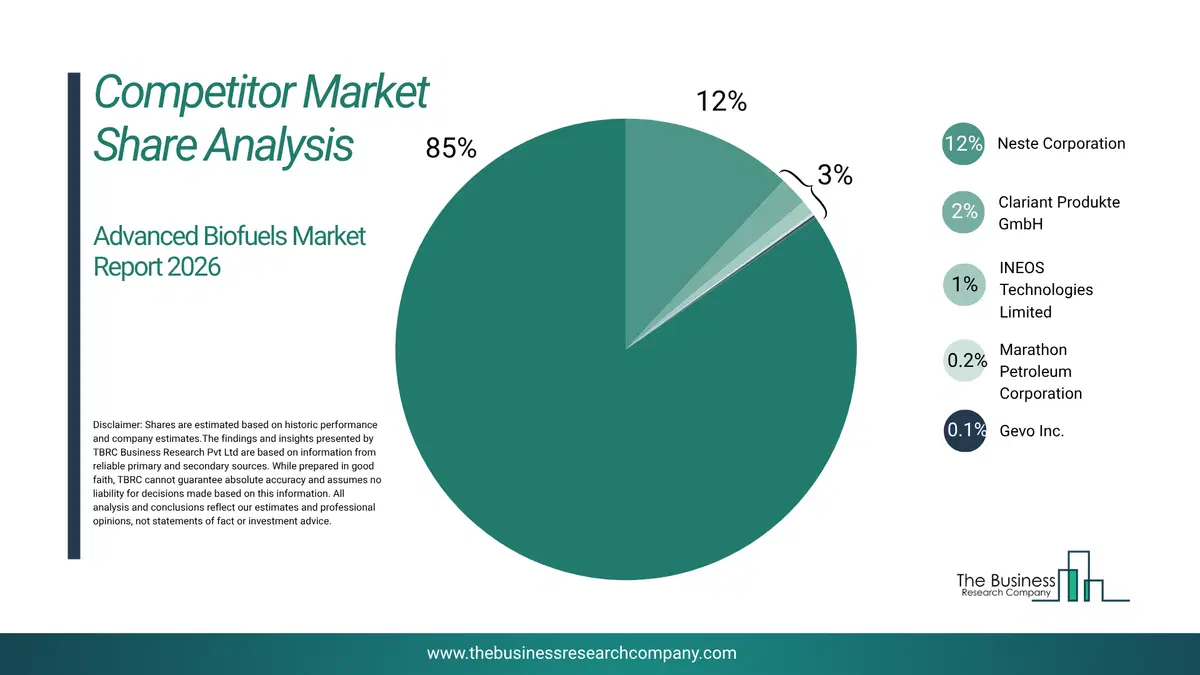
This chart is for illustrative purposes; the full report includes a detailed competitor analysis and comprehensive overview of the top 10 companies in the market.
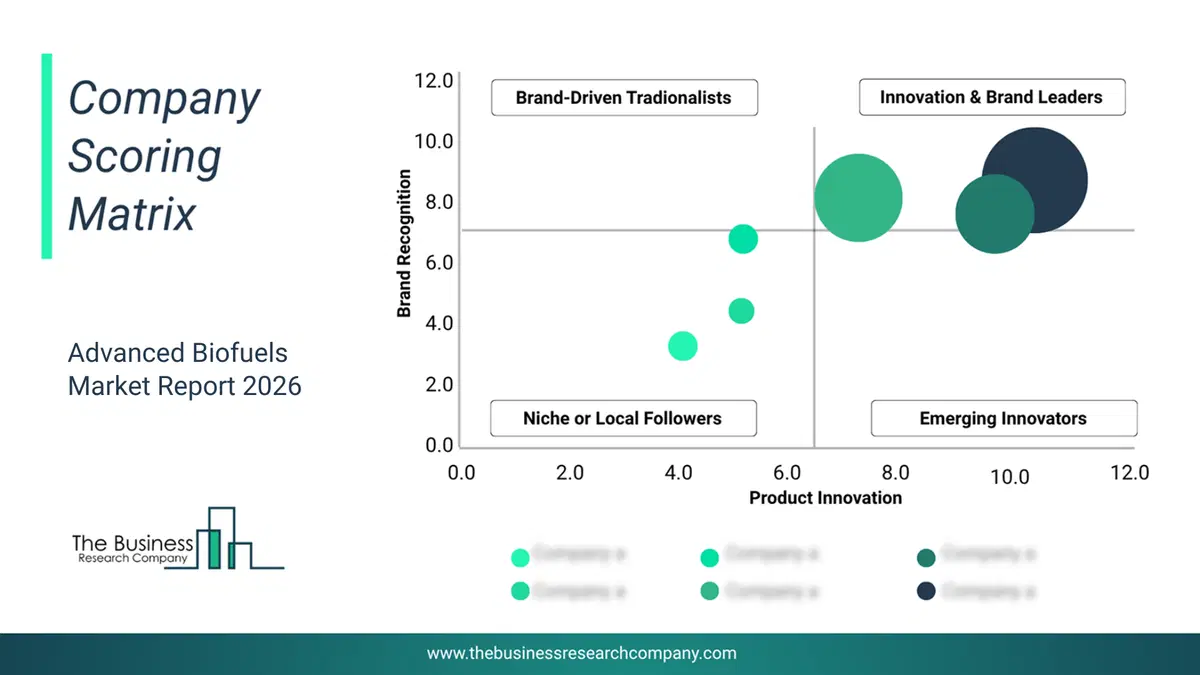
This chart maps companies by product innovation and brand strength, with bubble size indicating relative revenue, helping identify market leaders, challengers, and niche players. This is an illustrative chart; the full report provides a complete and accurate competitive analysis.
Global Advanced Biofuels Market Trends and Insights
Major companies operating in the advanced biofuels market are focused on developing technological innovations, such as sustainable aviation fuel (SAF) process technology, to gain a competitive edge in the market. Sustainable Aviation Fuel (SAF) technology encompasses a range of processes and methods to produce alternative jet fuel from non-petroleum-based, renewable sources. For instance, in September 2023, Lummus Technology LLC, a US-based provider of proprietary petrochemicals, refining, and gasification technologies, launched Ethanol-based SAF Technology. The technology offers a safe, reliable, and large-scale solution for producing SAF from a readily available and renewable source: ethanol. SAF promises significant greenhouse gas reductions, potentially reaching 80% depending on the specific ethanol source and production process.What Are Latest Mergers And Acquisitions In The Advanced Biofuels Market?
In August 2025, Licella Holdings Limited, an Australia-based provider of advanced bioenergy and biorefining technologies focused on converting biomass into renewable fuels and chemicals, acquired Arbios Biotech for an undisclosed amount. Through this acquisition, Licella aimed to accelerate the global commercialization of its proprietary hydrothermal liquefaction (HTL) technology by fully integrating Arbios’ operational capabilities and strengthening its position in the renewable fuels and sustainable chemicals market. Arbios Biotech is a Canada-based provider of biomass conversion and biorefinery development solutions, specializing in the production of low-carbon fuels and biochemicals from renewable feedstocks.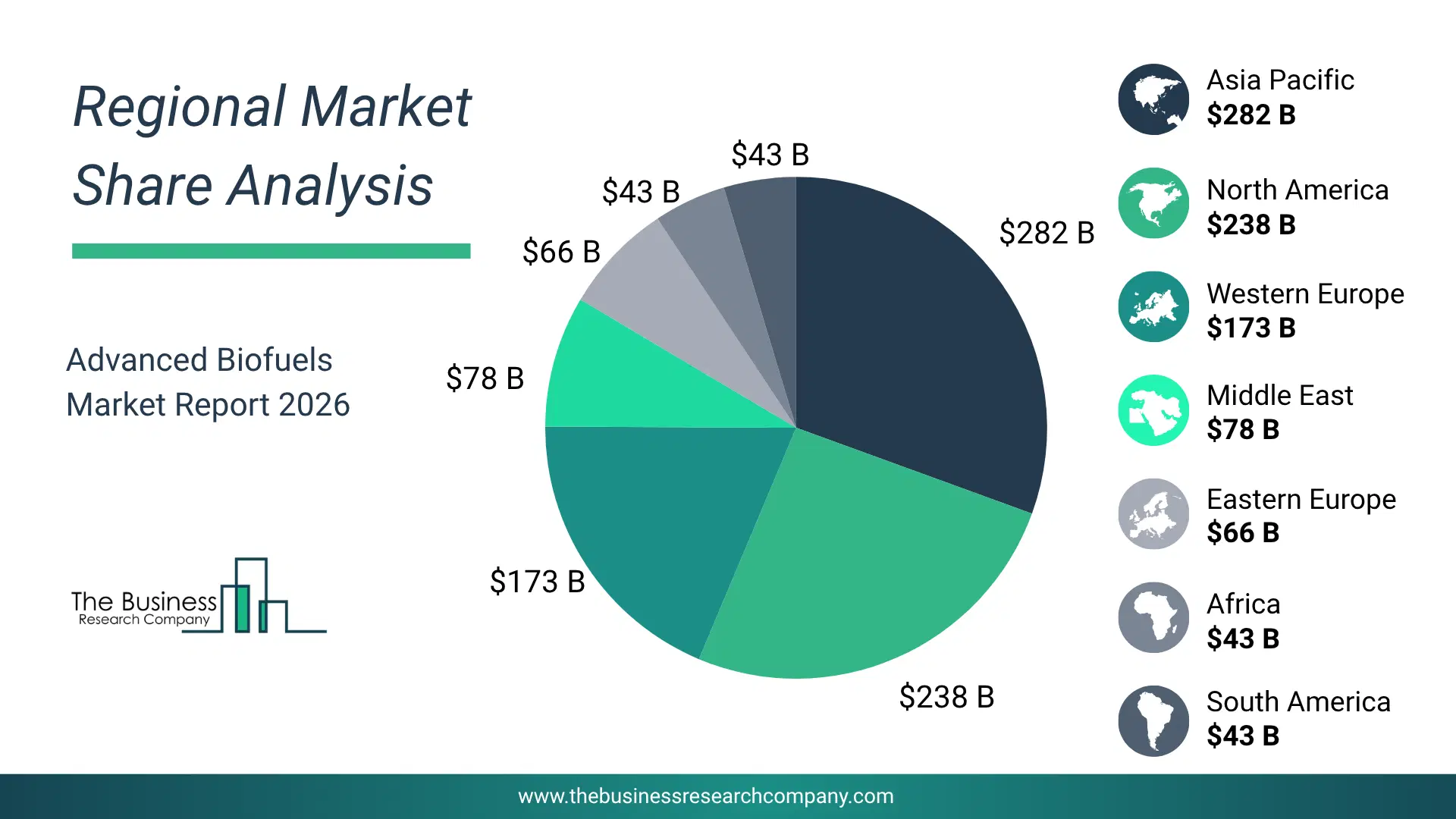
Regional Outlook
North America was the largest region in the advanced biofuels market in 2025.Asia-Pacific is expected to be the fastest-growing region in the global advanced biofuels market report during the forecast period. The regions covered in this market report are Asia-Pacific, South East Asia, Western Europe, Eastern Europe, North America, South America, Middle East, Africa. The countries covered in this market report are Australia, Brazil, China, France, Germany, India, Indonesia, Japan, Taiwan, Russia, South Korea, UK, USA, Canada, Italy, SpainWhat Defines the Advanced Biofuels Market?
The advanced biofuels market consists of sales of corn stover, switchgrass, or methane. Values in this market are ‘factory gate’ values, that is, the value of goods sold by the manufacturers or creators of the goods, whether to other entities (including downstream manufacturers, wholesalers, distributors, and retailers) or directly to end customers. The value of goods in this market includes related services sold by the creators of the goods.How is Market Value Defined and Measured?
The market value is defined as the revenues that enterprises gain from the sale of goods and/or services within the specified market and geography through sales, grants, or donations in terms of the currency (in USD unless otherwise specified). The revenues for a specified geography are consumption values that are revenues generated by organizations in the specified geography within the market, irrespective of where they are produced. It does not include revenues from resales along the supply chain, either further along the supply chain or as part of other products.
This chart presents market attractiveness based on a quantitative evaluation of growth, competition, strategic alignment, and risk, offering a clear view of opportunity areas for decision-making. This chart is for illustrative purposes; the full report contains the complete analysis.

This chart highlights the Total Addressable Market (TAM) by estimating the maximum revenue opportunity using an assumption-driven approach, supporting strategic planning and opportunity sizing across markets. The chart is illustrative; the full report provides a more comprehensive analysis.
What Key Data and Analysis Are Included in the Advanced Biofuels Market Report 2026?
The advanced biofuels market research report is one of a series of new reports from The Business Research Company that provides market statistics, including industry global market size, regional shares, competitors with the market share, detailed market segments, market trends and opportunities, and any further data you may need to thrive in the advanced biofuels industry. The market research report delivers a complete perspective of everything you need, with an in-depth analysis of the current and future state of the industry.Advanced Biofuels Market Report Forecast Analysis
| Report Attribute | Details |
|---|---|
| Market Size Value In 2026 | $229.97 billion |
| Revenue Forecast In 2030 | $923.84 billion |
| Growth Rate | CAGR of 41.6% from 2026 to 2030 |
| Base Year For Estimation | 2025 |
| Actual Estimates/Historical Data | 2020-2025 |
| Forecast Period | 2026 - 2030 |
| Market Representation | Revenue in USD Billion and CAGR from 2026 to 2030 |
| Segments Covered | Fuel Type, Processing Technology, Raw Material |
| Regional Scope | Asia-Pacific, Western Europe, Eastern Europe, North America, South America, Middle East, Africa |
| Country Scope | The countries covered in the report are Australia, Brazil, China, France, Germany, India, Indonesia, Japan, Taiwan, Russia, South Korea, UK, USA, Canada, Italy, Spain. |
| Key Companies Profiled | Abengoa Bioenergy Co. LLC, Algenol Biofuels Inc., Chemtex Group, Bangchak Corporation Public Company Limited (BCP), Clariant Produkte GmbH, Fiberight LLC, DuPont Industrial Biosciences, GranBio Investimentos S.A., A2BE Carbon Capture LLC, Fujian Zhongde Energy Co. Ltd., Inbicon A/S, INEOS Technologies Limited, Poet-DSM Advanced Biofuel LLC, Green Biologics Ltd., ZeaChem Inc., Sundrop Fuels Inc., Amyris Inc., Gevo Inc., Renewable Energy Group Inc., Novozymes A/S, LanzaTech Inc., Mascoma Corporation, Solazyme Inc., Cool Planet Energy Systems, Enerkem Inc., Butamax Advanced Biofuels LLC, Codexis Inc., Coskata Inc., Aemetis Inc., Iogen Corporation, Siluria Technologies, Kiverdi Inc., Alkol Biotech Inc. |
| Customization Scope | Request for Customization |
| Pricing And Purchase Options | Explore Purchase Options |