
Advanced Heating, Ventilation And Air Conditioning (HVAC) Control Market Report 2026
Global Outlook – By Type ( Centralized, Distributed), By Component ( Controllers, Sensors, Actuators), By Technology Type ( Smart Thermostats, Demand-Controlled Ventilation, Building Management Systems (BMS), Variable Refrigerant Flow (VRF) Systems), By Application ( Commercial Buildings, Industrial Facilities, Residential Homes), By End-User ( Building Owners, Facility Managers, Heating, Ventilation And Air Conditioning (HVAC) Contractors) – Market Size, Trends, Strategies, and Forecast to 2030
Advanced Heating, Ventilation And Air Conditioning (HVAC) Control Market Overview
• Advanced Heating, Ventilation And Air Conditioning (HVAC) Control market size has reached to $4.72 billion in 2025 • Expected to grow to $9.81 billion in 2030 at a compound annual growth rate (CAGR) of 15.7% • Growth Driver: The Increasing Adoption Of Smart Buildings Is Fueling The Growth Of The Market Due To Rising Demand For Energy Efficiency And Real-Time Climate Control • Market Trend: Development In Advanced Hydronic HVAC Control Solutions Enhance Energy Efficiency And Building Performance • North America was the largest region in 2025 and Asia-Pacific is the fastest growing region.Market Gains By 2030 – Top Opportunities By Segment
Market Gain identifies the most promising market opportunities by highlighting the segments or products expected to generate the highest incremental revenue growth over the next five years.
What Is Covered Under Advanced Heating, Ventilation And Air Conditioning (HVAC) Control Market?
Advanced heating, ventilation, and air conditioning (HVAC) control refers to the use of intelligent technologies and automated systems to optimize the performance, efficiency, and comfort of HVAC operations in buildings. These systems utilize real-time data from sensors, predictive algorithms, and connectivity with building automation systems to dynamically adjust heating, cooling, and ventilation. Advanced HVAC control enhances indoor air quality, reduces energy consumption, and supports sustainable building operations while maintaining optimal comfort for occupants. The main types of advanced heating, ventilation, and air conditioning (HVAC) control are centralized and distributed. Centralized HVAC systems manage all controls from a single point, enabling coordinated operation, energy efficiency, and remote management across large buildings. It includes various components such as controllers, sensors, and actuators with various technology types, including smart thermostats; demand-controlled ventilation; building management systems (BMS); and variable refrigerant flow (VRF) systems. It is applicable in several applications, such as commercial buildings, industrial facilities, and residential homes, and is used by various end-users, including building owners, facility managers, and heating, ventilation, and air conditioning (HVAC) contractors.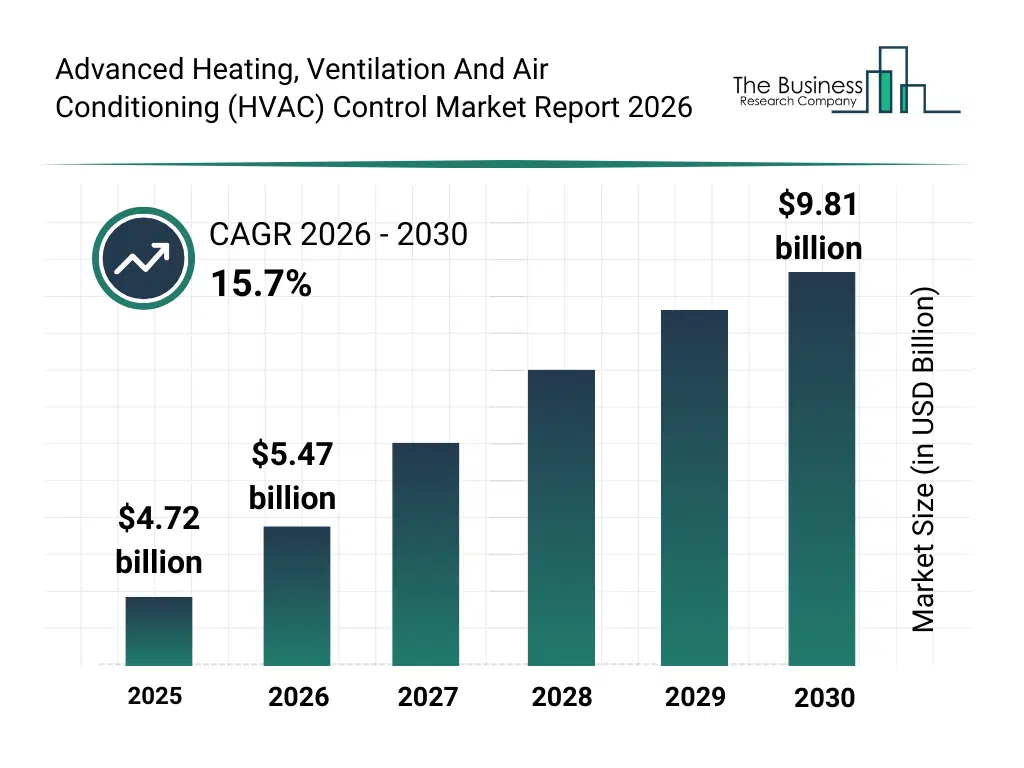
What Is The Advanced Heating, Ventilation And Air Conditioning (HVAC) Control Market Size 2026 And Growth Rate?
The advanced heating, ventilation and air conditioning (hvac) control market size has grown rapidly in recent years. It will grow from $4.72 billion in 2025 to $5.47 billion in 2026 at a compound annual growth rate (CAGR) of 16.0%. The growth in the historic period can be attributed to rise in urbanization and commercial infrastructure, increasing energy consumption in buildings, regulatory mandates on indoor air quality, advancements in sensor and automation technology, growth of smart building initiatives.What Is The Advanced Heating, Ventilation And Air Conditioning (HVAC) Control Market Growth Forecast?
The advanced heating, ventilation and air conditioning (hvac) control market size is expected to see rapid growth in the next few years. It will grow to $9.81 billion in 2030 at a compound annual growth rate (CAGR) of 15.7%. The growth in the forecast period can be attributed to demand for energy-efficient hvac systems, expansion of green building certifications, adoption of ai-driven building management systems, integration of hvac with iot platforms, rising awareness for occupant health and indoor air quality. Major trends in the forecast period include predictive maintenance and energy optimization, occupant-centric comfort management, adaptive ventilation and air quality control, integration with smart building ecosystems, cloud-based hvac analytics and reporting.
Global Advanced Heating, Ventilation And Air Conditioning (HVAC) Control Market Segmentation
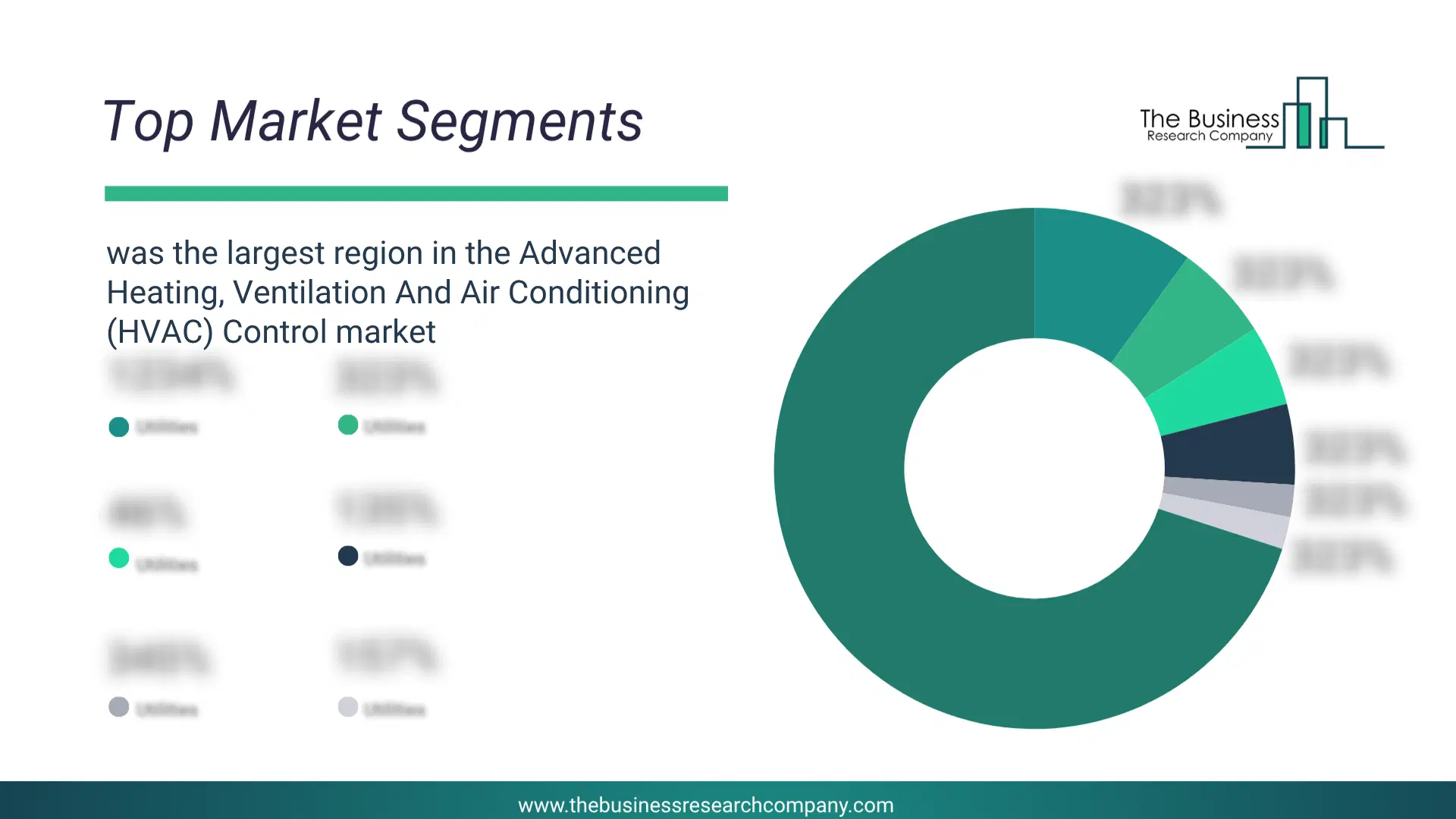
1) By Type: Centralized, Distributed 2) By Component: Controllers, Sensors, Actuators 3) By Technology Type: Smart Thermostats, Demand-Controlled Ventilation, Building Management Systems (BMS), Variable Refrigerant Flow (VRF) Systems 4) By Application: Commercial Buildings, Industrial Facilities, Residential Homes 5) By End-User: Building Owners, Facility Managers, Heating, Ventilation And Air Conditioning (HVAC) Contractors Subsegments: 1) By Centralized: Supervisory Control Systems, Zonal Control Systems, Cloud-Based Control Platforms, Integrated Building Management System 2) By Distributed: Room-Level Control Units, Wireless Control Modules, Edge-Based Control Devices, Decentralized Control Algorithms The top segments in the advanced heating, ventilation and air conditioning (hvac) control market will be: • Centralized will reach $5414.04 Million by 2030. • Commercial Buildings will reach $3822.95 Million by 2030. • Building Owners will reach $3251.69 Million by 2030. • Building Management Systems (BMS) will reach $3346.45 Million by 2030. • Controllers will reach $3140.57 Million by 2030.What Is The Driver Of The Advanced Heating, Ventilation And Air Conditioning (HVAC) Control Market?
The increasing adoption of smart buildings is expected to propel the growth of the advanced heating, ventilation, and air conditioning (HVAC) control market going forward. Smart buildings refer to structures that use automated processes to control building operations to enhance occupant comfort and energy efficiency. The growth of smart buildings is due to the rising demand for energy-efficient infrastructure. Advanced heating, ventilation, and air conditioning (HVAC) control systems support smart buildings by enabling real-time climate management, energy optimization, and remote system monitoring. For instance, in March 2025, according to Netguru S.A., a Poland-based software development company, in 2023, the number of U.S. households with smart home devices reached 63.43 million, marking a 10.2% increase from 2022. Therefore, the increasing adoption of smart buildings is driving the growth of the advanced heating, ventilation, and air conditioning (HVAC) control market.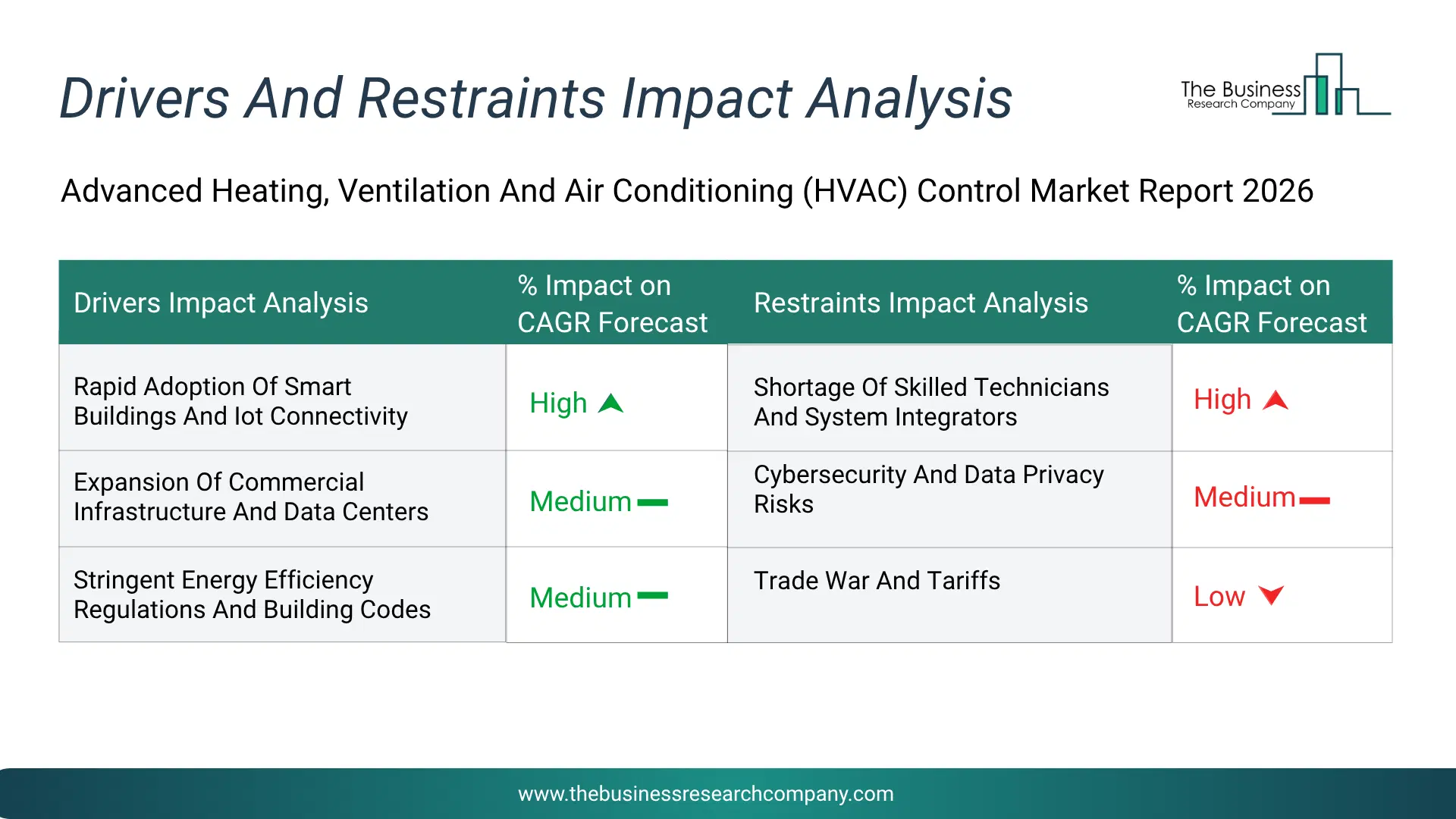
Infographic Chart Showing Key Market Drivers Analysis And Restraints For Advanced Heating, Ventilation And Air Conditioning (Hvac) Control Market
The chart presents an impact analysis of key drivers and restraints, quantifying their relative influence on the market's growth rate and helping assess the balance between growth enablers and limiting factors. This chart offers a high-level perspective; the full report contains more detailed insights.
How Will The Drivers Impact Growth In The Global Advanced Heating, Ventilation And Air Conditioning (HVAC) Control Market?
• Rapid Adoption Of Smart Buildings And Iot Connectivity (High) – During the forecast period, the rapid adoption of smart buildings and IoT connectivity is expected to be a key driver propelling growth in the advanced heating, ventilation and air conditioning (HVAC) control market. As digital transformation accelerates across commercial, industrial and institutional infrastructure and building owners increasingly prioritize real-time monitoring, automation, predictive maintenance and data-driven energy optimization, the deployment of connected HVAC control systems is projected to rise steadily, leading to heightened demand for intelligent thermostats, smart sensors, cloud-based building management systems and integrated control platforms across both new construction and retrofit projects. A growing smart building ecosystem increases the frequency of advanced HVAC control installations, system upgrades and connectivity enhancements across diverse facility types, driving sustained demand for centralized control dashboards, remote diagnostics capabilities, automated climate zoning and energy performance analytics. As a result, advanced HVAC control manufacturers, software providers, system integrators and facility management companies are increasingly expanding digital service capabilities, strengthening IoT-enabled partner networks and enhancing data integration and cybersecurity frameworks to support rising smart building adoption and sustain long-term growth in the global advanced HVAC control market. The rapid adoption of smart buildings and IoT connectivity growth contribution during the forecast period in 2025 is 2.3%. • Expansion Of Commercial Infrastructure And Data Centers (Medium) – During the forecast period, the expansion of commercial infrastructure and data centers globally is expected to be a key driver propelling growth in the advanced heating, ventilation and air conditioning (HVAC) control market. As digital transformation accelerates, cloud computing adoption increases and enterprises expand investments in office buildings, retail complexes, hospitals, airports, smart commercial facilities and hyperscale data centers across both developed and emerging economies, the volume of new commercial construction and technology-intensive infrastructure is projected to rise steadily, leading to heightened demand for intelligent HVAC control systems across both new-build and retrofit applications. A growing commercial and data center base increases the frequency of advanced HVAC control installations, system integrations, upgrades and performance optimization initiatives in energy-sensitive and mission-critical environments, driving sustained demand for building automation systems, centralized energy management platforms, smart sensors, predictive maintenance solutions and integrated climate control networks. As a result, advanced HVAC control manufacturers, software developers and system integrators are increasingly expanding digital capabilities, strengthening partnerships with commercial developers and data center operators and enhancing scalable, energy-efficient control solutions to support rising infrastructure development and sustain long-term growth in the global advanced HVAC control market. The expansion of commercial infrastructure and data centers growth contribution during the forecast period in 2025 is 1.5%. • Stringent Energy Efficiency Regulations And Building Codes (Medium) – During the forecast period, stringent energy efficiency regulations and building codes are expected to be a key driver propelling growth in the Advanced Heating, Ventilation and Air Conditioning (HVAC) Control market. As governments intensify climate action initiatives, enforce carbon reduction targets and implement stricter building energy performance standards across developed and emerging economies, compliance requirements for real-time energy monitoring, automated climate regulation and system-level optimization are projected to increase steadily, leading to heightened demand for advanced HVAC control solutions across both new construction and retrofit projects. The tightening regulatory framework compels building owners and facility managers to upgrade legacy HVAC infrastructure, integrate smart control systems and adopt energy management platforms capable of ensuring continuous compliance with evolving efficiency mandates. This regulatory push increases the frequency of system modernization, performance audits and control system enhancements across commercial offices, industrial facilities, healthcare institutions, educational campuses and residential complexes, thereby driving sustained demand for building automation systems, intelligent controllers, occupancy-based regulation and centralized energy management solutions. As a result, advanced HVAC control manufacturers, system integrators and building automation providers are expanding product portfolios, strengthening compliance-oriented service offerings and enhancing system optimization capabilities to align with regulatory requirements and sustain long-term growth in the global Advanced HVAC Control market. The stringent energy efficiency regulations and building codes growth contribution during the forecast period in 2025 is 1.0%. • Demand For Advanced Automation And System Optimization (Low) – During the forecast period, the demand for advanced automation and system optimization is expected to be a key driver propelling growth in the advanced heating, ventilation and air conditioning (HVAC) control market. As commercial buildings, industrial facilities, healthcare institutions and smart infrastructure projects increasingly prioritize operational efficiency, energy performance and centralized monitoring, the adoption of intelligent HVAC control systems is projected to rise steadily, leading to heightened demand for automated control platforms across both new installations and retrofit applications. A growing emphasis on real-time system monitoring, predictive maintenance strategies, occupancy-based adjustments and data-driven energy optimization increases the deployment of advanced HVAC control solutions across diverse building environments, driving sustained demand for building management systems (BMS), programmable controllers, smart sensors and integrated climate control software platforms. As a result, advanced HVAC control manufacturers, software developers, system integrators and service providers are increasingly expanding digital capabilities, strengthening analytics-driven service offerings and enhancing customization and integration support to meet rising automation requirements and sustain long-term growth in the global advanced HVAC control market. The demand for advanced automation and system optimization growth contribution during the forecast period in 2025 is 0.7%.How Will The Restraints Impact Growth In The Global Advanced Heating, Ventilation And Air Conditioning (HVAC) Control Market?
• Shortage Of Skilled Technicians And System Integrators (High) – During the forecast period, the shortage of skilled technicians and system integrators is restricting the growth of the advanced heating, ventilation and air conditioning (HVAC) control market. Persistent gaps in trained workforce availability, particularly professionals proficient in building automation systems, digital controls, system programming, commissioning and integration are placing operational strain on contractors, facility managers and building owners, which in turn discourages rapid deployment and full-scale optimization of advanced HVAC control solutions. From a commercial and operational perspective, limited access to certified integrators and experienced technicians increases project timelines, raises labor costs and creates implementation bottlenecks, putting pressure on end users to delay installations, scale back system complexity, or rely on basic control configurations, often at the expense of energy efficiency and system intelligence. These workforce constraints, coupled with growing demand for smart building technologies, evolving regulatory requirements and increasing system sophistication, intensify service backlogs and heighten the risk of improper installation, integration errors and suboptimal system performance. As a result, HVAC control manufacturers, system integrators and facility operators may face slower project execution rates, cautious adoption of advanced automation platforms and deferred investments in large-scale digital HVAC control upgrades and smart building initiatives. Growth affected by the shortage of skilled technicians and system integrators during the forecast period in 2025 is -2.0%. • Cybersecurity And Data Privacy Risks (Medium) – During the forecast period, cybersecurity and data privacy risks are restricting the growth of the Advanced Heating, Ventilation and Air Conditioning (HVAC) control market. Persistent concerns associated with data breaches, unauthorized system access, ransomware attacks and vulnerabilities in connected building management platforms are placing operational and reputational strain on building owners, facility managers and enterprise operators, which in turn discourages full-scale adoption of networked and cloud-enabled HVAC control systems. From a commercial and operational perspective, elevated risks related to IoT-connected controllers, remote monitoring platforms and integrated building automation networks increase pressure on end users to invest in additional cybersecurity infrastructure, conduct regular security audits and implement stricter compliance protocols, often raising total cost of ownership and slowing deployment timelines. These security-related challenges, coupled with evolving regulatory requirements, growing sophistication of cyber threats, third-party integration vulnerabilities and concerns over sensitive occupancy and energy usage data exposure, intensify operational burdens and heighten the risk of system disruptions, data loss and unplanned downtime. As a result, HVAC control manufacturers, software providers, system integrators and facility operators may face cautious procurement decisions, extended evaluation cycles and delayed investments in advanced connected control solutions and cloud-based building management technologies. Growth affected by the cybersecurity and data privacy risks during the forecast period in 2025 is -1.0%. • Trade War And Tariffs (Medium) – During the forecast period, trade wars and tariffs are restricting the growth of the Advanced Heating, Ventilation and Air Conditioning (HVAC) Control market. Persistent import duties, export restrictions and shifting trade policies affecting electronic components, sensors, semiconductors, controllers and communication modules are placing financial strain on manufacturers, system integrators, distributors and building owners, which in turn discourages large-scale procurement and long-term smart building upgrades. From a commercial and operational perspective, elevated tariffs on control hardware, microprocessors, printed circuit boards and specialized automation components, along with increased customs compliance costs, increase pressure on suppliers to adjust pricing structures, renegotiate vendor contracts and absorb margin compression, often at the expense of competitive positioning and market expansion. These trade-related cost dynamics, coupled with supply chain realignments, geopolitical uncertainty, currency volatility and delays in cross-border shipments, intensify operational burdens and heighten the risk of extended lead times, project postponements and higher end-user system costs. As a result, advanced HVAC control manufacturers, automation providers and commercial facility operators may face constrained capital investment, cautious deployment of smart control upgrades and delayed adoption of integrated building management and energy optimization solutions. Growth affected by the trade wars and tariffs during the forecast period in 2025 is -0.3%.Key Players In The Global Advanced Heating, Ventilation And Air Conditioning (HVAC) Control Market
Major companies operating in the advanced heating, ventilation and air conditioning (hvac) control market are Samsung Electronics Co. Ltd., Mitsubishi Electric Corporation, Siemens Aktiengesellschaft, LG Electronics Inc., Schneider Electric SE, Haier Smart Home Co. Ltd., Honeywell International Inc., AAB Ltd., Daikin Industries Ltd., Johnson Controls International plc, Carrier Global Corporation, Trane Technologies plc, Emerson Electric Co., Danfoss A/S, Lennox International Inc., Rheem Manufacturing Company, Fr. Sauter AG, Delta Controls Inc., Loytec electronics GmbH, KMC Controls Inc.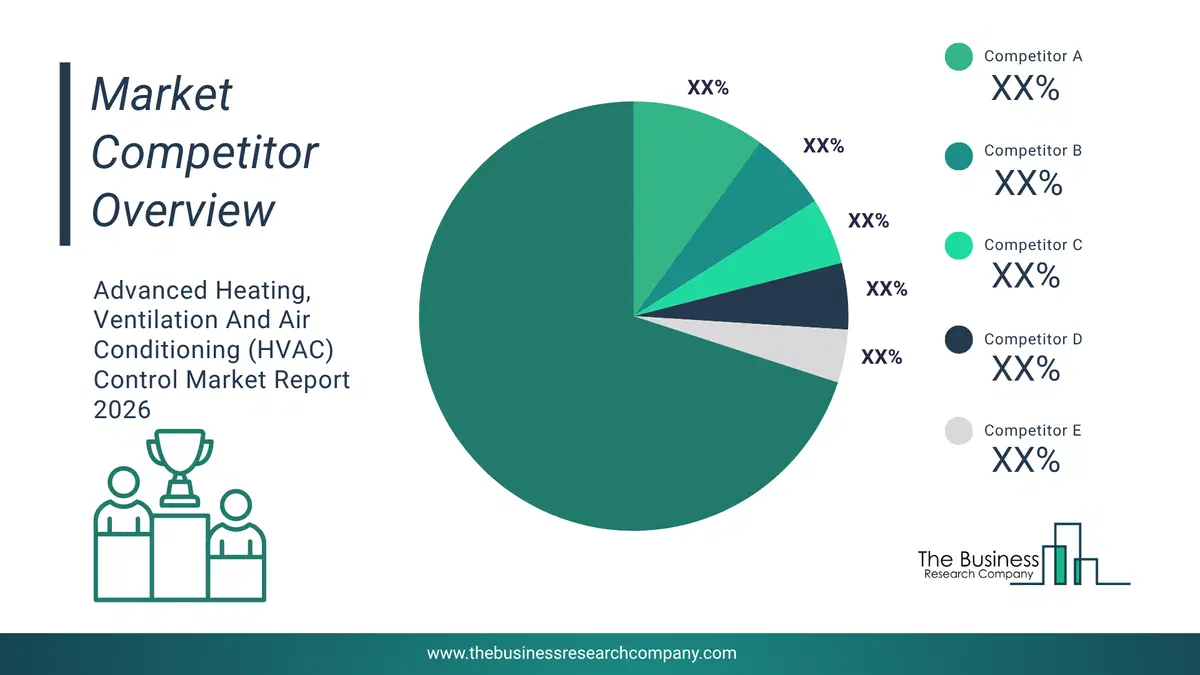
This chart is for illustrative purposes; the full report includes a detailed competitor analysis and comprehensive overview of the top 10 companies in the market.
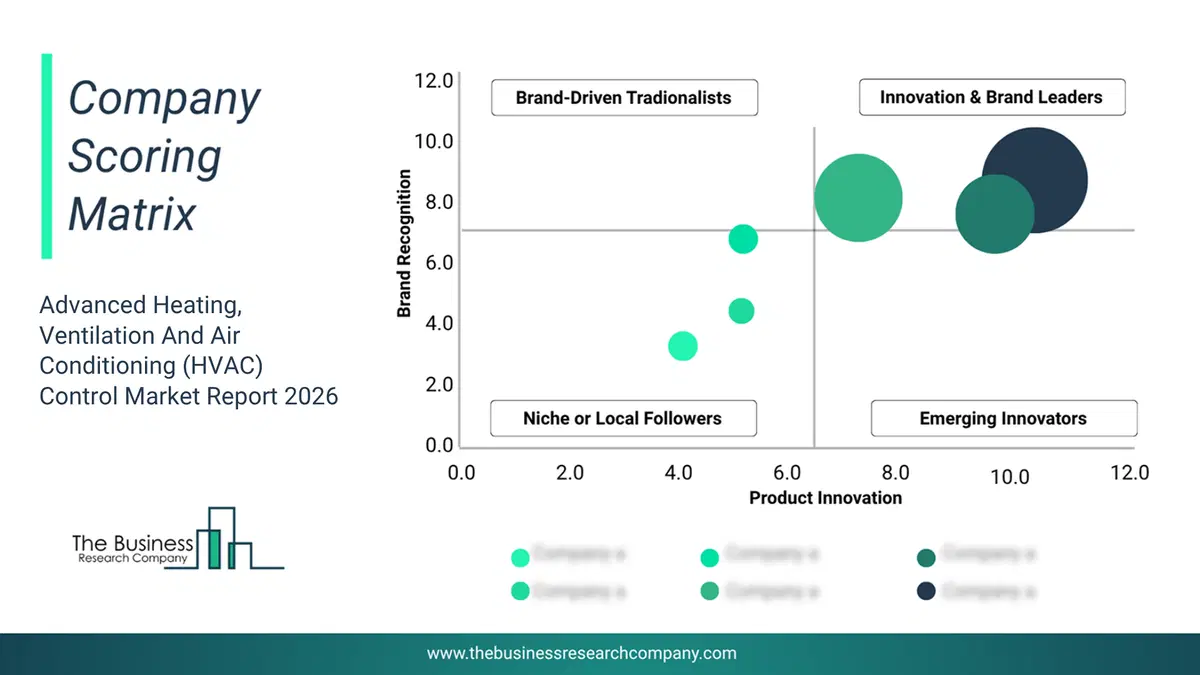
This chart maps companies by product innovation and brand strength, with bubble size indicating relative revenue, helping identify market leaders, challengers, and niche players. This is an illustrative chart; the full report provides a complete and accurate competitive analysis.
Global Advanced Heating, Ventilation And Air Conditioning (HVAC) Control Market Trends and Insights
Major companies operating in the advanced heating, ventilation, and air conditioning (HVAC) control market are focusing on developing advanced solutions such as hydronic HVAC plant management to enhance overall system efficiency in large commercial and industrial buildings. Hydronic HVAC plant management involves optimizing heating and cooling systems that circulate water for thermal control. It efficiently manages equipment to ensure consistent temperature, energy efficiency, and system performance in large facilities. For instance, in December 2024, Daikin Applied Europe, an Italy-based HVAC solutions company, launched the Smart Control System (SCS). It is designed to manage and optimize hydronic HVAC systems, including chillers, heat pumps, air handling units, and fan coils through Modbus/RS485 communication. It features scalable configurations (light, medium, full), advanced optimization algorithms, and plug-and-play installation for simplified setup and control. The product enhances energy efficiency, reduces operating costs, and ensures optimal comfort in light commercial buildings, offices, and small- to medium-sized hotels.What Are Latest Mergers And Acquisitions In The Advanced Heating, Ventilation And Air Conditioning (HVAC) Control Market?
In May 2025, Samsung Electronics Co. Ltd., a South Korea-based electronics manufacturer, acquired Fläktgroup for €1.5 billion ($1.68 billion). With this acquisition, Samsung aims to significantly scale up by adding Fläktgroup’s advanced ventilation, precision cooling systems, and building control platforms, particularly to support high-demand applications such as data centers, hospitals, and large industrial facilities. Fläktgroup is a Germany-based provider of centralized heating, ventilation, and air conditioning (HVAC) control solutions.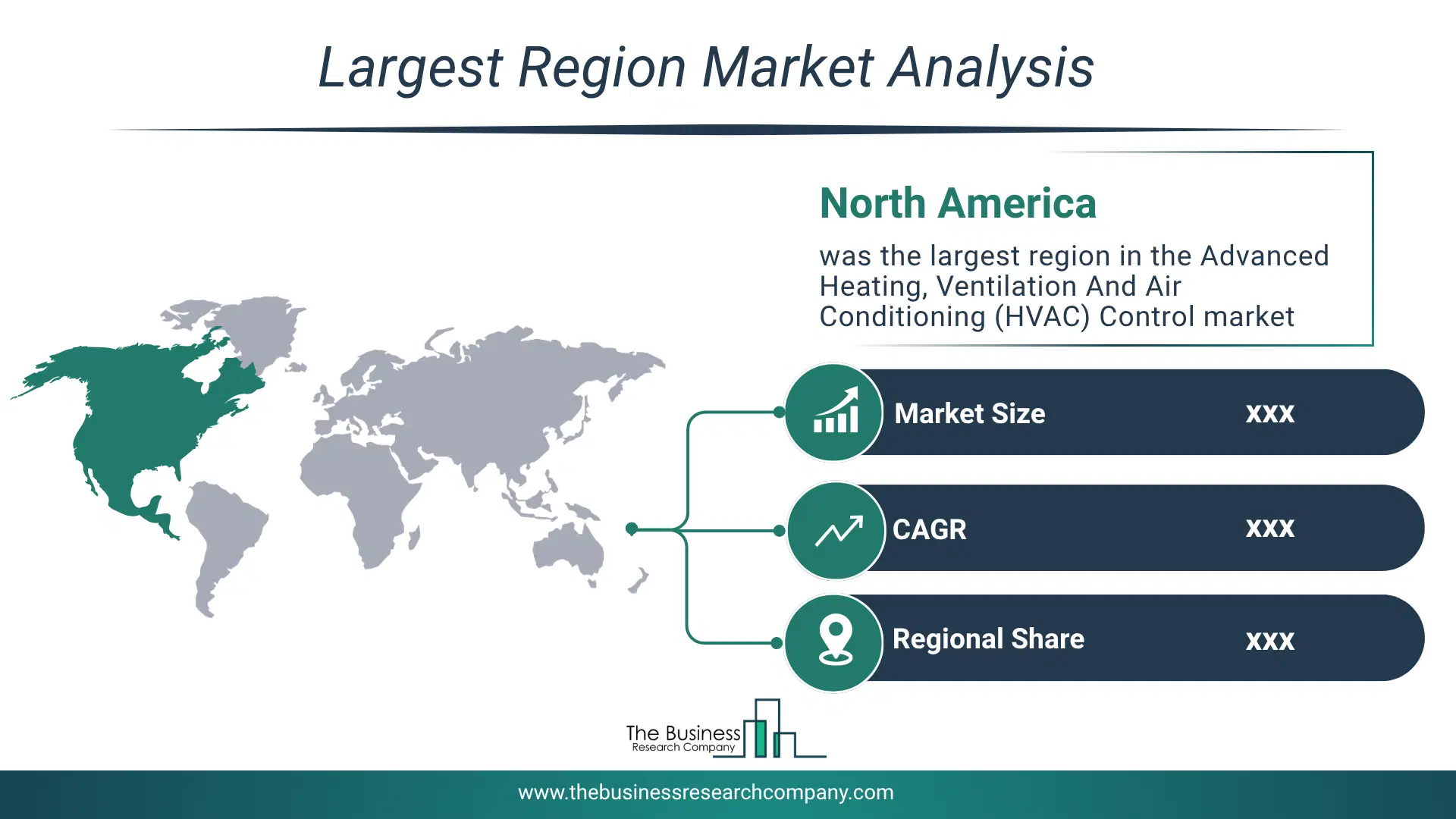
Regional Outlook
North America was the largest region in the advanced heating, ventilation, and air conditioning (HVAC) control market in 2025. Asia-Pacific is expected to be the fastest-growing region in the forecast period. The regions covered in this market report are Asia-Pacific, South East Asia, Western Europe, Eastern Europe, North America, South America, Middle East, Africa. The countries covered in this market report are Australia, Brazil, China, France, Germany, India, Indonesia, Japan, Taiwan, Russia, South Korea, UK, USA, Canada, Italy, Spain.What Defines the Advanced Heating, Ventilation And Air Conditioning (HVAC) Control Market?
The advanced heating, ventilation, and air conditioning (HVAC) control market consists of revenues earned by entities by providing services such as system installation, maintenance services, remote monitoring, energy optimization services, system commissioning, and software updates. The market value includes revenues earned by entities by providing services such as within the service offering. The advanced heating, ventilation, and air conditioning control market includes sales of carbon dioxide sensors, pressure sensors, variable air volume boxes, zoning control systems and wireless communication modules. Values in this market are ‘factory gate’ values, that is the value of goods sold by the manufacturers or creators of the goods, whether to other entities (including downstream manufacturers, wholesalers, distributors and retailers) or directly to end customers. The value of goods in this market includes related services sold by the creators of the goods.How is Market Value Defined and Measured?
The market value is defined as the revenues that enterprises gain from the sale of goods and/or services within the specified market and geography through sales, grants, or donations in terms of the currency (in USD unless otherwise specified). The revenues for a specified geography are consumption values that are revenues generated by organizations in the specified geography within the market, irrespective of where they are produced. It does not include revenues from resales along the supply chain, either further along the supply chain or as part of other products.
This chart presents market attractiveness based on a quantitative evaluation of growth, competition, strategic alignment, and risk, offering a clear view of opportunity areas for decision-making. This chart is for illustrative purposes; the full report contains the complete analysis.

This chart highlights the Total Addressable Market (TAM) by estimating the maximum revenue opportunity using an assumption-driven approach, supporting strategic planning and opportunity sizing across markets. The chart is illustrative; the full report provides a more comprehensive analysis.
What Key Data and Analysis Are Included in the Advanced Heating, Ventilation And Air Conditioning (HVAC) Control Market Report 2026?
The advanced heating, ventilation and air conditioning (hvac) control market research report is one of a series of new reports from The Business Research Company that provides market statistics, including industry global market size, regional shares, competitors with the market share, detailed market segments, market trends and opportunities, and any further data you may need to thrive in the advanced heating, ventilation and air conditioning (hvac) control industry. The market research report delivers a complete perspective of everything you need, with an in-depth analysis of the current and future state of the industry.Advanced Heating, Ventilation And Air Conditioning (HVAC) Control Market Report 2026 Market Report Forecast Analysis
| Report Attribute | Details |
|---|---|
| Market Size Value In 2026 | $5.47 billion |
| Revenue Forecast In 2030 | $9.81 billion |
| Growth Rate | CAGR of 16.0% from 2026 to 2030 |
| Base Year For Estimation | 2025 |
| Actual Estimates/Historical Data | 2020-2025 |
| Forecast Period | 2026 - 2030 - 2035 |
| Market Representation | Revenue in USD Billion and CAGR from 2026 to 2030 |
| Segments Covered | Type, Component, Technology Type, Application, End-User |
| Regional Scope | Asia-Pacific, Western Europe, Eastern Europe, North America, South America, Middle East, Africa |
| Country Scope | The countries covered in the report are Australia, Brazil, China, France, Germany, India, Indonesia, Japan, Taiwan, Russia, South Korea, UK, USA, Canada, Italy, Spain. |
| Key Companies Profiled | Samsung Electronics Co. Ltd., Mitsubishi Electric Corporation, Siemens Aktiengesellschaft, LG Electronics Inc., Schneider Electric SE, Haier Smart Home Co. Ltd., Honeywell International Inc., AAB Ltd., Daikin Industries Ltd., Johnson Controls International plc, Carrier Global Corporation, Trane Technologies plc, Emerson Electric Co., Danfoss A/S, Lennox International Inc., Rheem Manufacturing Company, Fr. Sauter AG, Delta Controls Inc., Loytec electronics GmbH, KMC Controls Inc. |
| Customization Scope | Request for Customization |
| Pricing And Purchase Options | Explore Purchase Options |