

Advanced Heating, Ventilation And Air Conditioning (HVAC) Control Global Market Opportunities And Strategies To 2035
By Type (Centralized, Distributed), By Component (Controllers, Sensors, Actuators), By Technology Type (Smart Thermostats, Demand-Controlled Ventilation, Building Management System (BMS), Variable Refrigerant Flow (VRF) System), By Application (Commercial Buildings, Industrial Facilities, Residential Homes), By End-User (Buildings Owners, Facility Managers, Heating, Ventilation And Air Conditioning (HVAC) Contractors), And By Region, Opportunities And Strategies – Global Forecast To 2035
Advanced Heating, Ventilation And Air Conditioning (HVAC) Control Market Definition
Advanced HVAC control refers to the use of intelligent digital technologies, such as sensors, automation systems, artificial intelligence, IoT platforms and building management systems (BMS) to monitor, regulate and optimize heating, cooling and ventilation operations in real time. The primary purpose of advanced HVAC control is to maximize energy efficiency, indoor comfort and system reliability. The advanced heating, ventilation and air conditioning (HVAC) control market consists of sales of advanced heating, ventilation and air conditioning (HVAC) control by entities (organization, sole traders and partnership) that are used continuously throughout building operation, responding dynamically to seasonal changes, occupancy schedules and external weather conditions. It enables precise climate regulation, reduces energy consumption and operating costs, supports predictive maintenance and helps buildings meet sustainability and regulatory standards in commercial, industrial and smart infrastructure environments. These systems go beyond basic thermostats by using sensors, analytics and automation to improve comfort, energy efficiency and system reliability. The market covered in this report includes centralized and distributed control systems, along with components such as controllers, sensors and actuators and technology types including smart thermostats, demand-controlled ventilation systems, building management systems (BMS) and variable refrigerant flow (VRF) systems. These solutions are applied across commercial buildings, industrial facilities and residential homes and are used by building owners, facility managers and HVAC contractors.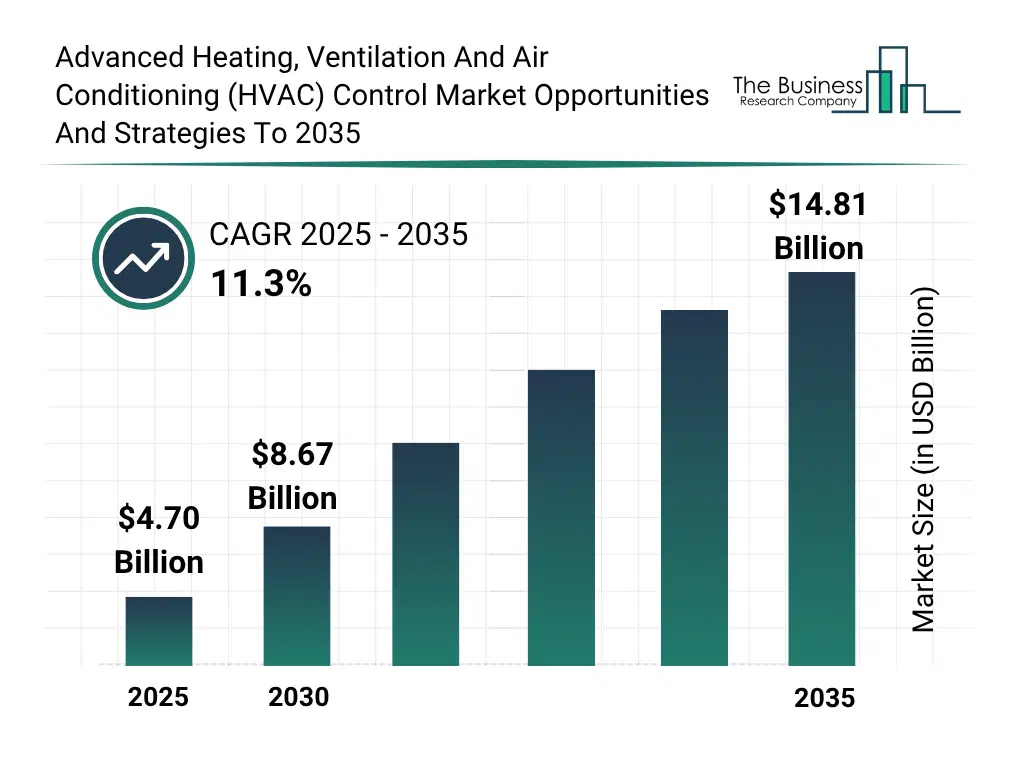
Advanced Heating, Ventilation And Air Conditioning (HVAC) Control Market Size
The global advanced heating, ventilation and air conditioning (HVAC) control market reached a value of nearly $4,702.7 million in 2025, having grown at a compound annual growth rate (CAGR) of 13.8% since 2020. The market is expected to grow from $4,702.7 million in 2025 to $8,671.7 million in 2030 at a rate of 13.0%. The market is then expected to grow at a CAGR of 11.3% from 2030 and reach $14,809.2 million in 2035. Growth in the historic period resulted from growing focus on indoor air quality (IAQ) and occupant health, adoption of green building certifications and ESG initiatives, increasing retrofit and building automation upgrades and rising energy costs. Factors that negatively affected growth in the historic period were high initial installation and integration costs and complexity of integration with legacy systems. Going forward, rapid adoption of smart buildings and IoT connectivity, expansion of commercial infrastructure and data centers, stringent energy efficiency regulations and building codes and demand for advanced automation and system optimization will drive the growth. Factors that could hinder the growth of the advanced heating, ventilation and air conditioning (HVAC) control market in the future include shortage of skilled technicians and system integrators, cybersecurity and data privacy risks and trade war and tariffs.
Advanced Heating, Ventilation And Air Conditioning (HVAC) Control Market Segmentation
The advanced heating, ventilation and air conditioning (HVAC) control market is segmented by type, by component, by technology type, by application and by end-user.By Type –
The advanced heating, ventilation and air conditioning (HVAC) control market is segmented by type into:
- a) Centralized
- b) Distributed
By Component –
The advanced heating, ventilation and air conditioning (HVAC) control market is segmented by component into:
- a) Controllers
- b) Sensors
- c) Actuators
By Technology Type –
The advanced heating, ventilation and air conditioning (HVAC) control market is segmented by technology type into:
- a) Smart Thermostats
- b) Demand-Controlled Ventilation
- c) Building Management System (BMS)
- d) Variable Refrigerant Flow (VRF) System
By Application –
The advanced heating, ventilation and air conditioning (HVAC) control market is segmented by application into:
- a) Commercial Buildings
- b) Industrial Facilities
- c) Residential Homes
By End-User –
The advanced heating, ventilation and air conditioning (HVAC) control market is segmented by end-user into:
- a) Buildings Owners
- b) Facility Managers
- c) Heating, Ventilation And Air Conditioning (HVAC) Contractors
By Geography - The advanced heating, ventilation and air conditioning (HVAC) control market is segmented by geography into:
- China
- India
- Japan
- Australia
- Indonesia
- South Korea
- USA
- Canada
- Brazil
- France
- Germany
- UK
- Italy
- Spain
- Russia
-
o Asia Pacific
o Africa