

Adversarial Learning Market Report 2026
Global Outlook – By Component (Software, Hardware, Services), By Deployment Mode (Cloud-Based, On-Premise), By Organization Size (Large Enterprises, Small And Medium Enterprises), By Application (Cybersecurity And Threat Detection, Autonomous Systems, Fraud Detection, Healthcare Artificial Intelligence, Natural Language Processing, Computer Vision), By End User (Artificial Intelligence Developers And Data Scientists, Enterprises, Government Agencies, Research Institutions) – Market Size, Trends, Strategies, and Forecast to 2030
Adversarial Learning Market Overview
• Adversarial Learning market size has reached to $0.3 billion in 2025 • Expected to grow to $0.39 billion in 2030 at a compound annual growth rate (CAGR) of 30.8% • Growth Driver: Adversarial Learning Growth Due To Increasing Demand For Robust Machine Learning Models • Market Trend: Advancements In Wavelet-Based Adversarial Training Strengthening AI Robustness In Healthcare Applications • North America was the largest region in 2025 and Asia-Pacific is the fastest growing region.What Is Covered Under Adversarial Learning Market?
Adversarial learning is a machine learning approach where models are trained in competitive settings in which one component generates challenging inputs (adversarial examples) while another component learns to correctly classify or respond to them. It enhances model robustness, generalization, and security by simulating worst-case scenarios that expose vulnerabilities in AI systems. This technique is widely used in improving the resilience of deep learning models against data manipulation and adversarial attacks. The main component types of adversarial learning include software, hardware and services. software solutions that provide programmable tools, platforms, and applications enabling automation, data processing, system operations, and digital workflows across computing environments and industries. The deployment mode into cloud-based and on-premise solutions, and by organization size into large enterprises and small and medium enterprises (SMEs). It is widely used across applications such as cybersecurity and threat detection, autonomous systems, fraud detection, healthcare artificial intelligence, natural language processing, and computer vision. Key end-user industries include artificial intelligence developers and data scientists, enterprises, government agencies, and research institutions.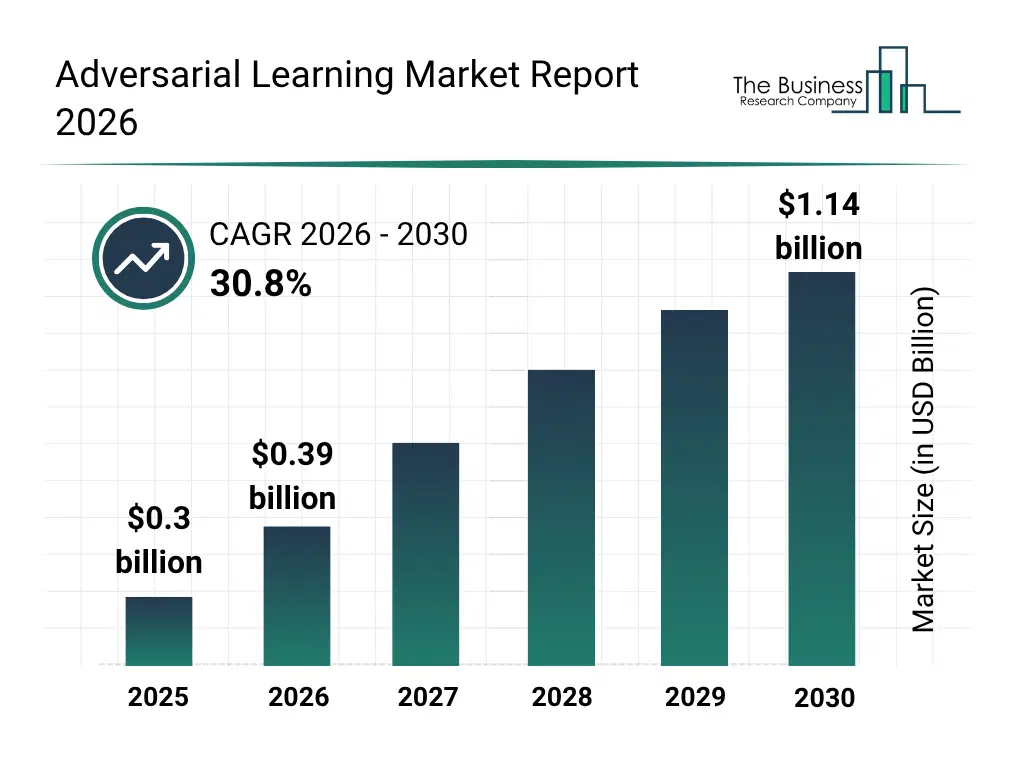
What Is The Adversarial Learning Market Size and Share 2026?
The adversarial learning market size has grown exponentially in recent years. It will grow from $0.3 billion in 2025 to $0.39 billion in 2026 at a compound annual growth rate (CAGR) of 30.5%. The growth in the historic period can be attributed to increasing vulnerabilities in early AI models, growth of deep learning applications, rising instances of data manipulation attacks, expansion of cybersecurity frameworks, adoption of AI in critical decision systems.What Is The Adversarial Learning Market Growth Forecast?
The adversarial learning market size is expected to see exponential growth in the next few years. It will grow to $1.14 billion by 2030 at a compound annual growth rate (CAGR) of 30.8%. The growth in the forecast period can be attributed to growing demand for secure and explainable AI models, expansion of AI in autonomous systems and critical infrastructure, rising investments in AI safety and governance, increasing use of synthetic and adversarial data for training, regulatory focus on AI risk mitigation and compliance. Major trends in the forecast period include adversarial attack simulation for model validation, robustness testing in deep learning models, integration of adversarial learning in AI security frameworks, defensive AI model training techniques expansion, cross domain adversarial learning applications.
Global Adversarial Learning Market Segmentation
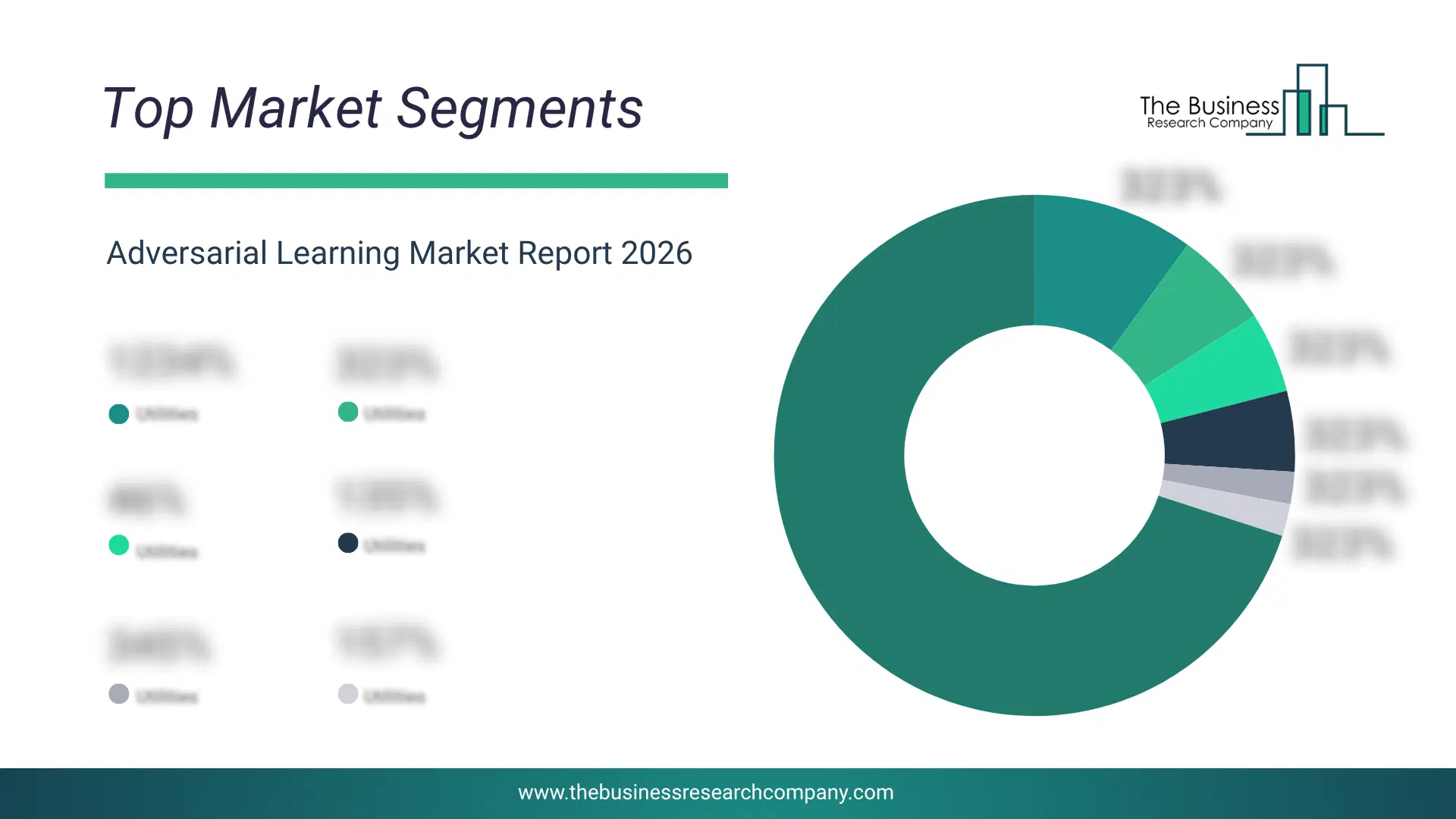
1) By Component: Software, Hardware, Services 2) By Deployment Mode: Cloud-Based, On-Premise 3) By Organization Size: Large Enterprises, Small And Medium Enterprises 4) By Application: Cybersecurity And Threat Detection, Autonomous Systems, Fraud Detection, Healthcare Artificial Intelligence, Natural Language Processing, Computer Vision 5) By End User: Artificial Intelligence Developers And Data Scientists, Enterprises, Government Agencies, Research Institutions Subsegments: 1) By Software: Adversarial Training Platforms, Model Robustness Tools, Attack Simulation Software, Data Augmentation Software, Security Analytics Software 2) By Hardware: Graphics Processing Units, Tensor Processing Units, Field Programmable Gate Arrays, Application Specific Integrated Circuits, High Performance Computing Servers 3) By Services: Consulting Services, Integration Services, Managed Services, Training And Support Services, Maintenance ServicesWhat Is The Driver Of The Adversarial Learning Market?
The increasing demand for robust machine learning models is expected to propel the growth of the adversarial learning market going forward. A machine learning model refers to a computational system or algorithm that learns patterns from data and uses those patterns to make predictions, decisions, or classifications without being explicitly programmed for every scenario. The rise of robust machine learning models is due to people want to build systems that can handle real-world imperfect data and conditions. Adversarial learning helps robust machine learning models by allowing them to train on intentionally challenging or misleading examples thereby improving resistant to errors and attacks. For instance, in January 2026, the Organisation for Economic Co-operation and Development, a France-based international organization, reported that 20.2% of firms reported using artificial intelligence in 2025, compared with 14.2% in 2024, reflecting a steady and significant increase in artificial intelligence adoption among businesses, much of which is driven by machine learning-based systems. Therefore, the increasing demand for robust machine learning models is driving the growth of adversarial learning industryKey Players In The Global Adversarial Learning Market
Major companies operating in the adversarial learning market are Google LLC; Microsoft Corporation; Meta Platforms Inc.; International Business Machines Corporation; NVIDIA Corporation; Anthropic PBC; Palo Alto Networks Inc.; Fortinet Inc.; CrowdStrike Holdings Inc.; Check Point Software Technologies Ltd.; Trend Micro Incorporated; Vectra AI Inc.; HiddenLayer Inc.; CalypsoAI Inc.; Adversa AI; OpenAI L.L.C.; Protect AI Inc.; Lakera AI AG; Darktrace plc; Trellix Inc.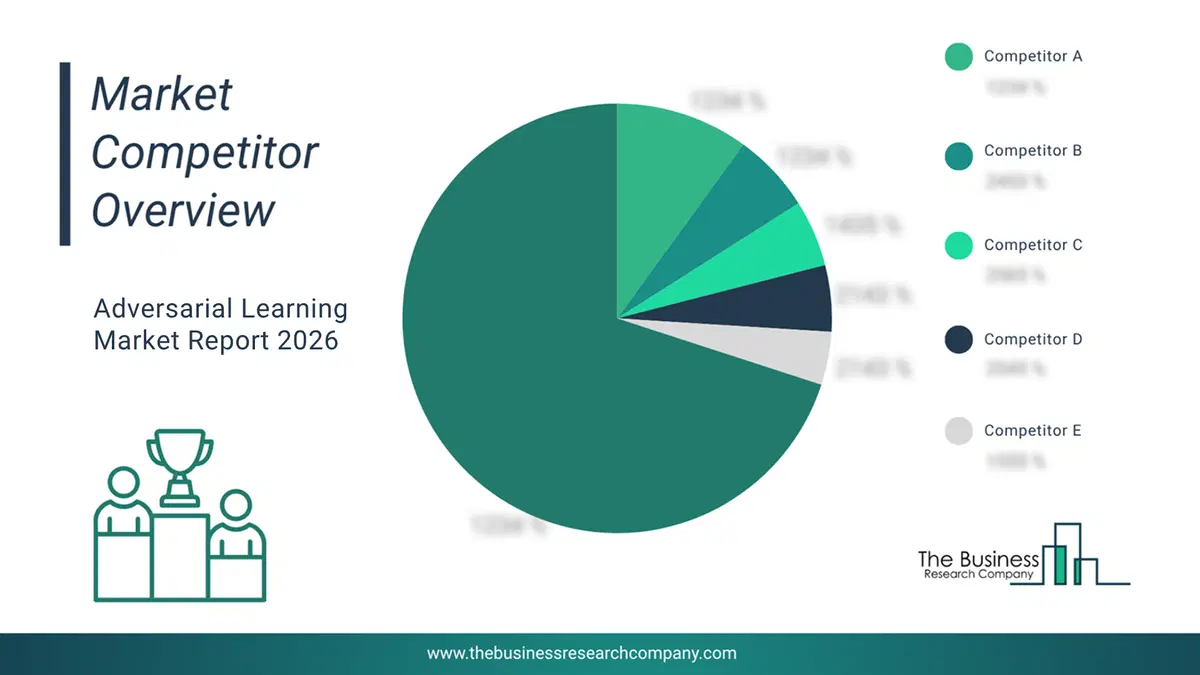
This chart is for illustrative purposes; the full report includes a detailed competitor analysis and comprehensive overview of the top 10 companies in the market.
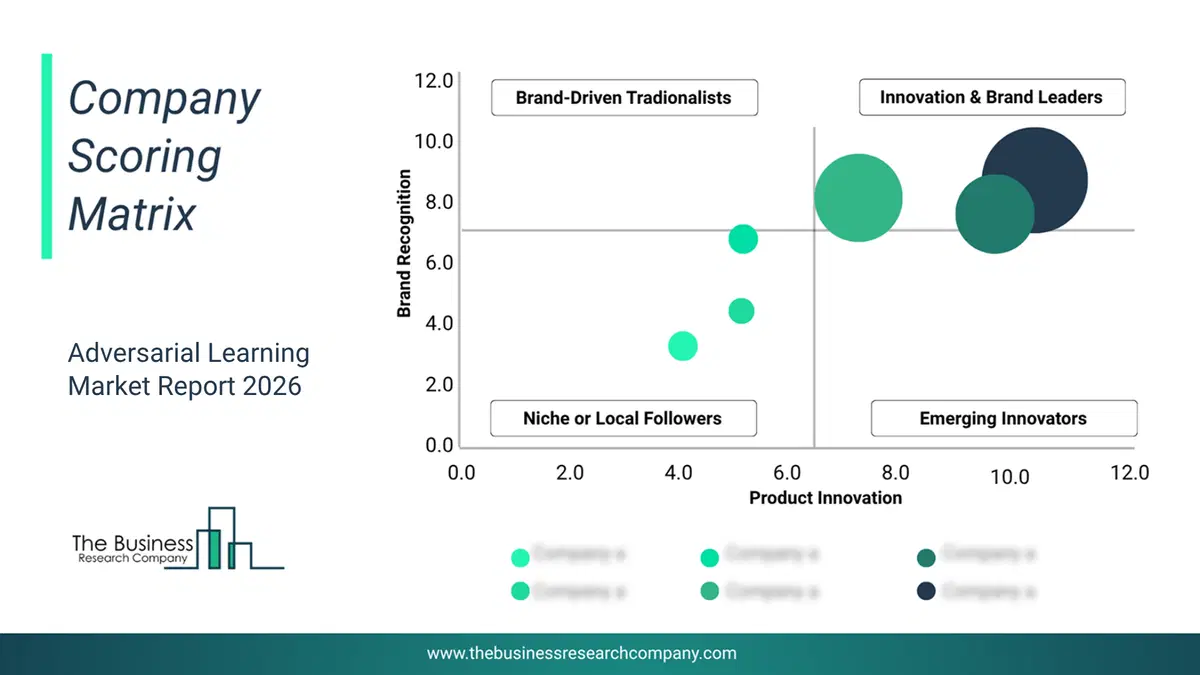
This chart maps companies by product innovation and brand strength, with bubble size indicating relative revenue, helping identify market leaders, challengers, and niche players. This is an illustrative chart; the full report provides a complete and accurate competitive analysis.
Global Adversarial Learning Market Trends and Insights
Major companies operating in the adversarial learning market are increasingly focusing on advanced adversarial training techniques, such as wavelet-based adversarial training, to enhance model robustness against sophisticated cyberattacks and ensure reliable AI performance in high-stakes applications. Wavelet-based adversarial training refers to a technique that uses wavelet transforms to remove adversarial noise from data while training AI models on both clean and manipulated inputs to improve their robustness and reliability. For instance, in April 2025, Dongguk University, a South Korea-based academic specializing in artificial intelligence and medical imaging security, developed a novel AI defense framework called Wavelet-Based Adversarial Training (WBAD), designed to protect medical digital twin systems from adversarial attacks that can distort diagnostic outcomes. The solution combines wavelet-based noise filtering with adversarial training to remove malicious data perturbations while strengthening the model’s ability to recognize and resist manipulated inputs. By significantly improving model robustness and restoring diagnostic accuracy even under attack conditions, WBAD enhances the reliability and safety of AI-driven healthcare applications, particularly in sensitive use cases such as disease prediction and personalized treatment planning.What Are Latest Mergers And Acquisitions In The Adversarial Learning Market?
In December 2025, Red Hat, Inc, a US-based enterprise software company, acquired Chatterbox Labs Limited for an undisclosed amount. Through this acquisition, Red Hat aims to enhance its artificial intelligence capabilities by strengthening artificial intelligence trust, security and governance by leveraging Chatterbox Labs’ expertise in artificial intelligence safety and generative artificial intelligence guardrails to support responsible artificial intelligence deployment and adversarial learning as it involves improving the robustness of machine learning systems against malicious or adversarial inputs. Chatterbox Labs Limited is a UK-based company specializing in adversarial machine learning technologies and capabilities.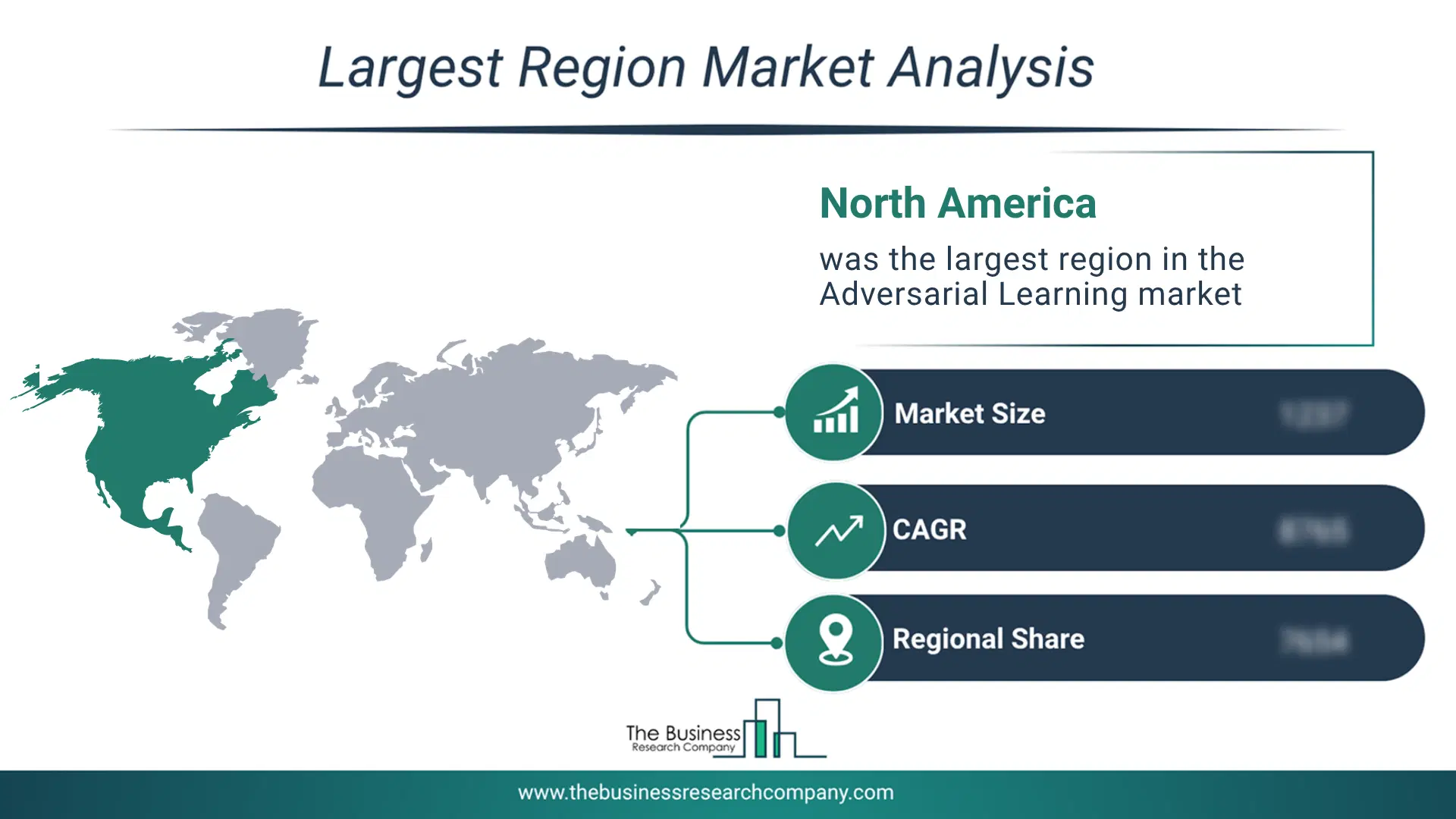
Regional Insights
North America was the largest region in the adversarial learning market in 2025. Asia-Pacific is expected to be the fastest-growing region in the forecast period. The regions covered in this market report are Asia-Pacific, South East Asia, Western Europe, Eastern Europe, North America, South America, Middle East, Africa. The countries covered in this market report are Australia, Brazil, China, France, Germany, India, Indonesia, Japan, Taiwan, Russia, South Korea, UK, USA, Canada, Italy, Spain.What Defines the Adversarial Learning Market?
The adversarial learning market consists of revenues earned by entities by providing services such as adversarial model development, cybersecurity-focused machine learning solutions, simulation and stress-testing of AI systems, consulting and integration services, and deployment of adversarial training frameworks. The market value includes the value of related software tools, platforms, and infrastructure components sold as part of the offering. The adversarial learning market also includes sales of AI development platforms, machine learning toolkits, and neural network training systems. Values in this market are ‘factory gate’ values, that is, the value of goods sold by the developers or creators of the solutions, whether to other entities (including downstream integrators, enterprises, and service providers) or directly to end customers. The value of goods in this market includes related services sold by the creators of the goods.How is Market Value Defined and Measured?
The market value is defined as the revenues that enterprises gain from the sale of goods and/or services within the specified market and geography through sales, grants, or donations in terms of the currency (in USD unless otherwise specified). The revenues for a specified geography are consumption values that are revenues generated by organizations in the specified geography within the market, irrespective of where they are produced. It does not include revenues from resales along the supply chain, either further along the supply chain or as part of other products.
This chart presents market attractiveness based on a quantitative evaluation of growth, competition, strategic alignment, and risk, offering a clear view of opportunity areas for decision-making. This chart is for illustrative purposes; the full report contains the complete analysis.

This chart highlights the Total Addressable Market (TAM) by estimating the maximum revenue opportunity using an assumption-driven approach, supporting strategic planning and opportunity sizing across markets. The chart is illustrative; the full report provides a more comprehensive analysis.
What Key Data and Analysis Are Included in the Adversarial Learning Market Report 2026?
The adversarial learning market research report is one of a series of new reports from The Business Research Company that provides market statistics, including industry global market size, regional shares, competitors with the market share, detailed market segments, market trends and opportunities, and any further data you may need to thrive in the adversarial learning industry. The market research report delivers a complete perspective of everything you need, with an in-depth analysis of the current and future state of the industry.Adversarial Learning Market Report Forecast Analysis
| Report Attribute | Details |
|---|---|
| Market Size Value In 2026 | $0.39 billion |
| Revenue Forecast In 2030 | $1.14 billion |
| Growth Rate | CAGR of 30.8% from 2026 to 2030 |
| Base Year For Estimation | 2025 |
| Actual Estimates/Historical Data | 2020-2025 |
| Forecast Period | 2026 - 2030 |
| Market Representation | Revenue in USD Billion and CAGR from 2026 to 2030 |
| Segments Covered | Component, Deployment Mode, Organization Size, Application, End User |
| Regional Scope | Asia-Pacific, Western Europe, Eastern Europe, North America, South America, Middle East, Africa |
| Country Scope | The Countries Covered In This Market Report Are Australia, Brazil, China, France, Germany, India, Indonesia, Japan, Taiwan, Russia, South Korea, Uk, Usa, Canada, Italy, Spain. |
| Key Companies Profiled | Google LLC, Microsoft Corporation, Meta Platforms Inc., International Business Machines Corporation, NVIDIA Corporation, Anthropic PBC, Palo Alto Networks Inc., Fortinet Inc., CrowdStrike Holdings Inc., Check Point Software Technologies Ltd., Trend Micro Incorporated, Vectra AI Inc., HiddenLayer Inc., CalypsoAI Inc., Adversa AI, OpenAI L.L.C., Protect AI Inc., Lakera AI AG, Darktrace plc, Trellix Inc. |
| Customization Scope | Request for Customization |
| Pricing And Purchase Options | Explore Purchase Options |