
Adverse Media Screening Market Report 2026
Global Outlook – By Component (Software, Services), By Deployment Mode (On-Premises, Cloud-Based), By Organization Size (Large Enterprises, Small And Medium Enterprises), By Application (Anti-Money Laundering Compliance, Fraud Detection, Risk Management, Customer Due Diligence, Other Applications), By End-User (Banking, Financial Services, And Insurance, Healthcare, Government, Information Technology And Telecommunications, Retail, Other End-Users) – Market Size, Trends, Strategies, and Forecast to 2030
Adverse Media Screening Market Overview
• Adverse Media Screening market size has reached to $1.31 billion in 2025 • Expected to grow to $2.61 billion in 2030 at a compound annual growth rate (CAGR) of 14.8% • Growth Driver: Rising Financial Crime And Fraud Risks Driving Growth Of The Market Due To Digitalization And Increasing Cyber Threats • Market Trend: Enhancing Compliance Efficiency Through Robotic Process Automation • North America was the largest region in 2025 and Asia-Pacific is the fastest growing region.What Is Covered Under Adverse Media Screening Market?
Adverse media screening refers to the process of scanning news and media sources to detect negative information about individuals, companies, or entities that could pose financial, legal, or reputational risks. It is commonly used by banks, financial institutions, and corporations for compliance, due diligence, and risk management purposes. The main components of adverse media screening solutions include software and services. Software comprises applications and platforms designed to identify and monitor negative or adverse information related to individuals, organizations, or entities. These solutions are deployed through on-premises and cloud-based models and cater to organizations of varying sizes, including large enterprises and small and medium enterprises (SMEs). They are used across applications such as anti-money laundering compliance, fraud detection, risk management, customer due diligence, and others, and serve end users across industries including banking, financial services, and insurance (BFSI), healthcare, government, information technology and telecommunications, retail, and others.
What Is The Adverse Media Screening Market Size and Share 2026?
The adverse media screening market size has grown rapidly in recent years. It will grow from $1.31 billion in 2025 to $1.5 billion in 2026 at a compound annual growth rate (CAGR) of 14.6%. The growth in the historic period can be attributed to increasing regulatory compliance requirements, rising financial crime and fraud incidents, growth in banking and financial services, adoption of manual screening processes, expansion of corporate due diligence practices.What Is The Adverse Media Screening Market Growth Forecast?
The adverse media screening market size is expected to see rapid growth in the next few years. It will grow to $2.61 billion by 2030 at a compound annual growth rate (CAGR) of 14.8%. The growth in the forecast period can be attributed to increasing adoption of ai-driven compliance solutions, growing demand for real-time risk intelligence, expansion of esg and reputational risk monitoring, rising digitalization of financial services, increasing cross-border regulatory scrutiny. Major trends in the forecast period include increasing adoption of ai-powered risk detection systems, rising demand for real-time media monitoring platforms, growing integration of automated compliance screening tools, expansion of cloud-based adverse media solutions, rising focus on multi-language and global news coverage analytics.
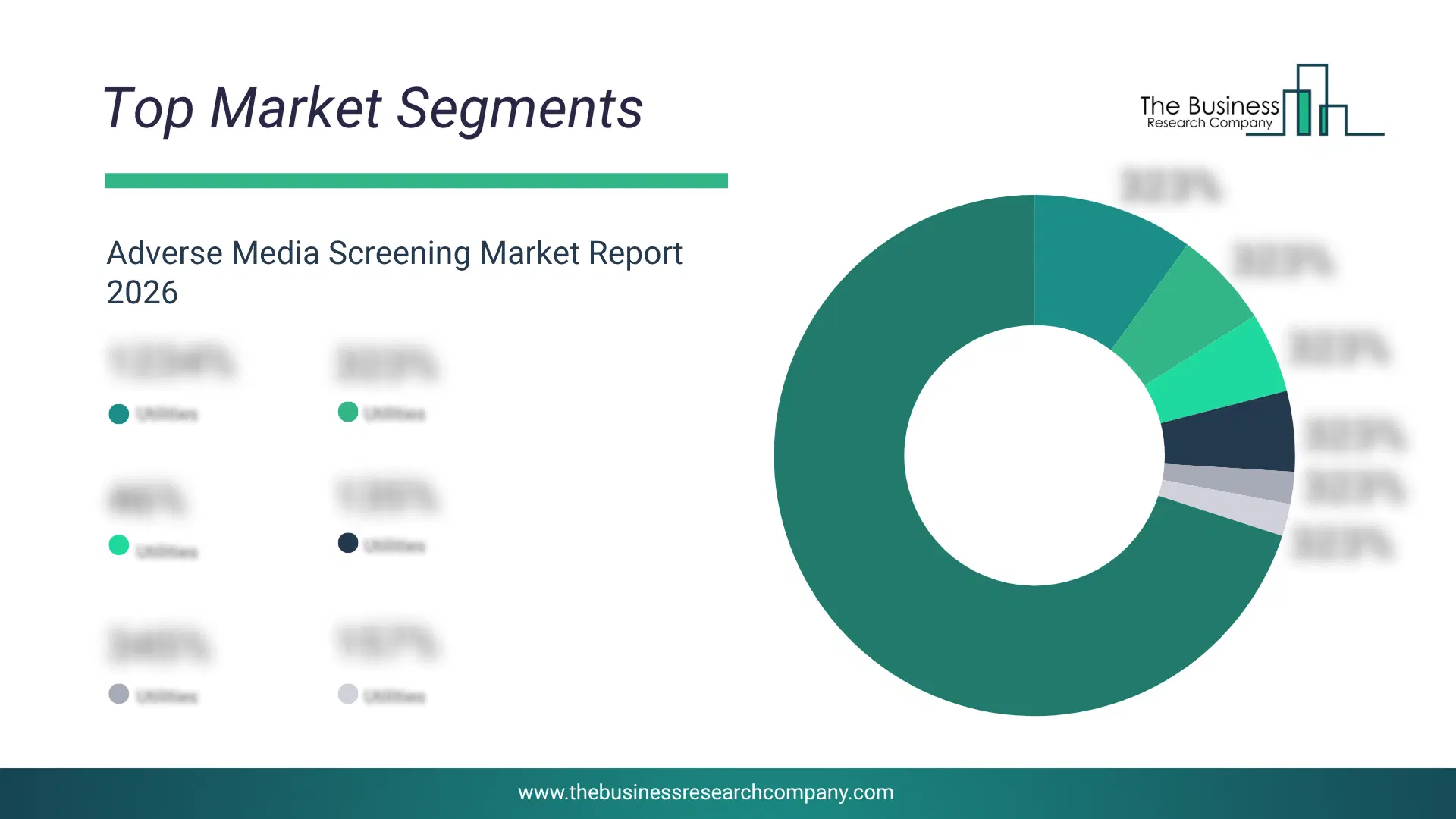
Global Adverse Media Screening Market Segmentation
1) By Component: Software, Services 2) By Deployment Mode: On-Premises, Cloud-Based 3) By Organization Size: Large Enterprises, Small And Medium Enterprises 4) By Application: Anti-Money Laundering Compliance, Fraud Detection, Risk Management, Customer Due Diligence, Other Applications 5) By End-User: Banking, Financial Services, And Insurance, Healthcare, Government, Information Technology And Telecommunications, Retail, Other End-Users Subsegments: 1) By Software: On-Premise Software, Cloud-Based Software 2) By Services: Professional Services, Managed ServicesWhat Is The Driver Of The Adverse Media Screening Market?
The rising financial crime and fraud risks are expected to propel the growth of the adverse media screening market going forward. Financial crime and fraud risks refer to the threat of illegal or deceptive financial activities that can cause monetary, legal, or reputational harm to individuals or organizations. These risks are increasing due to the rapid digitalization of financial services, which exposes systems to cyberattacks, identity theft, and online fraud. Adverse media screening helps mitigate financial crime and fraud risks by identifying negative news, sanctions, or regulatory reports related to individuals or entities, enabling organizations to detect potential involvement in illegal or high-risk activities before entering into business relationships. For instance, in July 2023, according to Chainalysis Inc., a US-based software company, ransomware is the only category of cryptocurrency-related crime projected to rise in 2023, with attackers extracting $175.8 million more than they had at the same point in 2022. Therefore, the rising financial crime and fraud risks are driving the growth of the adverse media screening industry.Key Players In The Global Adverse Media Screening Market
Major companies operating in the adverse media screening market are Oracle Corporation, London Stock Exchange Group Risk Intelligence, Thomson Reuters Corporation, Moody’s Analytics Inc., SAS Institute Inc., Fair Isaac Corporation (FICO), AML RightSource LLC, Fenergo Limited, Quantexa Limited, Feedzai Inc., Sum and Substance Ltd., SEON Technologies Ltd., ThetaRay Ltd., Persona Identities Inc., Napier Technologies Limited, Ripjar Limited, Quantifind Inc., ComplyAdvantage Limited, Sanction Scanner Teknoloji A.Ş., Ondato UAB, AML Partners LLC, Truth Technologies Inc., KYC Global Technologies Private Limited, iDenfy UAB, iComply Investor Services Inc.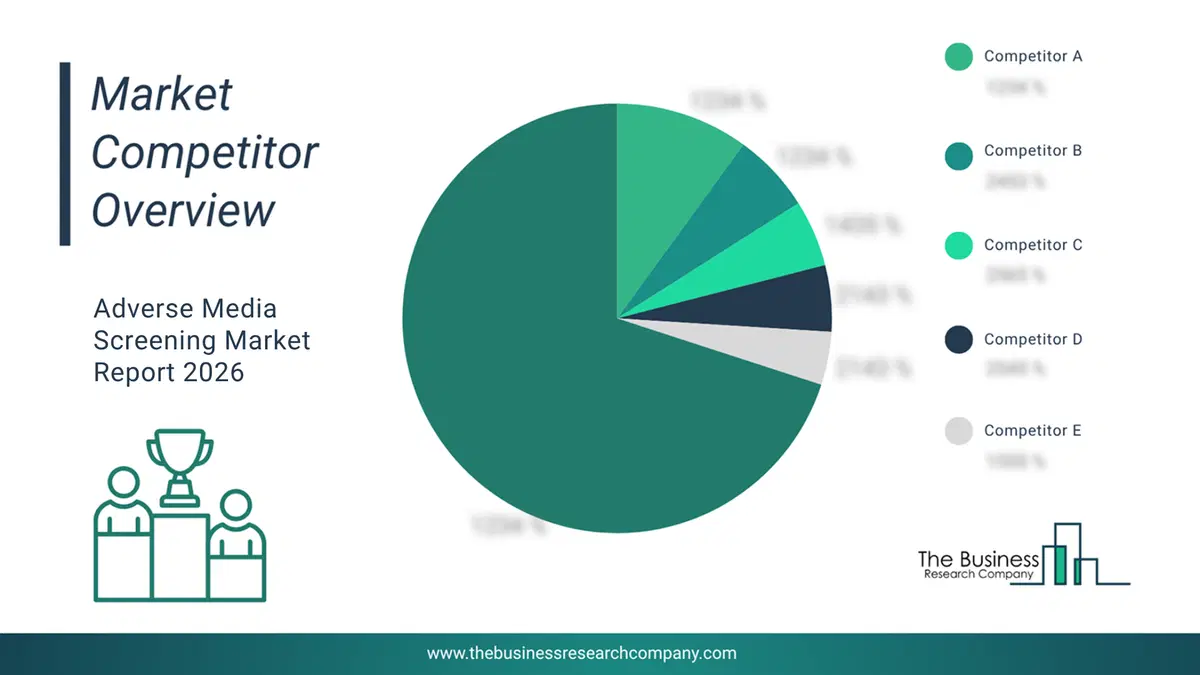
This chart is for illustrative purposes; the full report includes a detailed competitor analysis and comprehensive overview of the top 10 companies in the market.
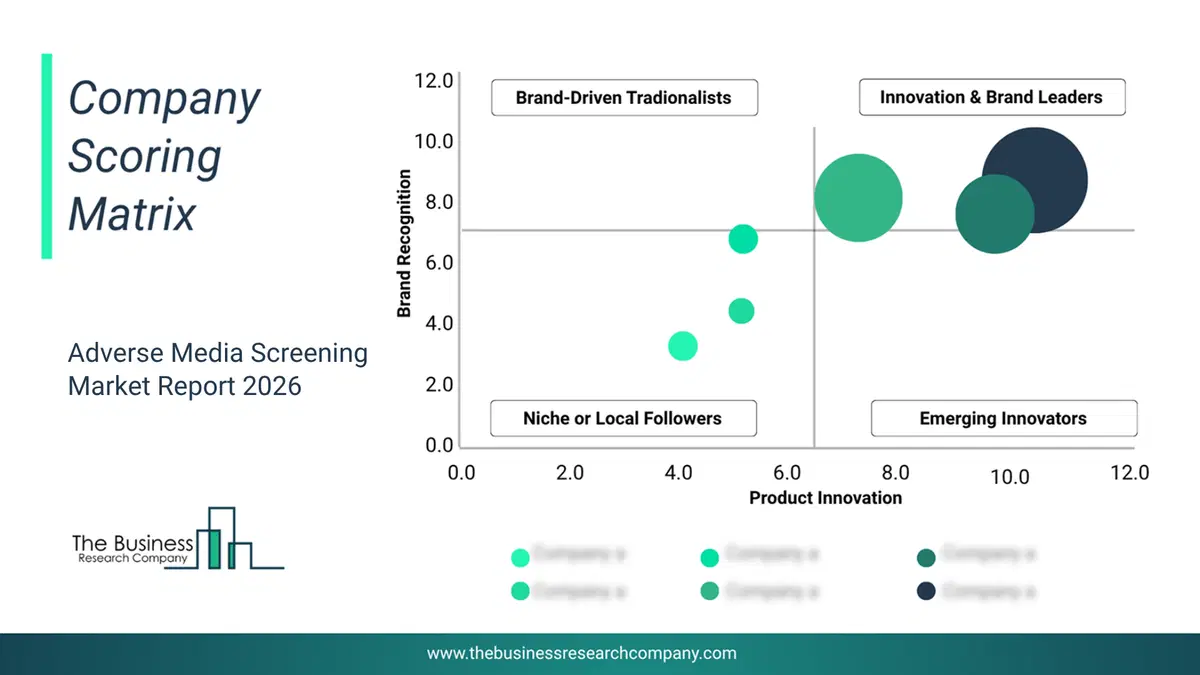
This chart maps companies by product innovation and brand strength, with bubble size indicating relative revenue, helping identify market leaders, challengers, and niche players. This is an illustrative chart; the full report provides a complete and accurate competitive analysis.
Global Adverse Media Screening Market Trends and Insights
Major companies operating in the adverse media screening market are focusing on developing innovative solutions such as robotic process automation to streamline risk assessment, automate screening processes, and enhance compliance efficiency. Robotic process automation (RPA) is a technology that enables software bots to mimic human actions and execute routine, structured tasks across digital systems without requiring changes to existing IT infrastructure. Its adoption is becoming increasingly critical in strengthening compliance frameworks, reducing operational costs, and enabling faster, more accurate risk detection across high-volume data environments. For instance, in March 2026, UiPath Inc., a US-based software company, launched agentic AI solutions to automate financial crime compliance and loan origination workflows. These solutions leverage technology from its WorkFusion acquisition to address increasing regulatory pressures and fraud risks in the banking sector. The financial crime compliance solution utilizes AI agents for sanctions screening, alert investigations, and adverse media monitoring across both internal and external data sources. It significantly reduces manual workloads, minimizes false positives, and enhances investigator productivity while ensuring full auditability. Notably, Valley National Bank automated 61% of its sanctions review processes using a similar AI-driven agent.What Are Latest Mergers And Acquisitions In The Adverse Media Screening Market?
In January 2026, Solytics Partners Private Limited, a US-based regulatory technology company, acquired Arachnys Information Services Limited for an undisclosed amount. With this acquisition, Solytics Partners aims to strengthen its end-to-end AML and financial crime compliance capabilities by integrating Arachnys' investigation tools with its AI-driven analytics. Arachnys Information Services Limited is a UK-based financial crime technology company that offers adverse media screening services.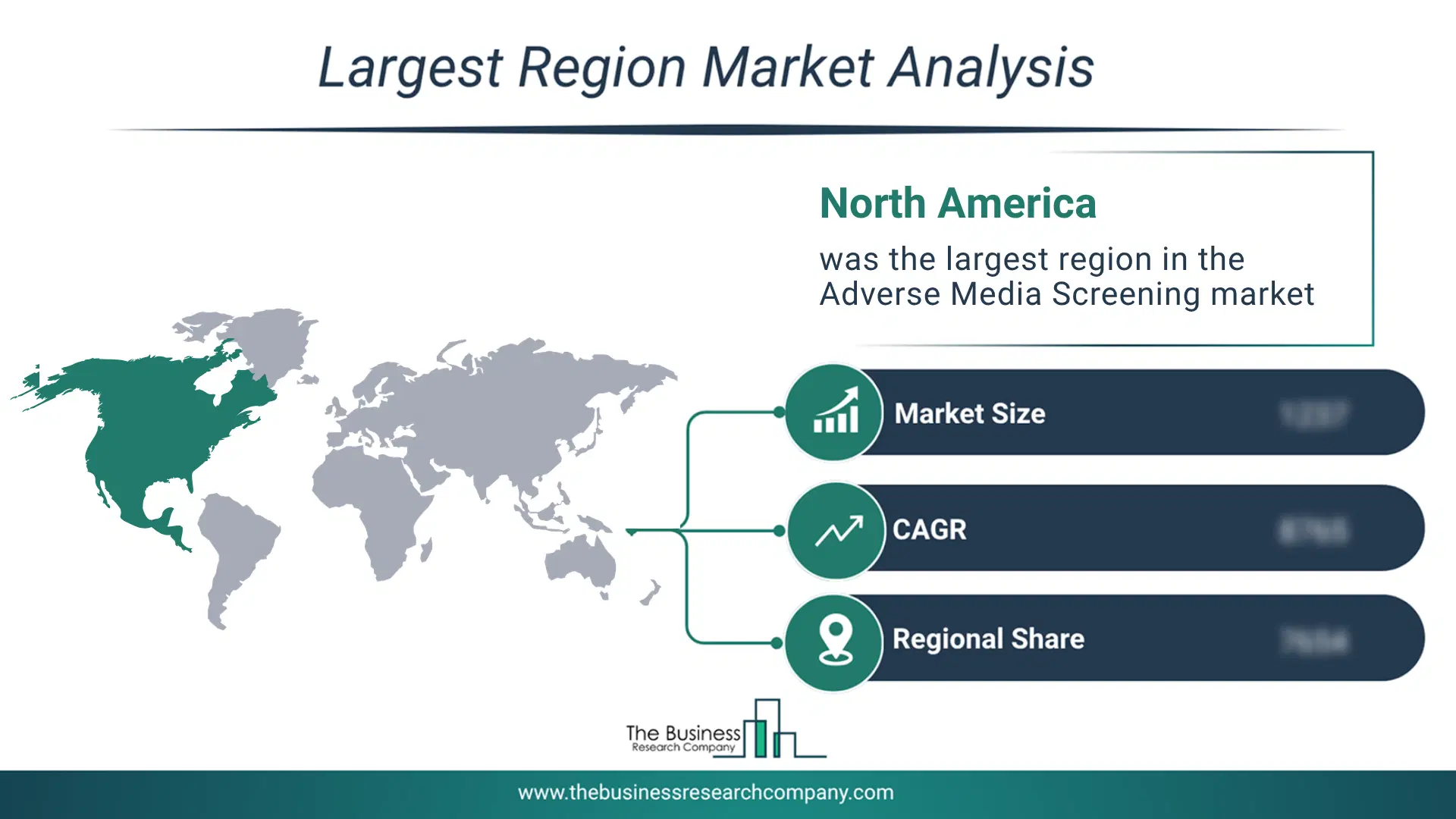
Regional Insights
North America was the largest region in the adverse media screening market in 2025. Asia-Pacific is expected to be the fastest-growing region in the forecast period. The regions covered in this market report are Asia-Pacific, South East Asia, Western Europe, Eastern Europe, North America, South America, Middle East, Africa. The countries covered in this market report are Australia, Brazil, China, France, Germany, India, Indonesia, Japan, Taiwan, Russia, South Korea, UK, USA, Canada, Italy, Spain.What Defines the Adverse Media Screening Market?
The adverse media screening market consists of revenues earned by entities by providing services such as real-time alerts, enhanced due diligence, and sanctions and watchlist screening. The market value includes the value of related goods sold by the service provider or included within the service offering. The market value includes the value of related goods sold by the service provider or included within the service offering. Only goods and services traded between entities or sold to end consumers are included.How is Market Value Defined and Measured?
The market value is defined as the revenues that enterprises gain from the sale of goods and/or services within the specified market and geography through sales, grants, or donations in terms of the currency (in USD unless otherwise specified). The revenues for a specified geography are consumption values that are revenues generated by organizations in the specified geography within the market, irrespective of where they are produced. It does not include revenues from resales along the supply chain, either further along the supply chain or as part of other products.
This chart presents market attractiveness based on a quantitative evaluation of growth, competition, strategic alignment, and risk, offering a clear view of opportunity areas for decision-making. This chart is for illustrative purposes; the full report contains the complete analysis.

This chart highlights the Total Addressable Market (TAM) by estimating the maximum revenue opportunity using an assumption-driven approach, supporting strategic planning and opportunity sizing across markets. The chart is illustrative; the full report provides a more comprehensive analysis.
What Key Data and Analysis Are Included in the Adverse Media Screening Market Report 2026?
The adverse media screening market research report is one of a series of new reports from The Business Research Company that provides market statistics, including industry global market size, regional shares, competitors with the market share, detailed market segments, market trends and opportunities, and any further data you may need to thrive in the adverse media screening industry. The market research report delivers a complete perspective of everything you need, with an in-depth analysis of the current and future state of the industry.Adverse Media Screening Market Report Forecast Analysis
| Report Attribute | Details |
|---|---|
| Market Size Value In 2026 | $1.5 billion |
| Revenue Forecast In 2030 | $2.61 billion |
| Growth Rate | CAGR of 14.8% from 2026 to 2030 |
| Base Year For Estimation | 2025 |
| Actual Estimates/Historical Data | 2020-2025 |
| Forecast Period | 2026 - 2030 |
| Market Representation | Revenue in USD Billion and CAGR from 2026 to 2030 |
| Segments Covered | Component, Deployment Mode, Organization Size, Application, End-User |
| Regional Scope | Asia-Pacific, Western Europe, Eastern Europe, North America, South America, Middle East, Africa |
| Country Scope | The Countries Covered In This Market Report Are Australia, Brazil, China, France, Germany, India, Indonesia, Japan, Taiwan, Russia, South Korea, Uk, Usa, Canada, Italy, Spain. |
| Key Companies Profiled | Oracle Corporation, London Stock Exchange Group Risk Intelligence, Thomson Reuters Corporation, Moody’s Analytics Inc., SAS Institute Inc., Fair Isaac Corporation (FICO), AML RightSource LLC, Fenergo Limited, Quantexa Limited, Feedzai Inc., Sum and Substance Ltd., SEON Technologies Ltd., ThetaRay Ltd., Persona Identities Inc., Napier Technologies Limited, Ripjar Limited, Quantifind Inc., ComplyAdvantage Limited, Sanction Scanner Teknoloji A.Ş., Ondato UAB, AML Partners LLC, Truth Technologies Inc., KYC Global Technologies Private Limited, iDenfy UAB, iComply Investor Services Inc. |
| Customization Scope | Request for Customization |
| Pricing And Purchase Options | Explore Purchase Options |