
Aerial Refueling Systems Market Report 2026
Global Outlook – By Component (Refueling Pods, Refueling Booms, Hoses And Drogues, Pumps And Valves, Software And Control Systems), By Aircraft Type (Fighter Aircraft, Transport Aircraft, Tanker Aircraft, Military Helicopters, Unmanned Aerial Vehicles), By System Type (Probe And Drogue Systems, Boom And Receptacle Systems, Autonomous Aerial Refueling Systems), By Distribution Channel (Original Equipment Manufacturer (OEM), Aftermarket), By End User (Air Force, Navy, Other Defense Organizations) – Market Size, Trends, Strategies, and Forecast to 2030
Aerial Refueling Systems Market Overview
• Aerial Refueling Systems market size has reached to $0.69 billion in 2025 • Expected to grow to $1.06 billion in 2030 at a compound annual growth rate (CAGR) of 8.7% • Growth Driver: Increasing Military Modernization Programs Driving The Market Growth Due To Escalating Geopolitical Tensions And Security Threats • Market Trend: Advanced Mission Management Solutions Enhance Fleet Utilization • North America was the largest region in 2025 and Asia-Pacific is the fastest growing region.What Is Covered Under Aerial Refueling Systems Market?
Aerial refueling systems are specialized systems that enable the transfer of fuel from one aircraft to another while both aircraft are in flight, extending the operational range and endurance of the receiving aircraft. These systems are widely used in military aviation to support long-duration missions, rapid force deployment, and sustained aerial operations without the need for ground-based refueling. They enhance mission flexibility, improve operational efficiency, and increase the strategic capabilities of air forces. The main components of aerial refueling systems include refueling pods, refueling booms, hoses and drogues, pumps and valves, and software and control systems. Refueling pods refer to external systems mounted on tanker or supporting aircraft that enable the transfer of fuel to receiver aircraft during flight operations, improving mission endurance and operational range. These systems are designed for aircraft types including fighter aircraft, transport aircraft, tanker aircraft, military helicopters, and unmanned aerial vehicles and operate through probe and drogue systems, boom and receptacle systems, and autonomous aerial refueling systems. They are supplied through original equipment manufacturer and aftermarket channels and are utilized by end users including air force, navy, and other defense organizations.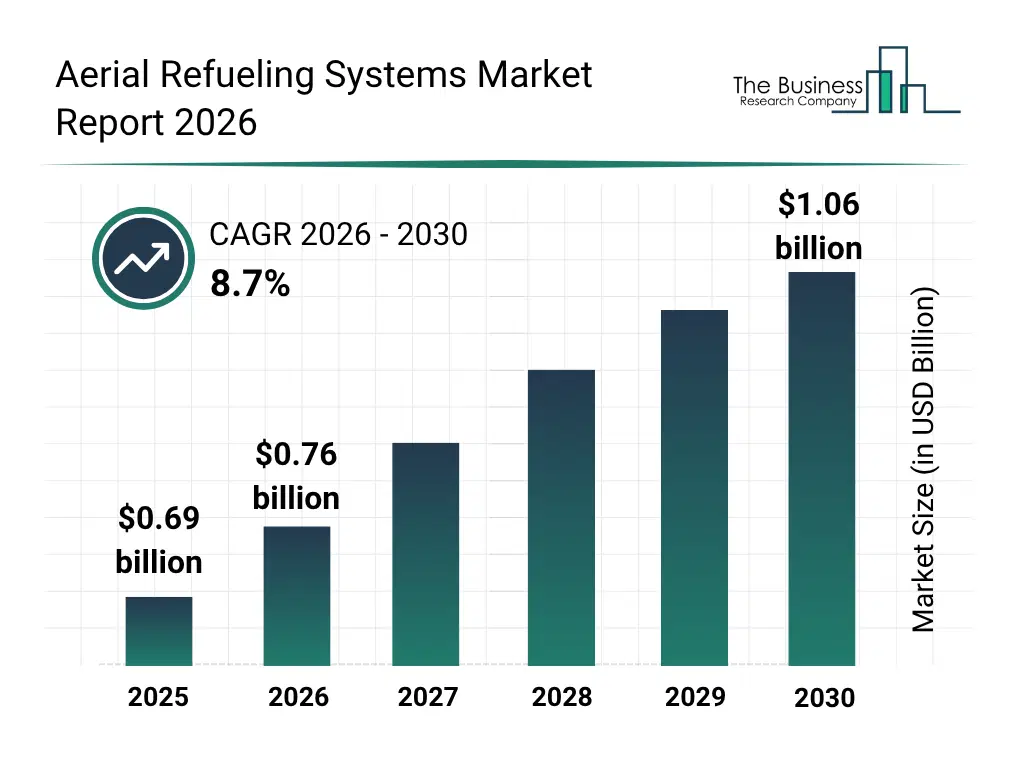
What Is The Aerial Refueling Systems Market Size and Share 2026?
The aerial refueling systems market size has grown strongly in recent years. It will grow from $0.69 billion in 2025 to $0.76 billion in 2026 at a compound annual growth rate (CAGR) of 9.2%. The growth in the historic period can be attributed to growing military modernization programs, increasing long-range combat missions, rising defense spending, expanding strategic air mobility requirements, growing procurement of tanker aircraft.What Is The Aerial Refueling Systems Market Growth Forecast?
The aerial refueling systems market size is expected to see strong growth in the next few years. It will grow to $1.06 billion in 2030 at a compound annual growth rate (CAGR) of 8.7%. The growth in the forecast period can be attributed to increasing deployment of unmanned aerial vehicles, rising investment in next-generation tanker fleets, growing demand for autonomous aerial refueling capabilities, expanding joint military operations, increasing focus on rapid force projection. Major trends in the forecast period include increasing adoption of multi mission aerial refueling platforms, rising demand for extended aircraft mission endurance, growing modernization of air refueling fleets, expanding deployment of high capacity refueling systems, increasing integration of advanced fuel transfer and safety systems.
Global Aerial Refueling Systems Market Segmentation
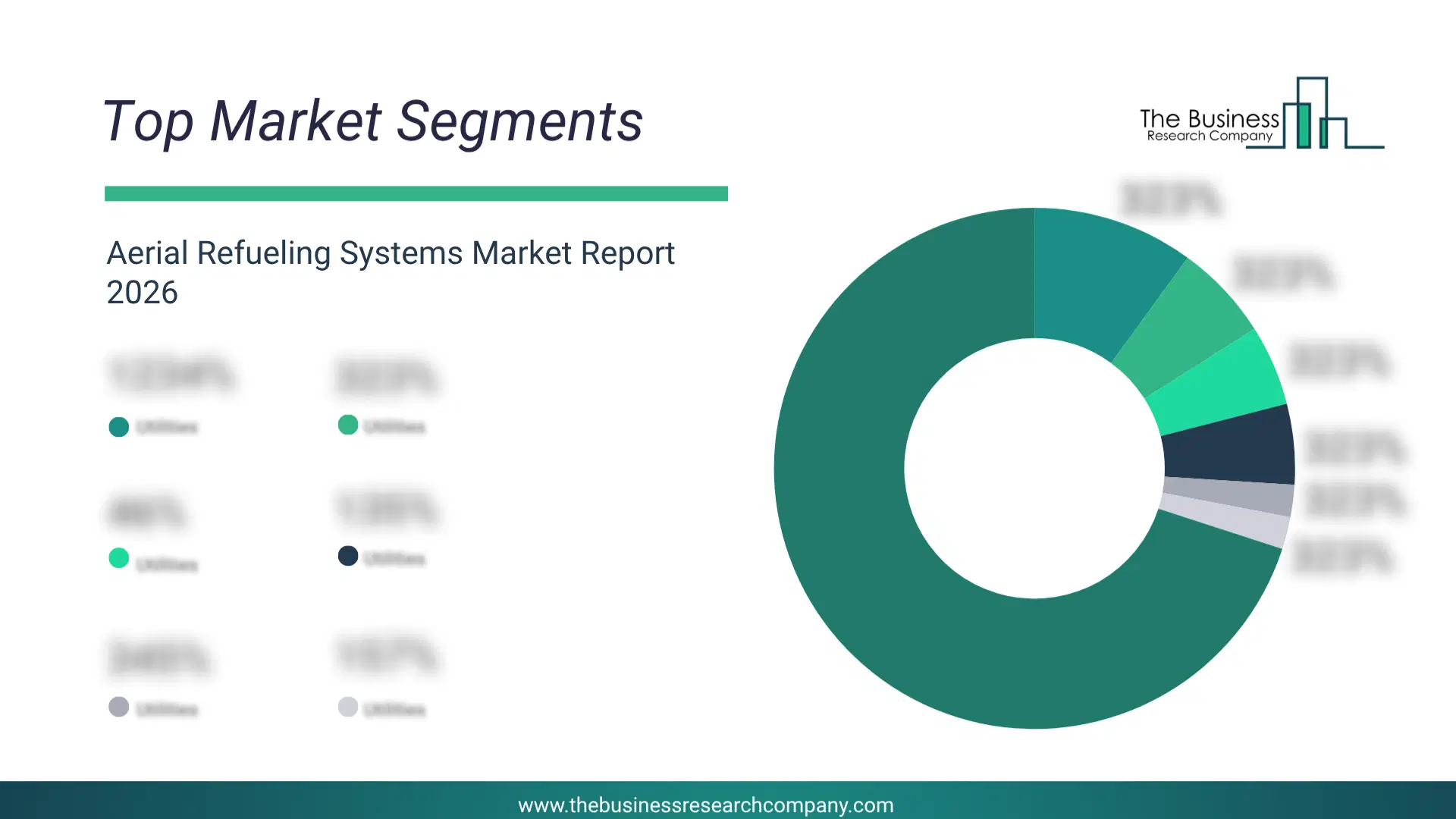
1) By Component: Refueling Pods, Refueling Booms, Hoses And Drogues, Pumps And Valves, Software And Control Systems 2) By Aircraft Type: Fighter Aircraft, Transport Aircraft, Tanker Aircraft, Military Helicopters, Unmanned Aerial Vehicles 3) By System Type: Probe And Drogue Systems, Boom And Receptacle Systems, Autonomous Aerial Refueling Systems 4) By Distribution Channel: Original Equipment Manufacturer (OEM), Aftermarket 5) By End User: Air Force, Navy, Other Defense Organizations Subsegments: 1) By Refueling Pods: Wing Mounted Refueling Pods, Fuselage Mounted Refueling Pods, High Capacity Refueling Pods, Modular Refueling Pods, Multi Point Refueling Pods 2) By Refueling Booms: Fly By Wire Refueling Booms, Telescopic Refueling Booms, Rigid Refueling Booms, Advanced Vision Refueling Booms, Remote Operated Refueling Booms 3) By Hoses And Drogues: Wing Mounted Hose And Drogue Systems, Centerline Hose And Drogue Systems, High Speed Hose And Drogue Systems, Retractable Hose And Drogue Systems, Flexible Hose And Drogue Assemblies 4) By Pumps And Valves: Fuel Transfer Pumps, Booster Pumps, Pressure Control Valves, Flow Control Valves, Shut Off Valves 5) By Software And Control Systems: Refueling Mission Management Software, Boom Control Software, Fuel Monitoring Software, Flight Control Integration Software, Operator Interface SystemsWhat Is The Driver Of The Aerial Refueling Systems Market?
The increasing military modernization programs is expected to propel the growth of the aerial refueling systems market going forward. Military modernization programs are comprehensive initiatives by armed forces to upgrade and enhance their defense capabilities through advanced weapons systems and technologies. The rising military modernization programs is due to escalating geopolitical tensions and security threats to national sovereignty and regional stability, as nations seek to enhance their defense capabilities, deter potential adversaries, and safeguard their strategic interests. Increasing military modernization programs are driving the development and adoption of aerial refueling systems by boosting investment in advanced tanker aircraft, enhancing mission endurance, and strengthening long-range operational capabilities. For instance, in March 2023, according to the European Security and Defence College, a Belgium-based autonomous institution, in 2030, the ongoing US Army modernization program is set to field 35 new future force systems, forming the core of more than 500 development, acquisition, or upgrade initiatives underway. Therefore, the increasing military modernization programs is driving the growth of the aerial refueling systems industry.Key Players In The Global Aerial Refueling Systems Market
Major companies operating in the aerial refueling systems market are AAR CORP., Airbus SE, BAE Systems plc, Dassault Aviation SA, Eaton Corporation plc, Elbit Systems Ltd., Embraer S.A., GKN Aerospace Services Limited, Israel Aerospace Industries Ltd., Leonardo S.p.A., Lockheed Martin Corporation, Marshall of Cambridge (Aerospace) Limited, Northrop Grumman Corporation, Omega Aerial Refueling Services Inc., Parker-Hannifin Corporation, PJSC United Aircraft Corporation, RTX Corporation, Safran Aerosystems SAS, The Boeing Company, Triumph Group Inc.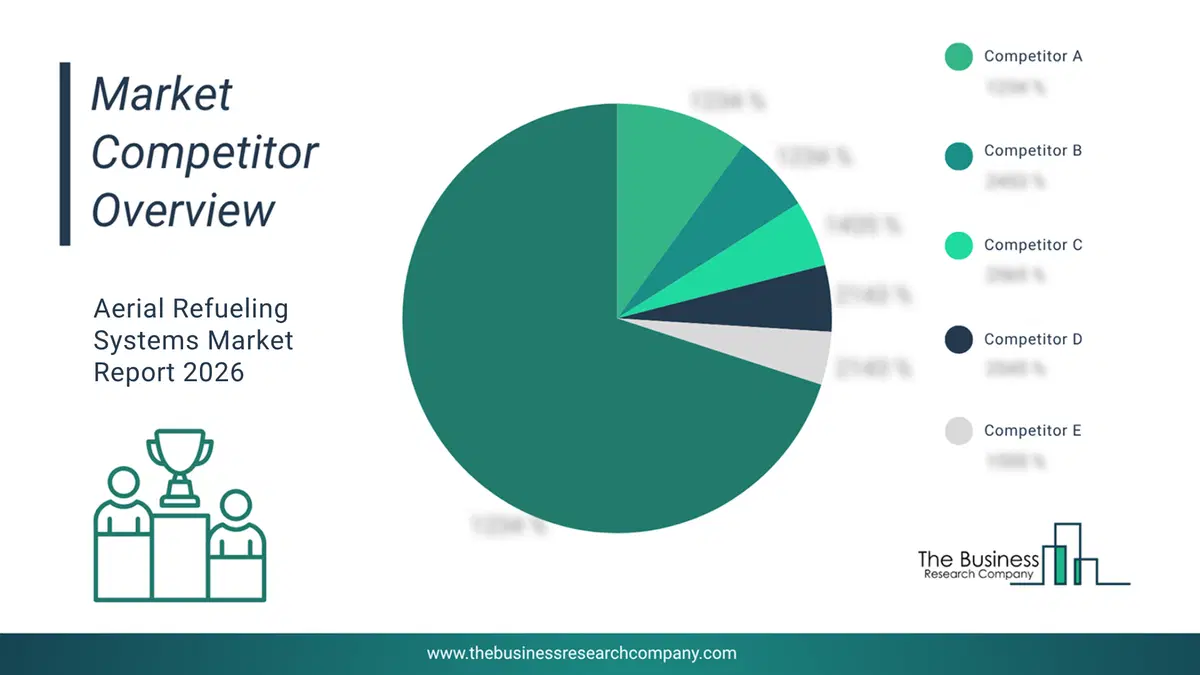
This chart is for illustrative purposes; the full report includes a detailed competitor analysis and comprehensive overview of the top 10 companies in the market.
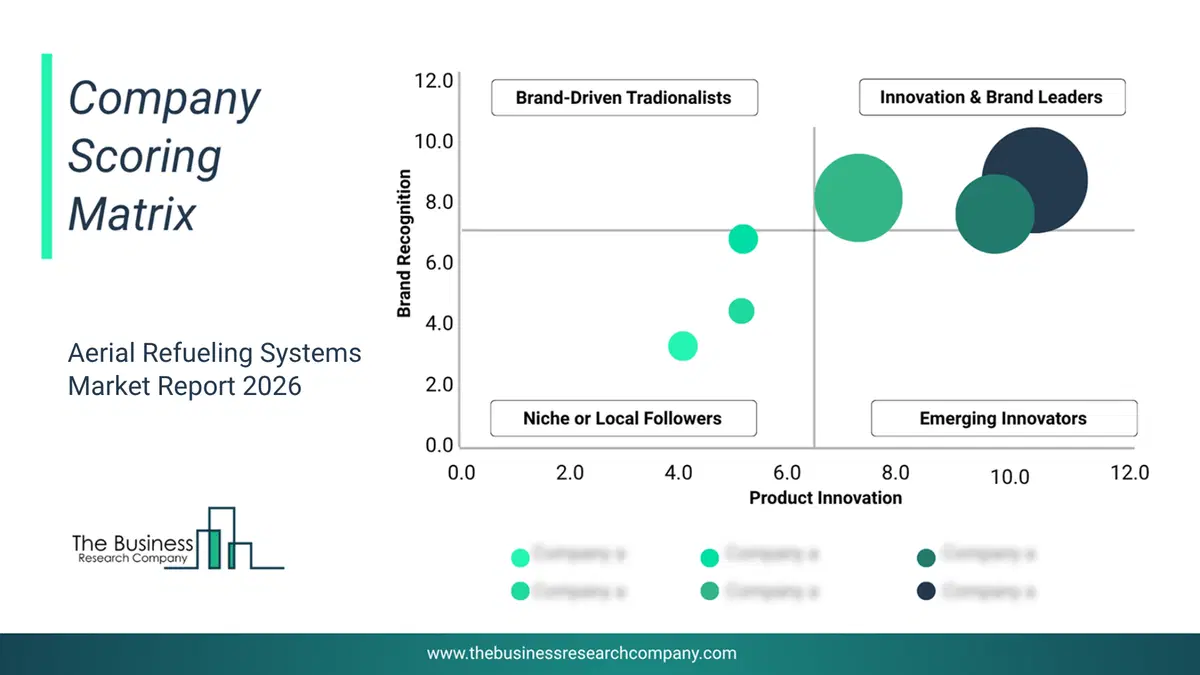
This chart maps companies by product innovation and brand strength, with bubble size indicating relative revenue, helping identify market leaders, challengers, and niche players. This is an illustrative chart; the full report provides a complete and accurate competitive analysis.
Global Aerial Refueling Systems Market Trends and Insights
Major companies operating in the aerial refueling systems market are focusing on developing innovative solutions, such as intelligent aerial refueling mission management systems, to enhance operational efficiency, optimize tanker allocation, and improve mission readiness. Intelligent aerial refueling mission management systems are advanced software-based solutions that use artificial intelligence, real-time operational data, and mission planning tools to optimize tanker scheduling, aircraft assignment, fuel distribution, and overall aerial refueling operations. For instance, in March 2026, the People's Liberation Army Air Force (PLAAF), a China-based aerial warfare services provider, launched an AI-powered aerial refueling dispatcher system designed to improve the efficiency and tempo of tanker operations. The system uses artificial intelligence to optimize aerial refueling task assignments, coordinate tanker aircraft deployment, and support dynamic mission planning based on operational requirements. By automating scheduling and dispatch functions, the platform enhances mission responsiveness while improving the utilization of aerial refueling assets across multiple flight operations.What Are Latest Mergers And Acquisitions In The Aerial Refueling Systems Market?
In April 2026, Paras Defence and Space Technologies Ltd, an India-based defence engineering company, partnered with Bandak Aviation Inc. to supply and support air-to-air refuelling systems and associated accessories for the Indian Armed Forces. Through this agreement, Paras Defence and Space Technologies Ltd and Bandak Aviation Inc. aim to strengthen India's indigenous aerial refuelling capabilities by establishing local maintenance facilities, depot-level infrastructure, and comprehensive lifecycle support services. Bandak Aviation Inc. is a US-based company specializing in the design, manufacture, and support of air-to-air refuelling systems and related aviation equipment.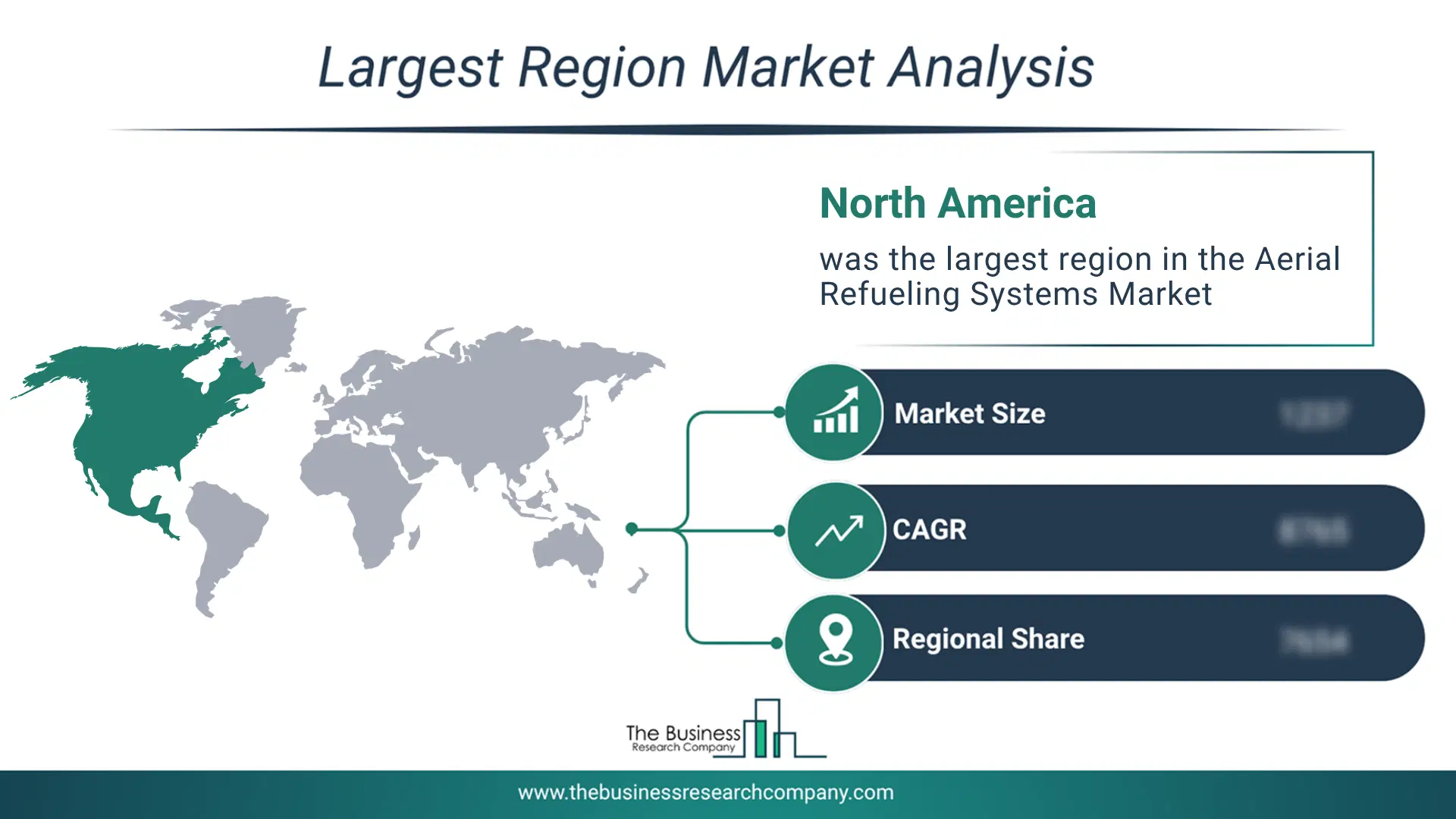
Regional Insights
North America was the largest region in the aerial refueling systems market in 2025. Asia-Pacific is expected to be the fastest-growing region in the forecast period. The regions covered in this market report are Asia-Pacific, South East Asia, Western Europe, Eastern Europe, North America, South America, Middle East, Africa. The countries covered in this market report are Australia, Brazil, China, France, Germany, India, Indonesia, Japan, Taiwan, Russia, South Korea, UK, USA, Canada, Italy, Spain.What Defines the Aerial Refueling Systems Market?
The aerial refueling systems market consists of sales of hose drum units, refueling pods, and refueling receptacles and probes. Values in this market are ‘factory gate’ values, that is, the value of goods sold by the manufacturers or creators of the goods, whether to other entities (including downstream manufacturers, wholesalers, distributors, and retailers) or directly to end customers. The value of goods in this market includes related services sold by the creators of the goods.How is Market Value Defined and Measured?
The market value is defined as the revenues that enterprises gain from the sale of goods and/or services within the specified market and geography through sales, grants, or donations in terms of the currency (in USD unless otherwise specified). The revenues for a specified geography are consumption values that are revenues generated by organizations in the specified geography within the market, irrespective of where they are produced. It does not include revenues from resales along the supply chain, either further along the supply chain or as part of other products.
This chart presents market attractiveness based on a quantitative evaluation of growth, competition, strategic alignment, and risk, offering a clear view of opportunity areas for decision-making. This chart is for illustrative purposes; the full report contains the complete analysis.

This chart highlights the Total Addressable Market (TAM) by estimating the maximum revenue opportunity using an assumption-driven approach, supporting strategic planning and opportunity sizing across markets. The chart is illustrative; the full report provides a more comprehensive analysis.
What Key Data and Analysis Are Included in the Aerial Refueling Systems Market Report 2026?
The aerial refueling systems market research report is one of a series of new reports from The Business Research Company that provides market statistics, including industry global market size, regional shares, competitors with the market share, detailed market segments, market trends and opportunities, and any further data you may need to thrive in the aerial refueling systems industry. The market research report delivers a complete perspective of everything you need, with an in-depth analysis of the current and future state of the industry.Aerial Refueling Systems Market Report Forecast Analysis
| Report Attribute | Details |
|---|---|
| Market Size Value In 2026 | $0.76 billion |
| Revenue Forecast In 2030 | $1.06 billion |
| Growth Rate | CAGR of 8.7% from 2026 to 2030 |
| Base Year For Estimation | 2025 |
| Actual Estimates/Historical Data | 2020-2025 |
| Forecast Period | 2026 - 2030 |
| Market Representation | Revenue in USD Billion and CAGR from 2026 to 2030 |
| Segments Covered | Component, Aircraft Type, System Type, Distribution Channel, End User |
| Regional Scope | Asia-Pacific, Western Europe, Eastern Europe, North America, South America, Middle East, Africa |
| Country Scope | The countries covered in the report are Australia, Brazil, China, France, Germany, India, Indonesia, Japan, Taiwan, Russia, South Korea, UK, USA, Canada, Italy, Spain. |
| Key Companies Profiled | AAR CORP., Airbus SE, BAE Systems plc, Dassault Aviation SA, Eaton Corporation plc, Elbit Systems Ltd., Embraer S.A., GKN Aerospace Services Limited, Israel Aerospace Industries Ltd., Leonardo S.p.A., Lockheed Martin Corporation, Marshall of Cambridge (Aerospace) Limited, Northrop Grumman Corporation, Omega Aerial Refueling Services Inc., Parker-Hannifin Corporation, PJSC United Aircraft Corporation, RTX Corporation, Safran Aerosystems SAS, The Boeing Company, Triumph Group Inc. |
| Customization Scope | Request for Customization |
| Pricing And Purchase Options | Explore Purchase Options |