

Aeroengine Composites Market Report 2026
Global Outlook – By Type (Polymer Matrix Composites, Ceramic Matrix Composites, Metal Matrix Composites), By Component (Fan Blades, Fan Case, Guide Vanes, Shrouds, Other Components), By Application (Commercial Aircraft, Military Aircraft, General Aviation Aircraft) – Market Size, Trends, Strategies, and Forecast to 2030
Aeroengine Composites Market Overview
• Aeroengine Composites market size has reached to $2.97 billion in 2025 • Expected to grow to $5.21 billion in 2030 at a compound annual growth rate (CAGR) of 11.6% • Growth Driver: The Surge In Air Travel Driving Aeroengine Composites Market Growth • Market Trend: Strategic Collaborations For A Sustainable Future • North America was the largest region in 2025 and Asia-Pacific is the fastest growing region.What Is Covered Under Aeroengine Composites Market?
The aero-engine composites refer to materials made up of two or more constituent parts used in the manufacture of various aerospace engines. Aeroengine composites help in reducing the overall weight of the aircraft and increase fuel efficiency. They offer high strength, thermal stability, and impact resistance. The aero-engine composites are easy to assemble and are resistant to fatigue or corrosion. The main types of aeroengine composites includes polymer matrix composites, ceramic matrix composites, and metal matrix composites. The polymer matrix composites include various types of organic polymers that form continuous phases with reinforced fibers. The continuous phase matrix serves as a platform for distributing the fibers evenly across the structure. The components manufactured through composites includes fan blades, fan case, guide vanes, shrouds, and other components. The applications of aeroengine composites includes commercial aircraft, military aircraft and general aviation aircraft.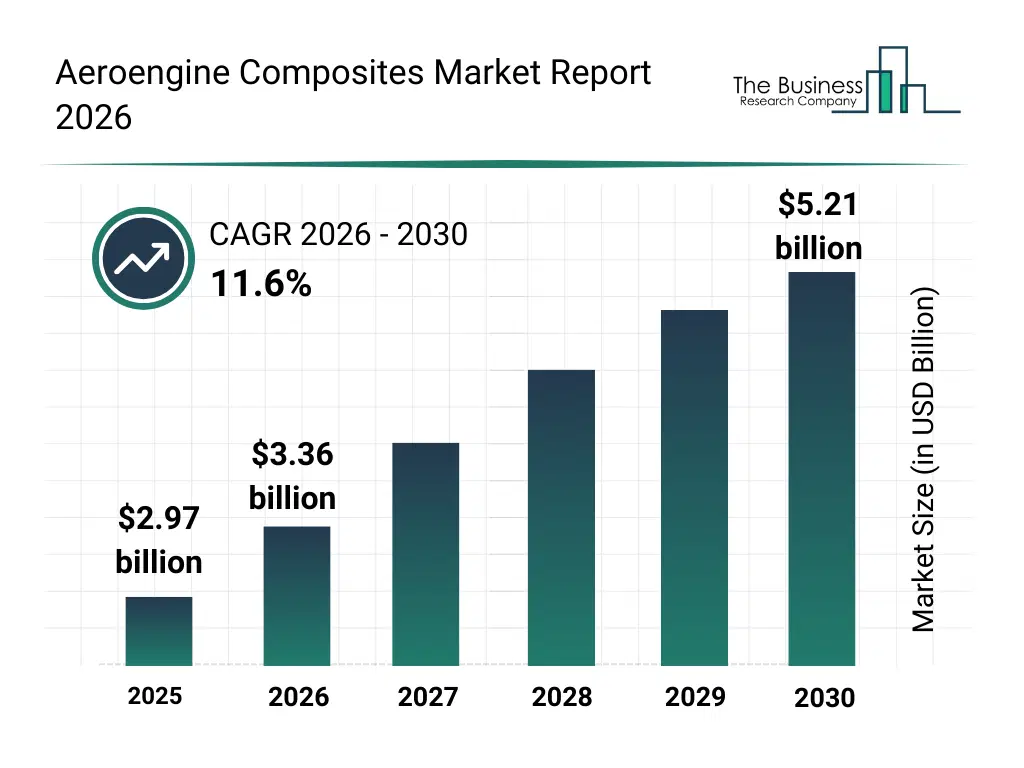
What Is The Aeroengine Composites Market Size and Share 2026?
The aeroengine composites market size has grown rapidly in recent years. It will grow from $2.97 billion in 2025 to $3.36 billion in 2026 at a compound annual growth rate (CAGR) of 13.4%. The growth in the historic period can be attributed to commercial aircraft production growth, adoption of polymer composites, military aircraft modernization, need for corrosion resistance, engine efficiency improvements.What Is The Aeroengine Composites Market Growth Forecast?
The aeroengine composites market size is expected to see rapid growth in the next few years. It will grow to $5.21 billion in 2030 at a compound annual growth rate (CAGR) of 11.6%. The growth in the forecast period can be attributed to sustainable aviation demand, next-generation jet engines, emission reduction regulations, lightweight material innovation, growth in air travel. Major trends in the forecast period include increasing use of lightweight engine materials, rising adoption of ceramic matrix composites, demand for high-temperature resistance, expansion of next-gen aircraft engines, focus on fuel efficiency.
Global Aeroengine Composites Market Segmentation
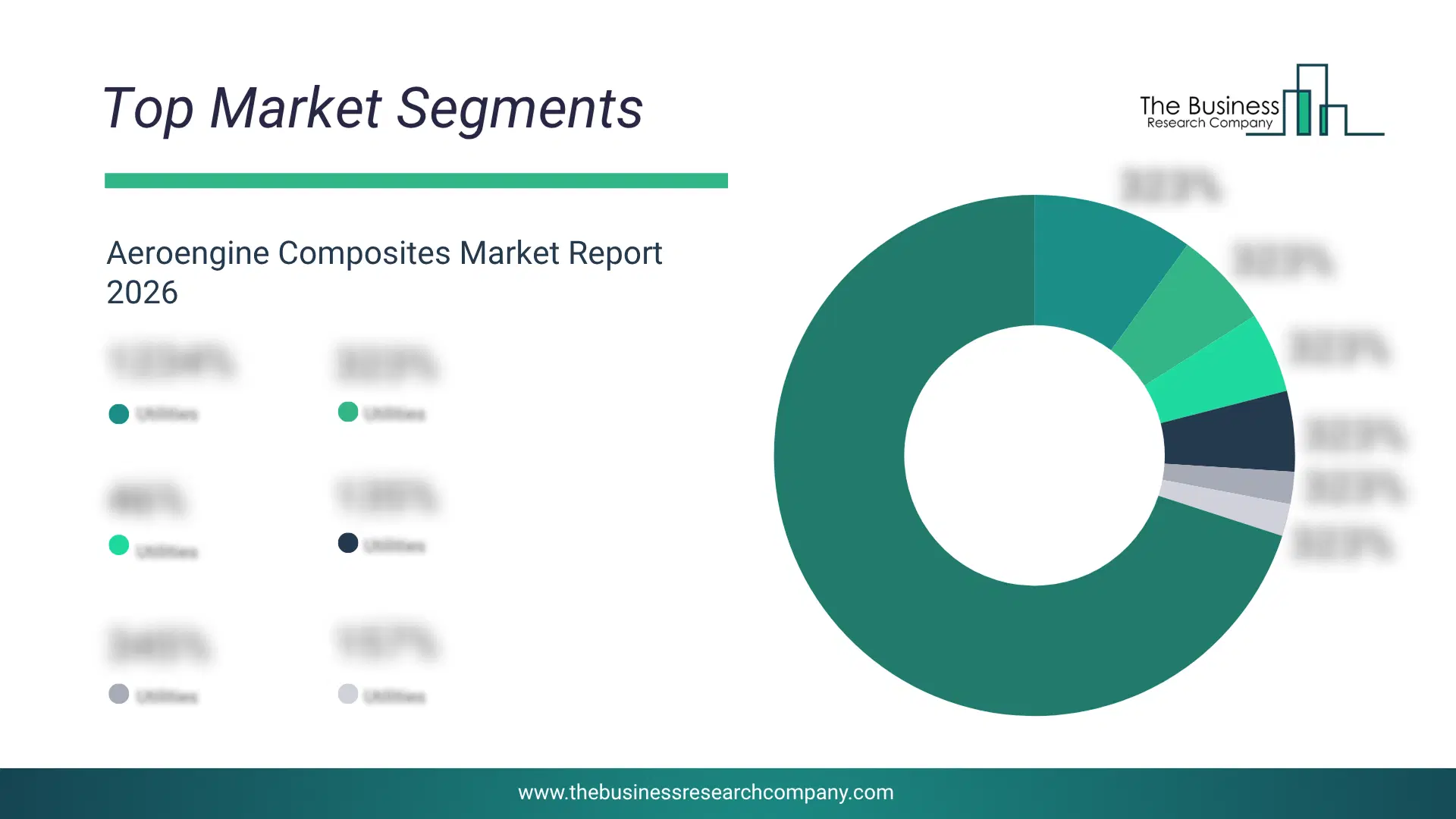
1) By Type: Polymer Matrix Composites, Ceramic Matrix Composites, Metal Matrix Composites 2) By Component: Fan Blades, Fan Case, Guide Vanes, Shrouds, Other Components 3) By Application: Commercial Aircraft, Military Aircraft, General Aviation Aircraft Subsegments: 1) By Polymer Matrix Composites (PMCs): Epoxy-Based Composites, Phenolic-Based Composites, Thermoplastic Composites 2) By Ceramic Matrix Composites (CMCs): Carbon Fiber Reinforced CMCs, Silicon Carbide Reinforced CMCs 3) By Metal Matrix Composites (MMCs): Aluminum Matrix Composites, Titanium Matrix Composites, Magnesium Matrix CompositesWhat Is The Driver Of The Aeroengine Composites Market?
Increase in demand for air travel is expected to propel the growth of the aeroengine composites market going forward. Air travel refers to the act of traveling by means of an aircraft, such as an airplane or helicopter, from one location to another. Aero engine composites are vital in air travel as they contribute to the development of lightweight, fuel-efficient aircraft engines. By replacing traditional materials with composites, such as carbon-fiber-reinforced polymers, these components reduce the overall weight of the engine, enhancing fuel efficiency and performance. This not only leads to cost savings for airlines but also lowers carbon emissions, aligning with the aviation industry's environmental sustainability goals. For instance, in July 2023, the International Air Transport Association, a Canada-based trade association of the world's airlines published an article according to which total air traffic in May 2023 has rose 39.1% compared to May 2022.Globally, air traffic is now at 96.1% of pre-pandemic levels. Therefore, the increase in demand for air travel is driving the aeroengine composites industry.Key Players In The Global Aeroengine Composites Market
Major companies operating in the aeroengine composites market report include Solvay SA, Meggitt plc, Hexcel Corporation, Albany Engineered Composites Inc., Fischer Advanced Composite Components AG, General Electric Aircraft Engines, Rolls-Royce plc, Safran SA, GKN Ltd., Triumph Group Inc., Safran Aerospace Composites, Albany International Corp, Mitsubishi Heavy Industries Ltd., Arconic Corporation, Aviation Industry Corporation of China Ltd., Aerojet Rocketdyne Holdings Inc., Diehl Aerospace GmbH, Hexion Inc., Toray Industries Inc., Teijin Ltd., Owens Corning, SGL Carbon SE, Huntsman Corporation, Cytec Industries Inc., DuPont de Nemours Inc.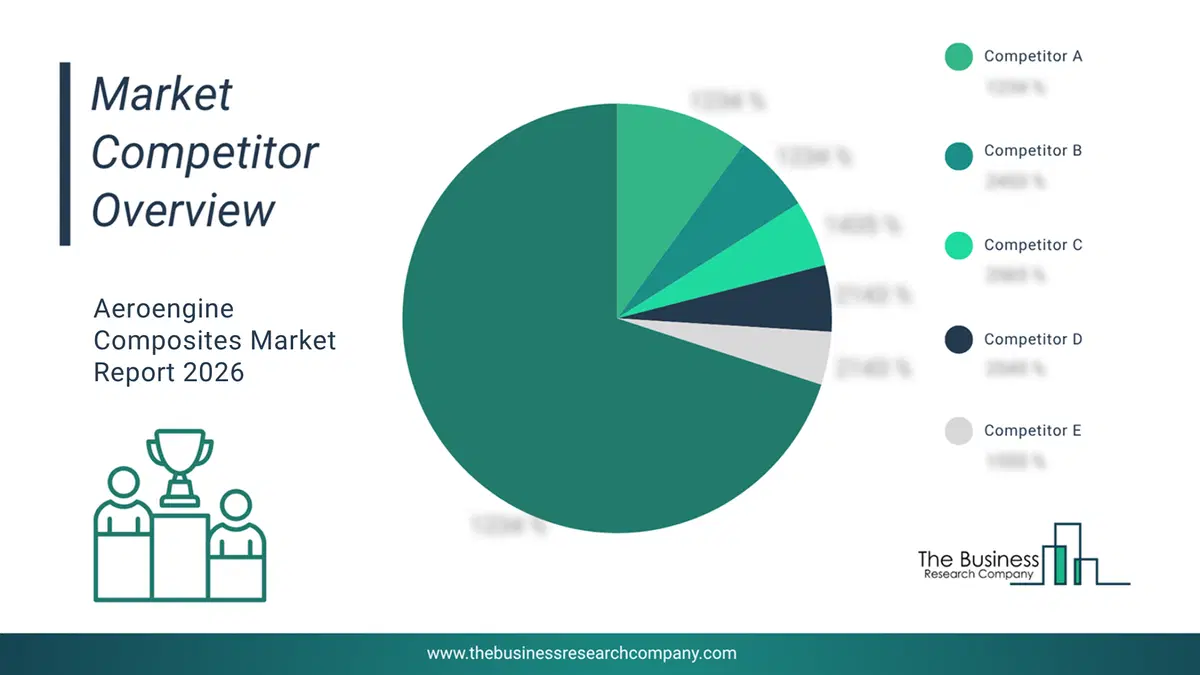
This chart is for illustrative purposes; the full report includes a detailed competitor analysis and comprehensive overview of the top 10 companies in the market.
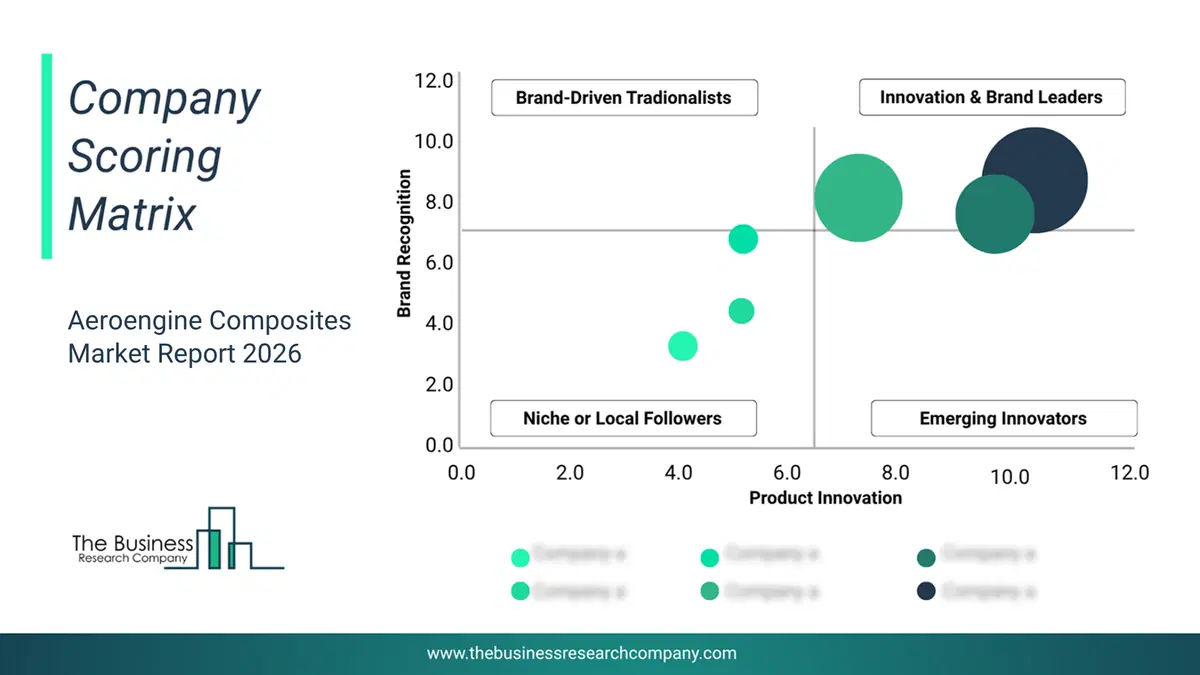
This chart maps companies by product innovation and brand strength, with bubble size indicating relative revenue, helping identify market leaders, challengers, and niche players. This is an illustrative chart; the full report provides a complete and accurate competitive analysis.
Global Aeroengine Composites Market Trends and Insights
Major companies in the aerospace composites market are getting into strategic collaborations and partnerships to strengthen their position in the aerospace composites market. For instance, in June 2023, Solvay SA, a Belgium-based chemical manufacturing company, announced strategic collaborations with Spirit AeroSystems US-based aerostructures for commercial and defense customers. This partnership aims to advance the development of composite aerostructures by combining their expertise in product development, aerospace design, and manufacturing technologies. This collaboration focuses on improving composite fabrication, automation, and assembly processes to enhance the performance, sustainability, and cost-efficiency of future aircraft platforms, aligning with the industry's goals for innovative, eco-friendly technologies.What Are Latest Mergers And Acquisitions In The Aeroengine Composites Market?
In November 2025, GKN Aerospace Limited, a UK-based aerospace engineering company, partnered with GE Aerospace to enhance their aeroengine agreement and jointly develop advanced materials and components for next-generation aircraft engines. With this partnership, GKN Aerospace Limited and GE Aerospace aim to leverage GKN’s expertise in composite and metallic aeroengine components alongside GE Aerospace’s engine technology to improve efficiency, durability, and performance in commercial and military engines. GE Aerospace is a US-based manufacturer specializing in aircraft engines, systems, and related services.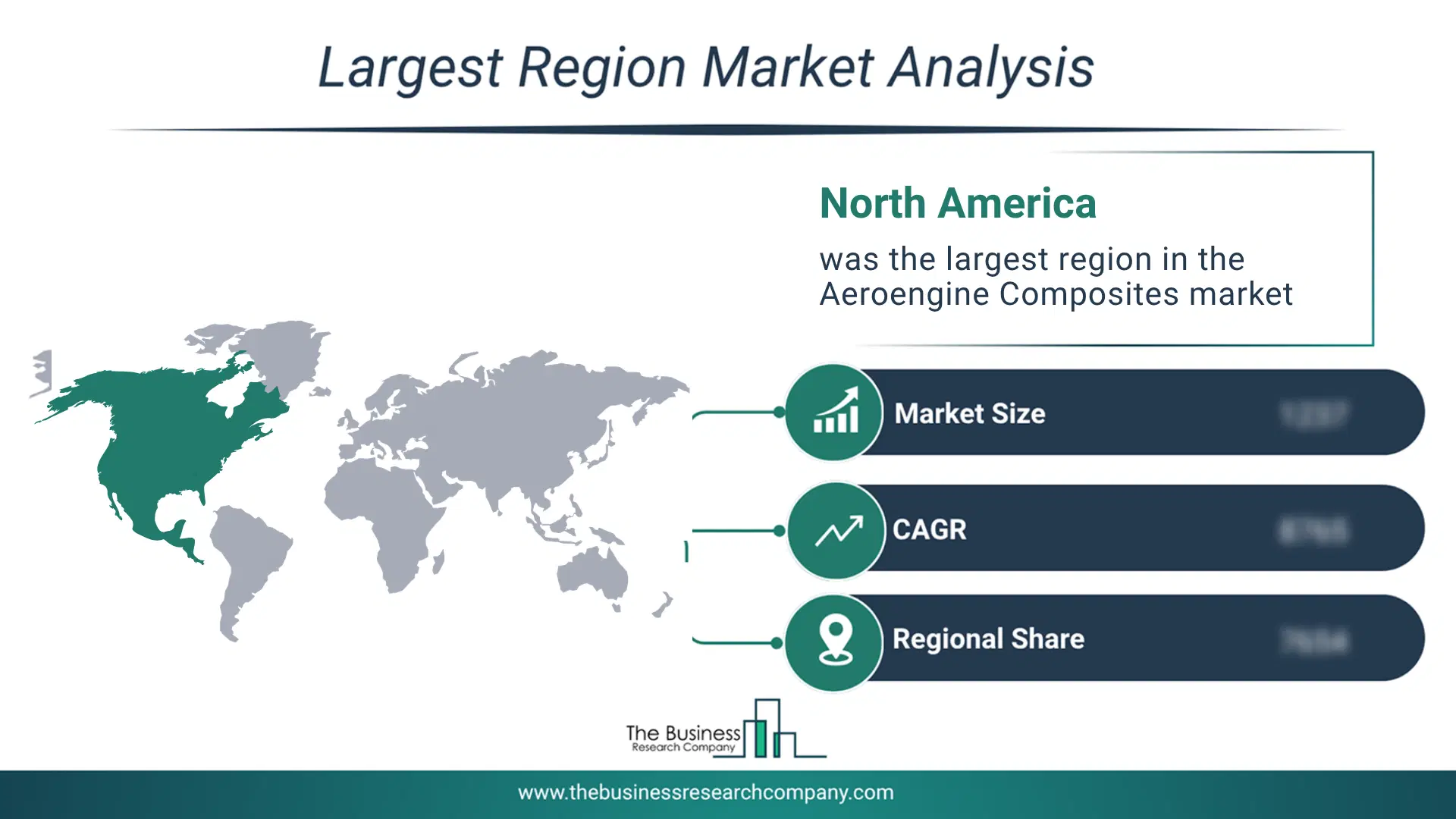
Regional Outlook
North America was the largest region in the aeroengine composites market in 2025. Asia-Pacific is expected to be the fastest growing region in the forecast period. The regions covered in this market report include Asia-Pacific, South East Asia, Western Europe, Eastern Europe, North America, South America, Middle East, Africa. The countries covered in this market report include Australia, Brazil, China, France, Germany, India, Indonesia, Japan, Taiwan, Russia, South Korea, UK, USA, Canada, Italy, SpainWhat Defines the Aeroengine Composites Market?
The aero-engine composites market consists of sales of spinners, vanes, ducts, stators, blade spacers, liners and exhaust flaps. Values in this market are ‘factory gate’ values, that is the value of goods sold by the manufacturers or creators of the goods, whether to other entities (including downstream manufacturers, wholesalers, distributors and retailers) or directly to end customers. The value of goods in this market includes related services sold by the creators of the goods.How is Market Value Defined and Measured?
The market value is defined as the revenues that enterprises gain from the sale of goods and/or services within the specified market and geography through sales, grants, or donations in terms of the currency (in USD unless otherwise specified). The revenues for a specified geography are consumption values that are revenues generated by organizations in the specified geography within the market, irrespective of where they are produced. It does not include revenues from resales along the supply chain, either further along the supply chain or as part of other products.
This chart presents market attractiveness based on a quantitative evaluation of growth, competition, strategic alignment, and risk, offering a clear view of opportunity areas for decision-making. This chart is for illustrative purposes; the full report contains the complete analysis.

This chart highlights the Total Addressable Market (TAM) by estimating the maximum revenue opportunity using an assumption-driven approach, supporting strategic planning and opportunity sizing across markets. The chart is illustrative; the full report provides a more comprehensive analysis.
What Key Data and Analysis Are Included in the Aeroengine Composites Market Report 2026?
The aeroengine composites market research report is one of a series of new reports from The Business Research Company that provides market statistics, including industry global market size, regional shares, competitors with the market share, detailed market segments, market trends and opportunities, and any further data you may need to thrive in the aeroengine composites industry. The market research report delivers a complete perspective of everything you need, with an in-depth analysis of the current and future state of the industry.Aeroengine Composites Market Report Forecast Analysis
| Report Attribute | Details |
|---|---|
| Market Size Value In 2026 | $3.36 billion |
| Revenue Forecast In 2030 | $5.21 billion |
| Growth Rate | CAGR of 13.4% from 2026 to 2030 |
| Base Year For Estimation | 2025 |
| Actual Estimates/Historical Data | 2020-2025 |
| Forecast Period | 2026 - 2030 - 2030 |
| Market Representation | Revenue in USD Billion and CAGR from 2026 to 2030 |
| Segments Covered | Type, Component, Application |
| Regional Scope | Asia-Pacific, Western Europe, Eastern Europe, North America, South America, Middle East, Africa |
| Country Scope | The countries covered in the report are Australia, Brazil, China, France, Germany, India, Indonesia, Japan, Taiwan, Russia, South Korea, UK, USA, Canada, Italy, Spain. |
| Key Companies Profiled | Solvay SA, Meggitt plc, Hexcel Corporation, Albany Engineered Composites Inc., Fischer Advanced Composite Components AG, General Electric Aircraft Engines, Rolls-Royce plc, Safran SA, GKN Ltd., Triumph Group Inc., Safran Aerospace Composites, Albany International Corp, Mitsubishi Heavy Industries Ltd., Arconic Corporation, Aviation Industry Corporation of China Ltd., Aerojet Rocketdyne Holdings Inc., Diehl Aerospace GmbH, Hexion Inc., Toray Industries Inc., Teijin Ltd., Owens Corning, SGL Carbon SE, Huntsman Corporation, Cytec Industries Inc., DuPont de Nemours Inc. |
| Customization Scope | Request for Customization |
| Pricing And Purchase Options | Explore Purchase Options |