

Aerospace And Aircraft Position Sensors Market Report 2026
Global Outlook – By Sensor Type (Linear Position Sensors, Rotary Position Sensors, Angular Position Sensors), By Aircraft Type (Commercial Aircraft, Military Aircraft, Business Jets, Helicopters, Unmanned Aerial Vehicles), By Technology (Hall Effect, Inductive, Potentiometric, Linear Variable Differential Transformer, Magnetostrictive, Optical, Capacitive, Other Technologies), By Application (Flight Control Systems, Landing Gear Systems, Engine Control Systems, Thrust Reverser Systems, Actuation Systems, Cabin Systems, Other Applications), By Sales Channel (Original Equipment Manufacturers, Aftermarket) – Market Size, Trends, Strategies, and Forecast to 2035
Aerospace And Aircraft Position Sensors Market Overview
• Aerospace And Aircraft Position Sensors market size has reached to $2.21 billion in 2025 • Expected to grow to $3.33 billion in 2030 at a compound annual growth rate (CAGR) of 8.4% • Growth Driver: Increasing Aircraft Production Fueling Growth Due To Rising Commercial Fleet Expansion And Defense Aircraft Modernization • Market Trend: Multi-Channel Contactless Transducers Secure Fly-By-Wire Actuation And Compress Total Ownership Costs • North America was the largest region in 2025 and Asia-Pacific is the fastest growing region.What Is Covered Under Aerospace And Aircraft Position Sensors Market?
Aerospace and aircraft position sensors are precision devices designed to detect, measure, and monitor the position, displacement, angle, and movement of mechanical and structural components within aerospace systems. They convert physical motion into accurate electrical signals, enabling reliable monitoring under demanding conditions such as extreme temperatures, vibration, pressure variations, and electromagnetic interference. Engineered to meet stringent aerospace standards, these sensors support the safe, efficient, and reliable operation of aircraft systems. The main sensor types of aerospace and aircraft position sensors include linear position sensors, rotary position sensors, and angular position sensors. Linear position sensors refer to devices that detect and measure the linear displacement or position of aircraft components, enabling accurate monitoring and control of mechanical movement. These sensors are used in commercial aircraft, military aircraft, business jets, helicopters, and unmanned aerial vehicles, and operate using Hall effect, inductive, potentiometric, linear variable differential transformer, magnetostrictive, optical, capacitive, and other technologies. The various applications involved are flight control systems, landing gear systems, engine control systems, thrust reverser systems, actuation systems, cabin systems, and others, and they are sold through original equipment manufacturers and aftermarket channels.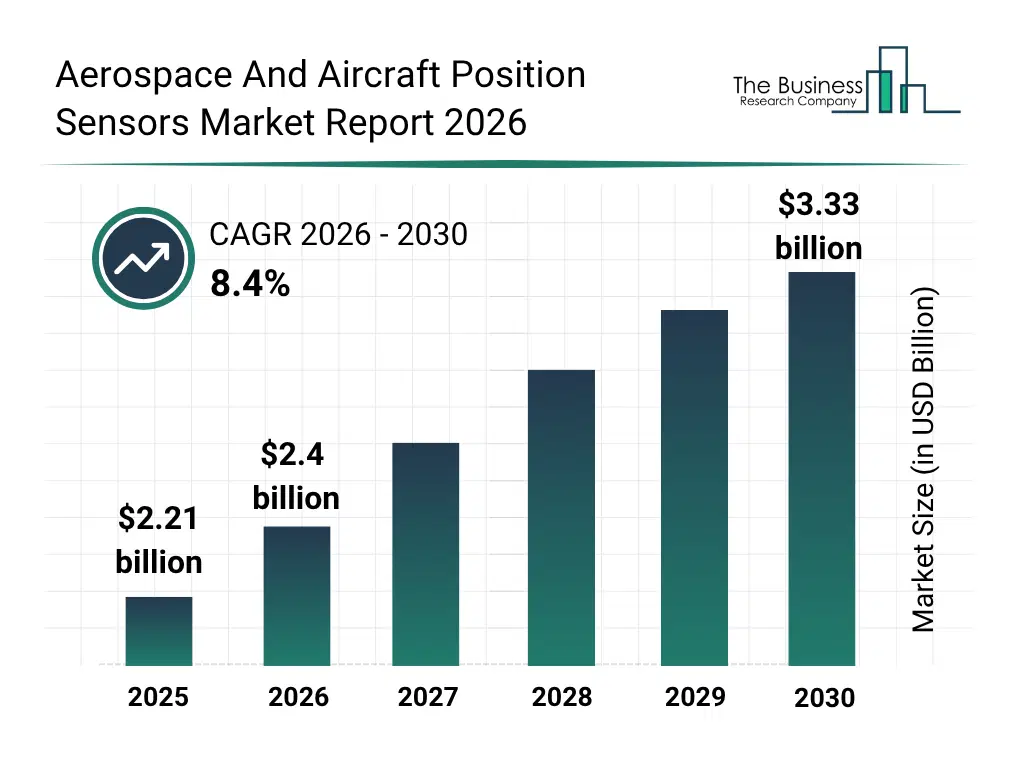
What Is The Aerospace And Aircraft Position Sensors Market Size and Share 2026?
The aerospace and aircraft position sensors market size has grown strongly in recent years. It will grow from $2.21 billion in 2025 to $2.4 billion in 2026 at a compound annual growth rate (CAGR) of 8.9%. The growth in the historic period can be attributed to increasing aircraft production and deliveries, rising demand for aircraft safety systems, growing adoption of electronic flight control systems, increasing modernization of military aircraft fleets, rising replacement demand from aircraft aftermarket.What Is The Aerospace And Aircraft Position Sensors Market Growth Forecast?
The aerospace and aircraft position sensors market size is expected to see strong growth in the next few years. It will grow to $3.33 billion in 2030 at a compound annual growth rate (CAGR) of 8.4%. The growth in the forecast period can be attributed to expansion of commercial aviation fleets, increasing adoption of electric and hybrid aircraft systems, growing deployment of unmanned aerial vehicles, rising demand for advanced aircraft actuation systems, increasing integration of high-reliability sensing technologies. Major trends in the forecast period include increasing adoption of non-contact position sensing, miniaturization of aerospace position sensors, development of high-temperature position sensors, integration of multi-axis position measurement, advancement of fault-tolerant position sensing.Tariff Impact On Aerospace And Aircraft Position Sensors Market
Tariffs are impacting the aerospace and aircraft position sensors market by increasing the cost of imported sensor components, electronic materials, precision manufacturing equipment, and aerospace-grade components. OEM and aftermarket segments may experience higher procurement and production costs, with North America, Europe, and Asia-Pacific particularly affected by cross-border aerospace supply chains. These pressures may encourage sensor manufacturers to localize production, diversify suppliers, and strengthen regional sourcing networks. However, tariffs can also support domestic aerospace component manufacturing and stimulate investment in localized sensor technologies.
Global Aerospace And Aircraft Position Sensors Market Segmentation
2) By Aircraft Type: Commercial Aircraft, Military Aircraft, Business Jets, Helicopters, Unmanned Aerial Vehicles 3) By Technology: Hall Effect, Inductive, Potentiometric, Linear Variable Differential Transformer, Magnetostrictive, Optical, Capacitive, Other Technologies 4) By Application: Flight Control Systems, Landing Gear Systems, Engine Control Systems, Thrust Reverser Systems, Actuation Systems, Cabin Systems, Other Applications 5) By Sales Channel: Original Equipment Manufacturers, Aftermarket Subsegments: 1) By Linear Position Sensors: Contact Linear Position Sensors, Non Contact Linear Position Sensors, Inductive Linear Position Sensors, Capacitive Linear Position Sensors, Magnetic Linear Position Sensors, Optical Linear Position Sensors 2) By Rotary Position Sensors: Contact Rotary Position Sensors, Non Contact Rotary Position Sensors, Magnetic Rotary Position Sensors, Optical Rotary Position Sensors, Inductive Rotary Position Sensors, Capacitive Rotary Position Sensors 3) By Angular Position Sensors: Absolute Angular Position Sensors, Incremental Angular Position Sensors, Magnetic Angular Position Sensors, Optical Angular Position Sensors, Inductive Angular Position Sensors, Capacitive Angular Position SensorsWhat Is The Driver Of The Aerospace And Aircraft Position Sensors Market?
The increasing aircraft production across commercial and defense aviation is expected to propel the growth of the aerospace and aircraft position sensors market going forward. Increasing aircraft production refers to the rising manufacturing output of commercial and military aircraft to meet growing air travel demand, fleet modernization programs, and defense capability requirements. Aircraft manufacturers are increasing production due to rising passenger traffic, airline fleet expansion, and government investments in defense aircraft procurement and upgrades. Aerospace and aircraft position sensors support increasing aircraft production by enabling precise measurement and control of critical aircraft components, including flight control systems, landing gear, engines, and navigation systems, which improves aircraft safety and operational reliability. For instance, in July 2026, according to Airbus, a Netherlands-based aerospace manufacturer, the company delivered 351 commercial aircraft in the first half of 2026, up from 306 aircraft in the first half of 2025, representing a 14.7% year-over-year increase. Therefore, the increasing aircraft production across commercial and defense aviation is driving the growth of the aerospace and aircraft position sensors industry.Key Players In The Global Aerospace And Aircraft Position Sensors Market
Major companies operating in the aerospace and aircraft position sensors market are Honeywell International Inc., Eaton Corporation, Thales Group, Amphenol Corporation, Parker Hannifin Corporation, TE Connectivity plc., Infineon Technologies AG, TDK Corporation, NXP Semiconductors N.V., STMicroelectronics N.V., Murata Manufacturing Co. Ltd., Analog Devices Inc., AMETEK Inc., Microchip Technology Inc., Moog Inc., Woodward Inc., Sensata Technologies Inc., Curtiss-Wright Corporation, Ontic Engineering & Manufacturing Inc., Gill Sensors & Controls Ltd., Trans-Tek Inc., Jewell Instruments LLC, SpaceAge Control Inc.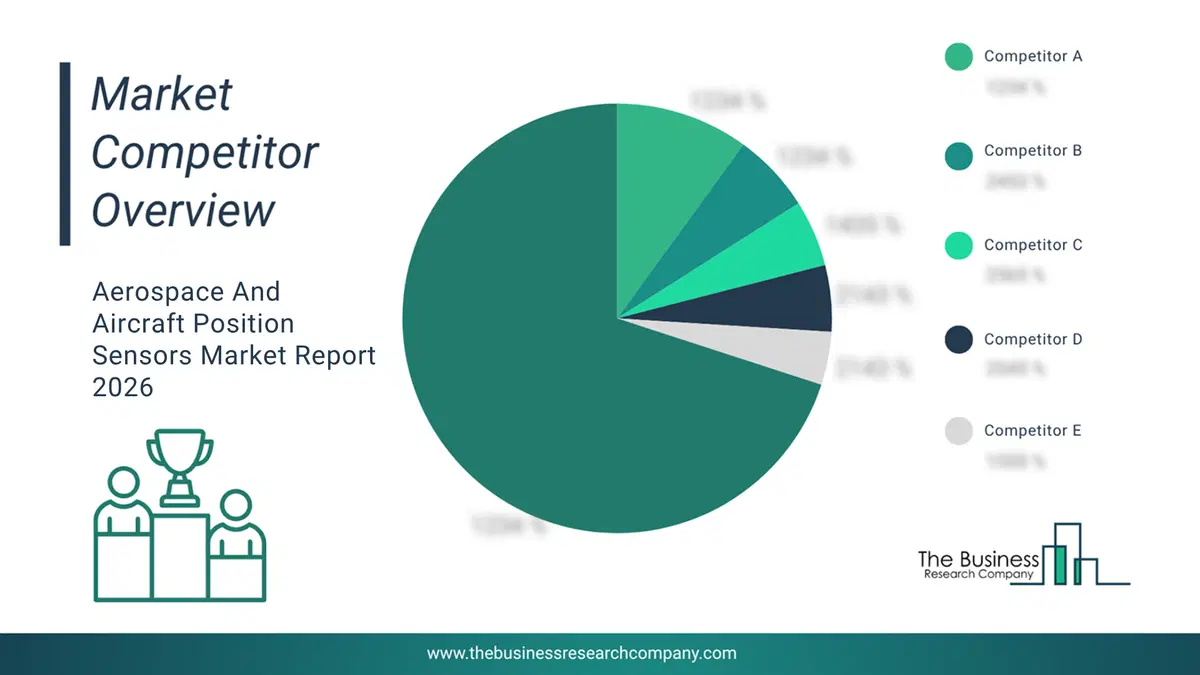
This chart is for illustrative purposes; the full report includes a detailed competitor analysis and comprehensive overview of the top 10 companies in the market.
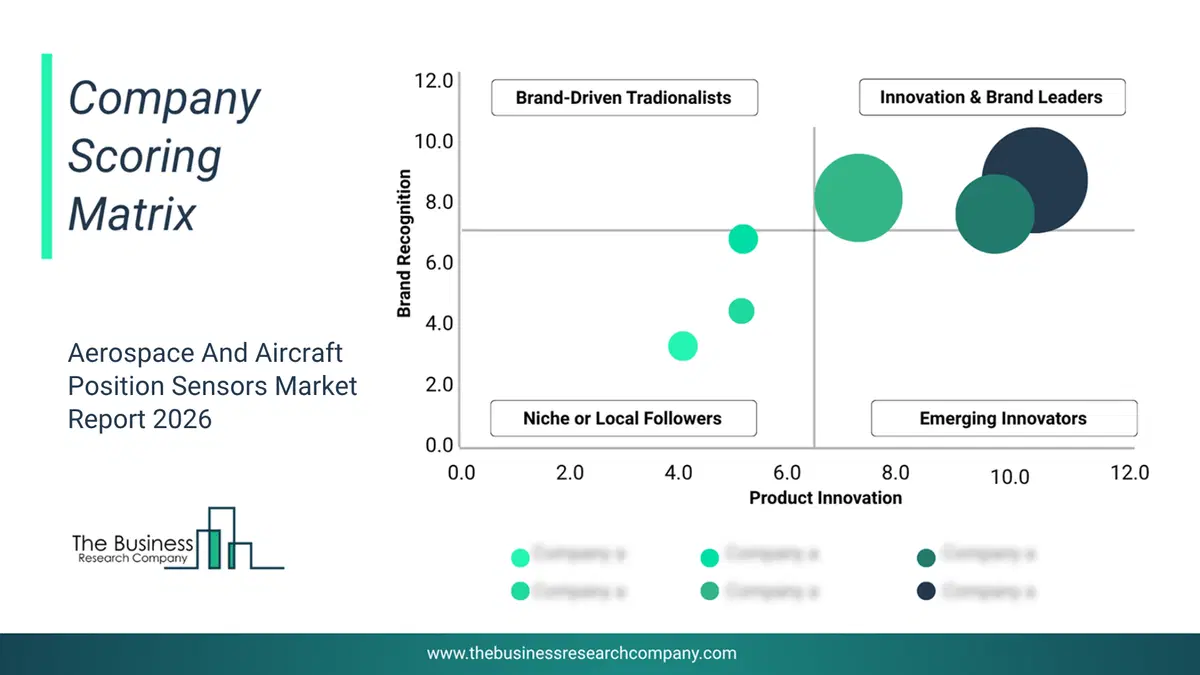
This chart maps companies by product innovation and brand strength, with bubble size indicating relative revenue, helping identify market leaders, challengers, and niche players. This is an illustrative chart; the full report provides a complete and accurate competitive analysis.
Global Aerospace And Aircraft Position Sensors Market Trends and Insights
Major companies operating in the aerospace and aircraft position sensors market are focusing on developing high-reliability motion monitoring architectures, such as multi-channel redundant linear variable differential transformers, to maintain continuous signal integrity across critical flight controls under extreme vibration and temperature stress. Multi-channel redundant linear variable differential transformers refer to inductive electromechanical transducers configured with up to four independent, galvanically isolated sensing channels within a single housing to deliver continuous displacement data even after channel failures. For instance, in March 2026, Curtiss-Wright Corporation, a US-based aerospace and defense company, introduced an expanded range of multi-channel redundant Linear Position Sensors through its Sensors Division. The product family delivers independent signal channels with up to fourfold electrical redundancy, supports linear measurement spans from 5 millimeters to 500 millimeters, and incorporates non-contact inductive sensing elements that eliminate internal friction surfaces to extend operational lifespan.What Are Latest Mergers And Acquisitions In The Aerospace And Aircraft Position Sensors Market?
In April 2026, Hexagon AB, a Sweden-based measurement and positioning technology company, completed its acquisition of Inertial Sense for an undisclosed amount. Through this acquisition, Hexagon aims to strengthen its assured positioning, navigation, and timing (PNT) portfolio by integrating Inertial Sense’s tactical-grade GNSS+INS technology and expanding its resilient navigation capabilities for aerospace and defense applications. Inertial Sense is a US-based provider of technology that fits aerospace and aircraft position sensors, particularly through its GNSS/INS (Inertial Navigation System) and IMU sensors.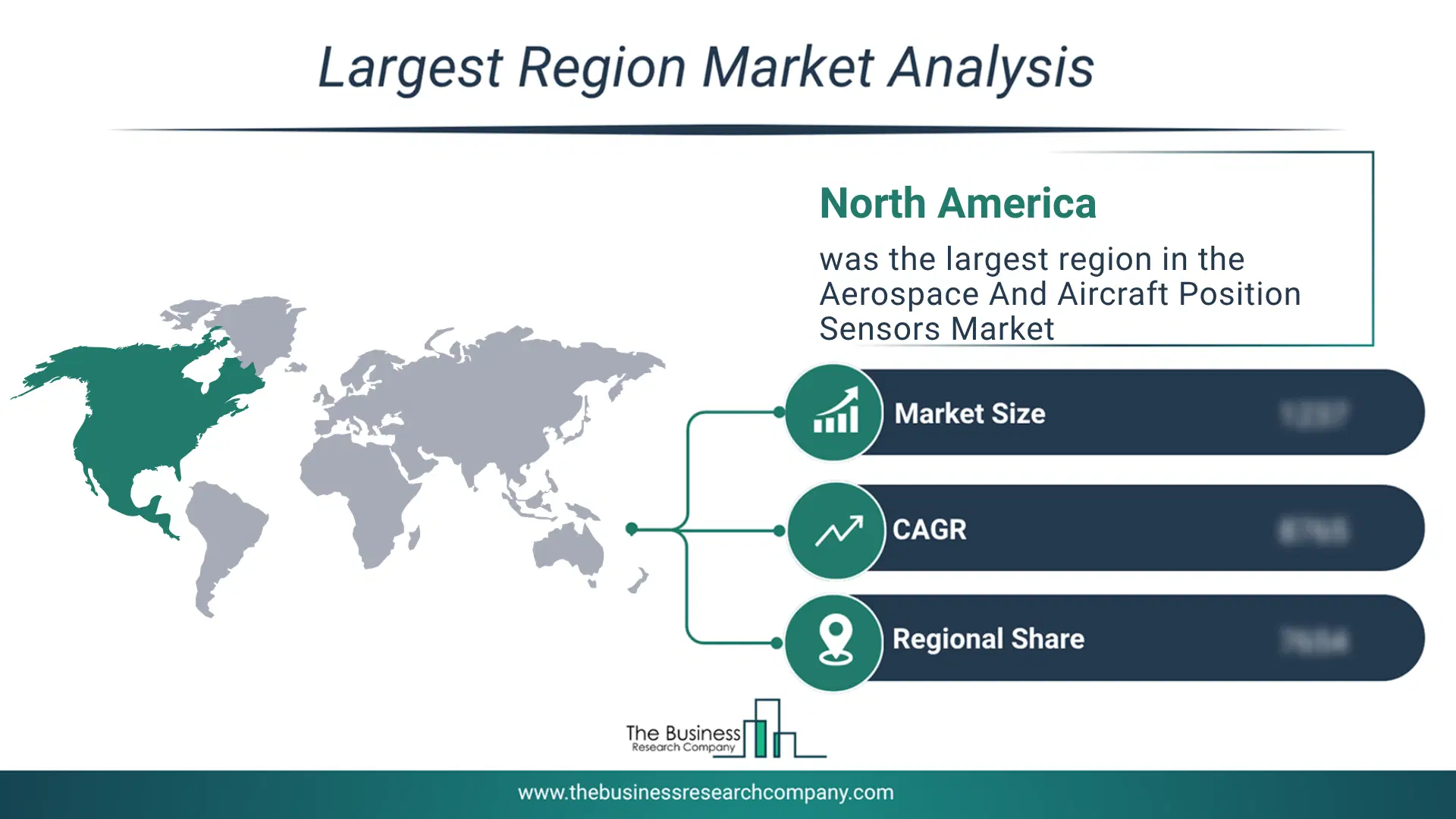
Regional Outlook/Insights
North America was the largest region in the aerospace and aircraft position sensors market in 2025. Asia-Pacific is expected to be the fastest-growing region in the forecast period. The regions covered in this market report are Asia-Pacific, South East Asia, Western Europe, Eastern Europe, North America, South America, Middle East, Africa. The countries covered in this market report are Australia, Brazil, China, France, Germany, India, Indonesia, Japan, Taiwan, Russia, South Korea, UK, USA, Canada, Italy, Spain.What Defines the Aerospace And Aircraft Position Sensors Market?
The aerospace and aircraft position sensors market consists of sales of linear position sensor, magnetic position sensor, inductive position sensor, capacitive position sensor. Values in this market are ‘factory gate’ values, that is, the value of goods sold by the manufacturers or creators of the goods, whether to other entities (including downstream manufacturers, wholesalers, distributors, and retailers) or directly to end customers. The value of goods in this market includes related services sold by the creators of the goods.How is Market Value Defined and Measured?
The market value is defined as the revenues that enterprises gain from the sale of goods and/or services within the specified market and geography through sales, grants, or donations in terms of the currency (in USD unless otherwise specified). The revenues for a specified geography are consumption values that are revenues generated by organizations in the specified geography within the market, irrespective of where they are produced. It does not include revenues from resales along the supply chain, either further along the supply chain or as part of other products.
This chart presents market attractiveness based on a quantitative evaluation of growth, competition, strategic alignment, and risk, offering a clear view of opportunity areas for decision-making. This chart is for illustrative purposes; the full report contains the complete analysis.

This chart highlights the Total Addressable Market (TAM) by estimating the maximum revenue opportunity using an assumption-driven approach, supporting strategic planning and opportunity sizing across markets. The chart is illustrative; the full report provides a more comprehensive analysis.
What Key Data and Analysis Are Included in the Aerospace And Aircraft Position Sensors Market Report 2026?
The aerospace and aircraft position sensors market research report is one of a series of new reports from The Business Research Company that provides market statistics, including industry global market size, regional shares, competitors with the market share, detailed market segments, market trends and opportunities, and any further data you may need to thrive in the aerospace and aircraft position sensors industry. The market research report delivers a complete perspective of everything you need, with an in-depth analysis of the current and future state of the industry.Aerospace And Aircraft Position Sensors Market Report Forecast Analysis
| Report Attribute | Details |
|---|---|
| Market Size Value In 2026 | $2.4 billion |
| Revenue Forecast In 2030 | $3.33 billion |
| Growth Rate | CAGR of 8.4% from 2026 to 2035 |
| Base Year For Estimation | 2025 |
| Actual Estimates/Historical Data | 2020-2025 |
| Forecast Period | 2026 - 2030 |
| Market Representation | Revenue in USD Billion and CAGR from 2026 to 2030 |
| Segments Covered | Sensor Type, Aircraft Type, Technology, Application, Sales Channel |
| Regional Scope | Asia-Pacific, Western Europe, Eastern Europe, North America, South America, Middle East, Africa |
| Country Scope | The countries covered in the report are Australia, Brazil, China, France, Germany, India, Indonesia, Japan, Taiwan, Russia, South Korea, UK, USA, Canada, Italy, Spain. |
| Customization Scope | Request for Customization |
| Pricing And Purchase Options | Explore Purchase Options |