
Aerospace and Defense Additive Manufacturing Market Report 2026
Global Outlook – By Technology (Direct Metal Laser Sintering (DMLS), Fused Deposition Modeling (FDM), Continuous Liquid Interface Production (CLIP), Stereolithography (SLA), Selective Laser Sintering (SLS), Other Technologies), By Material (Metal, Plastic, Rubber, Other Materials), By Platform (Aviation, Defense, Space), By Application (Engine Component, Space Component, Structural Component, Defense Equipment, Other Application) – Market Size, Trends, Strategies, and Forecast to 2030
Aerospace and Defense Additive Manufacturing Market Overview
• Aerospace and Defense Additive Manufacturing market size has reached to $5.19 billion in 2025 • Expected to grow to $11.48 billion in 2030 at a compound annual growth rate (CAGR) of 17.1% • Growth Driver: Increasing Air Passenger Traffic Spurs Growth In The Aerospace And Defense Additive Manufacturing Market • Market Trend: Collaborative Alliances Accelerate Development Of Mission-Critical Aerospace And Defense Components • North America was the largest region in 2025.Market Gains By 2030 – Top Opportunities By Segment
Market Gain identifies the most promising market opportunities by highlighting the segments or products expected to generate the highest incremental revenue growth over the next five years.
What Is Covered Under Aerospace and Defense Additive Manufacturing Market?
Aerospace and defense additive manufacturing is the application of 3D printing technology to make parts and components for the aerospace and military sectors. They are used to make components with complicated geometries, parts with enhanced performance characteristics, repair or replace broken parts, promote innovation, and generate prototypes for research and development. The main types of aerospace and defense additive manufacturing technologies are direct metal laser sintering (DMLS), fused deposition modeling (FDM), continuous liquid interface production (CLIP), stereolithography (SLA), selective laser sintering (SLS), and others. Direct metal laser sintering (DMLS) is a sort of additive manufacturing in which metal powder is fused together layer by layer to form a solid 3D object using a laser. They are made up of various materials such as metals, plastic, rubbers, and others. They are utilized in various platforms such as aviation, defense, and space, and are used in various applications, such as engine components, space components, structural components, defense components, and others.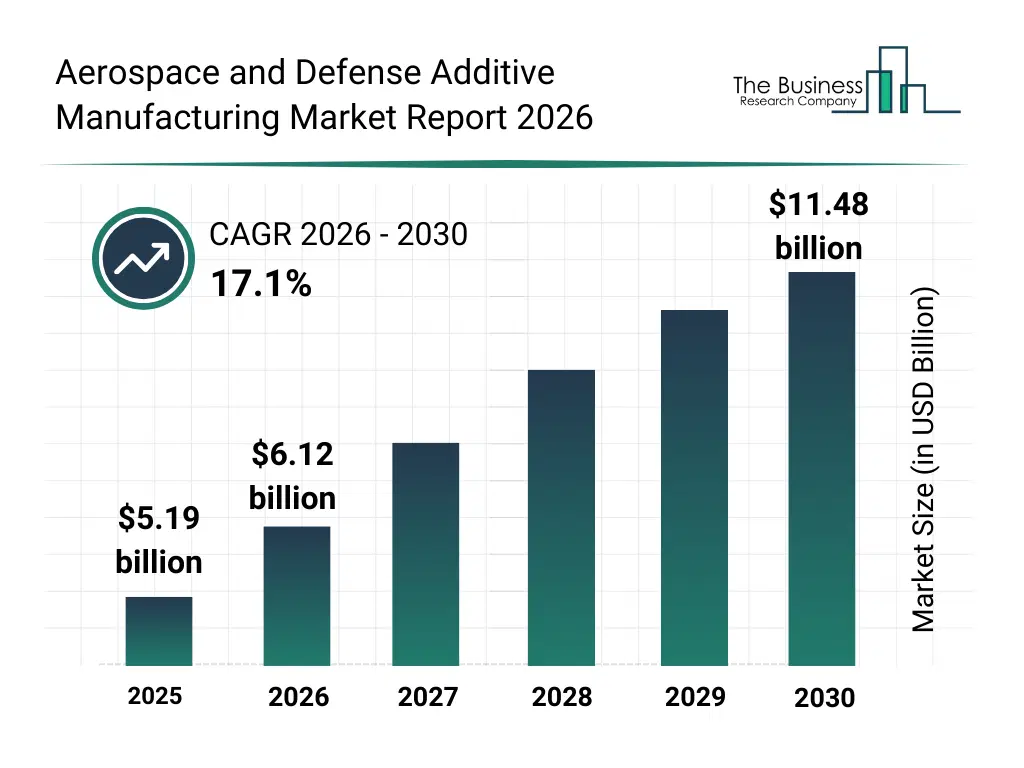
What Is The Aerospace and Defense Additive Manufacturing Market Size and Share 2026?
The aerospace and defense additive manufacturing market size has grown rapidly in recent years. It will grow from $5.19 billion in 2025 to $6.12 billion in 2026 at a compound annual growth rate (CAGR) of 17.8%. The growth in the historic period can be attributed to early adoption of additive manufacturing for rapid prototyping in aerospace and defense programs, increasing need for complex geometries in radio frequency hardware and propulsion components, initial integration of powder bed fusion and material extrusion techniques in defense manufacturing workflows, rising demand for lightweight and high-performance engine components, development of additive methods for repairing and replacing mission-critical parts in military systems.What Is The Aerospace and Defense Additive Manufacturing Market Growth Forecast?
The aerospace and defense additive manufacturing market size is expected to see rapid growth in the next few years. It will grow to $11.48 billion in 2030 at a compound annual growth rate (CAGR) of 17.1%. The growth in the forecast period can be attributed to expanding use of directed energy deposition and binder jetting for large-scale defense components, growing adoption of additive manufacturing to enhance supply chain resilience in aerospace and defense, increasing production of advanced heat exchangers and casting patterns via additive techniques, rising demand for certified 3D-printed propulsion and engine parts to improve platform performance, continuous innovation in multi-material and high-temperature additive processes supporting next-generation defense applications. Major trends in the forecast period include advanced multi-material printing for mission-critical aerospace parts, increased adoption of additive technologies for rapid prototyping, growth in additive repair and refurbishment of defense components, rising demand for lightweight, high-strength engine and structural parts, expansion of certified additive manufacturing processes for aerospace compliance.
Global Aerospace and Defense Additive Manufacturing Market Segmentation
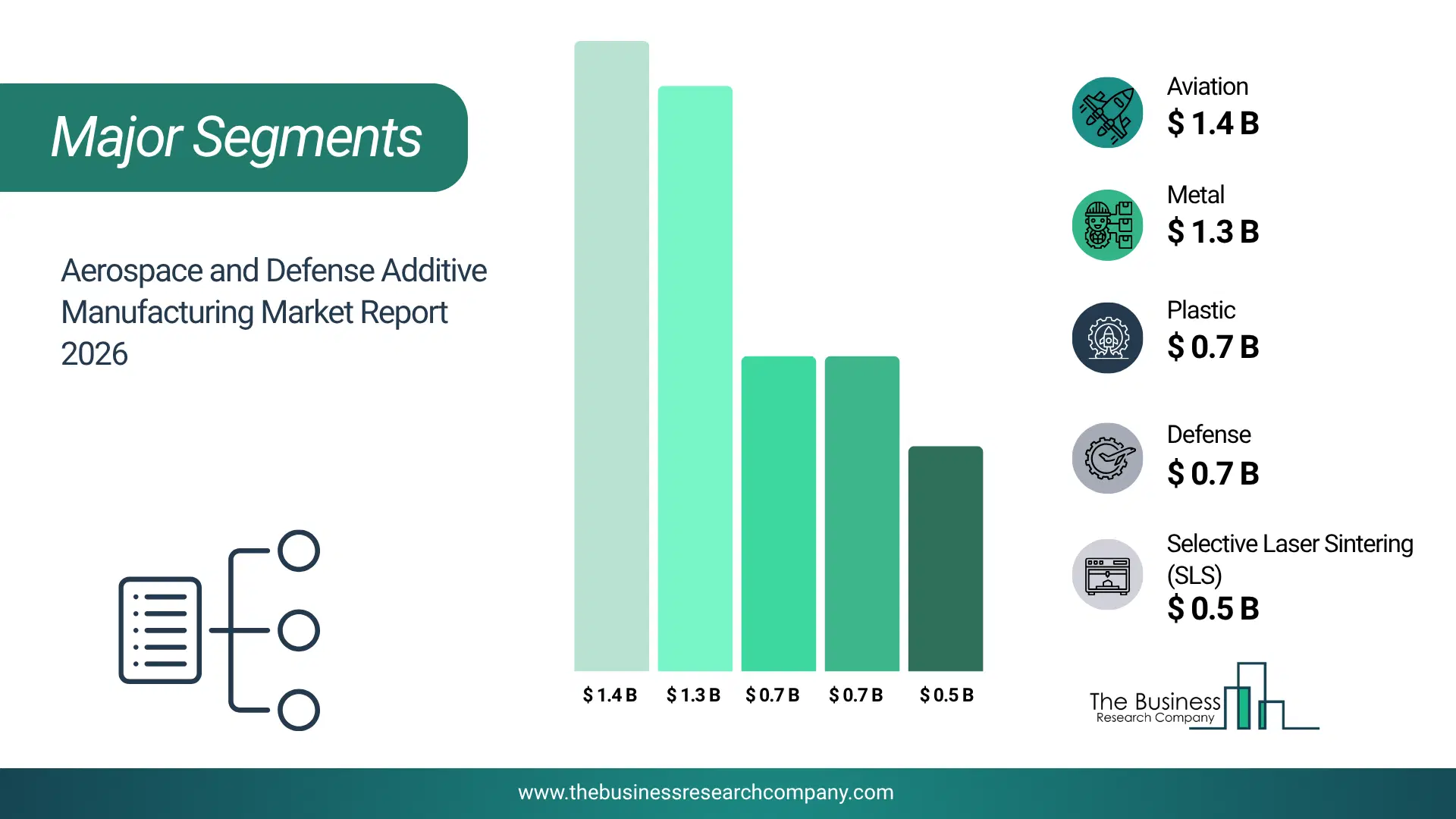
1) By Technology: Direct Metal Laser Sintering (DMLS), Fused Deposition Modeling (FDM), Continuous Liquid Interface Production (CLIP), Stereolithography (SLA), Selective Laser Sintering (SLS), Other Technologies 2) By Material: Metal, Plastic, Rubber, Other Materials 3) By Platform: Aviation, Defense, Space 4) By Application: Engine Component, Space Component, Structural Component, Defense Equipment, Other Application Subsegments: 1) By Direct Metal Laser Sintering (DMLS): Titanium Alloys, Aluminum Alloys, Stainless Steel 2) By Fused Deposition Modeling (FDM): Thermoplastic Materials, Composite Filaments 3) By Continuous Liquid Interface Production (CLIP): Resin-Based Materials, Elastomers 4) By Stereolithography (SLA): Standard Resins, Engineering Resins, Bio-Compatible Resins 5) By Selective Laser Sintering (SLS): Nylon Powder, Metal Powders, Composite Powders 6) By Other Technologies: Electron Beam Melting (EBM), Laminated Object Manufacturing (LOM), Binder Jetting The top segments in the aerospace and defense additive manufacturing market will be: • Aviation will reach $1446.26 Million by 2030. • Metal will reach $1299.02 Million by 2030. • Plastic will reach $758.15 Million by 2030. • Defense will reach $704.75 Million by 2030. • Selective Laser Sintering (SLS) will reach $578.85 Million by 2030.What Is Driver Of The Aerospace and Defense Additive Manufacturing Market?
The increasing air passenger traffic is expected to propel the growth of the aerospace and defense additive manufacturing market going forward. Air passenger traffic refers to the number of passengers traveling by air within a specified period, typically measured in terms of the total count of individuals who board commercial flights. The adoption of aerospace and defense additive manufacturing technologies has the potential to positively impact air passenger traffic by improving aircraft efficiency, innovation, fuel efficiency, and affordability while ensuring the reliability and sustainability of air travel operations. For instance, in December 2025, according to Eurostat, a Luxembourg-based government agency, in 2023, the number of passengers transported by air rose by 19.3% compared to 2022. Therefore, the increasing air passenger traffic is driving the growth of the aerospace and defense additive manufacturing industry.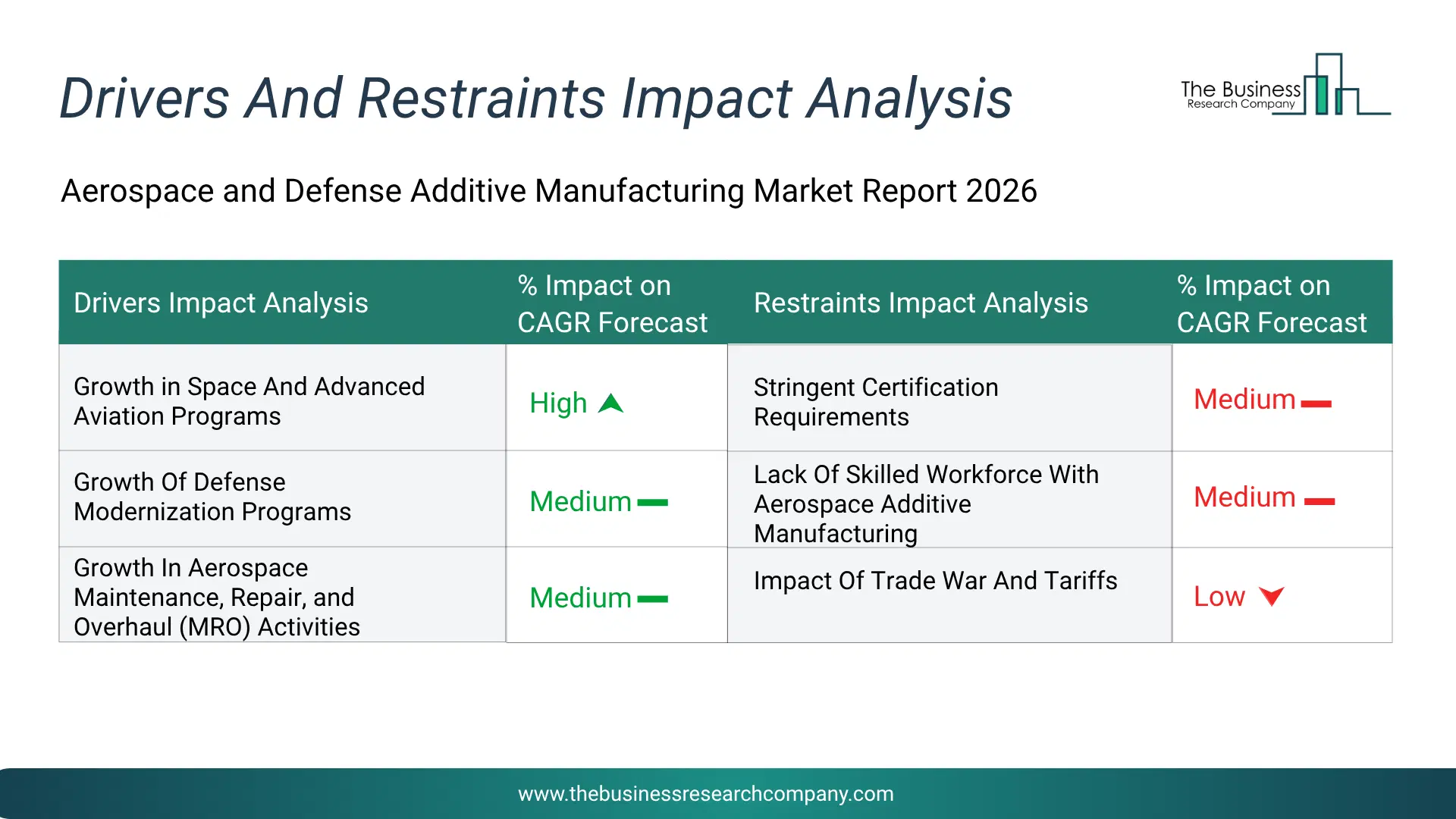
Infographic Chart Showing Key Market Drivers Analysis And Restraints For Aerospace And Defense Additive Manufacturing Market
The chart presents an impact analysis of key drivers and restraints, quantifying their relative influence on the market's growth rate and helping assess the balance between growth enablers and limiting factors. This chart offers a high-level perspective; the full report contains more detailed insights.
How Will The Drivers Impact Growth In The Global Aerospace and Defense Additive Manufacturing Market?
• Growth in Space And Advanced Aviation Programs (High) – During the forecast period, the expansion of space exploration initiatives and next-generation aviation programs will propel the growth of the aerospace and defense additive manufacturing market. As governments and private players accelerate investments in satellite constellations, reusable launch vehicles, hypersonic platforms, and advanced military aircraft, there is a rising demand for lightweight, high-strength, and complex components with shorter production cycles. These programs require rapid prototyping, design optimization, and on-demand manufacturing of mission-critical parts that meet stringent performance and reliability standards. Additive manufacturing is increasingly adopted across propulsion systems, airframes, structural components, and tooling to enable faster development, reduced material waste, and enhanced design flexibility, thereby supporting sustained growth of the aerospace and defense additive manufacturing market during the forecast period. The expansion of space exploration initiatives and next-generation aviation programs growth contribution during the forecast period in 2025 is 2.0%. • Growth Of Defense Modernization Programs (Medium) – During the forecast period, sustained investments in defense modernization programs focused on upgrading military capabilities with advanced systems, indigenous production, and cutting-edge technologies—will drive growth across the aerospace and defense ecosystem by creating stable procurement pipelines and stimulating innovation. As governments increase defense spending to enhance readiness, resilience, and technological superiority, the aerospace and defense additive manufacturing market will benefit from these modernisation efforts by enabling rapid production of complex, lightweight components, on-demand spare parts, and enhanced supply-chain flexibility. Additive manufacturing’s ability to reduce lead times, material waste, and costs while supporting mission-critical applications positions it as a strategic enabler of defense modernization initiatives throughout the forecast period. The sustained investments in defense modernization programs growth contribution during the forecast period in 2025 is 1.5%. • Growth In Aerospace Maintenance, Repair, and Overhaul (MRO) Activities (Medium) – During the forecast period, the sustained expansion of global aircraft fleets and the aging of existing commercial and military aircraft are expected to drive significant growth in aerospace Maintenance, Repair, and Overhaul (MRO) activities, as operators require more frequent inspections, repairs, and overhauls to ensure safety, reliability, and regulatory compliance. Technological advancements such as predictive maintenance, digitalization, and the integration of additive manufacturing are further enhancing operational efficiency, reducing turnaround times, and lowering lifecycle costs in MRO operations. In parallel, the aerospace and defense additive manufacturing market is projected to grow rapidly, propelled by increasing demand for lightweight, cost-effective, and complex parts that traditional manufacturing cannot easily produce, as well as defense sector adoption for rapid prototyping and on-demand parts production. Together, these trends are anticipated to support robust market growth across OEMs, service providers, and defense agencies throughout the forecast period. The growth in aerospace maintenance, repair, and overhaul (MRO) activities growth contribution during the forecast period in 2025 is 1.0%. • Increased Adoption Of Additive Manufacturing in Hypersonic Programs (Low) – During the forecast period, the aerospace and defense additive manufacturing market is poised for robust expansion as the increasing adoption of additive manufacturing technologies, especially within hypersonic programs and advanced aerospace systems, drives demand for lightweight, high-performance, and geometrically complex components that traditional manufacturing cannot efficiently produce. Additive manufacturing’s ability to enable rapid prototyping, reduced material waste, and on-demand production is accelerating its deployment in hypersonic propulsion systems and mission-critical defense applications, supporting faster design iteration and improved performance at extreme conditions. This trend, coupled with growing investments by defense agencies and aerospace OEMs to integrate certified 3D-printed parts into critical platforms, underpins strong market growth throughout the forecast period. The increased adoption of additive manufacturing in hypersonic programs growth contribution during the forecast period in 2025 is 0.5%.How Will The Restraints Impact Growth In The Global Aerospace and Defense Additive Manufacturing Market?
• Stringent Certification Requirements (High) – During the forecast period, stringent certification requirements are restraining the growth of the aerospace and defense additive manufacturing market during the forecast period. additively manufactured aerospace and defense components must comply with rigorous airworthiness, safety, material traceability, and process validation standards set by aviation authorities and defense agencies. the lengthy qualification cycles, extensive testing, and high compliance costs associated with certifying new materials, printers, and production processes slow technology adoption and delay program timelines. as a result, manufacturers face longer commercialization cycles and higher development risks, limiting the pace of large-scale deployment of additive manufacturing solutions. growth affected by stringent certification requirements during the forecast period in 2025 is -1.5%. • Lack Of Skilled Workforce With Aerospace Additive Manufacturing (Medium) – During the forecast period, the lack of a skilled workforce is restraining the growth of the aerospace and defense additive manufacturing market during the forecast period. aerospace-grade additive manufacturing requires highly specialized expertise in materials science, design for additive manufacturing (dfam), process qualification, and certification standards, which limits the availability of trained engineers and technicians. this skills gap increases production risks, slows technology adoption, and raises operational costs for aerospace and defense manufacturers. as a result, limited workforce readiness is slowing large-scale deployment of additive manufacturing across aerospace and defense programs in 2025. growth affected by the lack of a skilled workforce during the forecast period in 2025 is -1.3%. • Impact Of Trade War And Tariffs (Medium) – During the forecast period, the impact of trade wars and rising tariffs is restricting the growth of the aerospace and defense additive manufacturing market during the forecast period. higher import duties on metal powders, advanced printers, and critical components are increasing production costs and disrupting cross-border supply chains, while export restrictions are limiting access to global customers. at the same time, a lack of skilled workforce with expertise in aerospace-grade additive manufacturing, materials science, and certification standards is slowing technology adoption and scaling. the combined pressure of trade barriers and talent shortages is reducing manufacturing efficiency, delaying qualification programs, and constraining the pace of industrial deployment. growth affected by trade war, tariffs, and lack of skilled workforce during the forecast period in 2025 is -0.3%.Key Players In The Global Aerospace and Defense Additive Manufacturing Market
Major companies operating in the aerospace and defense additive manufacturing market are General Electric Company, Raytheon Technologies Corporation, The Boeing Company, Lockheed Martin Corporation, Airbus SE, Northrop Grumman Corporation, BAE Systems, Safran SA, Rolls-Royce Holdings, Honeywell Aerospace, Siemens Digital Industries Software, OC Oerlikon Corporation AG, Moog Inc., Aerojet Rocketdyne Holdings Inc., Carpenter Technology Corporation, Renishaw plc, GKN Aerospace, Stratasys Ltd., EOS GmbH, 3D Systems Corporation, Proto Labs Inc., Materialise NV, Desktop Metal Inc., SLM Solutions Group AG, Optomec Inc., Sintavia, Additive Industries, Optisys LLC, CRP Technology SRL, BeAM Machines Inc.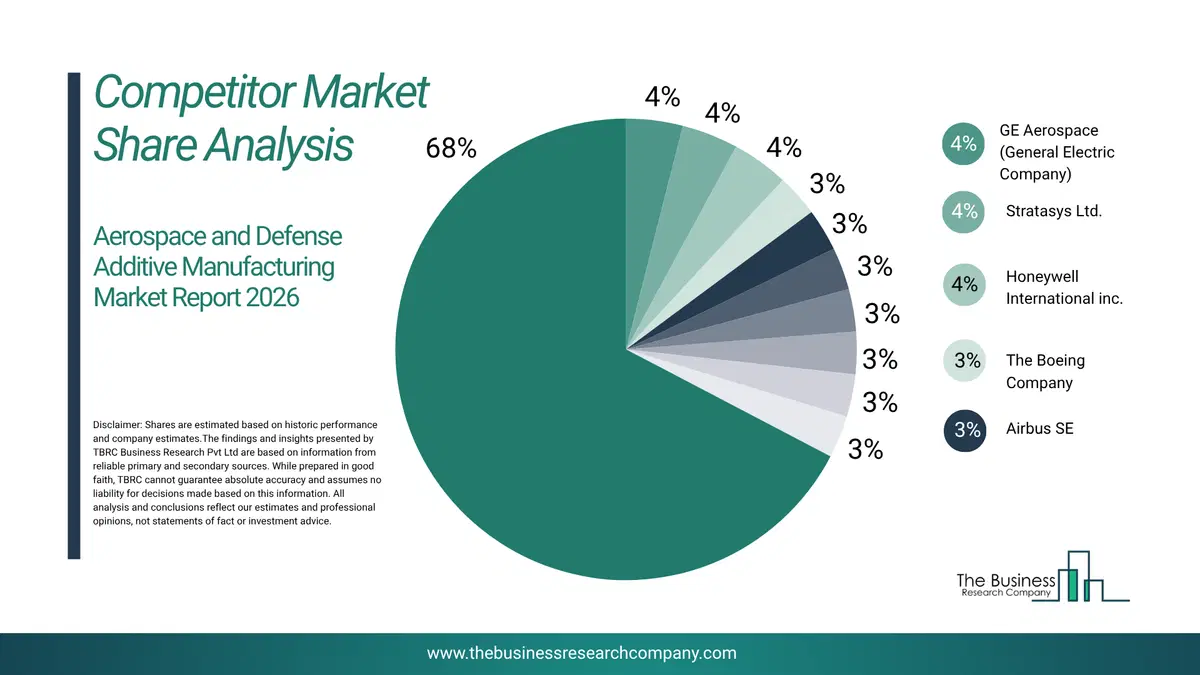
This chart is for illustrative purposes; the full report includes a detailed competitor analysis and comprehensive overview of the top 10 companies in the market.
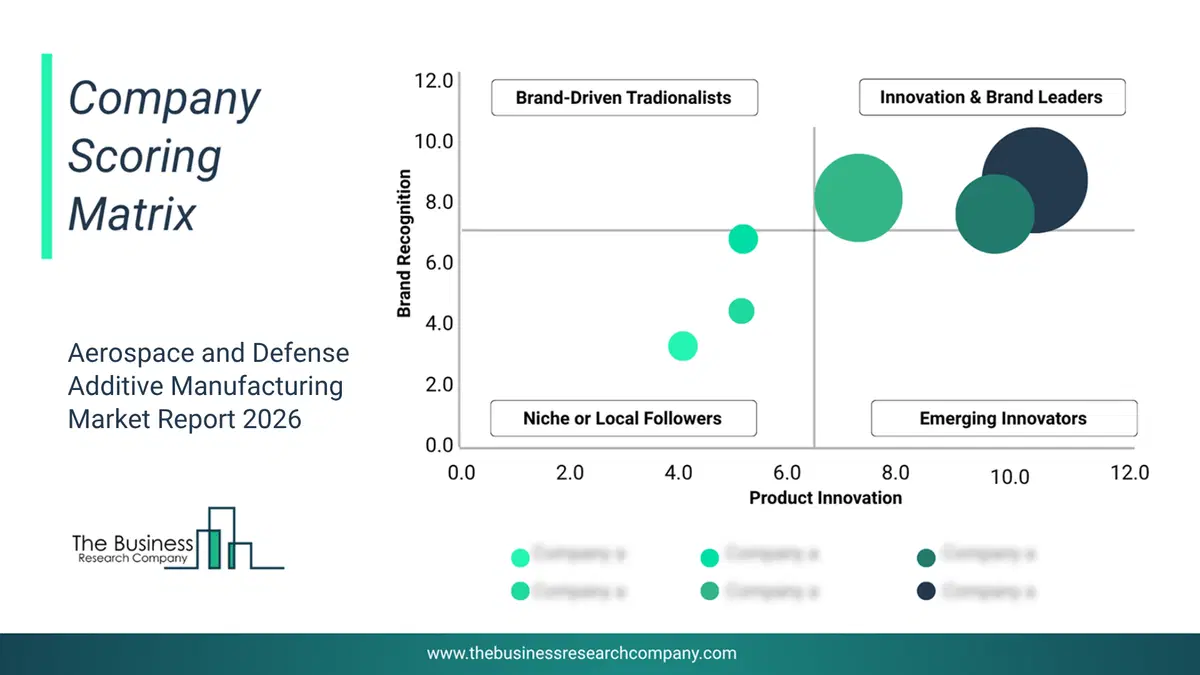
This chart maps companies by product innovation and brand strength, with bubble size indicating relative revenue, helping identify market leaders, challengers, and niche players. This is an illustrative chart; the full report provides a complete and accurate competitive analysis.
Global Aerospace and Defense Additive Manufacturing Market Trends and Insights
Major companies operating in the aerospace and defense additive manufacturing market are adopting strategic partnerships to advance the development of mission-critical components for military and aerospace applications. Strategic partnerships in this market bring together technical expertise and specialized manufacturing capabilities, facilitating the development of high-performance, mission-critical components and improving scalability for aerospace and defense applications. These alliances support the production and qualification of advanced metal additive manufacturing solutions, particularly for military flight hardware. For instance, in June 2025, Velo3D, Inc., a US-based metal additive manufacturing company, entered a Cooperative Research and Development Agreement (CRADA) with two Naval Air Systems Command (NAVAIR) federal laboratories, Naval Air Warfare Center Aircraft Division (NAWCAD) and Fleet Readiness Center East (FRC East). With this collaboration, Velo3D and NAVAIR aim to enhance additive manufacturing capabilities for aerospace and defense applications by combining Velo3D’s advanced 3D printing technology with NAVAIR’s technical expertise and operational requirements.What Are Latest Mergers And Acquisitions In The Aerospace and Defense Additive Manufacturing Market? SBO Group Gmbh Acquires 3T Additive Manufacturing Ltd. To Strengthen Metal 3D Printing Capabilities
In August 2025, SBO Group GmbH, an Austria-based manufacturing company, acquired 3T Additive Manufacturing Ltd. for an undisclosed amount. With this acquisition, SBO aims to strengthen its metal additive manufacturing capabilities, gain access to established customer relationships, modern production infrastructure, and a highly qualified team, and accelerate its growth in scaled production within the additive manufacturing sector. 3T Additive Manufacturing Ltd. is a UK-based manufacturing company that specializes in the production of finished metal 3D printed parts with a core focus on net-zero production.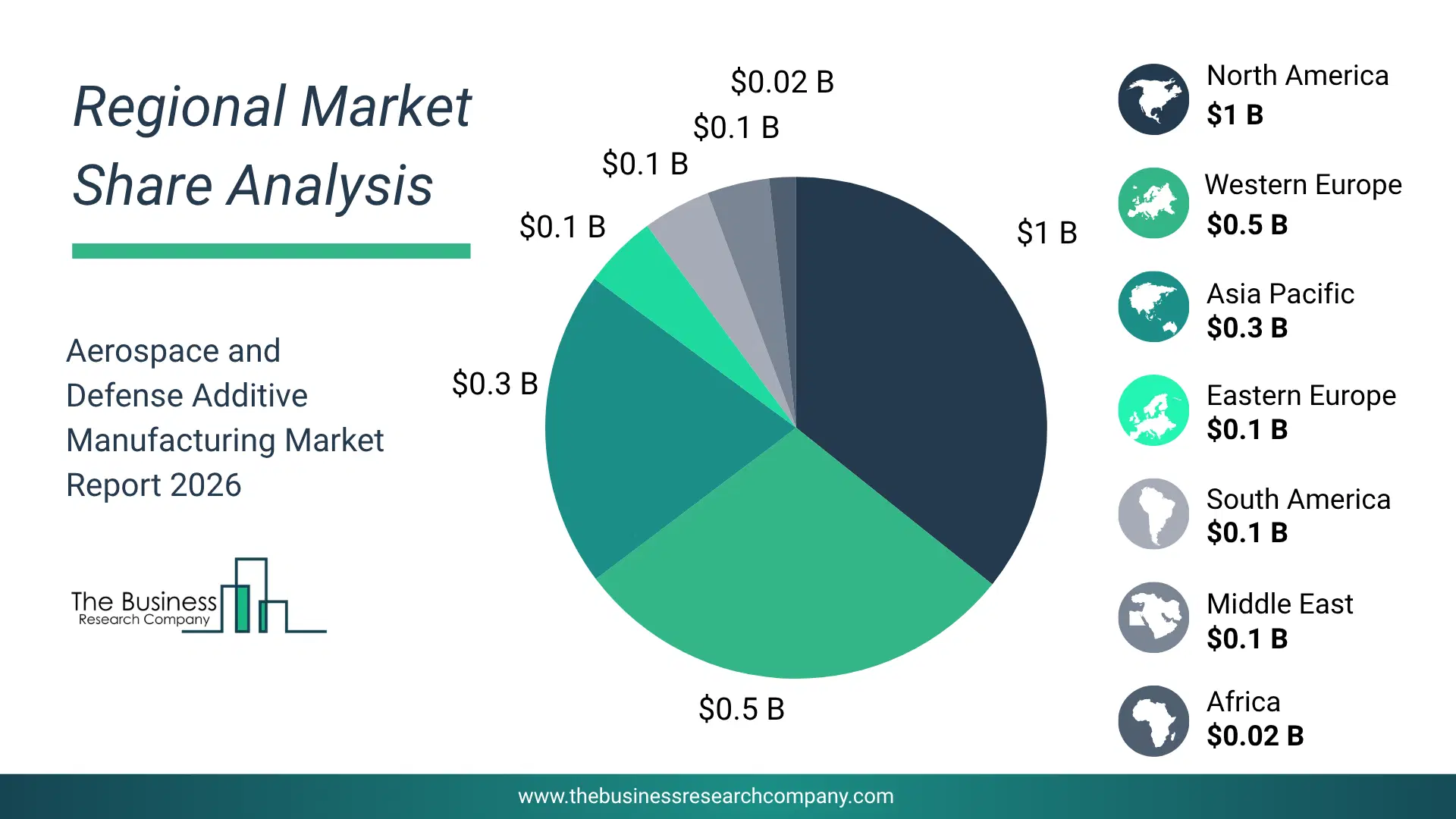
Regional Insights
North America was the largest region in the aerospace and defense additive manufacturing market in 2025. The regions covered in this market report are Asia-Pacific, South East Asia, Western Europe, Eastern Europe, North America, South America, Middle East, Africa. The countries covered in this market report are Australia, Brazil, China, France, Germany, India, Indonesia, Japan, Taiwan, Russia, South Korea, UK, USA, Canada, Italy, SpainWhat Defines the Aerospace and Defense Additive Manufacturing Market?
The aerospace and defense additive manufacturing market consists of revenues earned by entities by providing material extrusion, sheet lamination, binder jetting, material jetting, directed energy deposition, powder bed fusion, and vat photopolymerization. The market value includes the value of related goods sold by the service provider or included within the service offering. The aerospace & defense additive manufacturing market also includes the sale of radio frequency hardware, propulsion systems, heat exchangers, casting patterns, and engine components. Values in this market are ‘factory gate’ values, that is, the value of goods sold by the manufacturers or creators of the goods, whether to other entities (including downstream manufacturers, wholesalers, distributors, and retailers) or directly to end customers. The value of goods in this market includes related services sold by the creators of the goods.How is Market Value Defined and Measured?
The market value is defined as the revenues that enterprises gain from the sale of goods and/or services within the specified market and geography through sales, grants, or donations in terms of the currency (in USD unless otherwise specified). The revenues for a specified geography are consumption values that are revenues generated by organizations in the specified geography within the market, irrespective of where they are produced. It does not include revenues from resales along the supply chain, either further along the supply chain or as part of other products.
This chart presents market attractiveness based on a quantitative evaluation of growth, competition, strategic alignment, and risk, offering a clear view of opportunity areas for decision-making. This chart is for illustrative purposes; the full report contains the complete analysis.

This chart highlights the Total Addressable Market (TAM) by estimating the maximum revenue opportunity using an assumption-driven approach, supporting strategic planning and opportunity sizing across markets. The chart is illustrative; the full report provides a more comprehensive analysis.
What Key Data and Analysis Are Included in the Aerospace and Defense Additive Manufacturing Market Report 2026?
The aerospace and defense additive manufacturing market research report is one of a series of new reports from The Business Research Company that provides market statistics, including industry global market size, regional shares, competitors with the market share, detailed market segments, market trends and opportunities, and any further data you may need to thrive in the aerospace and defense additive manufacturing industry. The market research report delivers a complete perspective of everything you need, with an in-depth analysis of the current and future state of the industry.Aerospace and Defense Additive Manufacturing Market Report Forecast Analysis
| Report Attribute | Details |
|---|---|
| Market Size Value In 2026 | $6.12 billion |
| Revenue Forecast In 2030 | $11.48 billion |
| Growth Rate | CAGR of 17.8% from 2026 to 2030 |
| Base Year For Estimation | 2025 |
| Actual Estimates/Historical Data | 2020-2025 |
| Forecast Period | 2026 - 2030 - 2035 |
| Market Representation | Revenue in USD Billion and CAGR from 2026 to 2030 |
| Segments Covered | Technology, Material, Platform, Application |
| Regional Scope | Asia-Pacific, Western Europe, Eastern Europe, North America, South America, Middle East, Africa |
| Country Scope | The countries covered in the report are Australia, Brazil, China, France, Germany, India, Indonesia, Japan, Taiwan, Russia, South Korea, UK, USA, Canada, Italy, Spain. |
| Key Companies Profiled | General Electric Company, Raytheon Technologies Corporation, The Boeing Company, Lockheed Martin Corporation, Airbus SE, Northrop Grumman Corporation, BAE Systems, Safran SA, Rolls-Royce Holdings, Honeywell Aerospace, Siemens Digital Industries Software, OC Oerlikon Corporation AG, Moog Inc., Aerojet Rocketdyne Holdings Inc., Carpenter Technology Corporation, Renishaw plc, GKN Aerospace, Stratasys Ltd., EOS GmbH, 3D Systems Corporation, Proto Labs Inc., Materialise NV, Desktop Metal Inc., SLM Solutions Group AG, Optomec Inc., Sintavia, Additive Industries, Optisys LLC, CRP Technology SRL, BeAM Machines Inc. |
| Customization Scope | Request for Customization |
| Pricing And Purchase Options | Explore Purchase Options |