

Contact Us
  Search
The Business Research Company Logo
Aerospace And Defense Additive Manufacturing Global Market Opportunities And Strategies To 2035
Published :June 2026
Pages :228
Format :PDF
Delivery Time :2-3 Business Days
Why 2-3 days? We update the report with the latest data and news before delivery. Let us know if you need us to expedite.
Report Price :$4,490.00

Aerospace And Defense Additive Manufacturing Global Market Opportunities And Strategies To 2035

By Technology (Direct Metal Laser Sintering (DMLS), Fused Deposition Modeling (FDM), Continuous Liquid Interface Production (CLIP), Stereolithography (SLA), Selective Laser Sintering (SLS), Other Technologies), By Material (Metal, Plastic, Rubber, Other Materials), By Platform (Aviation, Defense, Space), By Application (Engine Component, Space Component, Structural Component, Defense Equipment, Other Application), And By Region, Opportunities And Strategies – Global Forecast To 2035

Aerospace And Defense Additive Manufacturing Market Definition

Aerospace and defense additive manufacturing refers to the application of layer-by-layer fabrication technologies — commonly known as 3D printing — to produce components, tooling, prototypes and end-use parts for the aerospace and defense sectors. These technologies encompass a range of processes including direct metal laser sintering (DMLS), selective laser sintering (SLS), fused deposition modeling (FDM), stereolithography (SLA), continuous liquid interface production (CLIP) and electron beam melting (EBM), each suited to different materials and performance requirements. The aerospace and defense additive manufacturing market consists of revenues from the sale of additive manufacturing hardware, materials (metals, polymers, rubber and composites), software and related services used for the fabrication of aerospace and defense components. Key applications include engine components, space components, structural components, defense equipment and related sub-assemblies. End users encompass commercial aircraft OEMs, military aircraft manufacturers, satellite and launch vehicle producers, defense contractors and MRO (maintenance, repair and overhaul) service providers.
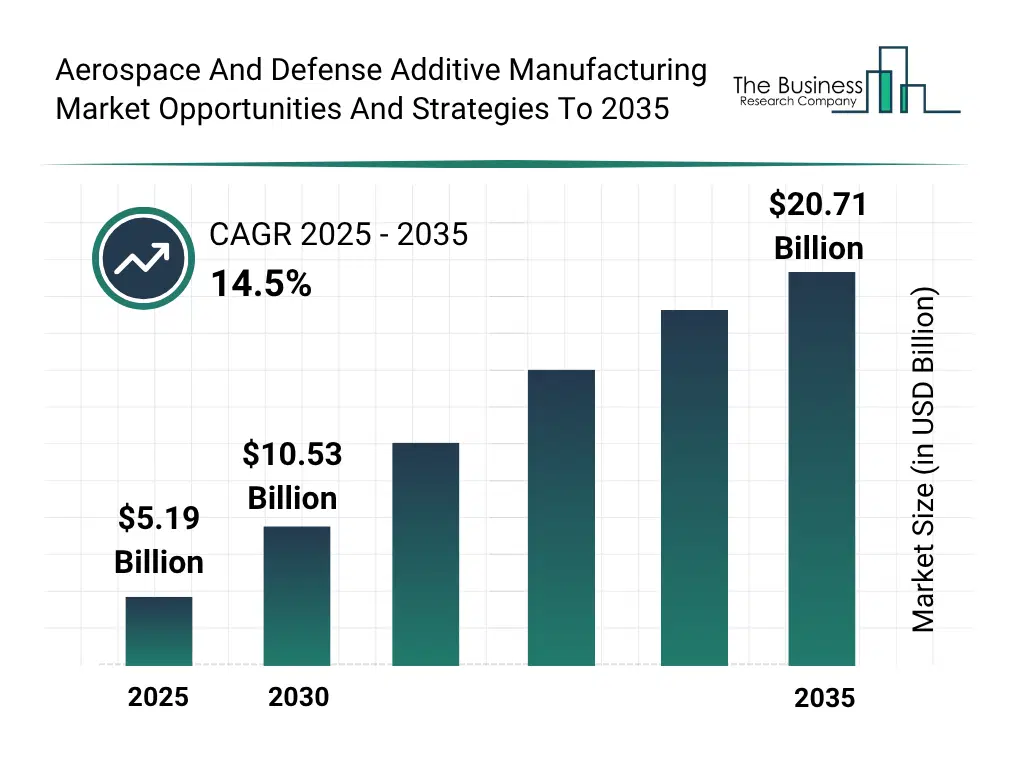
Aerospace And Defense Additive Manufacturing Global Market Opportunities And Strategies To 2035 Market Size and growth rate 2026 to 2030: Graph

Aerospace And Defense Additive Manufacturing Market Size

The global aerospace and defense additive manufacturing market reached a value of nearly $5,194.3 million in 2025, having grown at a compound annual growth rate (CAGR) of 15.7% since 2020. The market is expected to grow from $5,194.3 million in 2025 to $10,529.3 million in 2030 at a rate of 15.2%. The market is then expected to grow at a CAGR of 14.5% from 2030 and reach $20,709.2 million in 2035. Growth in the historic period resulted from increasing aircraft orders worldwide, increasing demand for lightweight and fuel-efficient aerospace components, growth of unmanned aerial vehicles and autonomous defense systems and government and defense investments in additive manufacturing techniques. Factors that negatively affected growth in the historic period were high initial capital costs and material limitations and qualification issues. Going forward, growth in space and advanced aviation programs, increased adoption of additive manufacturing in hypersonic programs, growth of defense modernization programs and growth in aerospace maintenance, repair and overhaul (MRO) activities will drive the growth. Factors that could hinder the growth of the aerospace and defense additive manufacturing market in the future include stringent certification requirements, lack of skilled workforce with aerospace additive manufacturing and impact of trade war and tariff.
Research Expert

Book your 30 minutes free consultation with our research experts

Aerospace And Defense Additive Manufacturing Market Segmentation

The aerospace and defense additive manufacturing market is segmented by technology, by material, by platform and by application.

By Technology –
The aerospace and defense additive manufacturing market is segmented by technology into:
    • a) Direct Metal Laser Sintering (DMLS)
    • b) Fused Deposition Modeling (FDM)
    • c) Continuous Liquid Interface Production (CLIP)
    • d) Stereolithography (SLA)
    • e) Selective Laser Sintering (SLS)
    • f) Other Technologies
The direct metal laser sintering (DMLS) market was the largest segment of the aerospace and defense additive manufacturing market segmented by technology, accounting for 25.9% or $1,346.2 million of the total in 2025. Going forward, the other technologies segment is expected to be the fastest-growing segment in the aerospace and defense additive manufacturing market segmented by technology, at a CAGR of 19.7% during 2025-2030.

By Material –
The aerospace and defense additive manufacturing market is segmented by material into:
    • a) Metal
    • b) Plastic
    • c) Rubber
    • d) Other Materials
The metal market was the largest segment of the aerospace and defense additive manufacturing market segmented by material, accounting for 57.9% or $3,009.6 million of the total in 2025. Going forward, the other materials segment is expected to be the fastest-growing segment in the aerospace and defense additive manufacturing market segmented by material, at a CAGR of 18.1% during 2025-2030.

By Platform –
The aerospace and defense additive manufacturing market is segmented by platform into:
    • a) Aviation
    • b) Defense
    • c) Space
The aviation market was the largest segment of the aerospace and defense additive manufacturing market segmented by platform, accounting for 52.6% or $2,731.0 million of the total in 2025. Going forward, the space segment is expected to be the fastest-growing segment in the aerospace and defense additive manufacturing market segmented by platform, at a CAGR of 21.6% during 2025-2030.

By Application –
The aerospace and defense additive manufacturing market is segmented by application into:
  1. a) Fixed-Wing Drone
  2. b) Rotary Wing Drone
  3. c) Hybrid Wing Drone
The rotary wing drone market was the largest segment of the drone flight controller system market segmented by application, accounting for 55.93% or $3,993.72 million of the total in 2025. Going forward, the rotary wing drone segment is expected to be the fastest growing segment in the drone flight controller system market segmented by application, at a CAGR of 13.78% during 2025-2030.

By End User –
The aerospace and defense additive manufacturing market is segmented by end user into:
    • a) Engine Component
    • b) Space Component
    • c) Structural Component
    • d) Defense Equipment
    • e) Other Application
The engine component market was the largest segment of the aerospace and defense additive manufacturing market segmented by application, accounting for 41.5% or $2,154.7 million of the total in 2025. Going forward, the space component segment is expected to be the fastest-growing segment in the aerospace and defense additive manufacturing market segmented by application, at a CAGR of 18.4% during 2025-2030.

By Geography - The aerospace and defense additive manufacturing market is segmented by geography into:
      o Asia Pacific
      • China
      • India
      • Japan
      • Australia
      • Indonesia
      • South Korea
      o North America
      • USA
      • Canada
      o South America
      • Brazil
      o Western Europe
      • France
      • Germany
      • UK
      • Italy
      • Spain
      o Eastern Europe
      • Russia
      o Middle East
      o Africa
North America was the largest region in the aerospace and defense additive manufacturing market, accounting for 37.5% or $1,920.5 million of the total in 2025. It was followed by Western Europe, Asia Pacific and then the other regions. Going forward, the fastest-growing regions in the aerospace and defense additive manufacturing market will be Asia Pacific and Western Europe where growth will be at CAGRs of 17.4% and 15.9% respectively.

Aerospace And Defense Additive Manufacturing Market Competitive Landscape

Major Competitors are:

  • GE Aerospace (General Electric Company)
  • Stratasys Ltd.
  • Honeywell International Inc.
  • The Boeing Company
  • Airbus SE
  • Other Competitors Include:

  • 3D Systems Corporation
  • Northrop Grumman Corporation
  • Renishaw plc
  • Moog Inc.
  • Safran SA
  • Lockheed Martin Corporation
  • RTX Corporation (Raytheon)
  • BAE Systems plc
  • MTU Aero Engines AG
  • Aero Engine Corporation of China (AECC)
  • Mitsubishi Heavy Industries Ltd. (MHI)
  • Kawasaki Heavy Industries Ltd. (KHI)
  • IHI Corporation (IHI Aerospace)
  • INNOSPACE
  • Oqton
  • Korea Aerospace Industries (KAI)
  • Hanwha Aerospace
  • Agnikul Cosmos
  • Aerospace Industrial Development Corporation (AIDC)
  • Rolls-Royce Holdings plc
  • ST Engineering Aerospace
  • BEAMIT Group
  • Saab AB
  • GKN Aerospace
  • CRP Technology
  • Leonardo S.p.A.
  • United Aircraft Corporation (UAC)
  • PZL Mielec
  • Polska Grupa Zbrojeniowa (PGZ)
  • ATI Inc.
  • General Atomics Aeronautical Systems, Inc.
  • Burloak Technologies
  • Agile Manufacturing Inc.
  • Upsurge Additive Manufacturing Ltd.
  • Embraer S.A.
  • Avibras
  • INVAP S.E.
  • National Additive Manufacturing and Innovation Company (NAMI)
  • Thales Group
  • Aerosud
  • Denel Aerostructures
  • Aerospace And Defense Additive Manufacturing Market Drivers

    The key drivers of the aerospace and defense additive manufacturing market include: Growth In Space And Advanced Aviation Programs Growth in space and advanced aviation programs is expected to be a key driver of the aerospace and defense additive manufacturing market in the forecast period. The expansion of space exploration initiatives and next-generation aviation programs is propelling demand for lightweight, high-strength and complex components with shorter production cycles. Governments and private players are accelerating investments in satellite constellations, reusable launch vehicles, hypersonic platforms and advanced military aircraft, creating strong demand for rapid prototyping and on-demand manufacturing of mission-critical parts. Additive manufacturing is increasingly adopted across propulsion systems, airframes, structural components and tooling, thereby supporting sustained market growth. The growth in space and advanced aviation programs growth contribution during the forecast period in 2025 is 2.0%.

    Aerospace And Defense Additive Manufacturing Market Restraints

    The key restraints on the aerospace and defense additive manufacturing market include: Stringent Certification Requirements Stringent certification requirements are restraining the growth of the aerospace and defense additive manufacturing market during the forecast period. Additively manufactured aerospace and defense components must comply with rigorous airworthiness, safety, material traceability and process validation standards set by aviation authorities and defense agencies. The lengthy qualification cycles, extensive testing and high compliance costs associated with certifying new materials, printers and production processes slow technology adoption and delay program timelines, limiting the pace of large-scale deployment of additive manufacturing solutions. Growth affected by stringent certification requirements during the forecast period in 2025 is -1.5%.

    Need data on a specific region in this market?

    Opportunities And Recommendations In The Aerospace And Defense Additive Manufacturing Market

    Opportunities – The top opportunities in the aerospace and defense additive manufacturing market segmented by technology will arise in the direct metal laser sintering (DMLS) segment, which will gain $1,678.5 million of global annual sales by 2030. The top opportunities in the aerospace and defense additive manufacturing market segmented by material will arise in the metal segment, which will gain $3,570.6 million of global annual sales by 2030. The top opportunities in the aerospace and defense additive manufacturing market segmented by platform will arise in the aviation segment, which will gain $2,092.1 million of global annual sales by 2030. The top opportunities in the aerospace and defense additive manufacturing market segmented by application will arise in the engine component segment, which will gain $2,151.1 million of global annual sales by 2030. The aerospace and defense additive manufacturing market size will gain the most in the USA at $1,517.9 million. Recommendations- To take advantage of the opportunities, The Business Research Company recommends the aerospace and defense additive manufacturing companies to focus on high-throughput metal additive manufacturing for aerospace and défense, focus on large-format additive manufacturing for aerospace and propulsion , focus on strategic partnerships to accelerate additive manufacturing qualification , focus on expanding additive manufacturing for military propulsion , focus on scaling industrial-grade additive manufacturing capacity , focus on expanding adoption of next-generation high-throughput am technologies , focus on advanced materials for high-performance aerospace applications, focus on space applications for high-growth additive manufacturing, expand in emerging markets , continue to focus on developed markets , focus on expanding distribution networks for additive manufacturing, focus on value-based pricing strategies for additive manufacturing , focus on targeted industry engagement and awareness , focus on collaborative marketing and strategic partnerships, focus on space components for high-growth additive manufacturing.
    Chat with us