
Aerospace And Defense Biometrics Market Report 2026
Global Outlook – By Component (Hardware, Software, Services), By Technology (Fingerprint Recognition, Face Recognition, Iris Recognition, Voice Recognition, Palm Vein Recognition, Deoxyribonucleic Acid Biometrics, Signature Recognition, Multimodal Biometrics), By Deployment (On Premises, Cloud-Based), By Application (Access Control And Secure Identification, Surveillance And Security, Payment And Transaction, Border Control And Immigration, Intelligence And Reconnaissance, Criminal Identification And Forensics, Personnel Identification And Authentication), By End User (Military And Defense, Homeland Security, Law Enforcement Agencies, Intelligence Agencies, Government Organizations) – Market Size, Trends, Strategies, and Forecast to 2030
Aerospace And Defense Biometrics Market Overview
• Aerospace And Defense Biometrics market size has reached to $11.36 billion in 2025 • Expected to grow to $17.03 billion in 2030 at a compound annual growth rate (CAGR) of 8.5% • Growth Driver: Increasing Complexity Of Security Threats Driving The Market Due To Rapid Digitalization And Expanding Attack Surfaces • Market Trend: Edge-Based On-Premises Biometric Authentication Enhancing Secure Identity Verification In Defense Environments • North America was the largest region in 2025 and Asia-Pacific is the fastest growing region.What Is Covered Under Aerospace And Defense Biometrics Market?
Aerospace and defense biometrics involves applying biometric authentication technologies to control and monitor access within military and aerospace environments. It enhances security by ensuring that only verified personnel can access restricted areas, systems, and sensitive defense operations. The main components of aerospace and defense biometrics include hardware, software, and services. Hardware refers to biometric scanning devices and authentication systems used for secure identification and access management in aerospace and defense environments. These systems are based on technologies such as fingerprint recognition, face recognition, iris recognition, voice recognition, palm vein recognition, deoxyribonucleic acid biometrics, signature recognition, and multimodal biometrics and are deployed through on premises and Cloud-Based models. They find application in access control and secure identification, surveillance and security, payment and transaction, border control and immigration, intelligence and reconnaissance, criminal identification and forensics, and personnel identification and authentication, serving end users including military and defense, homeland security, law enforcement agencies, intelligence agencies, and government organizations.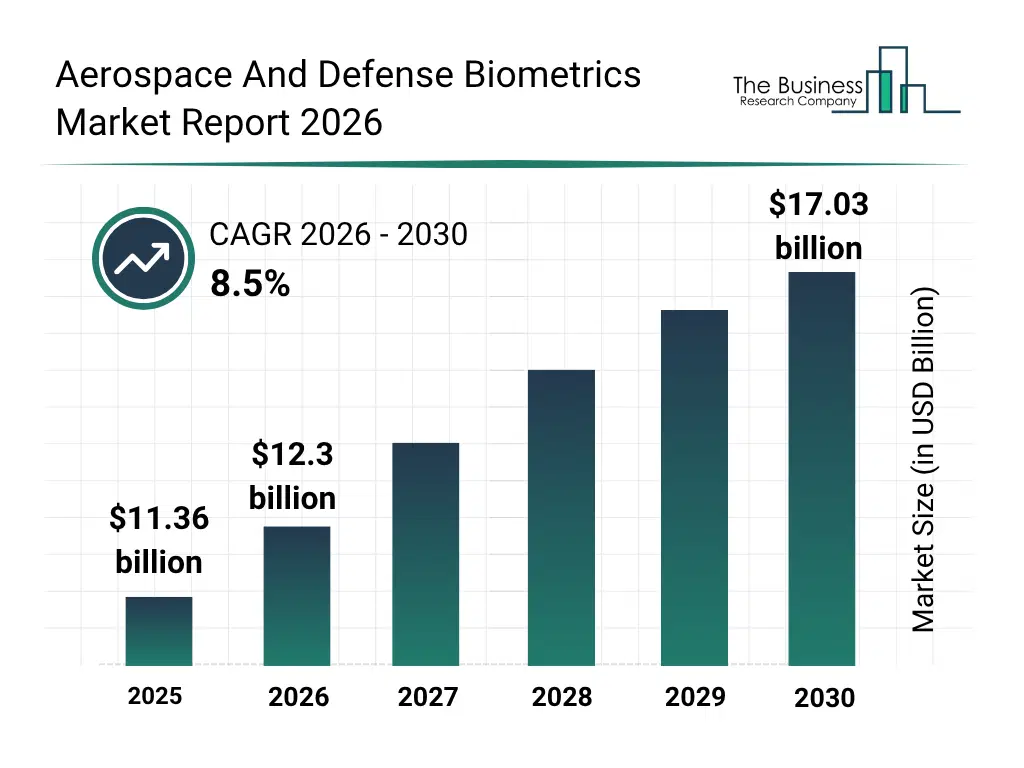
What Is The Aerospace And Defense Biometrics Market Size and Share 2026?
The aerospace and defense biometrics market size has grown strongly in recent years. It will grow from $11.36 billion in 2025 to $12.3 billion in 2026 at a compound annual growth rate (CAGR) of 8.2%. The growth in the historic period can be attributed to increasing need for secure military access control systems, rise in terrorist threats and global security concerns, adoption of fingerprint-based authentication in defense installations, modernization of military base security infrastructure, growing use of biometric systems in government facilities.What Is The Aerospace And Defense Biometrics Market Growth Forecast?
The aerospace and defense biometrics market size is expected to see strong growth in the next few years. It will grow to $17.03 billion in 2030 at a compound annual growth rate (CAGR) of 8.5%. The growth in the forecast period can be attributed to expansion of AI-powered biometric recognition systems, increasing adoption of multimodal authentication in defense operations, rising investment in smart military infrastructure, integration of biometrics with cybersecurity frameworks, growth in automated border control and defense surveillance systems. Major trends in the forecast period include increasing adoption of multimodal biometric authentication for high security defense access control, rising deployment of facial recognition and iris scanning systems in military bases and air defense facilities, growing integration of biometric systems with cybersecurity and identity management platforms, expansion of cloud-based biometric identity verification for remote defense operations, increasing use of biometric-enabled surveillance and perimeter security systems in aerospace facilities.
Global Aerospace And Defense Biometrics Market Segmentation
1) By Component: Hardware, Software, Services 2) By Technology: Fingerprint Recognition, Face Recognition, Iris Recognition, Voice Recognition, Palm Vein Recognition, Deoxyribonucleic Acid Biometrics, Signature Recognition, Multimodal Biometrics 3) By Deployment: On Premises, Cloud-Based 4) By Application: Access Control And Secure Identification, Surveillance And Security, Payment And Transaction, Border Control And Immigration, Intelligence And Reconnaissance, Criminal Identification And Forensics, Personnel Identification And Authentication 5) By End User: Military And Defense, Homeland Security, Law Enforcement Agencies, Intelligence Agencies, Government Organizations Subsegments: 1) By Hardware: Fingerprint Scanners, Facial Recognition Cameras, Iris Scanners, Voice Recognition Devices, Handheld Biometric Devices 2) By Software: Biometric Identification Software, Facial Recognition Software, Identity Management Platforms, Automated Border Control Software, Data Analytics Software 3) By Services: System Integration Services, Consulting Services, Maintenance And Support Services, Training Services, Managed Security ServicesWhat Is The Driver Of The Aerospace And Defense Biometrics Market?
The increasing complexity of security threats is expected to propel the growth of the aerospace and defense biometrics market going forward. A security threat is any possible action or event that can compromise the confidentiality, integrity, or availability of systems and data. Security threats are increasing mainly due to rapid digitalization, as more sensitive data and critical services move online, creating a larger attack surface for cybercriminals to exploit. Aerospace and defense biometrics help mitigate security threats by enabling rapid, accurate identity verification to prevent unauthorized access and enhance threat detection in critical defense environments. For instance, in October 2023, according to the Offshore Energy Exhibition & Conference (OEEC), a Netherlands-based event management company, the average cyberattack in the maritime industry now costs the affected organization around $550,000, compared to $182,000 in 2022. Therefore, the increasing complexity of security threats is driving the growth of the aerospace and defense biometrics industry.Key Players In The Global Aerospace And Defense Biometrics Market
Major companies operating in the aerospace and defense biometrics market are Lockheed Martin Corporation, Northrop Grumman Corporation, General Dynamics Corporation, Collins Aerospace, Thales Group, Fujitsu Limited, L3Harris Technologies Inc., NEC Corporation, Amadeus IT Group, Leidos Holdings Inc., Peraton Inc., Science Applications International Corporation, CACI International Inc., Elbit Systems Ltd., ManTech International Corporation, QinetiQ Group plc, IDEMIA Group, HID Global Corporation, Telos Corporation, Secunet Security Networks AG, Daon Inc., Aware Inc., Neurotechnology UAB, BIO-key International Inc., Iris ID Systems Inc., M2SYS Technology Inc.Global Aerospace And Defense Biometrics Market Trends and Insights
Major companies operating in the aerospace and defense biometrics market are focusing on developing innovative solutions, such as edge-based biometric authentication systems, to perform on-device identity matching at military installations, improving response speed, minimizing network dependency, and strengthening security against centralized system breaches. An edge-based biometric authentication system is a decentralized security framework that performs identity verification directly at the device or network edge, enabling quick access decisions while improving data privacy and system resilience. For instance, in March 2025, Precise Biometrics AB, a Sweden-based software and cybersecurity company, launched a fully on-premises biometric access control solution targeting high-security industries such as defense, critical infrastructure, and government agencies. The solution offers enhanced data sovereignty, advanced biometric authentication, seamless integration with existing access-control systems, reduced cybersecurity exposure, and scalable deployment capabilities designed for defense, government, and other mission-critical environments.What Are Latest Mergers And Acquisitions In The Aerospace And Defense Biometrics Market?
In November 2025, Gentex Corporation, a US-based technology company, acquired BioConnect for an undisclosed amount. With this acquisition, Gentex aims to strengthen its identity authentication and biometric capabilities by integrating BioConnect’s identity management solutions into its advanced sensing and access control platforms to enhance secure authentication and security applications. BioConnect is a Canada-based company that provides aerospace and defense biometrics solutions, including AI-powered biometric authentication, multi-modal access control, and identity management platforms for high-security environments.Regional Outlook
North America was the largest region in the aerospace and defense biometrics market in 2025. Asia-Pacific is expected to be the fastest-growing region in the forecast period. The regions covered in this market report are Australia, Brazil, China, France, Germany, India, Indonesia, Japan, Taiwan, Russia, South Korea, UK, USA, Canada, Italy, Spain. The countries covered in this market report are Australia, Brazil, China, France, Germany, India, Indonesia, Japan, Taiwan, Russia, South Korea, UK, USA, Canada, Italy, Spain.What Defines the Aerospace And Defense Biometrics Market?
The aerospace and defense biometrics market consists of revenues earned by entities by providing services such as identity enrollment and credentialing services, biometric authentication and verification services, and multimodal biometric integration services. The market value includes the value of related goods sold by the service provider or included within the service offering. The aerospace and defense biometrics market also includes sales of fingerprint recognition scanners, voice recognition systems, and mobile biometric handheld devices. Values in this market are ‘factory gate’ values, that is, the value of goods sold by the manufacturers or creators of the goods, whether to other entities (including downstream manufacturers, wholesalers, distributors, and retailers) or directly to end customers. The value of goods in this market includes related services sold by the creators of the goods.How is Market Value Defined and Measured?
The market value is defined as the revenues that enterprises gain from the sale of goods and/or services within the specified market and geography through sales, grants, or donations in terms of the currency (in USD unless otherwise specified). The revenues for a specified geography are consumption values that are revenues generated by organizations in the specified geography within the market, irrespective of where they are produced. It does not include revenues from resales along the supply chain, either further along the supply chain or as part of other products.What Key Data and Analysis Are Included in the Aerospace And Defense Biometrics Market Report 2026?
The aerospace and defense biometrics market research report is one of a series of new reports from The Business Research Company that provides aerospace and defense biometrics market statistics, including aerospace and defense biometrics industry global market size, regional shares, competitors with a aerospace and defense biometrics market share, detailed aerospace and defense biometrics market segments, market trends and opportunities, and any further data you may need to thrive in the aerospace and defense biometrics industry. This aerospace and defense biometrics market research report delivers a complete perspective of everything you need, with an in-depth analysis of the current and future scenario of the industry.Aerospace And Defense Biometrics Market Report Forecast Analysis
| Report Attribute | Details |
|---|---|
| Market Size Value In 2026 | $12.3 billion |
| Revenue Forecast In 2030 | $17.03 billion |
| Growth Rate | CAGR of 8.5% from 2026 to 2030 |
| Base Year For Estimation | 2025 |
| Actual Estimates/Historical Data | 2020-2025 |
| Forecast Period | 2026 - 2030 |
| Market Representation | Revenue in USD Billion and CAGR from 2026 to 2030 |
| Segments Covered | Component, Technology, Deployment, Application, End User |
| Regional Scope | Asia-Pacific, Western Europe, Eastern Europe, North America, South America, Middle East, Africa |
| Country Scope | The countries covered in the aerospace and defense biometrics market report are Australia, Brazil, China, France, Germany, India, Indonesia, Japan, Taiwan, Russia, South Korea, UK, USA, Canada, Italy, Spain. |
| Key Companies Profiled | Lockheed Martin Corporation, Northrop Grumman Corporation, General Dynamics Corporation, Collins Aerospace, Thales Group, Fujitsu Limited, L3Harris Technologies Inc., NEC Corporation, Amadeus IT Group, Leidos Holdings Inc., Peraton Inc., Science Applications International Corporation, CACI International Inc., Elbit Systems Ltd., ManTech International Corporation, QinetiQ Group plc, IDEMIA Group, HID Global Corporation, Telos Corporation, Secunet Security Networks AG, Daon Inc., Aware Inc., Neurotechnology UAB, BIO-key International Inc., Iris ID Systems Inc., M2SYS Technology Inc. |
| Customization Scope | Request for Customization |
| Pricing And Purchase Options | Explore Purchase Options |