

Aerospace And Defense Core Materials Market Report 2026
Global Outlook – By Material Type (Honeycomb Core Materials, Foam Core Materials, Balsa Core Materials), By Aircraft Type (Commercial Aircraft, Military Aircraft, Business Jets), By Application (Airframe Manufacturers, Aerostructures Manufacturers, Research And Development, Maintenance Repair And Overhaul) – Market Size, Trends, Strategies, and Forecast to 2030
Aerospace And Defense Core Materials Market Overview
• Aerospace And Defense Core Materials market size has reached to $0.39 billion in 2025 • Expected to grow to $0.68 billion in 2030 at a compound annual growth rate (CAGR) of 11.7% • Growth Driver: Rising Global Defense Expenditure Fueling The Growth Of The Market Due To Increasing Geopolitical Tensions • Market Trend: Advanced Honeycomb Core Materials Enhance Aerospace Composite Performance • Asia-Pacific was the largest region and fastest growing region.What Is Covered Under Aerospace And Defense Core Materials Market?
Aerospace and defense core materials are high-performance materials used in the production of aircraft, spacecraft, military vehicles, missiles, and defense systems. These materials deliver exceptional strength, durability, lightweight characteristics, and resistance to extreme environmental conditions, helping improve operational efficiency, fuel economy, payload capacity, reliability, and overall mission safety. The main material types of aerospace and defense core materials include honeycomb core materials, foam core materials, and balsa core materials. Honeycomb core materials refer to lightweight structural materials with a honeycomb-shaped internal configuration that provide high strength-to-weight ratio and stiffness for aerospace and defense applications. These materials are used in commercial aircraft, military aircraft, and business jets and they find application in airframe manufacturers, aerostructures manufacturers, research and development, and maintenance repair and overhaul.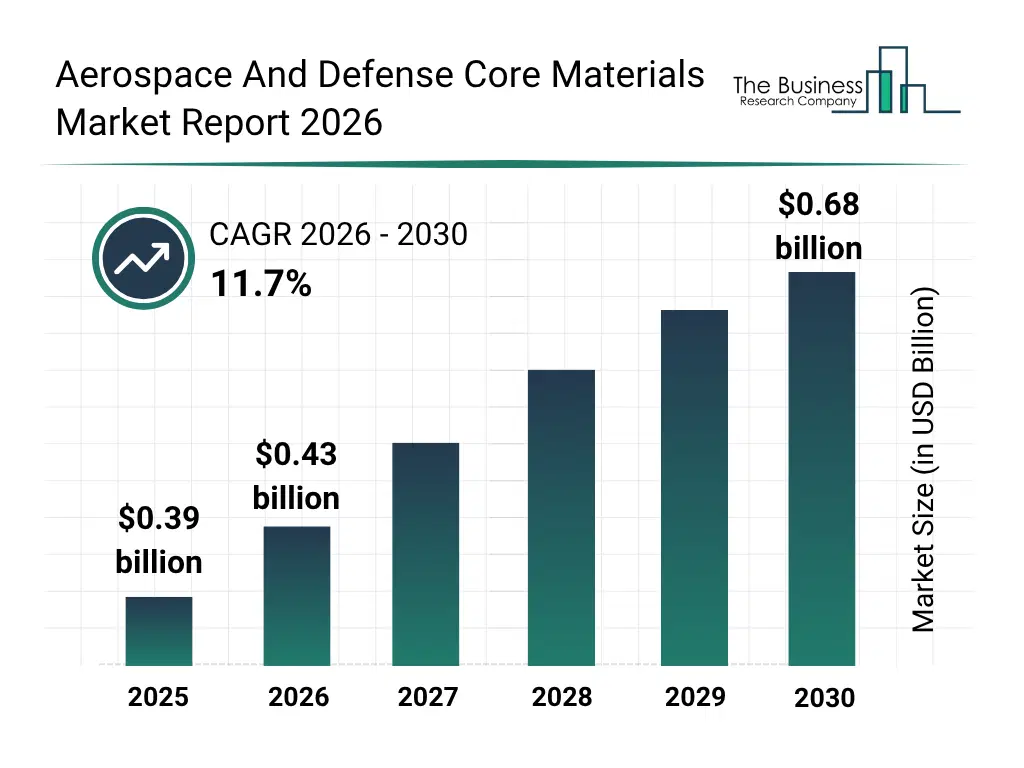
What Is The Aerospace And Defense Core Materials Market Size and Share 2026?
The aerospace and defense core materials market size has grown rapidly in recent years. It will grow from $0.39 billion in 2025 to $0.43 billion in 2026 at a compound annual growth rate (CAGR) of 12.2%. The growth in the historic period can be attributed to increasing aircraft production, growing defense modernization programs, rising demand for lightweight aerospace structures, expanding composite material adoption, increasing investment in military aviation.What Is The Aerospace And Defense Core Materials Market Growth Forecast?
The aerospace and defense core materials market size is expected to see rapid growth in the next few years. It will grow to $0.68 billion in 2030 at a compound annual growth rate (CAGR) of 11.7%.The growth in the forecast period can be attributed to growing demand for next generation aircraft platforms, rising investment in space exploration programs, increasing adoption of advanced composite structures, expanding production of unmanned aerial systems, growing demand for fuel efficient aerospace components. Major trends in the forecast period include increasing adoption of lightweight high strength core materials, growing demand for advanced impact resistant composite structures, rising use of high temperature resistant core materials, expansion of multi layer sandwich composite structures, increasing development of durable corrosion resistant core materials.
Global Aerospace And Defense Core Materials Market Segmentation
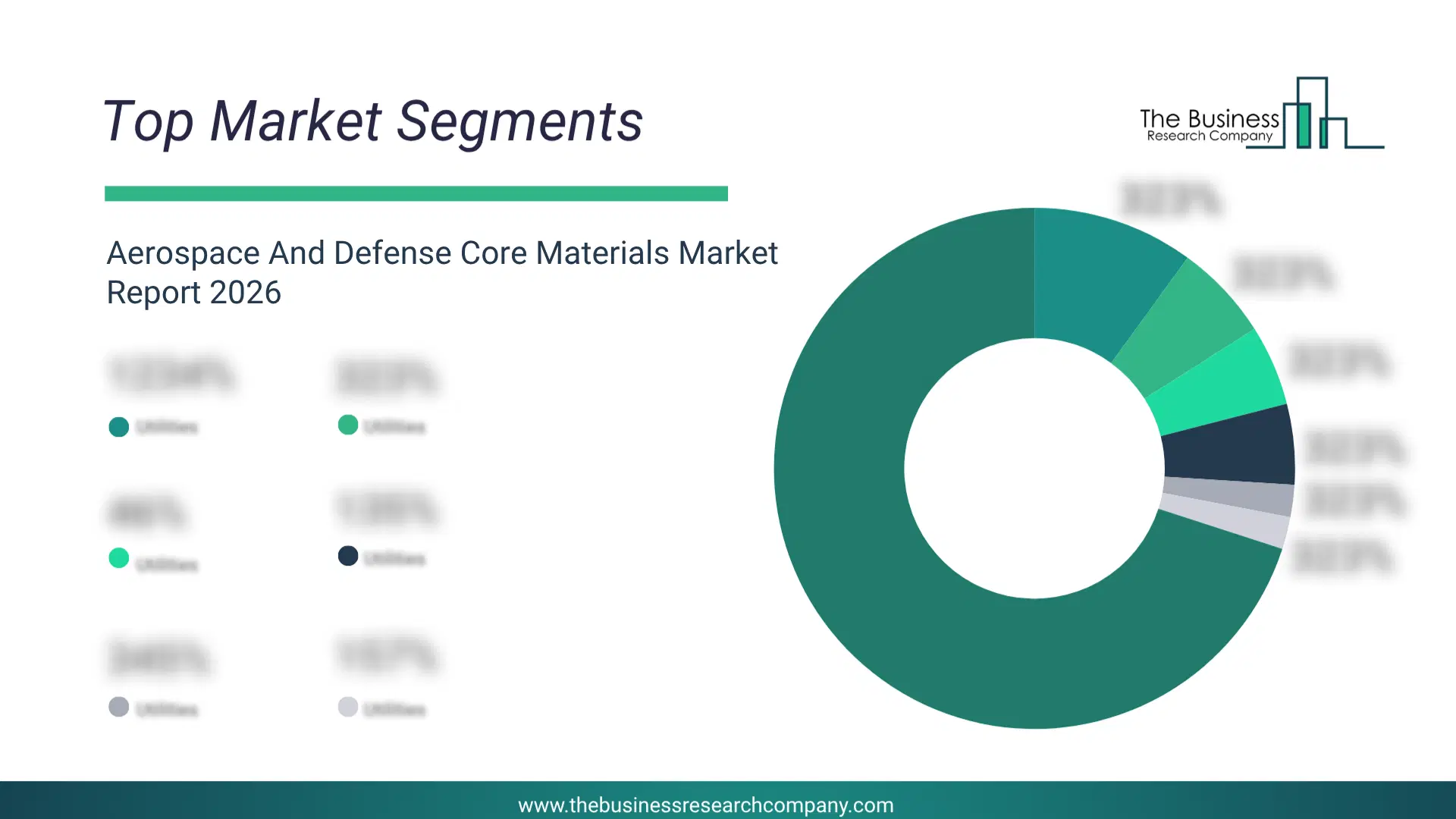
2) By Aircraft Type: Commercial Aircraft, Military Aircraft, Business Jets 3) By Application: Airframe Manufacturers, Aerostructures Manufacturers, Research And Development, Maintenance Repair And Overhaul Subsegments: 1) By Honeycomb Core Materials: Aramid Honeycomb, Aluminum Honeycomb, Thermoplastic Honeycomb 2) By Foam Core Materials: Polyvinyl Chloride Foam, Polyethylene Terephthalate Foam, Polymethacrylimide Foam 3) By Balsa Core Materials: End Grain Balsa Core, Contour Balsa Core, Scrim Backed Balsa CoreWhat Is The Driver Of The Aerospace And Defense Core Materials Market?
The rising global defense expenditure is expected to propel the growth of the aerospace and defense core materials market going forward. Defense expenditure refers to government spending on military personnel, equipment, weapons systems, research and development, infrastructure, and security operations. The rise in global defense expenditure is due to increasing geopolitical tensions that are prompting governments to strengthen military readiness and modernize defense capabilities. Aerospace and defense core materials support defense expenditure by enabling the production of lightweight, high-strength, and durable structures used in military aircraft, unmanned aerial vehicles, missiles, radomes, naval platforms, and other advanced defense systems. For instance, in April 2025, according to the Stockholm International Peace Research Institute (SIPRI), a Sweden-based independent research institute, world military expenditure reached $2.718 trillion in 2024, representing a 9.4% increase compared with 2023, when global military spending was approximately $2.485 trillion. Therefore, the rising global defense expenditure is driving the growth of the aerospace and defense core materials industry.Key Players In The Global Aerospace And Defense Core Materials Market
Major companies operating in the aerospace and defense core materials market are 3A Composites Core Materials, ACP Composites, Arconic, CoreLite, Corex Honeycomb, Diab International, EconCore, Euro-Composites, Evonik Industries, General Plastics & Composites, Gurit Holding, Hexcel Corporation, HONYLITE, Jiangsu Jiuding New Material, Kineco, Lantor, Plascore, SABIC, SCHÜTZ Composites, Sicomin Epoxy Systems, Solvay, Toray Industries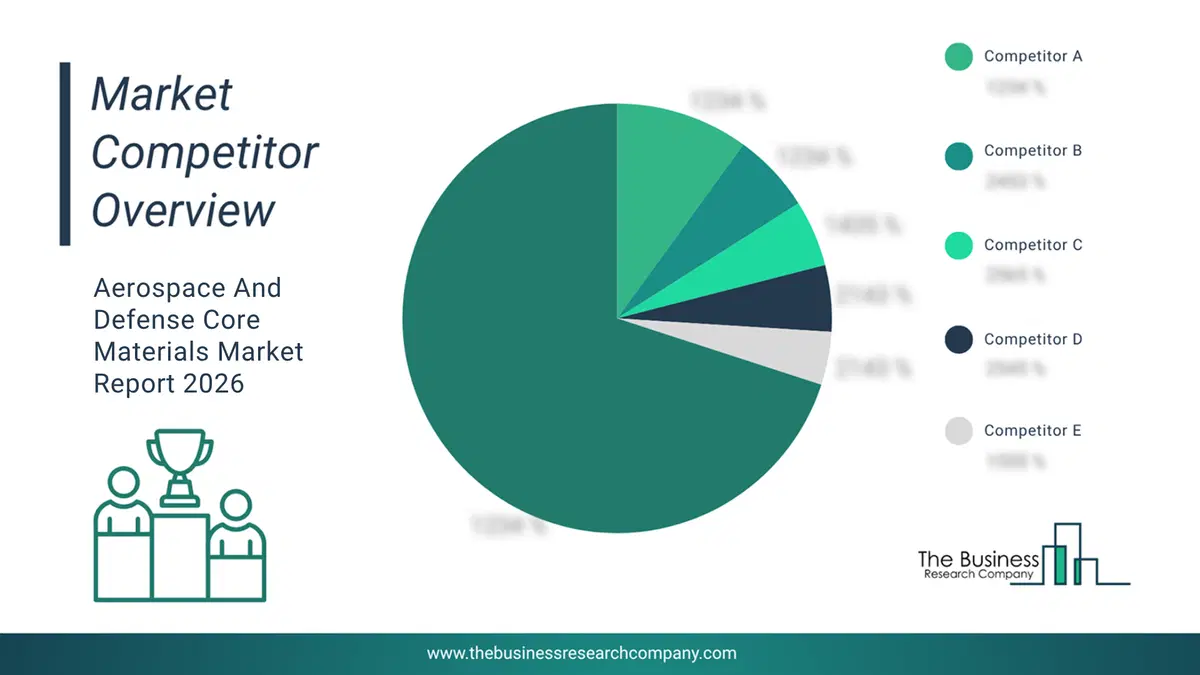
This chart is for illustrative purposes; the full report includes a detailed competitor analysis and comprehensive overview of the top 10 companies in the market.
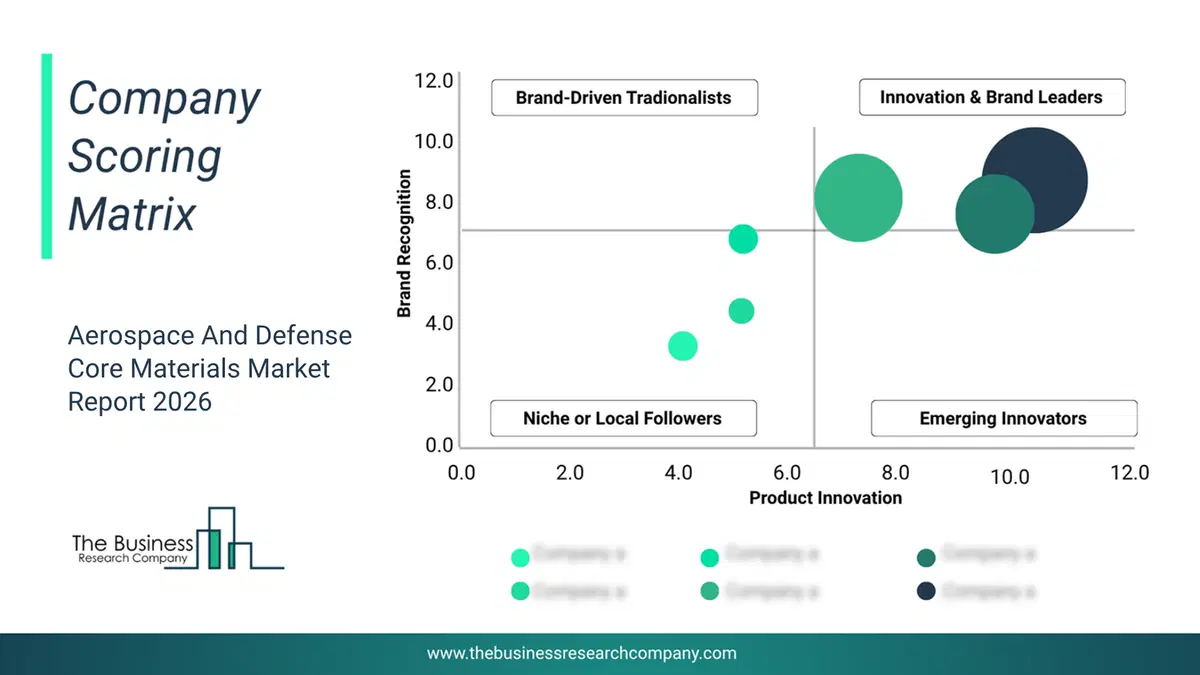
This chart maps companies by product innovation and brand strength, with bubble size indicating relative revenue, helping identify market leaders, challengers, and niche players. This is an illustrative chart; the full report provides a complete and accurate competitive analysis.
Global Aerospace And Defense Core Materials Market Trends and Insights
Major companies operating in the aerospace and defense core materials market are focusing on developing advanced materials, such as mid-temperature honeycomb core solutions, to enhance thermal performance, structural efficiency, and manufacturability in aerospace composite applications. Mid-temperature honeycomb core solutions refer to lightweight cellular core materials engineered to maintain structural integrity and mechanical performance under elevated-temperature operating conditions while supporting the production of high-strength composite structures. For instance, in October 2024, Hexcel Corporation, a US-based advanced composites manufacturer, introduced the Flex-Core HRH-302 mid-temperature honeycomb core. The new core material is designed to provide improved thermal stability, enhanced formability, and high strength-to-weight performance for aerospace composite applications. It enables manufacturers to produce complex composite components more efficiently while maintaining lightweight structural characteristics. These capabilities help aerospace and defense manufacturers improve aircraft performance, durability, and manufacturing efficiency.What Are Latest Mergers And Acquisitions In The Aerospace And Defense Core Materials Market?
In April 2026, Arclin, a US-based manufacturer of specialty materials and engineered solutions, acquired DuPont’s Aramids Business from DuPont de Nemours, Inc. for approximately $1.8 billion. Through this acquisition, Arclin aims to expand its portfolio of high-performance materials and strengthen its presence in aerospace, defense, industrial, and safety applications by adding the renowned Kevlar and Nomex product lines. DuPont de Nemours, Inc. is a US-based provider of high-performance aramid-based materials such as Kevlar and Nomex.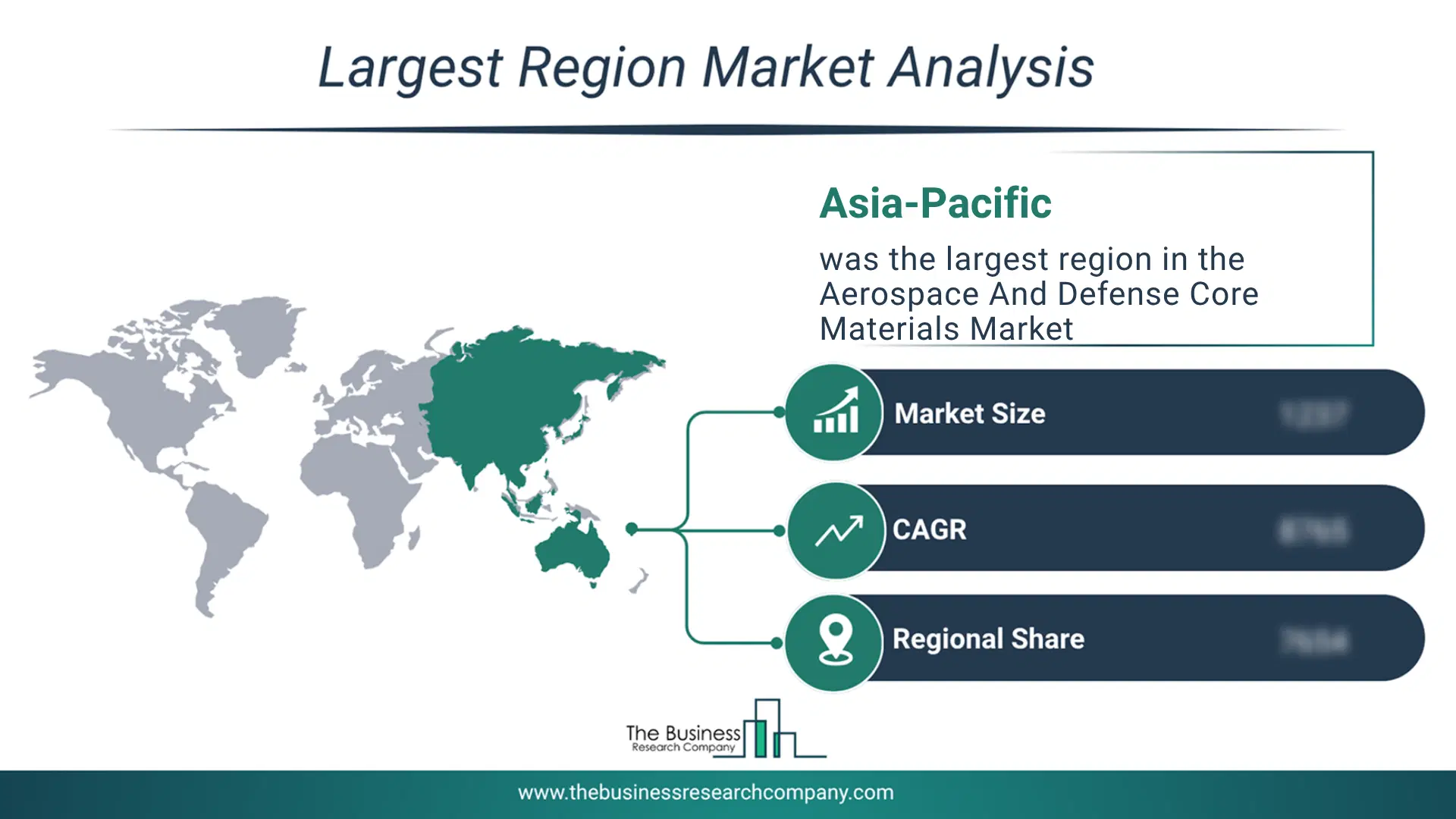
Regional Outlook/Insights
Asia-Pacific was the largest region in the aerospace and defense core materials market in 2025. Asia-Pacific is expected to be the fastest-growing region in the forecast period. The regions covered in this market report are Asia-Pacific, South East Asia, Western Europe, Eastern Europe, North America, South America, Middle East, Africa. The countries covered in this market report are Australia, Brazil, China, France, Germany, India, Indonesia, Japan, Taiwan, Russia, South Korea, UK, USA, Canada, Italy, Spain.What Defines the Aerospace And Defense Core Materials Market?
The aerospace and defense core materials market consists of sales of corrugated core materials, lattice core materials, truss core materials, thermoplastic core materials, aluminum core structures, aramid paper core structures, polypropylene core materials, polyethylene terephthalate (PET) structural cores, polyvinyl chloride (PVC) structural cores, and engineered composite core panels. Values in this market are ‘factory gate’ values, that is, the value of goods sold by manufacturers or creators of the goods, whether to other entities (including aircraft manufacturers, defense contractors, composite fabricators, wholesalers, distributors, and retailers) or directly to end customers. The value of goods in this market includes related services sold by the creators of the goods.How is Market Value Defined and Measured?
The market value is defined as the revenues that enterprises gain from the sale of goods and/or services within the specified market and geography through sales, grants, or donations in terms of the currency (in USD unless otherwise specified). The revenues for a specified geography are consumption values that are revenues generated by organizations in the specified geography within the market, irrespective of where they are produced. It does not include revenues from resales along the supply chain, either further along the supply chain or as part of other products.
This chart presents market attractiveness based on a quantitative evaluation of growth, competition, strategic alignment, and risk, offering a clear view of opportunity areas for decision-making. This chart is for illustrative purposes; the full report contains the complete analysis.

This chart highlights the Total Addressable Market (TAM) by estimating the maximum revenue opportunity using an assumption-driven approach, supporting strategic planning and opportunity sizing across markets. The chart is illustrative; the full report provides a more comprehensive analysis.
What Key Data and Analysis Are Included in the Aerospace And Defense Core Materials Market Report 2026?
The aerospace and defense core materials market research report is one of a series of new reports from The Business Research Company that provides aerospace and defense core materials market statistics, including aerospace and defense core materials industry global market size, regional shares, competitors with a aerospace and defense core materials market share, detailed aerospace and defense core materials market segments, market trends and opportunities, and any further data you may need to thrive in the aerospace and defense core materials industry. This aerospace and defense core materials market research report delivers a complete perspective of everything you need, with an in-depth analysis of the current and future scenario of the industry.Aerospace And Defense Core Materials Market Report Forecast Analysis
| Report Attribute | Details |
|---|---|
| Market Size Value In 2026 | $0.43 billion |
| Revenue Forecast In 2030 | $0.68 billion |
| Growth Rate | CAGR of 11.7% from 2026 to 2030 |
| Base Year For Estimation | 2025 |
| Actual Estimates/Historical Data | 2020-2025 |
| Forecast Period | 2026 - 2030 |
| Market Representation | Revenue in USD Billion and CAGR from 2026 to 2030 |
| Segments Covered | Material Type, Aircraft Type, Application |
| Regional Scope | Asia-Pacific, Western Europe, Eastern Europe, North America, South America, Middle East, Africa |
| Country Scope | The countries covered in the report are Australia, Brazil, China, France, Germany, India, Indonesia, Japan, Taiwan, Russia, South Korea, UK, USA, Canada, Italy, Spain. |
| Key Companies Profiled | 3A Composites Core Materials, ACP Composites, Arconic, CoreLite, Corex Honeycomb, Diab International, EconCore, Euro-Composites, Evonik Industries, General Plastics & Composites, Gurit Holding, Hexcel Corporation, HONYLITE, Jiangsu Jiuding New Material, Kineco, Lantor, Plascore, SABIC, SCHÜTZ Composites, Sicomin Epoxy Systems, Solvay, Toray Industries |
| Customization Scope | Request for Customization |
| Pricing And Purchase Options | Explore Purchase Options |