
Aerospace And Defense Material Market Report 2026
Global Outlook – By Material Type (Metals And Alloys, Composites, Ceramics And Ceramic Matrix Composites, Elastomers And Rubber Materials, Adhesives, Sealants And Coatings), By Aircraft Or Platform Type (Commercial Aircraft, Military Aircraft, Helicopters, Unmanned Aerial Vehicles Or Drones, Spacecraft And Launch Vehicles, Naval And Marine Defense Platforms), By Distribution Channel (Direct Supply, Distributors And Tier Two Or Tier Three Suppliers, Specialized Material Service Centers), By End User (Commercial Aviation Original Equipment Manufacturers, Defense Original Equipment Manufacturers, Maintenance, Repair And Overhaul, Space Agencies And Private Space Companies, Defense Vehicle Manufacturers) – Market Size, Trends, Strategies, and Forecast to 2030
Aerospace And Defense Material Market Overview
• Aerospace And Defense Material market size has reached to $42.27 billion in 2025 • Expected to grow to $58.49 billion in 2030 at a compound annual growth rate (CAGR) of 6.6% • Growth Driver: Increasing Military Modernization Programs Driving The Market Growth Due To Escalating Geopolitical Tensions And Security Threats • Market Trend: Advanced Additive Manufacturing Materials Enable Production Of Mission-Critical Components • North America was the largest region in 2025 and Asia-Pacific is the fastest growing region.What Is Covered Under Aerospace And Defense Material Market?
Aerospace and defense material refers to engineered substances specifically designed to meet the stringent performance, safety, and reliability requirements of aerospace and military applications, including operation under extreme environmental and mechanical conditions. These materials are used in the manufacturing of aircraft, spacecraft, missiles, defense platforms, and related systems to improve structural integrity, operational efficiency, and mission performance. The main material types of aerospace and defense material include metals and alloys, composites, ceramics and ceramic matrix composites, elastomers and rubber materials, and adhesives, sealants and coatings. Metals and alloys refer to high-strength metallic materials engineered to withstand extreme mechanical, thermal, and environmental conditions in aerospace and defense applications. These materials are used across commercial aircraft, military aircraft, helicopters, unmanned aerial vehicles or drones, spacecraft and launch vehicles, and naval and marine defense platforms. These are supplied through direct supply, distributors and tier two or tier three suppliers, and specialized material service centers and are utilized by end users including commercial aviation original equipment manufacturers, defense original equipment manufacturers, maintenance, repair and overhaul providers, space agencies and private space companies, and defense vehicle manufacturers.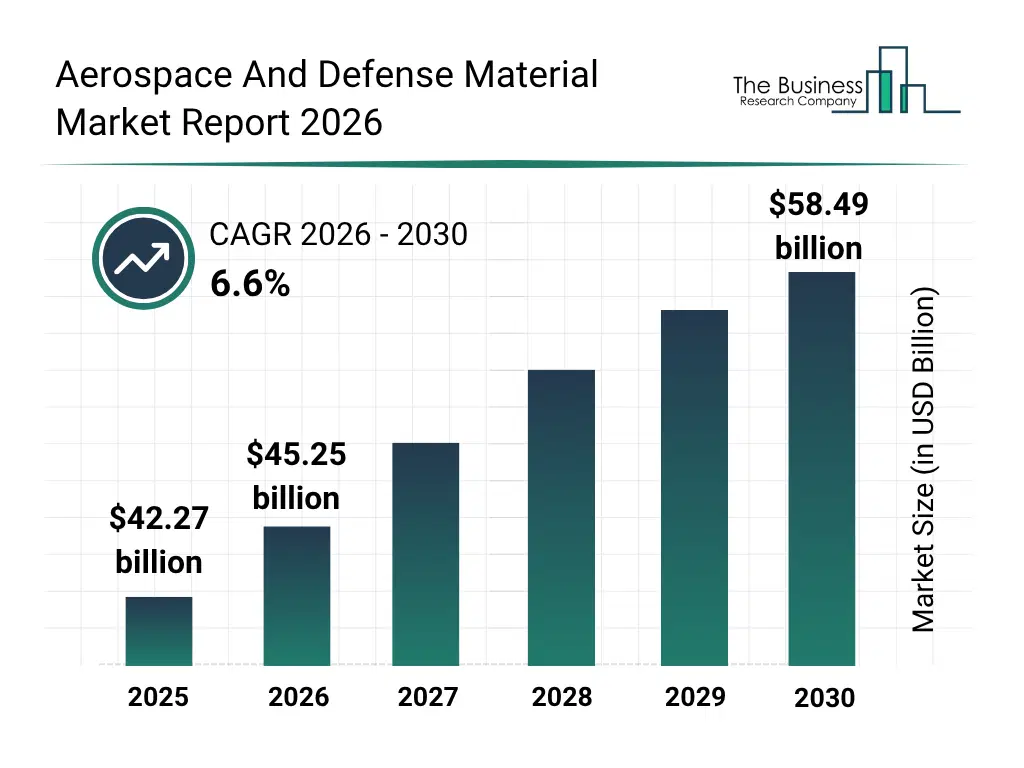
What Is The Aerospace And Defense Material Market Size and Share 2026?
The aerospace and defense material market size has grown strongly in recent years. It will grow from $42.27 billion in 2025 to $45.25 billion in 2026 at a compound annual growth rate (CAGR) of 7.1%. The growth in the historic period can be attributed to increasing commercial aircraft production, rising global defense expenditure, growing demand for lightweight structural materials, expansion of aerospace manufacturing capabilities, increasing investments in military modernization programs.What Is The Aerospace And Defense Material Market Growth Forecast?
The aerospace and defense material market size is expected to see strong growth in the next few years. It will grow to $58.49 billion in 2030 at a compound annual growth rate (CAGR) of 6.6%. The growth in the forecast period can be attributed to growing demand for next generation aircraft platforms, increasing investments in space exploration programs, rising adoption of advanced composite materials, expanding production of unmanned aerial vehicles, growing demand for high performance thermal protection materials. Major trends in the forecast period include rising adoption of lightweight composite materials in aerospace structures, increasing demand for high temperature resistant materials in defense applications, growing use of advanced corrosion resistant coatings for military platforms, expansion of ceramic matrix composites in aerospace propulsion systems, rising preference for high strength alloys in aircraft manufacturing.
Global Aerospace And Defense Material Market Segmentation
2) By Aircraft Or Platform Type: Commercial Aircraft, Military Aircraft, Helicopters, Unmanned Aerial Vehicles Or Drones, Spacecraft And Launch Vehicles, Naval And Marine Defense Platforms 3) By Distribution Channel: Direct Supply, Distributors And Tier Two Or Tier Three Suppliers, Specialized Material Service Centers 4) By End User: Commercial Aviation Original Equipment Manufacturers, Defense Original Equipment Manufacturers, Maintenance, Repair And Overhaul, Space Agencies And Private Space Companies, Defense Vehicle Manufacturers Subsegments: 1) By Metals And Alloys: Aluminum Alloys, Titanium Alloys, Nickel Based Alloys, Stainless Steel Alloys, Magnesium Alloys, Cobalt Based Alloys, High Strength Low Alloy Steels 2) By Composites: Carbon Fiber Reinforced Composites, Glass Fiber Reinforced Composites, Aramid Fiber Reinforced Composites, Hybrid Fiber Composites, Thermoplastic Composites, Thermoset Composites 3) By Ceramics And Ceramic Matrix Composites: Oxide Ceramics, Non Oxide Ceramics, Silicon Carbide Matrix Composites, Oxide Matrix Composites, Carbon Matrix Composites, Ultra High Temperature Ceramics 4) By Elastomers And Rubber Materials: Silicone Rubber Materials, Fluoroelastomer Materials, Nitrile Rubber Materials, Ethylene Propylene Rubber Materials, Neoprene Rubber Materials, Polyurethane Elastomer Materials 5) By Adhesives, Sealants And Coatings: Structural Adhesives, Epoxy Adhesives, Polyurethane Adhesives, Aerospace Sealants, Corrosion Resistant Coatings, Thermal Barrier Coatings, Protective Surface Coatings, Fire Resistant CoatingsWhat Is The Driver Of The Aerospace And Defense Material Market?
The increasing military modernization programs is expected to propel the growth of the aerospace and defense material market going forward. Military modernization programs are comprehensive initiatives by armed forces to upgrade and enhance their defense capabilities through advanced weapons systems and technologies. The rising military modernization programs is due to escalating geopolitical tensions and security threats to national sovereignty and regional stability, as nations seek to enhance their defense capabilities, deter potential adversaries, and safeguard their strategic interests. Increasing military modernization programs are driving demand for advanced aerospace and defense materials by accelerating the development and procurement of next-generation aircraft, missiles, unmanned systems, and defense platforms that require lightweight, high-strength, and high-performance materials. For instance, in March 2023, according to the European Security and Defence College, a Belgium-based autonomous institution, in 2030, the ongoing US Army modernization program is set to field 35 new future force systems, forming the core of more than 500 development, acquisition, or upgrade initiatives underway. Therefore, the increasing military modernization programs is driving the growth of the aerospace and defense material industry.Key Players In The Global Aerospace And Defense Material Market
Major companies operating in the aerospace and defense material market are 3M Company, Alleima AB, AMG Critical Materials N.V., ATI Inc., Carpenter Technology Corporation, Constellium SE, DuPont de Nemours Inc., Hexcel Corporation, Howmet Aerospace Inc., Kaiser Aluminum Corporation, Kobe Steel Ltd., Materion Corporation, Morgan Advanced Materials plc, Rogers Corporation, SGL Carbon SE, Syensqo SA, Teijin Limited, Toray Industries Inc., Victrex plc
This chart is for illustrative purposes; the full report includes a detailed competitor analysis and comprehensive overview of the top 10 companies in the market.
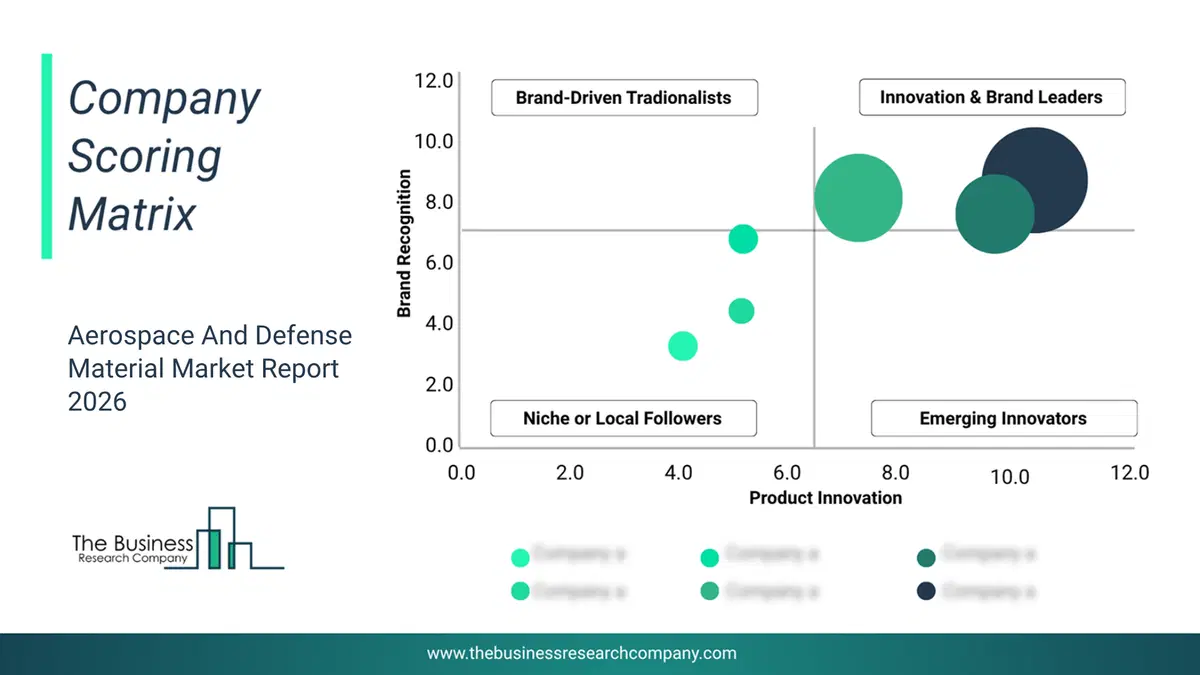
This chart maps companies by product innovation and brand strength, with bubble size indicating relative revenue, helping identify market leaders, challengers, and niche players. This is an illustrative chart; the full report provides a complete and accurate competitive analysis.
Global Aerospace And Defense Material Market Trends and Insights
Major companies operating in the aerospace and defense material market are focusing on developing innovative solutions, such as flight-ready high-performance 3D printing materials, to enhance component durability, reduce weight, and accelerate the production of mission-critical aerospace and defense parts. Flight-ready high-performance 3D printing materials are advanced polymer-based materials specifically engineered for additive manufacturing applications that require exceptional thermal stability, chemical resistance, and mechanical strength, offering a lightweight and flexible alternative to conventional aerospace materials and enabling the rapid production of certified end-use components. For instance, in May 2025, Stratasys Ltd., an Israel-based provider of polymer 3D printing solutions, partnered with Northrop Grumman Corporation, a US-based aerospace and defense technology company; The Boeing Company, a US-based aerospace, defense, and commercial aircraft manufacturer; RTX Corporation, a US-based defense technology company; Blue Origin LLC, a US-based aerospace manufacturing company; and the United States Air Force, a US-based military service, to launch AIS Antero 800NA and AIS Antero 840CN03, two newly qualified high-performance materials validated for use with the F900 industrial 3D printer. Developed for high-stress applications, including spacecraft interiors and avionics housings, these materials offer exceptional temperature and chemical resistance, lightweight characteristics, and NCAMP-equivalent performance data to ensure manufacturing consistency across production sites.What Are Latest Mergers And Acquisitions In The Aerospace And Defense Material Market?
In August 2023, Apollo Global Management Inc., a US-based asset management firm, acquired Arconic Corporation for an undisclosed amount. With this acquisition, Apollo aims to strengthen its presence in the aluminum fabrication sector by leveraging Arconic’s advanced manufacturing capabilities and metallurgical expertise while investing in technology upgrades and capacity enhancements to support long-term growth across aerospace, transportation, and industrial markets. Arconic Corporation is a US-based company that provides aerospace and defense materials, specifically high-performance aluminum sheet, plate, and extrusions for aircraft fuselages, wings, and defense applications.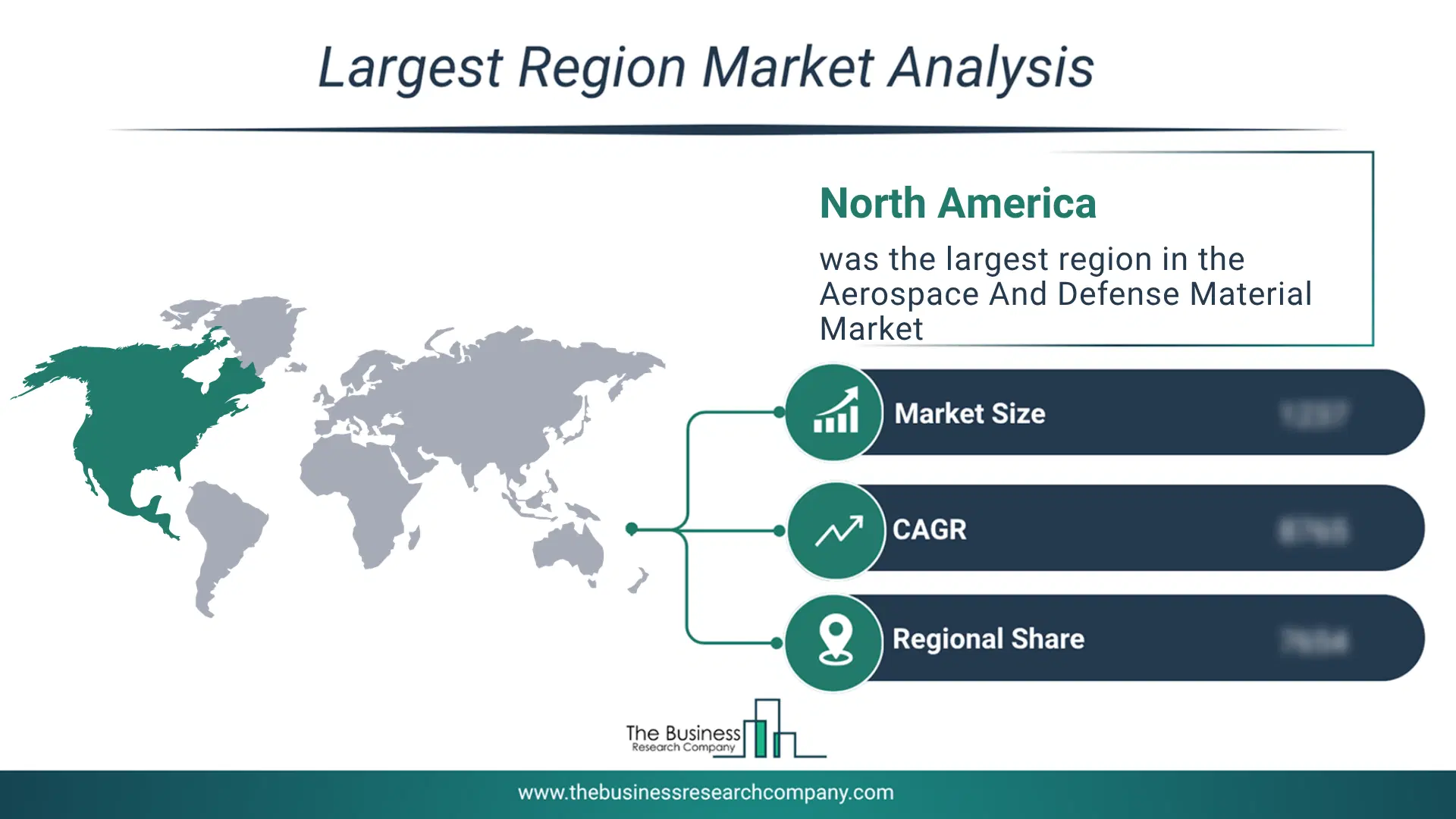
Regional Outlook/Insights
North America was the largest region in the aerospace and defense material market in 2025. Asia-Pacific is expected to be the fastest-growing region in the forecast period. The regions covered in this market report are Asia-Pacific, South East Asia, Western Europe, Eastern Europe, North America, South America, Middle East, Africa. The countries covered in this market report are Australia, Brazil, China, France, Germany, India, Indonesia, Japan, Taiwan, Russia, South Korea, UK, USA, Canada, Italy, Spain.What Defines the Aerospace And Defense Material Market?
The aerospace and defense material market consist of sales of armor materials and ballistic protection systems, thermal protection and insulation materials, stealth and radar-absorbing materials, high-temperature engine and turbine materials, and structural honeycomb and core materials. Values in this market are ‘factory gate’ values, that is, the value of goods sold by the manufacturers or creators of the goods, whether to other entities (including downstream manufacturers, wholesalers, distributors, and retailers) or directly to end customers. The value of goods in this market includes related services sold by the creators of the goods.How is Market Value Defined and Measured?
The market value is defined as the revenues that enterprises gain from the sale of goods and/or services within the specified market and geography through sales, grants, or donations in terms of the currency (in USD unless otherwise specified). The revenues for a specified geography are consumption values that are revenues generated by organizations in the specified geography within the market, irrespective of where they are produced. It does not include revenues from resales along the supply chain, either further along the supply chain or as part of other products.
This chart presents market attractiveness based on a quantitative evaluation of growth, competition, strategic alignment, and risk, offering a clear view of opportunity areas for decision-making. This chart is for illustrative purposes; the full report contains the complete analysis.

This chart highlights the Total Addressable Market (TAM) by estimating the maximum revenue opportunity using an assumption-driven approach, supporting strategic planning and opportunity sizing across markets. The chart is illustrative; the full report provides a more comprehensive analysis.
What Key Data and Analysis Are Included in the Aerospace And Defense Material Market Report 2026?
The aerospace and defense material market research report is one of a series of new reports from The Business Research Company that provides aerospace and defense material market statistics, including aerospace and defense material industry global market size, regional shares, competitors with a aerospace and defense material market share, detailed aerospace and defense material market segments, market trends and opportunities, and any further data you may need to thrive in the aerospace and defense material industry. This aerospace and defense material market research report delivers a complete perspective of everything you need, with an in-depth analysis of the current and future scenario of the industry.Aerospace And Defense Material Market Report Forecast Analysis
| Report Attribute | Details |
|---|---|
| Market Size Value In 2026 | $45.25 billion |
| Revenue Forecast In 2030 | $58.49 billion |
| Growth Rate | CAGR of 6.6% from 2026 to 2030 |
| Base Year For Estimation | 2025 |
| Actual Estimates/Historical Data | 2020-2025 |
| Forecast Period | 2026 - 2030 |
| Market Representation | Revenue in USD Billion and CAGR from 2026 to 2030 |
| Segments Covered | Material Type, Aircraft Or Platform Type, Distribution Channel, End User |
| Regional Scope | Asia-Pacific, Western Europe, Eastern Europe, North America, South America, Middle East, Africa |
| Country Scope | The countries covered in the report are Australia, Brazil, China, France, Germany, India, Indonesia, Japan, Taiwan, Russia, South Korea, UK, USA, Canada, Italy, Spain. |
| Key Companies Profiled | 3M Company, Alleima AB, AMG Critical Materials N.V., ATI Inc., Carpenter Technology Corporation, Constellium SE, DuPont de Nemours Inc., Hexcel Corporation, Howmet Aerospace Inc., Kaiser Aluminum Corporation, Kobe Steel Ltd., Materion Corporation, Morgan Advanced Materials plc, Rogers Corporation, SGL Carbon SE, Syensqo SA, Teijin Limited, Toray Industries Inc., Victrex plc |
| Customization Scope | Request for Customization |
| Pricing And Purchase Options | Explore Purchase Options |