
Aerospace And Defense Thermal Management Systems Market Report 2026
Global Outlook – By System Type (Active Thermal Management Systems, Passive Thermal Management Systems), By Component (Heat Exchangers, Thermal Control Units, Cooling Systems, Radiators, Heat Pipes, Thermal Insulation Materials, Temperature Sensors, Thermal Management Software, Valves And Actuators, Pumps And Compressors, Fans And Blowers), By Platform (Aircraft, Spacecraft, Land Systems, Naval Systems), By Service (Design And Engineering Services, Testing And Validation Services, Installation Services, Overhaul (MRO) Services, Consulting And Research And Development Services), By Application (Avionics And Electronics Cooling, Cabin Comfort, Other Applications) – Market Size, Trends, Strategies, and Forecast to 2035
Aerospace And Defense Thermal Management Systems Market Overview
• Aerospace And Defense Thermal Management Systems market size has reached to $24.35 billion in 2025 • Expected to grow to $35.09 billion in 2030 at a compound annual growth rate (CAGR) of 7.5% • Growth Driver: Rising Complexity And Heat Generation Of Advanced Avionics, Radar, And Electronic Warfare Systems Fueled The Market Growth Due To Increased Waste Heat In Power-Dense Platforms • Market Trend: Enhancing Thermal Control With Pumped Two?Phase Architecture, High?Efficiency Heat Transfer, And Mission?Ready Reliability • North America was the largest region in 2025 and Asia-Pacific is the fastest growing region.What Is Covered Under Aerospace And Defense Thermal Management Systems Market?
Aerospace and defense thermal management systems are advanced solutions designed to control and regulate temperature in aerospace and defense applications. They ensure optimal performance, reliability, and safety of critical systems under extreme conditions. These systems integrate innovative cooling, heating, and temperature monitoring technologies to maintain operational efficiency. The main system types of aerospace and defense thermal management systems include active thermal management systems and passive thermal management systems. Active thermal management systems refer to systems that use powered devices and mechanisms to control, regulate, and maintain optimal temperatures in aerospace and defense applications. The components include heat exchangers, thermal control units, cooling systems, radiators, heat pipes, thermal insulation materials, temperature sensors, thermal management software, valves and actuators, pumps and compressors, and fans and blowers. The platforms include aircraft, spacecraft, land systems, and naval systems. The services include design and engineering services, testing and validation services, installation services, overhaul (MRO) services, and consulting and research and development services. The applications include avionics and electronics cooling, engine cooling, energy storage cooling, weapons systems cooling, cabin comfort, and others.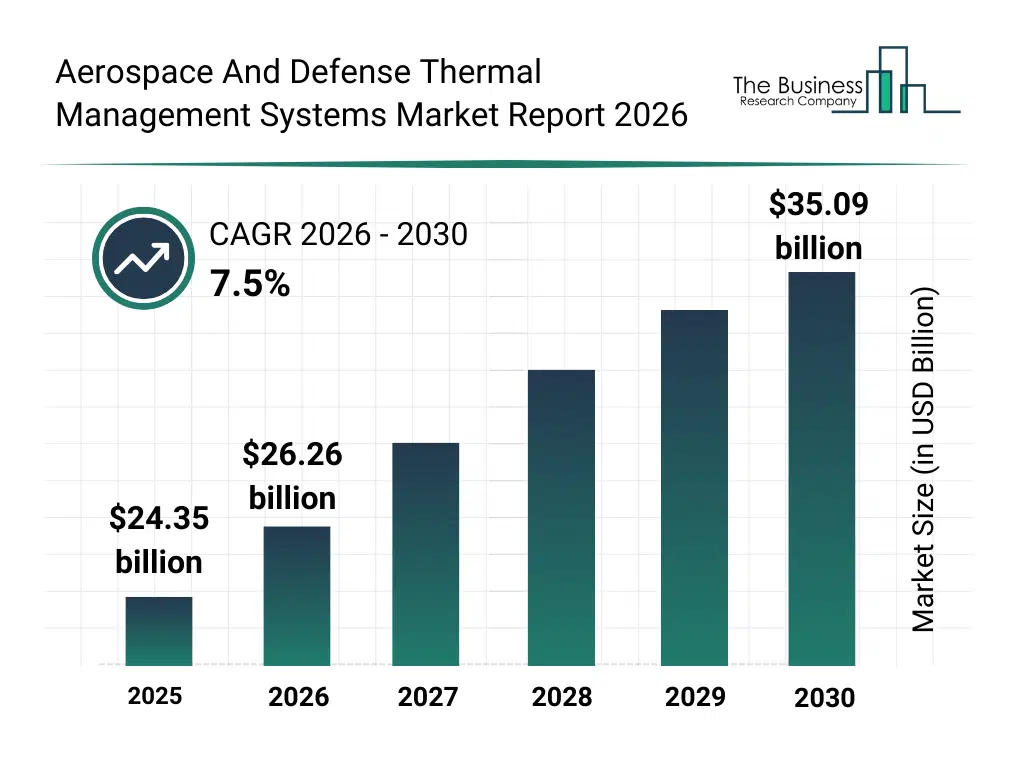
What Is The Aerospace And Defense Thermal Management Systems Market Size and Share 2026?
The aerospace and defense thermal management systems market size has grown strongly in recent years. It will grow from $24.35 billion in 2025 to $26.26 billion in 2026 at a compound annual growth rate (CAGR) of 7.8%. The growth in the historic period can be attributed to increasing demand for advanced cooling solutions, growing adoption of unmanned aerial vehicles, rising need for efficient engine thermal management, expansion of avionics and electronics systems, and growing military modernization programs.What Is The Aerospace And Defense Thermal Management Systems Market Growth Forecast?
The aerospace and defense thermal management systems market size is expected to see strong growth in the next few years. It will grow to $35.09 billion in 2030 at a compound annual growth rate (CAGR) of 7.5%. The growth in the forecast period can be attributed to increasing focus on energy-efficient thermal systems, growing integration of thermal management with power and propulsion systems, rising investments in r&d for innovative materials, expansion of space and satellite programs, and growing demand for lightweight and compact thermal solutions. Major trends in the forecast period include advancements in phase-change and two-phase cooling technologies, innovations in thermal interface materials, developments in smart and adaptive thermal control systems, research and development in hybrid and integrated thermal solutions, and increasing use of predictive thermal management software.
Global Aerospace And Defense Thermal Management Systems Market Segmentation
1) By System Type: Active Thermal Management Systems, Passive Thermal Management Systems 2) By Component: Heat Exchangers, Thermal Control Units, Cooling Systems, Radiators, Heat Pipes, Thermal Insulation Materials, Temperature Sensors, Thermal Management Software, Valves And Actuators, Pumps And Compressors, Fans And Blowers 3) By Platform: Aircraft, Spacecraft, Land Systems, Naval Systems 4) By Service: Design And Engineering Services, Testing And Validation Services, Installation Services, Overhaul (MRO) Services, Consulting And Research And Development Services 5) By Application: Avionics And Electronics Cooling, Engine Cooling, Energy Storage Cooling, Weapons Systems Cooling, Cabin Comfort, Other Applications Subsegments: 1) By Active Thermal Management Systems: Liquid Cooling Solutions, Air Cooling Solutions, Vapor Cycle Cooling Systems, Refrigerant-Based Cooling Systems, Thermoelectric Cooling Modules 2) By Passive Thermal Management Systems: Heat Pipes, Phase Change Materials, Thermal Insulation Materials, Radiative Cooling Solutions, Conduction-Based Heat SpreadersWhat Is The Driver Of The Aerospace And Defense Thermal Management Systems Market?
The rising complexity and heat generation of advanced avionics, radar, and electronic warfare systems are expected to propel the growth of the aerospace and defense thermal management systems market going forward. Rising complexity and heat generation refer to the increasing waste heat produced by high‑power, high‑density electronic and propulsion systems in modern aerospace and defense platforms that require engineered solutions to regulate, dissipate, and control temperature to maintain performance, reliability, and safety. The rise in heat generation of advanced avionics, radar, and electronic warfare systems is due to the integration of higher‑power processors, megawatt‑level electrified aircraft propulsion systems, advanced radar modules, and next‑generation electronic warfare suites that operate at significantly greater power levels than legacy systems. Aerospace and defense thermal management systems help in managing heat generation of advanced avionics, radar, and electronic warfare systems by enabling early and efficient removal of waste heat, maintaining safe operating temperatures, and ensuring reliable operation of high‑performance electronics under extreme operational conditions. For instance, in April 2025, according to National Aeronautics and Space Administration (NASA), a US‑based government space agency, future electrified aircraft concepts such as NASA’s STARC‑ABL can produce between 600 kilowatts (kW) and 6 megawatts (MW) of heat, while other hybrid‑electric aircraft concepts can generate 200 kW to 1 MW of heat, demonstrating substantially elevated thermal loads compared to conventional systems. Therefore, the rising complexity and heat generation of advanced avionics, radar, and electronic warfare systems are driving the growth of the aerospace and defense thermal management systems industry.Key Players In The Global Aerospace And Defense Thermal Management Systems Market
Major companies operating in the aerospace and defense thermal management systems market are Lockheed Martin Corporation, Northrop Grumman Corporation, Honeywell International Inc., BAE Systems Plc, Safran Aerosystems, Parker Hannifin Corporation, L3Harris Technologies Inc., RTX Corp., Boyd Corporation, Meggitt Plc, Materion Corporation, CoorsTek Inc., Thermal Management Solutions Group, Senior Plc, Rogers Corporation, KULR Technology Group, Marotta Controls Inc., Airborne Systems, Creare LLC, Lytron, Ultramet, Advanced Cooling Technologies (ACT) Inc., Vacuum Process Engineering (VPE) Inc.Global Aerospace And Defense Thermal Management Systems Market Trends and Insights
Major companies operating in the aerospace & defense thermal management systems market are focusing on developing advanced technologies, such as pumped two‑phase architecture, to support precise temperature regulation for high‑performance avionics, propulsion components, and space systems. Pumped two‑phase architecture refers to a thermal management design that circulates a working fluid through interconnected liquid and vapor phases using active pumping, enabling highly efficient heat absorption and dissipation across wide operational ranges, a critical requirement for aerospace and defense environments where thermal stability directly impacts system performance and reliability. For instance, in June 2023, Intergalactic Aerospace Corporation, a US‑based advanced space propulsion and spacecraft systems developer, launched the GS1‑EV Eagle5, the first orbital delivery spacecraft to feature a pumped two‑phase architecture for thermal control. This innovative system uses actively pumped two‑phase loops to manage heat from onboard electronics, power systems, and environmental loads during all mission phases, ensuring components remain within optimal temperature thresholds without excessive mass or power penalties.What Are Latest Mergers And Acquisitions In The Aerospace And Defense Thermal Management Systems Market?
In August 2024, Lufthansa Technik North America Holding Corp., a US‑based provider of comprehensive maintenance, repair, and overhaul (MRO) services, acquired an 80% ownership stake in ETP Thermal Dynamics for an undisclosed amount. With this acquisition, Lufthansa Technik aims to strengthen its aerospace thermal management systems aftermarket services by enhancing its capabilities in the maintenance, repair, and overhaul of critical thermal components, expanding service capacity, and improving turnaround times for global airline and defense customers. ETP Thermal Dynamics is a US‑based maintenance, repair, and overhaul provider that specializes in thermal management systems used in aerospace and defense applicationsRegional Insights
North America was the largest region in the aerospace and defense thermal management systems market in 2025. Asia-Pacific is expected to be the fastest-growing region in the forecast period. The regions covered in this market report are Asia-Pacific, South East Asia, Western Europe, Eastern Europe, North America, South America, Middle East, Africa. The countries covered in this market report are Australia, Brazil, China, France, Germany, India, Indonesia, Japan, Taiwan, Russia, South Korea, UK, USA, Canada, Italy, Spain.What Defines the Aerospace And Defense Thermal Management Systems Market?
The aerospace and defense thermal management systems market includes revenues earned by entities by providing services such as design services, engineering services, testing and validation services, maintenance services, installation services, consulting services, research and development services. The market value includes the value of related goods sold by the service provider or included within the service offering. Only goods and services traded between entities or sold to end consumers are included. The aerospace and defense thermal management systems market consists of sales of heat exchangers, thermal control units, cooling systems, radiators, heat pipes, thermal insulation materials, temperature sensors, thermal management software. Values in this market are ‘factory gate’ values, that is the value of goods sold by the manufacturers or creators of the goods, whether to other entities (including downstream manufacturers, wholesalers, distributors and retailers) or directly to end customers. The value of goods in this market includes related services sold by the creators of the goods.How is Market Value Defined and Measured?
The market value is defined as the revenues that enterprises gain from the sale of goods and/or services within the specified market and geography through sales, grants, or donations in terms of the currency (in USD unless otherwise specified). The revenues for a specified geography are consumption values that are revenues generated by organizations in the specified geography within the market, irrespective of where they are produced. It does not include revenues from resales along the supply chain, either further along the supply chain or as part of other products.What Key Data and Analysis Are Included in the Aerospace And Defense Thermal Management Systems Market Report 2026?
The aerospace and defense thermal management systems market research report is one of a series of new reports from The Business Research Company that provides market statistics, including industry global market size, regional shares, competitors with the market share, detailed market segments, market trends and opportunities, and any further data you may need to thrive in the aerospace and defense thermal management systems industry. The market research report delivers a complete perspective of everything you need, with an in-depth analysis of the current and future state of the industry.Aerospace And Defense Thermal Management Systems Market Report Forecast Analysis
| Report Attribute | Details |
|---|---|
| Market Size Value In 2026 | $26.26 billion |
| Revenue Forecast In 2035 | $35.09 billion |
| Growth Rate | CAGR of 7.8% from 2026 to 2035 |
| Base Year For Estimation | 2025 |
| Actual Estimates/Historical Data | 2020-2025 |
| Forecast Period | 2026 - 2030 - 2035 |
| Market Representation | Revenue in USD Billion and CAGR from 2026 to 2035 |
| Segments Covered | System Type, Component, Platform, Service, Application |
| Regional Scope | Asia-Pacific, Western Europe, Eastern Europe, North America, South America, Middle East, Africa |
| Country Scope | The countries covered in the report are Australia, Brazil, China, France, Germany, India, ... |
| Key Companies Profiled | Lockheed Martin Corporation, Northrop Grumman Corporation, Honeywell International Inc., BAE Systems Plc, Safran Aerosystems, Parker Hannifin Corporation, L3Harris Technologies Inc., RTX Corp., Boyd Corporation, Meggitt Plc, Materion Corporation, CoorsTek Inc., Thermal Management Solutions Group, Senior Plc, Rogers Corporation, KULR Technology Group, Marotta Controls Inc., Airborne Systems, Creare LLC, Lytron, Ultramet, Advanced Cooling Technologies (ACT) Inc., Vacuum Process Engineering (VPE) Inc. |
| Customization Scope | Request for Customization |
| Pricing And Purchase Options | Explore Purchase Options |