
Aerospace Cold Forgings Market Report 2026
Global Outlook – By Component Type (Shafts And Spindles, Landing Gear Components, Engine And Turbine Discs, Structural Fittings, Fasteners And Bolts, Rings And Flanges, Other Component Types), By Process Type (Single Stroke Forging, Multi Stroke Forging, Cold Heading, Precision Forging), By Material Type (Aluminum, Titanium, Steel, Other Material Types), By Application (Commercial Aviation, Military Aviation, General Aviation, Space), By End User (Original Equipment Manufacturers, Tier 1 And Tier 2 Suppliers, Maintenance Repair And Operations Service Providers, Defense And Government Procurement Agencies) – Market Size, Trends, Strategies, and Forecast to 2030
Aerospace Cold Forgings Market Report 2026 Market Overview
• Aerospace Cold Forgings Market Report 2026 market size has reached to $4.09 billion in 2025 • Expected to grow to $6.62 billion in 2030 at a compound annual growth rate (CAGR) of 10% • Growth Driver: The Growing Production Of Commercial Aircraft Driving The Growth Of The Market Due To Increasing Global Air Passenger Traffic • North America was the largest region in 2025 and Asia-Pacific is the fastest growing region.What Is Covered Under Aerospace Cold Forgings Market?
Aerospace cold forgings refers to the manufacturing process in which metal components used in aircraft and spacecraft are shaped at or near room temperature using high-pressure mechanical force. This process enhances the strength, precision, and fatigue resistance of critical aerospace parts such as landing gear components, fasteners, and structural fittings. The main component types of aerospace cold forgings include shafts and spindles, landing gear components, engine and turbine discs, structural fittings, fasteners and bolts, rings and flanges, and other component types. Shafts and spindles refer to precision cold-forged aerospace components engineered to transmit rotational motion and mechanical power while providing high strength, dimensional accuracy, and fatigue resistance. These components are manufactured using single stroke forging, multi stroke forging, cold heading, and precision forging processes and utilize materials including aluminum, titanium, steel, and other material types. The various applications involved are commercial aviation, military aviation, general aviation, and space, and they are used by several end users such as original equipment manufacturers, tier one and tier two suppliers, maintenance repair and operations service providers, and defense and government procurement agencies.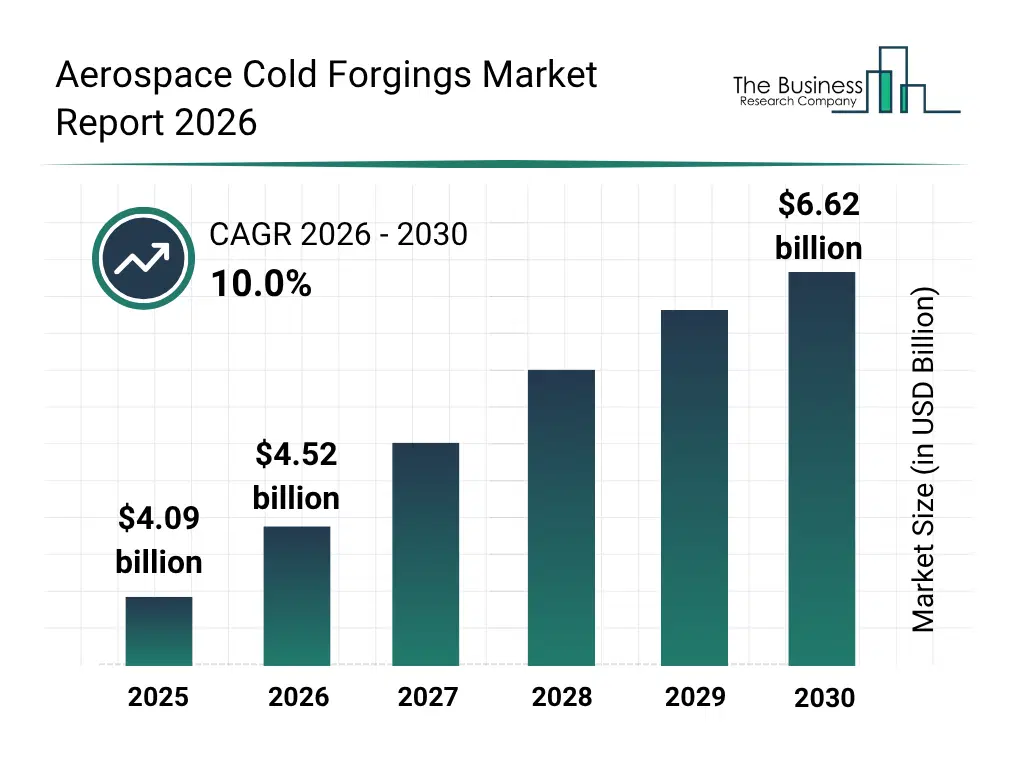
What Is The Aerospace Cold Forgings Market Size and Share 2026?
The aerospace cold forgings market size has grown rapidly in recent years. It will grow from $4.09 billion in 2025 to $4.52 billion in 2026 at a compound annual growth rate (CAGR) of 10.4%. The growth in the historic period can be attributed to increasing commercial aircraft production, growing demand for lightweight aerospace components, rising defense aircraft procurement, expansion of global air passenger traffic, increasing use of high-strength metal alloys.What Is The Aerospace Cold Forgings Market Growth Forecast?
The aerospace cold forgings market size is expected to see rapid growth in the next few years. It will grow to $6.62 billion in 2030 at a compound annual growth rate (CAGR) of 10.0%. The growth in the forecast period can be attributed to growing next-generation aircraft development, rising space exploration programs, increasing aircraft fleet modernization, expanding demand for fuel-efficient aircraft, growing investments in aerospace manufacturing capacity. Major trends in the forecast period include increasing adoption of high-strength lightweight forgings, growing demand for precision cold forged aerospace components, rising utilization of titanium cold forgings, expansion of near-net shape forging processes, increasing production of fatigue-resistant aerospace parts.
Global Aerospace Cold Forgings Market Segmentation
1) By Component Type: Shafts And Spindles, Landing Gear Components, Engine And Turbine Discs, Structural Fittings, Fasteners And Bolts, Rings And Flanges, Other Component Types 2) By Process Type: Single Stroke Forging, Multi Stroke Forging, Cold Heading, Precision Forging 3) By Material Type: Aluminum, Titanium, Steel, Other Material Types 4) By Application: Commercial Aviation, Military Aviation, General Aviation, Space 5) By End User: Original Equipment Manufacturers, Tier 1 And Tier 2 Suppliers, Maintenance Repair And Operations Service Providers, Defense And Government Procurement Agencies Subsegments: 1) By Shafts And Spindles: Precision Shafts, Drive Spindles, Transmission Shafts, Rotor Shafts, Actuator Spindles 2) By Landing Gear Components: Landing Gear Struts, Landing Gear Axles, Landing Gear Trunnions, Landing Gear Actuators, Landing Gear Pins 3) By Engine And Turbine Discs: Compressor Discs, Turbine Discs, Fan Discs, Blisk Discs, Spacer Discs 4) By Structural Fittings: Wing Fittings, Fuselage Fittings, Bracket Fittings, Frame Fittings, Attachment Fittings 5) By Fasteners And Bolts: Aerospace Bolts, Aerospace Screws, Aerospace Rivets, Aerospace Nuts, Aerospace Studs 6) By Rings And Flanges: Sealing Rings, Retaining Rings, Mounting Flanges, Connecting Flanges, Support Rings 7) By Other Component Types: Bushings, Collars, Couplings, Connectors, HousingsWhat Are The Drivers Of The Aerospace Cold Forgings Market?
The growing production of commercial aircraft is expected to propel the growth of the aerospace cold forgings market going forward. Commercial aircraft refers to fixed-wing airplanes that are designed, certified, and operated primarily for transporting passengers or cargo for commercial purposes by airlines or other operators in civil aviation. Growing production of commercial aircraft is due to increasing global air passenger traffic, which is forcing airlines to expand their fleets and add more aircraft to meet rising travel demand. Aerospace cold forgings enhance the production of commercial aircraft by enabling the manufacture of high-strength, lightweight, and precision-engineered components that improve aircraft performance, durability, and fuel efficiency while supporting large-scale, cost-effective production. For instance, in January 2024, according to Airbus SE, a Netherlands-based aerospace and defense corporation, 735 commercial aircraft were delivered in 2023, marking an 11% increase compared with 2022. Therefore, the growing production of commercial aircraft is driving the growth of the aerospace cold forgings industry. The rising air passenger traffic is expected to propel the growth of the aerospace cold forgings market going forward. Air passenger traffic refers to the total number of passengers transported by airlines through domestic and international air services over a specific period and serves as a key indicator of air travel demand. Air passenger traffic is rising due to higher disposable incomes, as more people can afford air travel for business and leisure. Rising air passenger traffic is driving demand for new aircraft production and fleet expansion, thereby increasing the need for high-strength, lightweight aerospace cold forgings used in critical aircraft components. For instance, in October 2024, according to the Department of Transportation, a US-based government department, in August 2024, 647,205 flights were operated, representing a 2.61% increase from the 630,761 flights in August 2023. Therefore, the rising air passenger traffic is driving the growth of the aerospace cold forgings industry.Key Players In The Global Aerospace Cold Forgings Market
Major companies operating in the aerospace cold forgings market report are IHI Corporation, Precision Castparts Corp., Thyssenkrupp AG, Howmet Aerospace Inc., Alcoa Corporation, ATI Inc., Aichi Steel Corporation, Safran Landing Systems, LISI S.A., VSMPO-AVISMA Corporation, Otto Fuchs KG, Bharat Forge Limited, AVIC Heavy Machinery Co. Ltd., Ellwood Group Inc., Magellan Aerospace Corporation, Doncasters Group Ltd., Forged Solutions Group, Farinia Group, Scot Forge Company, Wuxi Paike Special Steel Co. Ltd., Anchor-Harvey Components LLC, Trenton Forging Company, Queen City Forging Company, Kaiser Aluminum Corporation
This chart is for illustrative purposes; the full report includes a detailed competitor analysis and comprehensive overview of the top 10 companies in the market.
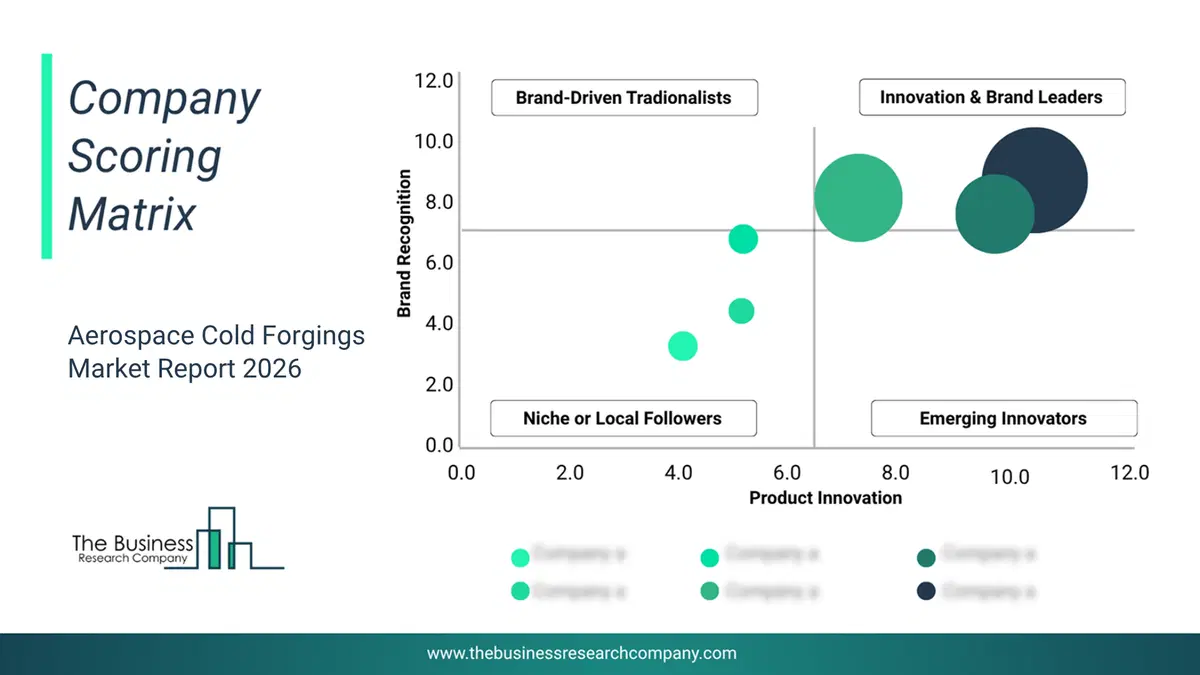
This chart maps companies by product innovation and brand strength, with bubble size indicating relative revenue, helping identify market leaders, challengers, and niche players. This is an illustrative chart; the full report provides a complete and accurate competitive analysis.
What Are Latest Mergers And Acquisitions In The Aerospace Cold Forgings Market?
In March 2026, J. F. Lehman And Company, a US-based private equity investment firm, acquired Forged Solutions Group for an undisclosed amount. With this acquisition, J.F. Lehman and Company aims to strengthen its aerospace and defense manufacturing portfolio and expand its exposure to high-precision engineered components used in critical aviation and defense applications. Forged Solutions Group is a UK-based company that provides aerospace cold-forged components.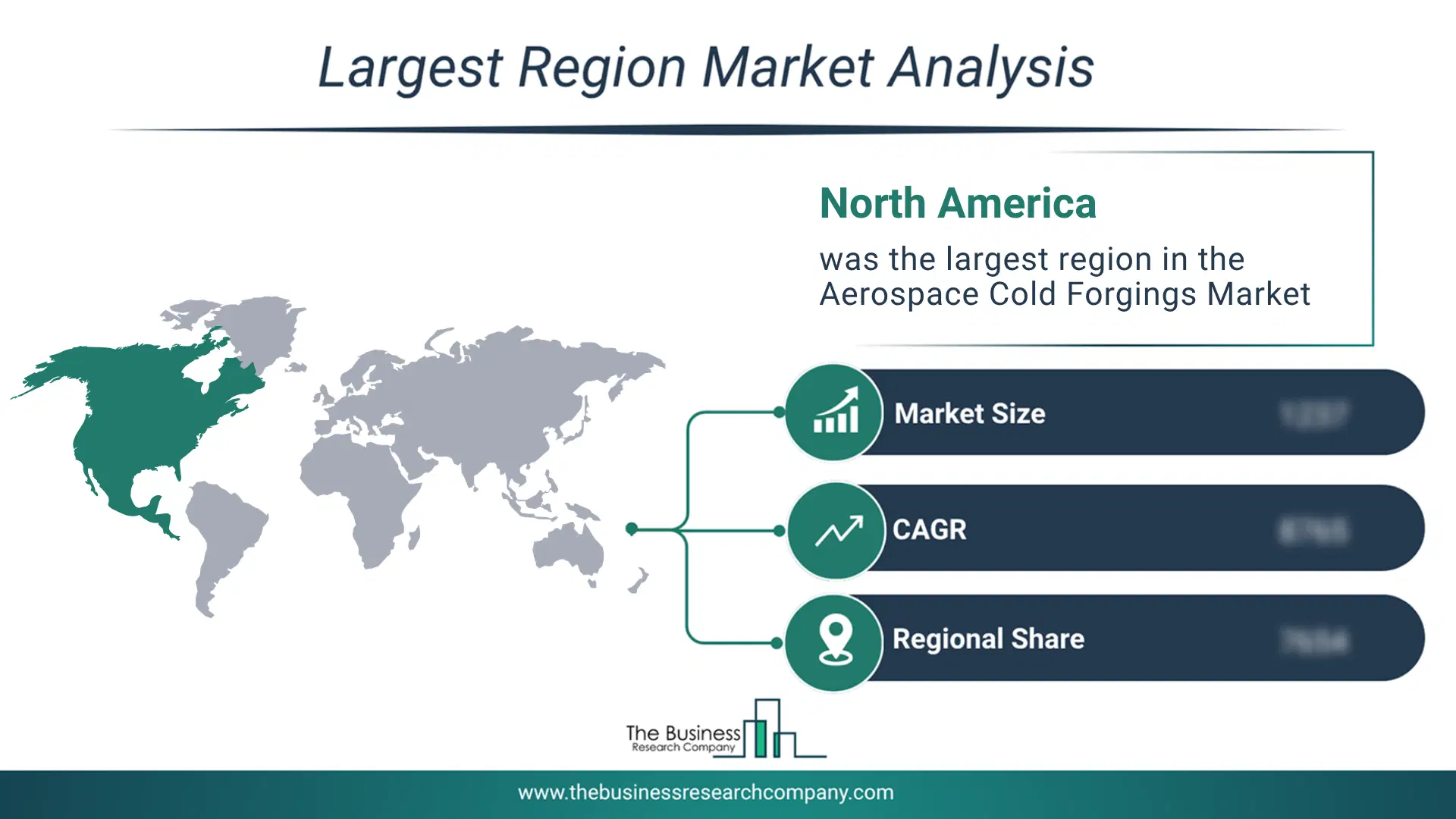
Regional Outlook
North America was the largest region in the aerospace cold forgings market in 2025. Asia-Pacific is expected to be the fastest-growing region in the forecast period. The regions covered in this market report are Asia-Pacific, South East Asia, Western Europe, Eastern Europe, North America, South America, Middle East, Africa. The countries covered in this market report are Australia, Brazil, China, France, Germany, India, Indonesia, Japan, Taiwan, Russia, South Korea, UK, USA, Canada, Italy, Spain.What Defines the Aerospace Cold Forgings Market?
The aerospace cold forgings market consists of sales of bushings, precision pins, sleeves, collars, and spacers. Values in this market are ‘factory gate’ values, that is, the value of goods sold by the manufacturers or creators of the goods, whether to other entities (including downstream manufacturers, wholesalers, distributors, and retailers) or directly to end customers. The value of goods in this market includes related services sold by the creators of the goods.How is Market Value Defined and Measured?
The market value is defined as the revenues that enterprises gain from the sale of goods and/or services within the specified market and geography through sales, grants, or donations in terms of the currency (in USD unless otherwise specified). The revenues for a specified geography are consumption values that are revenues generated by organizations in the specified geography within the market, irrespective of where they are produced. It does not include revenues from resales along the supply chain, either further along the supply chain or as part of other products.
This chart presents market attractiveness based on a quantitative evaluation of growth, competition, strategic alignment, and risk, offering a clear view of opportunity areas for decision-making. This chart is for illustrative purposes; the full report contains the complete analysis.

This chart highlights the Total Addressable Market (TAM) by estimating the maximum revenue opportunity using an assumption-driven approach, supporting strategic planning and opportunity sizing across markets. The chart is illustrative; the full report provides a more comprehensive analysis.
What Key Data and Analysis Are Included in the Aerospace Cold Forgings Market Report 2026?
The aerospace cold forgings market research report is one of a series of new reports from The Business Research Company that provides market statistics, including industry global market size, regional shares, competitors with the market share, detailed market segments, market trends and opportunities, and any further data you may need to thrive in the aerospace cold forgings industry. The market research report delivers a complete perspective of everything you need, with an in-depth analysis of the current and future state of the industry.Aerospace Cold Forgings Market Report Forecast Analysis
| Report Attribute | Details |
|---|---|
| Market Size Value In 2026 | $4.52 billion |
| Revenue Forecast In 2030 | $6.62 billion |
| Growth Rate | CAGR of 10% from 2026 to 2030 |
| Base Year For Estimation | 2025 |
| Actual Estimates/Historical Data | 2020-2025 |
| Forecast Period | 2026 - 2030 |
| Market Representation | Revenue in USD Billion and CAGR from 2026 to 2030 |
| Segments Covered | Component Type, Process Type, Material Type, Application, End User |
| Regional Scope | Asia-Pacific, Western Europe, Eastern Europe, North America, South America, Middle East, Africa |
| Country Scope | The countries covered in the report are Australia, Brazil, China, France, Germany, India, Indonesia, Japan, Taiwan, Russia, South Korea, UK, USA, Canada, Italy, Spain. |
| Key Companies Profiled | IHI Corporation, Precision Castparts Corp., Thyssenkrupp AG, Howmet Aerospace Inc., Alcoa Corporation, ATI Inc., Aichi Steel Corporation, Safran Landing Systems, LISI S.A., VSMPO-AVISMA Corporation, Otto Fuchs KG, Bharat Forge Limited, AVIC Heavy Machinery Co. Ltd., Ellwood Group Inc., Magellan Aerospace Corporation, Doncasters Group Ltd., Forged Solutions Group, Farinia Group, Scot Forge Company, Wuxi Paike Special Steel Co. Ltd., Anchor-Harvey Components LLC, Trenton Forging Company, Queen City Forging Company, Kaiser Aluminum Corporation |
| Customization Scope | Request for Customization |
| Pricing And Purchase Options | Explore Purchase Options |