
Aerospace Engineering Software Market Report 2026
Global Outlook – By Component (Software, Services), By Deployment Mode (Cloud, On Premise), By Enterprise Size (Large Enterprises, Small And Medium Enterprises), By Application (Aerodynamic Analysis And Optimization, Aircraft Design And Development, Flight Simulation And Control Systems), By End User (Aircraft Manufacturers, Defense And Military Organizations, Maintenance Repair Organizations, Research Institutions) – Market Size, Trends, Strategies, and Forecast to 2030
Aerospace Engineering Software Market Report 2026 Market Overview
• Aerospace Engineering Software Market Report 2026 market size has reached to $11.2 billion in 2025 • Expected to grow to $17.26 billion in 2030 at a compound annual growth rate (CAGR) of 8.9% • Growth Driver: The Rising Aircraft Production Is Fueling Market Growth Due To Increasing Air Travel Demand • Market Trend: Next-Generation Fluid Dynamics Platforms Improving Aerodynamic Performance And Mission Safety • North America was the largest region in 2025 and Asia-Pacific is the fastest growing region.What Is Covered Under Aerospace Engineering Software Market?
Aerospace engineering software refers to specialized computer programs and digital tools used for the design, simulation, testing, and manufacturing of aircraft, spacecraft, and related systems. It enables engineers to analyze aerodynamics, structural integrity, propulsion, and performance while improving accuracy, safety, and efficiency throughout the aerospace development lifecycle. The main components of aerospace engineering software include software and services. Software refers to advanced digital tools used for modeling, simulation, and optimization of aerospace systems, enabling efficient aircraft design and performance evaluation. These solutions are deployed through cloud and on premise modes and are designed for enterprise sizes including large enterprises and small and medium enterprises. The various applications involved are aerodynamic analysis and optimization, aircraft design and development, and flight simulation and control systems and they are utilized by end users including aircraft manufacturers, defense and military organizations, maintenance repair organizations, and research institutions.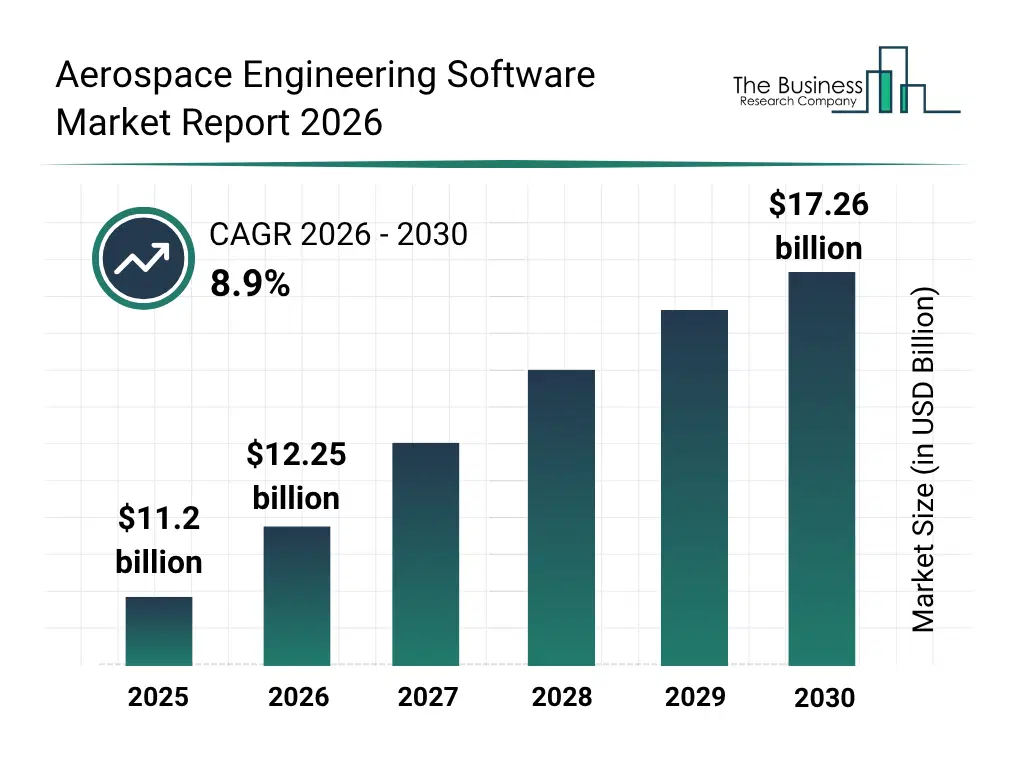
What Is The Aerospace Engineering Software Market Size and Share 2026?
The aerospace engineering software market size has grown strongly in recent years. It will grow from $11.2 billion in 2025 to $12.25 billion in 2026 at a compound annual growth rate (CAGR) of 9.4%. The growth in the historic period can be attributed to rising aircraft production demand, increased defense modernization programs, growth in simulation-based engineering practices, expansion of commercial aviation fleets, higher focus on aircraft safety compliance.What Is The Aerospace Engineering Software Market Growth Forecast?
The aerospace engineering software market size is expected to see strong growth in the next few years. It will grow to $17.26 billion in 2030 at a compound annual growth rate (CAGR) of 8.9%. The growth in the forecast period can be attributed to increasing adoption of cloud-based engineering platforms, rising development of advanced air mobility vehicles, expansion of space exploration programs, growing demand for autonomous aircraft systems, increasing investment in digital engineering ecosystems. Major trends in the forecast period include digital twin integration in aerospace development workflows, model-based systems engineering adoption, growing use of multiphysics simulation platforms, increased demand for predictive maintenance software tools, collaborative engineering platforms for distributed teams.
Global Aerospace Engineering Software Market Segmentation
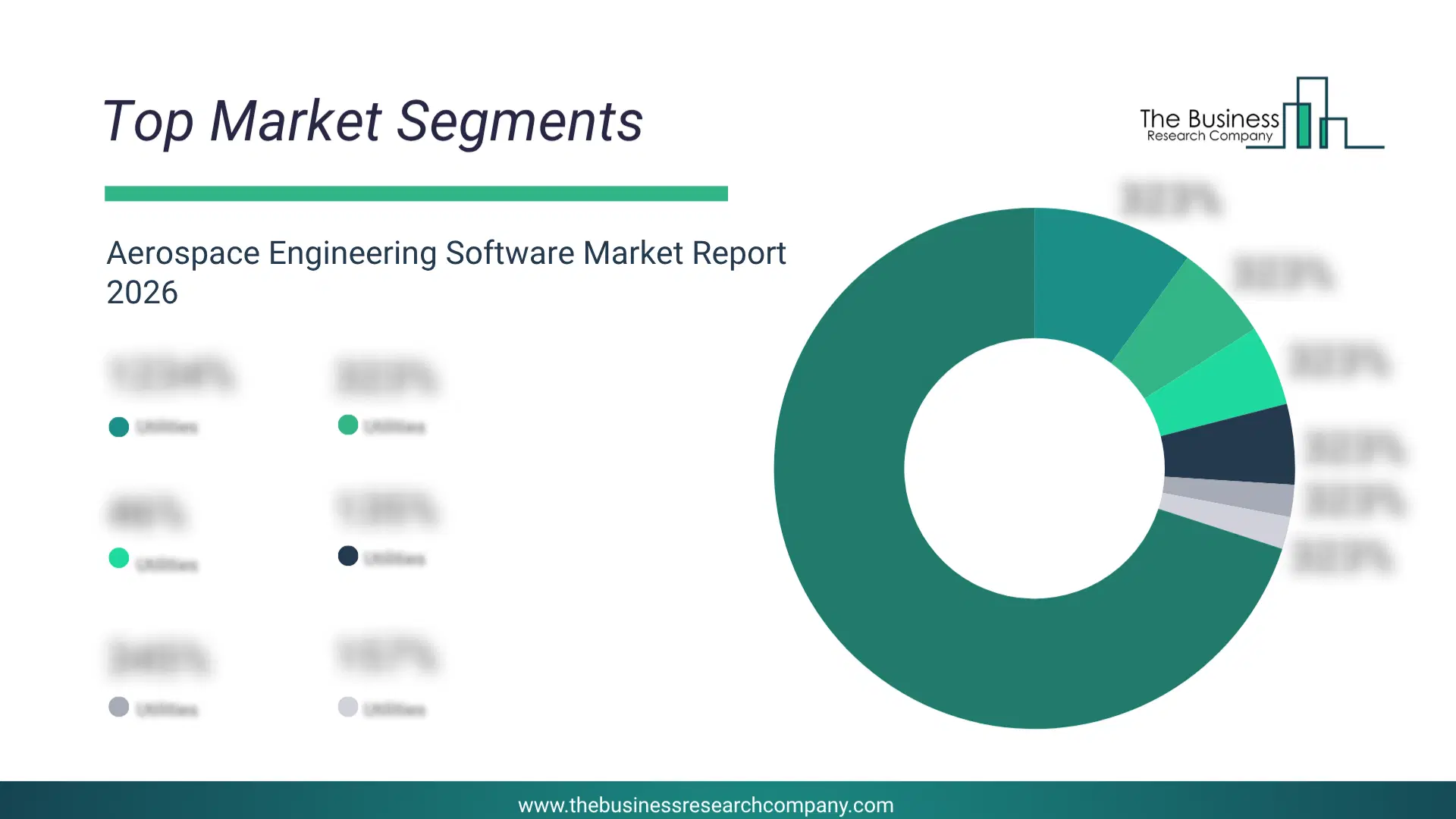
1) By Component: Software, Services 2) By Deployment Mode: Cloud, On Premise 3) By Enterprise Size: Large Enterprises, Small And Medium Enterprises 4) By Application: Aerodynamic Analysis And Optimization, Aircraft Design And Development, Flight Simulation And Control Systems 5) By End User: Aircraft Manufacturers, Defense And Military Organizations, Maintenance Repair Organizations, Research Institutions Subsegments: 1) By Software: Design Software, Simulation Software, Analysis Software, Manufacturing Software, Maintenance Software 2) By Services: Consulting Services, Integration Services, Support And Maintenance Services, Training Services, Managed ServicesWhat Is The Driver Of The Aerospace Engineering Software Market?
The rising aircraft production is expected to propel the growth of the aerospace engineering software market going forward. Aircraft production refers to the entire process of designing, manufacturing, assembling, testing, and delivering aircraft. The aircraft production is increasing due to the growing demand for air travel, as more passengers worldwide are opting for air transportation for faster and more convenient travel. Aerospace engineering software helps aircraft production by integrating advanced design, simulation, and manufacturing workflows that improve precision, reduce development time, and optimize overall production efficiency. For instance, in January 2024, according to the report published by Aircraft Interiors International, a UK-based company, aircraft orders surged by 91% in 2023 compared to 2022, with single-aisle aircraft orders growing by 78% and widebody aircraft orders climbing by 169%. New aircraft deliveries totaled 1,265 in 2023, representing an 11% increase over the previous year. Therefore, the rising aircraft production is driving the growth of the aerospace engineering software industry.Key Players In The Global Aerospace Engineering Software Market
Major companies operating in the aerospace engineering software market report are Aras Corporation, Autodesk Inc., Cadence Design Systems Inc., Capgemini Engineering, COMSOL AB, Concepts NREC LLC, Coreform LLC, Dassault Systemes SE, ESTECO S.p.A., Hexagon AB, International Business Machines Corporation, Keysight Technologies, PTC Inc., Rescale Inc., Siemens AG, SimScale GmbH, Synopsys Inc., The MathWorks Inc., Wolfram Research Inc., Zuken Inc.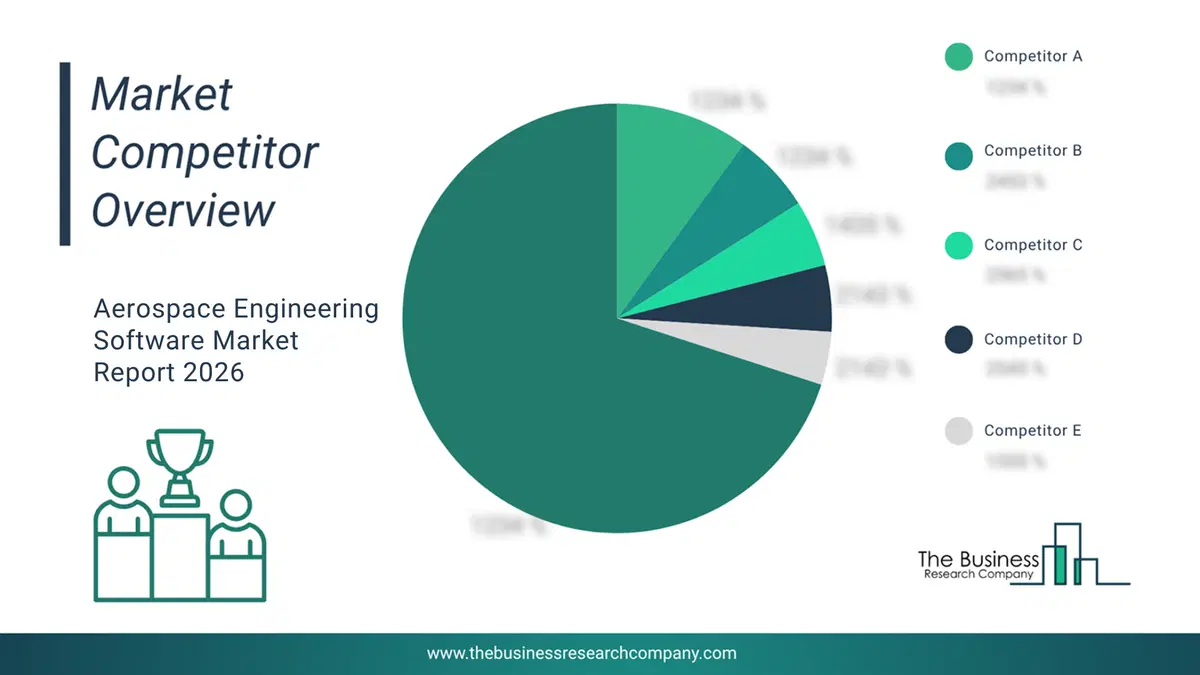
This chart is for illustrative purposes; the full report includes a detailed competitor analysis and comprehensive overview of the top 10 companies in the market.
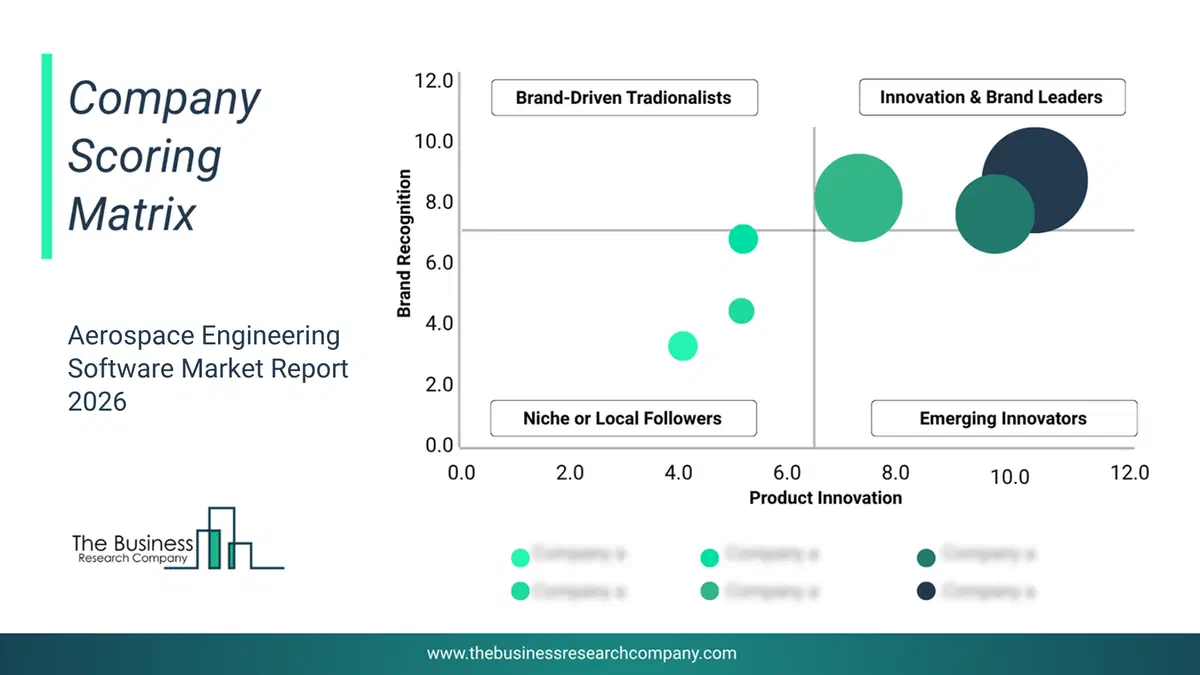
This chart maps companies by product innovation and brand strength, with bubble size indicating relative revenue, helping identify market leaders, challengers, and niche players. This is an illustrative chart; the full report provides a complete and accurate competitive analysis.
Global Aerospace Engineering Software Market Trends and Insights
Major companies operating in the aerospace engineering software market are focusing on developing innovative tools, such as powerful computational fluid dynamics (CFD) platforms to enhance aerodynamic design accuracy, reduce development time, and improve the performance and safety of aircraft and spacecraft systems. Powerful computational fluid dynamics (CFD) platforms are advanced simulation software systems that use numerical methods and high-performance computing to model, analyze, and predict how gases and liquids behave around objects such as aircraft, spacecraft, and engines. For instance, in April 2026, National Aeronautics and Space Administration, a US-based government space agency, released the Launch, Ascent, and Vehicle Aerodynamics (LAVA) software framework to the US aerospace industry. The system is designed to simulate complex airflow and fluid-structure interactions during spacecraft launch and ascent phases, including exhaust plume behavior, aerodynamic pressure distribution, and water interaction on launchpads. It supports mission-critical applications such as rocket design validation, re-entry analysis, and launch safety optimization, helping engineers assess performance risks and improve vehicle reliability for future space missions.What Are Latest Mergers And Acquisitions In The Aerospace Engineering Software Market?
In May 2024, Cadence Design Systems Inc., a US-based engineering design and simulation software company, acquired BETA CAE Systems International AG for $1.24 billion. With this acquisition, Cadence aims to expand its multiphysics engineering simulation and system analysis portfolio, strengthening its capabilities in structural analysis, computational engineering, and aerospace engineering software applications. BETA CAE Systems International AG is a Switzerland-based company that provides advanced Computer-Aided Engineering (CAE) software extensively utilized in the aerospace industry.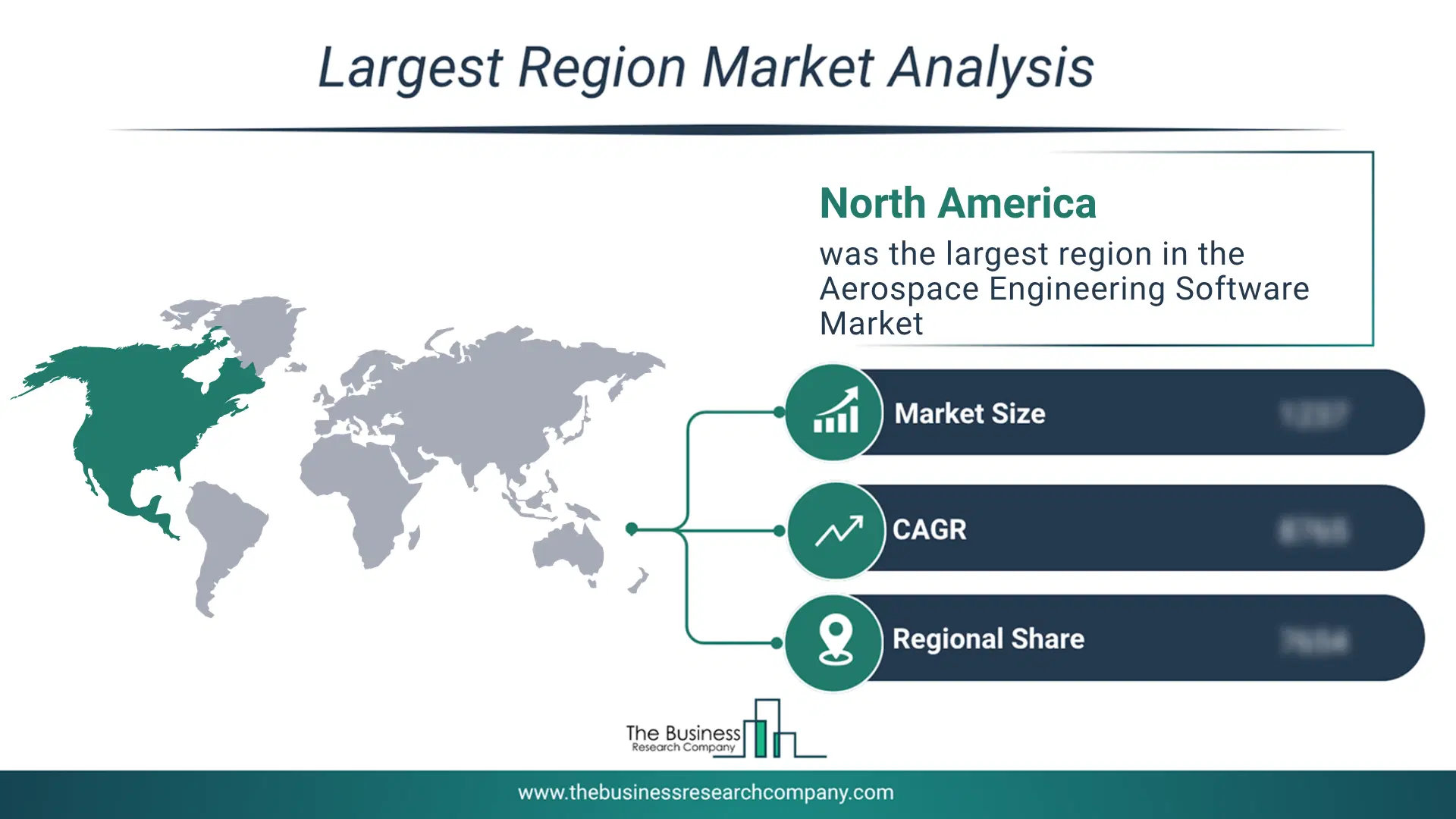
Regional Outlook
North America was the largest region in the aerospace engineering software market in 2025. Asia-Pacific is expected to be the fastest-growing region in the forecast period. The regions covered in this market report are Asia-Pacific, South East Asia, Western Europe, Eastern Europe, North America, South America, Middle East, Africa. The countries covered in this market report are Australia, Brazil, China, France, Germany, India, Indonesia, Japan, Taiwan, Russia, South Korea, UK, USA, Canada, Italy, Spain.What Defines the Aerospace Engineering Software Market?
The aerospace engineering software market includes revenues earned by entities by providing services such as simulation and modeling services, product lifecycle management (PLM) services, flight simulation services, and maintenance, repair, and overhaul (MRO) software services. The market value includes the value of related goods sold by the service provider or included within the service offering. Only goods and services traded between entities or sold to end consumers are included.How is Market Value Defined and Measured?
The market value is defined as the revenues that enterprises gain from the sale of goods and/or services within the specified market and geography through sales, grants, or donations in terms of the currency (in USD unless otherwise specified). The revenues for a specified geography are consumption values that are revenues generated by organizations in the specified geography within the market, irrespective of where they are produced. It does not include revenues from resales along the supply chain, either further along the supply chain or as part of other products.
This chart presents market attractiveness based on a quantitative evaluation of growth, competition, strategic alignment, and risk, offering a clear view of opportunity areas for decision-making. This chart is for illustrative purposes; the full report contains the complete analysis.

This chart highlights the Total Addressable Market (TAM) by estimating the maximum revenue opportunity using an assumption-driven approach, supporting strategic planning and opportunity sizing across markets. The chart is illustrative; the full report provides a more comprehensive analysis.
What Key Data and Analysis Are Included in the Aerospace Engineering Software Market Report 2026?
The aerospace engineering software market research report is one of a series of new reports from The Business Research Company that provides market statistics, including industry global market size, regional shares, competitors with the market share, detailed market segments, market trends and opportunities, and any further data you may need to thrive in the aerospace engineering software industry. The market research report delivers a complete perspective of everything you need, with an in-depth analysis of the current and future state of the industry.Aerospace Engineering Software Market Report Forecast Analysis
| Report Attribute | Details |
|---|---|
| Market Size Value In 2026 | $12.25 billion |
| Revenue Forecast In 2030 | $17.26 billion |
| Growth Rate | CAGR of 8.9% from 2026 to 2030 |
| Base Year For Estimation | 2025 |
| Actual Estimates/Historical Data | 2020-2025 |
| Forecast Period | 2026 - 2030 |
| Market Representation | Revenue in USD Billion and CAGR from 2026 to 2030 |
| Segments Covered | Component, Deployment Mode, Enterprise Size, Application, End User |
| Regional Scope | Asia-Pacific, Western Europe, Eastern Europe, North America, South America, Middle East, Africa |
| Country Scope | The countries covered in the report are Australia, Brazil, China, France, Germany, India, Indonesia, Japan, Taiwan, Russia, South Korea, UK, USA, Canada, Italy, Spain. |
| Key Companies Profiled | Aras Corporation, Autodesk Inc., Cadence Design Systems Inc., Capgemini Engineering, COMSOL AB, Concepts NREC LLC, Coreform LLC, Dassault Systemes SE, ESTECO S.p.A., Hexagon AB, International Business Machines Corporation, Keysight Technologies, PTC Inc., Rescale Inc., Siemens AG, SimScale GmbH, Synopsys Inc., The MathWorks Inc., Wolfram Research Inc., Zuken Inc. |
| Customization Scope | Request for Customization |
| Pricing And Purchase Options | Explore Purchase Options |