
Aerospace Metal Closed-Die Forging Market Report 2026
Global Outlook – By Forging Process (Conventional Closed Die Forging, Precision Closed Die Forging, Isothermal Closed Die Forging, Hot Die Forging), By Material Type (Titanium, Aluminium Alloys, Nickel Alloys, Steel Alloys), By Application (Engine Components, Landing Gear Components, Structural Components), By End Use (Commercial Aviation, Military Aviation, Space Exploration) – Market Size, Trends, Strategies, and Forecast to 2030
Aerospace Metal Closed-Die Forging Market Overview
• Aerospace Metal Closed-Die Forging market size has reached to $90.36 billion in 2025 • Expected to grow to $133.45 billion in 2030 at a compound annual growth rate (CAGR) of 8% • Growth Driver: Increasing Commercial Aircraft Deliveries Driving The Market Growth Due To Rising Air Passenger Traffic • Market Trend: Strategic Partnership Supports The Development Of Scalable Isothermal Forging Processes For Advanced Superalloys • North America was the largest region in 2025 and Asia-Pacific is the fastest growing region.What Is Covered Under Aerospace Metal Closed-Die Forging Market?
Aerospace metal closed-die forging refers to a precision metal forming process in which heated metal is compressed between specially designed dies to produce high-strength, near-net-shape components for aerospace applications. The process enhances the mechanical properties, structural integrity, and dimensional accuracy of forged parts by refining the metal's grain structure under controlled pressure. It is used to manufacture critical components that require superior strength, fatigue resistance, and long-term reliability under demanding operating conditions. The main forging processes of aerospace metal closed-die forging include conventional closed-die forging, precision closed-die forging, isothermal closed-die forging, and hot die forging. Conventional closed-die forging is a process in which heated metal is compressed within shaped dies to produce components with specific geometries and enhanced mechanical properties. These forgings are produced from materials including titanium, aluminium alloys, nickel alloys, and steel alloys. They find application in engine components, landing gear components, and structural components, serving end uses including commercial aviation, military aviation, and space exploration.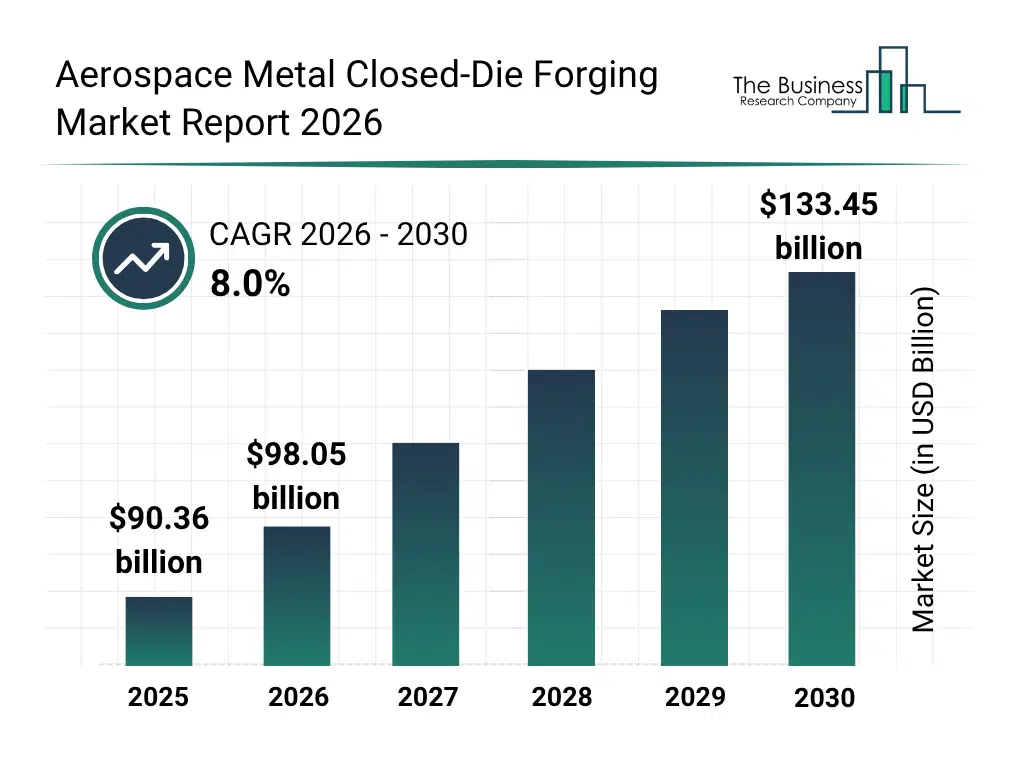
What Is The Aerospace Metal Closed-Die Forging Market Size and Share 2026?
The aerospace metal closed-die forging market size has grown strongly in recent years. It will grow from $90.36 billion in 2025 to $98.05 billion in 2026 at a compound annual growth rate (CAGR) of 8.5%. The growth in the historic period can be attributed to increasing aerospace aircraft production, growing demand for lightweight aerospace components, rising adoption of titanium and nickel alloys in aircraft manufacturing, increasing demand for high-strength structural components, growing aircraft maintenance repair and overhaul activities.What Is The Aerospace Metal Closed-Die Forging Market Growth Forecast?
The aerospace metal closed-die forging market size is expected to see strong growth in the next few years. It will grow to $133.45 billion in 2030 at a compound annual growth rate (CAGR) of 8.0%. The growth in the forecast period can be attributed to expansion of commercial aircraft fleets, increasing military aircraft procurement, rising spacecraft and satellite manufacturing, growing demand for fuel-efficient aircraft, increasing production of next-generation aerospace engines. Major trends in the forecast period include increasing adoption of near-net-shape forging, growing use of advanced aerospace alloys, rising demand for high-precision forged components, increasing production of complex geometry components, growing adoption of isothermal forging for high-temperature alloys.Tariff Impact On Aerospace Metal Closed-Die Forging Market
Tariffs are impacting the aerospace metal closed-die forging market by increasing the cost of imported titanium, aluminium alloys, nickel alloys, steel alloys, and specialized forging equipment required for aerospace component production. This is raising manufacturing costs and potentially delaying production across engine components, landing gear components, and structural components, particularly in regions dependent on imports such as North America, Europe, and Asia-Pacific. Material-intensive segments such as titanium and nickel alloy forging are most affected due to global supply chain dependencies. However, tariffs are also encouraging local metal production, regional supplier diversification, and increased investment in domestic forging capabilities, creating long-term resilience in the market.
Global Aerospace Metal Closed Die Forging Market Segmentation
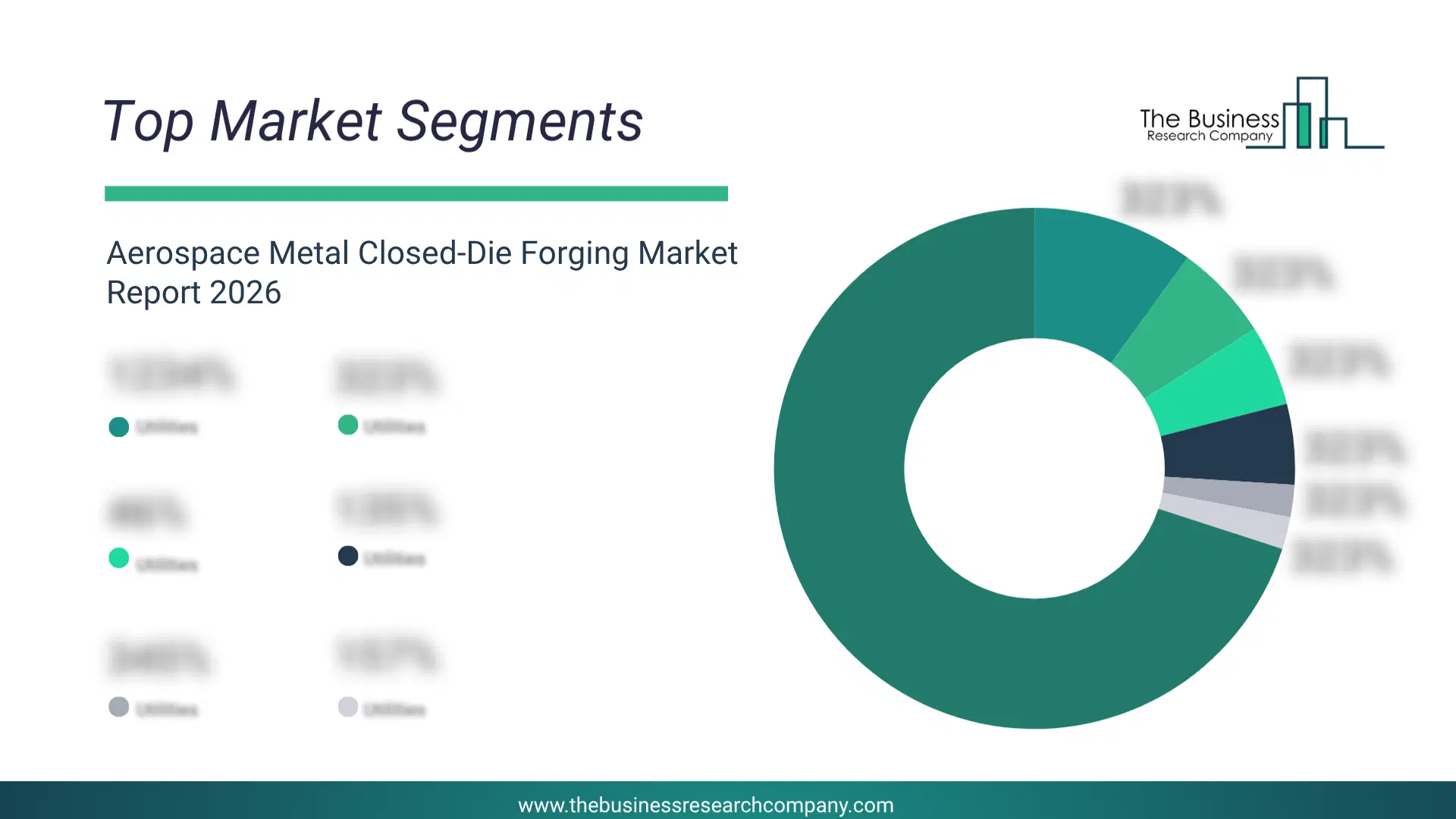
1) By Forging Process: Conventional Closed Die Forging, Precision Closed Die Forging, Isothermal Closed Die Forging, Hot Die Forging 2) By Material Type: Titanium, Aluminium Alloys, Nickel Alloys, Steel Alloys 3) By Application: Engine Components, Landing Gear Components, Structural Components 4) By End Use: Commercial Aviation, Military Aviation, Space Exploration Subsegments: 1) By Conventional Closed Die Forging: Mechanical Press Closed Die Forging, Hydraulic Press Closed Die Forging, Drop Hammer Closed Die Forging, Multi Impression Closed Die Forging, Near Net Shape Closed Die Forging 2) By Precision Closed Die Forging: Flashless Precision Forging, High Tolerance Precision Forging, Thin Wall Precision Forging, Complex Geometry Precision Forging, Net Shape Precision Forging 3) By Isothermal Closed Die Forging: Vacuum Isothermal Forging, Controlled Atmosphere Isothermal Forging, High Temperature Isothermal Forging, Near Net Shape Isothermal Forging, High Precision Isothermal Forging 4) By Hot Die Forging: Controlled Temperature Hot Die Forging, High Pressure Hot Die Forging, Multi Stage Hot Die Forging, Large Component Hot Die Forging, High Speed Hot Die ForgingWhat Is The Driver Of The Aerospace Metal Closed-Die Forging Market?
The increasing commercial aircraft deliveries are expected to propel the growth of the aerospace metal closed-die forging market going forward. Commercial aircraft are fixed-wing airplanes designed to transport passengers or cargo for business purposes and require highly durable, precision-engineered structural and engine components to ensure safety, performance, and reliability. The increase in commercial aircraft deliveries is driven by rising global air passenger traffic, which is encouraging airlines to expand and modernize their fleets to meet growing travel demand. Rising commercial aircraft deliveries drive demand for aerospace metal closed-die forging by increasing the need for high-strength, lightweight, and precision-forged components used in airframes, landing gear, engines, and other critical aircraft systems. For instance, in January 2026, according to Airbus SE, a Netherlands-based aerospace and defense corporation, the company delivered 793 commercial aircraft to 91 customers worldwide in 2025, representing a 3.5% increase compared to the 766 aircraft delivered in 2024. Therefore, the increasing commercial aircraft deliveries are driving the growth of the aerospace metal closed-die forging industry.Key Players In The Global Aerospace Metal Closed-Die Forging Market
Major companies operating in the aerospace metal closed-die forging market are Precision Castparts Corp., Howmet Aerospace Inc., ATI Inc., VSMPO-AVISMA Corporation, Otto Fuchs KG, Safran SA, voestalpine BÖHLER Aerospace GmbH, Aubert & Duval, Bharat Forge Ltd, LISI Aerospace, Ellwood Group Inc, SIFCO Industries Inc, Mettis Aerospace Ltd, Pacific Forge Inc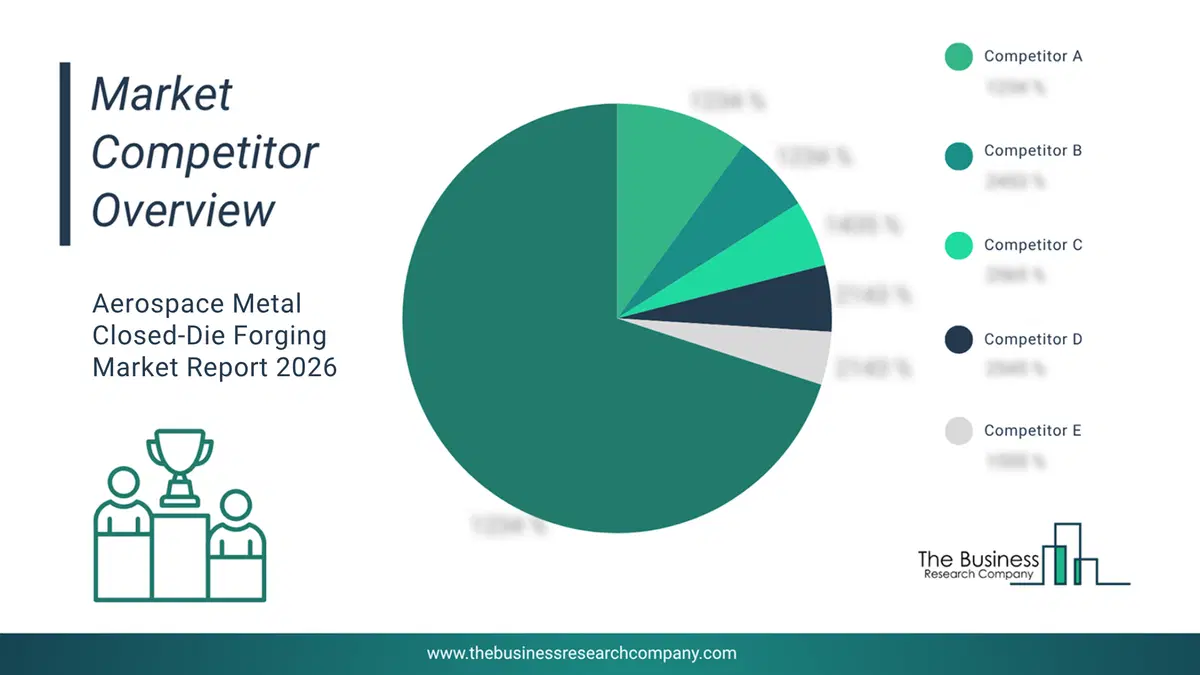
This chart is for illustrative purposes; the full report includes a detailed competitor analysis and comprehensive overview of the top 10 companies in the market.
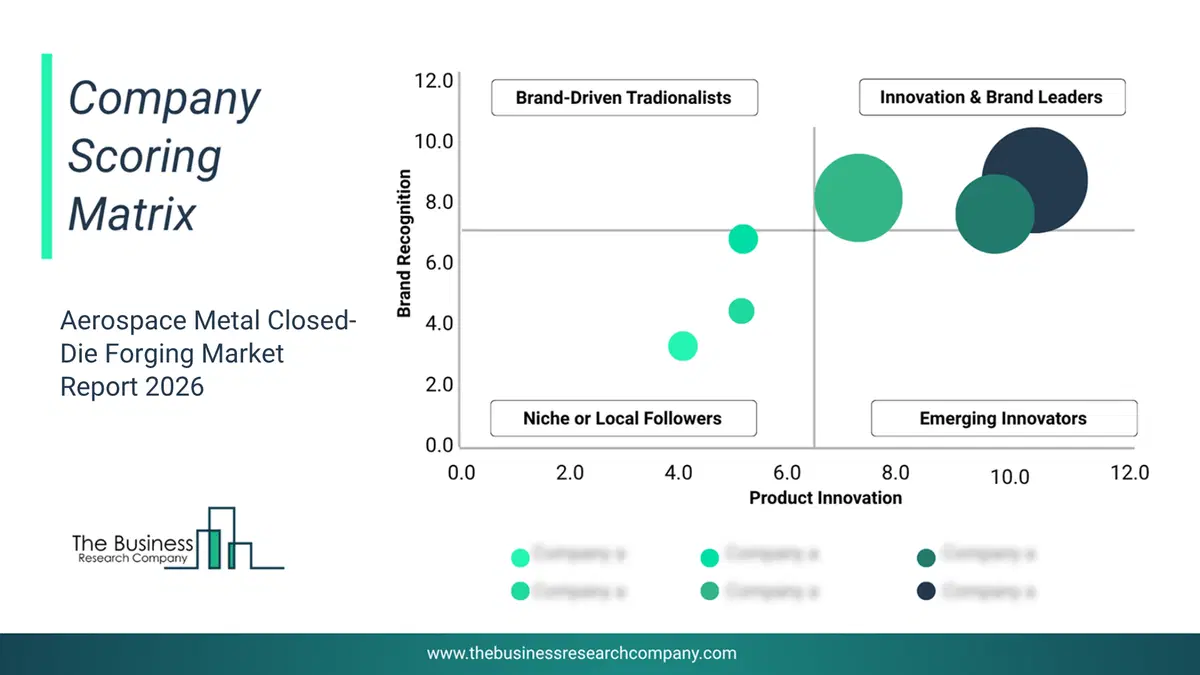
This chart maps companies by product innovation and brand strength, with bubble size indicating relative revenue, helping identify market leaders, challengers, and niche players. This is an illustrative chart; the full report provides a complete and accurate competitive analysis.
Global Aerospace Metal Closed-Die Forging Market Trends and Insights
Major companies operating in the aerospace metal closed-die forging market are adopting advanced isothermal forging technologies and collaborating with research institutions to accelerate the development of high-performance aerospace materials, improve forging precision, and enhance manufacturing capabilities for critical components. Strategic partnerships help drive the growth of the aerospace metal closed-die forging market by enabling collaboration between forging equipment manufacturers, research organizations, and aerospace material developers to combine expertise in vacuum processing, metallurgy, and advanced forming technologies. For instance, in January 2026, SMS group, a Germany-based metallurgical plant and machinery manufacturer, partnered with the Institute of Forming Technology and Machines (IFUM), a Germany-based research institution, to supply a state-of-the-art isothermal forging module for advanced materials research. Through this collaboration, SMS group will integrate a flexible vacuum-based isothermal forging module with IFUM’s 6,000-kilonewton synchronous screw press, enabling the automated processing of titanium and nickel-based superalloys under controlled vacuum and constant-temperature conditions. The system prevents oxidation and preserves the microstructure of reactive high-performance materials while supporting the scalable development of next-generation aerospace, medical, and industrial components. The partnership is expected to strengthen research capabilities, accelerate technology transfer from academia to industry, and advance innovation in aerospace metal closed-die forging through automated, high-precision isothermal forming processes.What Are Latest Mergers And Acquisitions In The Aerospace Metal Closed-Die Forging Market?
In March 2026, J.F. Lehman & Company, a US-based investment firm focused on the aerospace, defense, government, maritime, environmental, and infrastructure sectors, acquired Forged Solutions Group for an undisclosed amount. Through this acquisition, J.F. Lehman & Company aims to support Forged Solutions Group's strategic growth initiatives, increase production throughput, and strengthen its position in the aerospace, defense, and space markets. Forged Solutions Group is a UK-based provider of high-specification forgings for aerospace, defense, and space applications, with vertically integrated capabilities in closed-die, open-die, extrusion, and rolled-ring forging of nickel, titanium, steel, and aluminum alloys.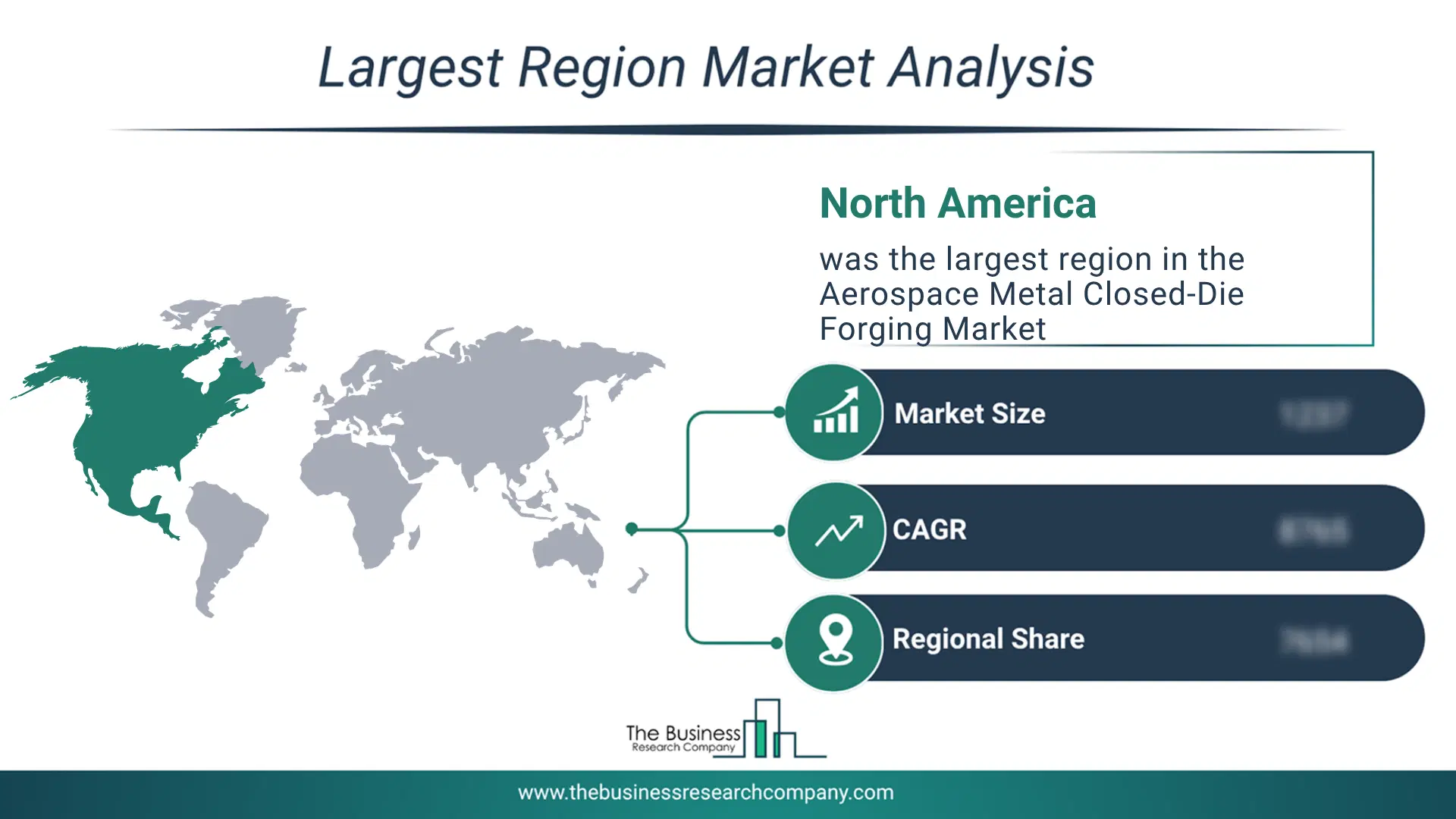
Regional Outlook
North America was the largest region in the aerospace metal closed-die forging market in 2025. Asia-Pacific is expected to be the fastest-growing region in the forecast period. The regions covered in this market report are Asia-Pacific, South East Asia, Western Europe, Eastern Europe, North America, South America, Middle East, Africa. The countries covered in this market report are Australia, Brazil, China, France, Germany, India, Indonesia, Japan, Taiwan, Russia, South Korea, UK, USA, Canada, Italy, Spain.What Defines the Aerospace Metal Closed-Die Forging Market?
The aerospace metal closed-die forging market consists of sales of forged engine components, landing gear components, structural airframe parts, turbine discs, shafts, rings, brackets, fittings, housings, flanges, connecting rods, bearing supports, actuator components, and compressor components. Values in this market are ‘factory gate’ values, that is, the value of goods sold by the manufacturers or creators of the goods, whether to other entities (including downstream manufacturers, wholesalers, distributors, and retailers) or directly to end customers. The value of goods in this market includes related services sold by the creators of the goods.How is Market Value Defined and Measured?
The market value is defined as the revenues that enterprises gain from the sale of goods and/or services within the specified market and geography through sales, grants, or donations in terms of the currency (in USD unless otherwise specified). The revenues for a specified geography are consumption values that are revenues generated by organizations in the specified geography within the market, irrespective of where they are produced. It does not include revenues from resales along the supply chain, either further along the supply chain or as part of other products.
This chart presents market attractiveness based on a quantitative evaluation of growth, competition, strategic alignment, and risk, offering a clear view of opportunity areas for decision-making. This chart is for illustrative purposes; the full report contains the complete analysis.

This chart highlights the Total Addressable Market (TAM) by estimating the maximum revenue opportunity using an assumption-driven approach, supporting strategic planning and opportunity sizing across markets. The chart is illustrative; the full report provides a more comprehensive analysis.
What Key Data and Analysis Are Included in the Aerospace Metal Closed-Die Forging Market Report 2026?
The aerospace metal closed-die forging market research report is one of a series of new reports from The Business Research Company that provides market statistics, including industry global market size, regional shares, competitors with the market share, detailed market segments, market trends and opportunities, and any further data you may need to thrive in the aerospace metal closed-die forging industry. The market research report delivers a complete perspective of everything you need, with an in-depth analysis of the current and future state of the industry.Aerospace Metal Closed-Die Forging Market Report Forecast Analysis
| Report Attribute | Details |
|---|---|
| Market Size Value In 2026 | $98.05 billion |
| Revenue Forecast In 2030 | $133.45 billion |
| Growth Rate | CAGR of 8.0% from 2026 to 2030 |
| Base Year For Estimation | 2025 |
| Actual Estimates/Historical Data | 2020-2025 |
| Forecast Period | 2026 - 2030 |
| Market Representation | Revenue in USD Billion and CAGR from 2026 to 2030 |
| Segments Covered | Forging Process, Material Type, Application, End Use |
| Regional Scope | Asia-Pacific, Western Europe, Eastern Europe, North America, South America, Middle East, Africa |
| Country Scope | The countries covered in the report are Australia, Brazil, China, France, Germany, India, Indonesia, Japan, Taiwan, Russia, South Korea, UK, USA, Canada, Italy, Spain. |
| Key Companies Profiled | Precision Castparts Corp., Howmet Aerospace Inc., ATI Inc., VSMPO-AVISMA Corporation, Otto Fuchs KG, Safran SA, voestalpine BÖHLER Aerospace GmbH, Aubert & Duval, Bharat Forge Ltd, LISI Aerospace, Ellwood Group Inc, SIFCO Industries Inc, Mettis Aerospace Ltd, Pacific Forge Inc |
| Customization Scope | Request for Customization |
| Pricing And Purchase Options | Explore Purchase Options |