
Aerospace Nanotechnology Market Report 2026
Global Outlook – By Nanomaterial Type (Nanoparticles, Nanocoatings, Other Nanomaterial Types), By Material (Alloys, Ceramics, Composites, Polymers), By Applications (Space And Defense, Commercial Aviation) – Market Size, Trends, Strategies, and Forecast to 2030
Aerospace Nanotechnology Market Overview
• Aerospace Nanotechnology market size has reached to $4.78 billion in 2025 • Expected to grow to $6.86 billion in 2030 at a compound annual growth rate (CAGR) of 7.5% • Growth Driver: Aerospace Nanotechnology Market Driver: Aviation Sector Propels Growth In Aerospace Nanotechnology Market • Market Trend: Breakthrough Nanotech Coating Enhances Optical Performance and Light Absorption in Aerospace and Defense Systems • North America was the largest region in 2025.What Is Covered Under Aerospace Nanotechnology Market?
Nanotechnology is the process of studying extremely small things; it is a technology conducted at the nanoscale, which is about 1 to 100 nanometers. The use of nanotechnology in aerospace is called aerospace nanotechnology. Aerospace nanotechnology is used to create sensors in aircraft. Sensors in aircraft are the most crucial part of examining the performance of various parts of engines. Hence, a larger number of smaller sensors helps monitor various parameters in an aircraft. The main type of aerospace nanotechnology includes nanoparticles, nanocoatings, and others. Nanoparticles are small particles which have one dimension less than 100 nm. The different materials used to make aerospace nanotechnology are alloys, ceramics, composites, and polymers. They are used in various application such as space and defense, and commercial aviation.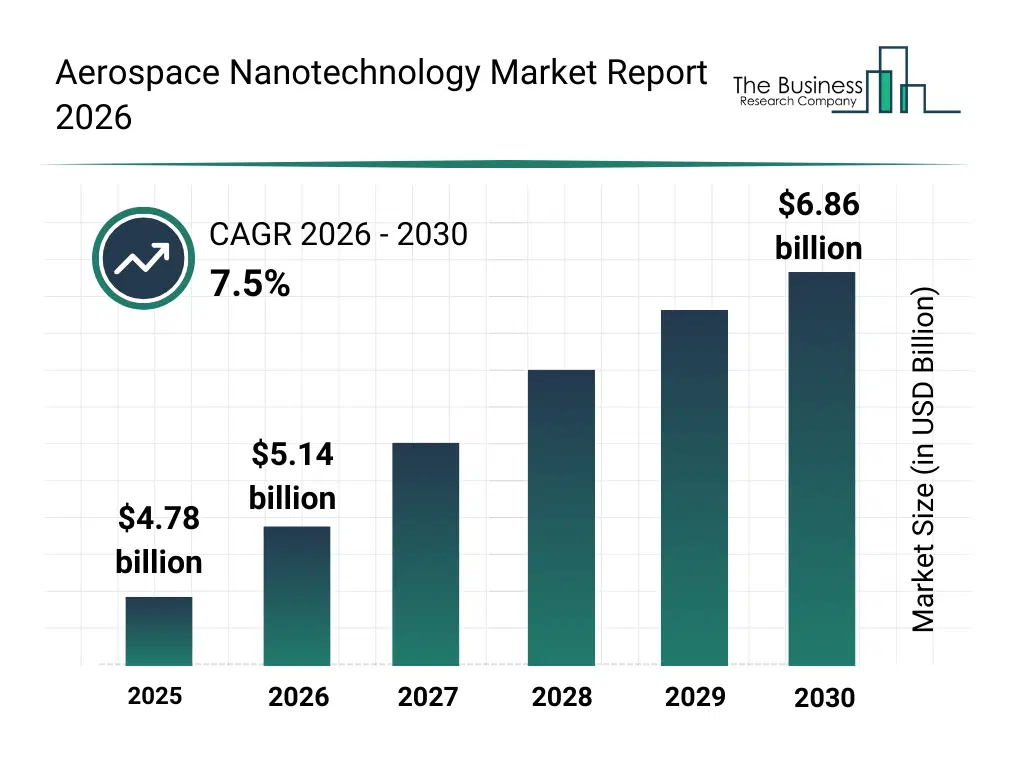
What Is The Aerospace Nanotechnology Market Size and Share 2026?
The aerospace nanotechnology market size has grown strongly in recent years. It will grow from $4.78 billion in 2025 to $5.14 billion in 2026 at a compound annual growth rate (CAGR) of 7.5%. The growth in the historic period can be attributed to early adoption of nanomaterials such as carbon nanotubes to enhance sensor performance in aircraft, rising need for miniaturized sensors to monitor complex engine and structural parameters, initial integration of nanoclays and nanofibers to improve material strength and thermal stability, growing emphasis on lightweight materials to support aerospace efficiency goals, development of graphene-based components enabling improved electrical and mechanical properties.What Is The Aerospace Nanotechnology Market Growth Forecast?
The aerospace nanotechnology market size is expected to see strong growth in the next few years. It will grow to $6.86 billion in 2030 at a compound annual growth rate (CAGR) of 7.5%. The growth in the forecast period can be attributed to increasing demand for advanced nanosensors to support real-time health monitoring of aircraft systems, rising adoption of high-performance nanomaterials for next-generation aerospace structures, expansion of research into multifunctional graphene applications for avionics and propulsion systems, growing integration of nanotechnology into composite manufacturing for enhanced durability and weight reduction, technological advancements enabling scalable production of aerospace-grade nanomaterials. Major trends in the forecast period include adoption of carbon nanotubes in aerospace sensors, increased use of graphene for lightweight components, development of nanoclays for structural reinforcement, miniaturization of aircraft monitoring devices, integration of nanomaterials in engine performance analytics.
Global Aerospace Nanotechnology Market Segmentation
1) By Nanomaterial Type: Nanoparticles, Nanocoatings, Other Nanomaterial Types 2) By Material: Alloys, Ceramics, Composites, Polymers 3) By Applications: Space And Defense, Commercial Aviation Subsegments: 1) By Nanoparticles: Metallic Nanoparticles, Ceramic Nanoparticles, Polymeric Nanoparticles, Composite Nanoparticles 2) By Nanocoatings: Anti-corrosion Coatings, Thermal Barrier Coatings, Self-cleaning Coatings, Anti-fogging Coatings 3) By Other Nanomaterial Types: Nanofibers, Nanotubes, NanocompositesWhat Is Driver Of The Aerospace Nanotechnology Market?
The strong growth of the aviation sector is expected to propel the growth of the aerospace nanotechnology market going forward. The aviation sector refers to a private or public company involved in the production of hardware or software for the aviation or aerospace industry, in maintenance, repair, and overhaul, in the provision of parts to the aviation or aerospace sector, in the study and advancement of aviation or aerospace technology systems, and the instruction and training of aviation or aerospace personnel. Aerospace nanotechnology in the aviation sector is useful for lightweight, for enhanced protection of aircraft from harsh materials, and for sensors to monitor fuel, temperature, and engines of aircraft. For instance, in January 2024, according to the report published by Aircraft Interiors International, a UK-based media company, aircraft orders increased by 91% in 2023 compared to 2022, driven by a 78% rise in single-aisle aircraft orders and a 169% surge in widebody aircraft orders. Additionally, new aircraft deliveries reached 1,265 units in 2023, marking an 11% year-over-year increase. Therefore, the strong growth of the aviation sector is driving the aerospace nanotechnology industry.Key Players In The Global Aerospace Nanotechnology Market
Major companies operating in the aerospace nanotechnology market are Airbus SE, CHOOSE NanoTech Corporation, Flight Shield Inc., HR ToughGuard LLC, Lockheed Martin Corporation, Metamaterial Technologies Inc., TripleO Performance Solution Ltd., Zyvex Corp., Huntsman International LLC, Nanotechnology Company Glonatech SA, General Nano LLC, Raymor Industries Inc., Boeing Company, Northrop Grumman Corporation, General Electric Company, Rolls-Royce Holdings plc, Safran S.A., Raytheon Technologies Corporation, Honeywell International Inc., BAE Systems plc, Thales Group, Leonardo S.p.A., Saab AB, Israel Aerospace Industries Ltd., Dassault Aviation SA, AeroVironment Inc., Mitsubishi Heavy Industries Ltd., Ruag Group, Reaction Engines Ltd.
This chart is for illustrative purposes; the full report includes a detailed competitor analysis and comprehensive overview of the top 10 companies in the market.
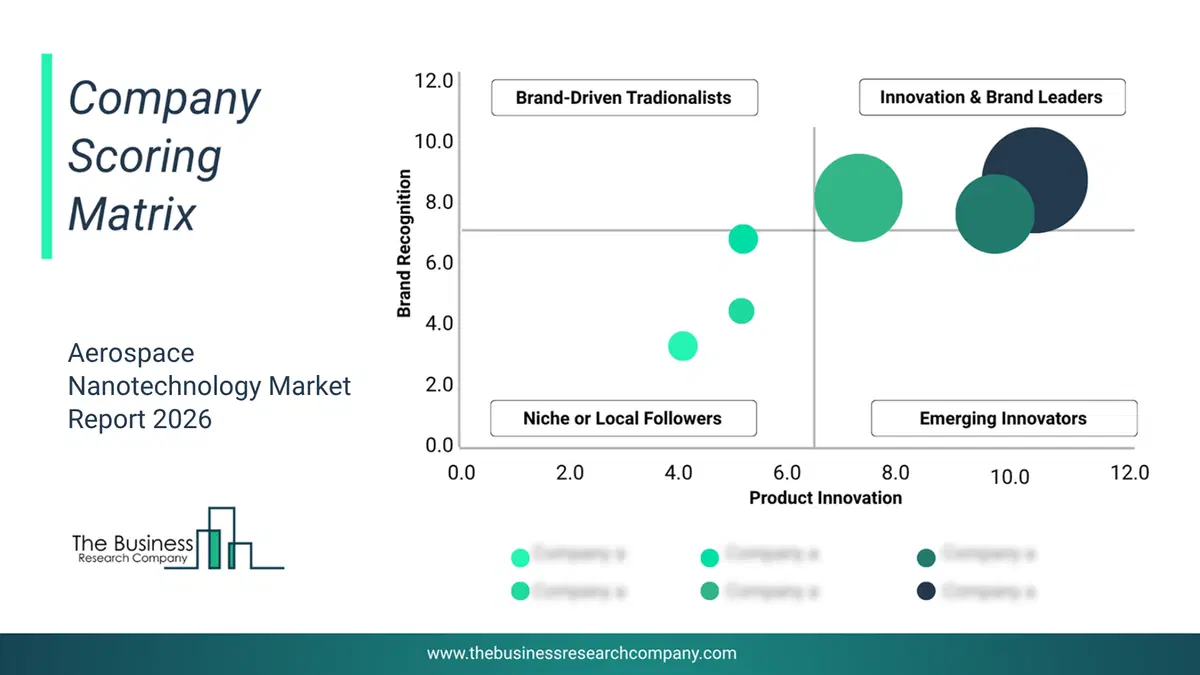
This chart maps companies by product innovation and brand strength, with bubble size indicating relative revenue, helping identify market leaders, challengers, and niche players. This is an illustrative chart; the full report provides a complete and accurate competitive analysis.
Global Aerospace Nanotechnology Market Trends and Insights
Major companies operating in the aerospace nanotechnology market are focusing on developing innovative solutions, such as advanced nanomaterials for optical and defense systems, to enhance performance, durability, and efficiency in aerospace applications. Advanced nanomaterials for optical and defense systems are engineered at the nanoscale to improve properties such as light absorption, thermal resistance, and strength, helping aerospace components become lighter, more durable, and more efficient than traditional materials. For instance, in May 2025, STRAYPROTECT S.A., a Luxembourg-based startup and spin-off from the Luxembourg Institute of Science and Technology (LIST), launched STRAYPROTECT Nanotech, a groundbreaking super-black coating that absorbs 99.4% of light to enhance optical performance in aerospace and defense applications. Developed using advanced carbon nanostructures, this innovative coating acts as a “light sponge,” eliminating unwanted reflections that can distort data in high-precision optical devices such as telescopes, sensors, and imaging systems. Originating from a collaboration with the European Space Agency (ESA) and the Luxembourg Space Agency (LSA), the technology has reached Technology Readiness Level 5 (TRL 5), confirming its functionality under real-world conditions.What Are Latest Mergers And Acquisitions In The Aerospace Nanotechnology Market? Carbice Corporation Partnered With Blue Canyon Inc. To Expand Aerospace Services
In February 2024, Carbice Corporation, a US-based nanotechnology company, partnered with Blue Canyon Inc. for an undisclosed amount. With this partnership, they aim to integrate Carbice’s aligned carbon nanotechnology solutions, specifically the Carbice Space Pad, into critical spacecraft programs to improve thermal management, enhance reliability, and support successful satellite missions. Blue Canyon Technologies Inc. is a US-based aerospace company specializing in the design and manufacturing of small satellites and spacecraft systems.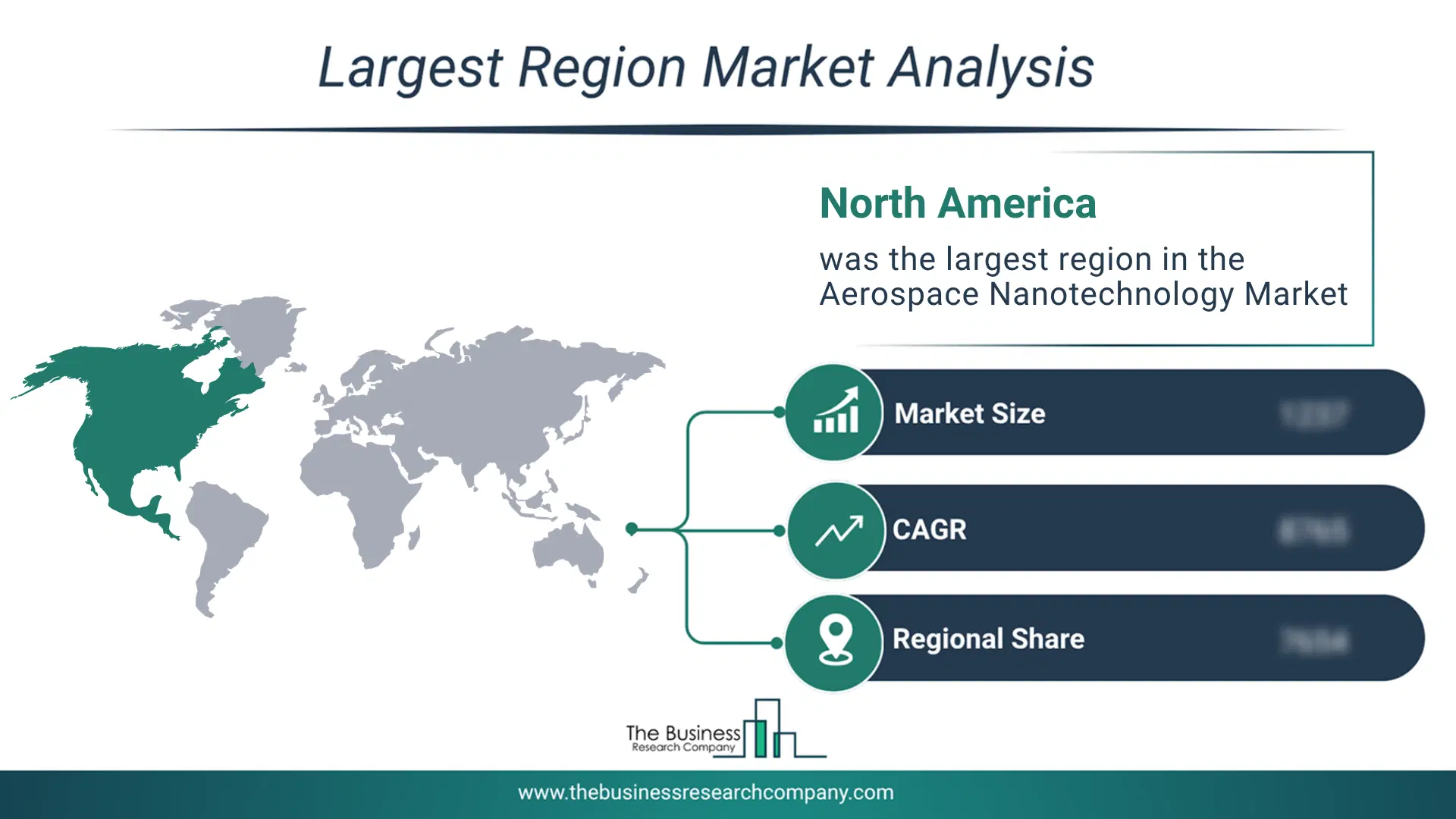
Regional Insights
North America was the largest region in the aerospace nanotechnology market in 2025. The regions covered in this market report are Asia-Pacific, South East Asia, Western Europe, Eastern Europe, North America, South America, Middle East, Africa. The countries covered in this market report are Australia, Brazil, China, France, Germany, India, Indonesia, Japan, Taiwan, Russia, South Korea, UK, USA, Canada, Italy, SpainWhat Defines the Aerospace Nanotechnology Market?
The aerospace nanotechnology market consists of sales of carbon nanotubes, nanoclays, nanofibers, and graphene. Values in this market are ‘factory gate’ values, that is, the value of goods sold by the manufacturers or creators of the goods, whether to other entities (including downstream manufacturers, wholesalers, distributors, and retailers) or directly to end customers. The value of goods in this market includes related services sold by the creators of the goods.How is Market Value Defined and Measured?
The market value is defined as the revenues that enterprises gain from the sale of goods and/or services within the specified market and geography through sales, grants, or donations in terms of the currency (in USD unless otherwise specified). The revenues for a specified geography are consumption values that are revenues generated by organizations in the specified geography within the market, irrespective of where they are produced. It does not include revenues from resales along the supply chain, either further along the supply chain or as part of other products.
This chart presents market attractiveness based on a quantitative evaluation of growth, competition, strategic alignment, and risk, offering a clear view of opportunity areas for decision-making. This chart is for illustrative purposes; the full report contains the complete analysis.

This chart highlights the Total Addressable Market (TAM) by estimating the maximum revenue opportunity using an assumption-driven approach, supporting strategic planning and opportunity sizing across markets. The chart is illustrative; the full report provides a more comprehensive analysis.
What Key Data and Analysis Are Included in the Aerospace Nanotechnology Market Report 2026?
The aerospace nanotechnology market research report is one of a series of new reports from The Business Research Company that provides market statistics, including industry global market size, regional shares, competitors with the market share, detailed market segments, market trends and opportunities, and any further data you may need to thrive in the aerospace nanotechnology industry. The market research report delivers a complete perspective of everything you need, with an in-depth analysis of the current and future state of the industry.Aerospace Nanotechnology Market Report Forecast Analysis
| Report Attribute | Details |
|---|---|
| Market Size Value In 2026 | $5.14 billion |
| Revenue Forecast In 2030 | $6.86 billion |
| Growth Rate | CAGR of 7.5% from 2026 to 2030 |
| Base Year For Estimation | 2025 |
| Actual Estimates/Historical Data | 2020-2025 |
| Forecast Period | 2026 - 2030 |
| Market Representation | Revenue in USD Billion and CAGR from 2026 to 2030 |
| Segments Covered | Nanomaterial Type, Material, Applications |
| Regional Scope | Asia-Pacific, Western Europe, Eastern Europe, North America, South America, Middle East, Africa |
| Country Scope | The countries covered in the aerospace nanotechnology market report are Australia, Brazil, China, France, Germany, India, Indonesia, Japan, Taiwan, Russia, South Korea, UK, USA, Canada, Italy, Spain |
| Key Companies Profiled | Airbus SE, CHOOSE NanoTech Corporation, Flight Shield Inc., HR ToughGuard LLC, Lockheed Martin Corporation, Metamaterial Technologies Inc., TripleO Performance Solution Ltd., Zyvex Corp., Huntsman International LLC, Nanotechnology Company Glonatech SA, General Nano LLC, Raymor Industries Inc., Boeing Company, Northrop Grumman Corporation, General Electric Company, Rolls-Royce Holdings plc, Safran S.A., Raytheon Technologies Corporation, Honeywell International Inc., BAE Systems plc, Thales Group, Leonardo S.p.A., Saab AB, Israel Aerospace Industries Ltd., Dassault Aviation SA, AeroVironment Inc., Mitsubishi Heavy Industries Ltd., Ruag Group, Reaction Engines Ltd. |
| Customization Scope | Request for Customization |
| Pricing And Purchase Options | Explore Purchase Options |