
Aerospace Robotics Market Report 2026
Global Outlook – By Type (Articulated, Cartesian, Other Types), By Technology (Conventional, Collaborative), By Component (Controller, Sensors, Drive, Arm Processor, End Effector), By Payload (Small-Medium Payloads Robots, Large Payloads Robots, Extra Large Payloads Robots), By Application (Drilling, Welding, Painting, Inspection, Other Applications) – Market Size, Trends, Strategies, and Forecast to 2030
Aerospace Robotics Market Overview
• Aerospace Robotics market size has reached to $5.16 billion in 2025 • Expected to grow to $8.77 billion in 2030 at a compound annual growth rate (CAGR) of 10.9% • Growth Driver: Expansion Of Space Exploration And Commercial Aviation Fueling The Growth Of The Market Due To Adoption Of Advanced Aerospace Technologies • Market Trend: Technological Advancements In Aerospace Robotics • North America was the largest region in 2025 and Asia-Pacific is the fastest growing region.What Is Covered Under Aerospace Robotics Market?
Aerospace robotics refers to programmable machines that assist humans in the construction of aircraft engines, performing tasks such as drilling and painting airframes, among others. The aerospace robotics enhance the performance and productivity of predefined operations in the aerospace sector. The main types of aerospace robotics include articulated, cartesian, and other types. Articulated robots are equipped with two or more rotary joints, support circular movements, and are used in the aircraft manufacturing process. The different applications of aerospace robotics are drilling, welding, painting, inspection, and others. The different aerospace robotics components include controllers, sensors, drive, arm processor, and end effector with technologies including conventional and collaborative and aerospace robotics payloads including small-medium payload robots, large payload robots, and extra-large payload robots.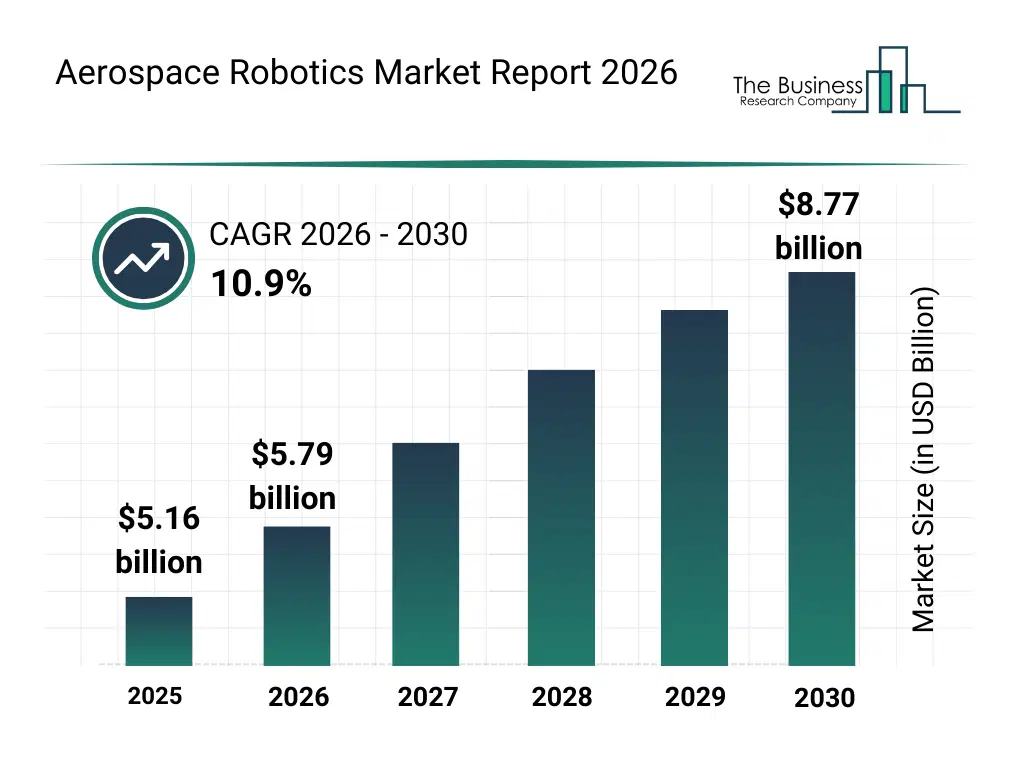
What Is The Aerospace Robotics Market Size and Share 2026?
The aerospace robotics market size has grown rapidly in recent years. It will grow from $5.16 billion in 2025 to $5.79 billion in 2026 at a compound annual growth rate (CAGR) of 12.3%. The growth in the historic period can be attributed to increasing adoption of robotics to automate repetitive aerospace manufacturing tasks such as drilling and fastening, rising need for precision and consistency in aircraft engine and airframe production, expansion of aerospace manufacturing capacity driving uptake of industrial robots, growing deployment of robotic inspection systems to improve quality assurance, early integration of robotic painting and surface treatment solutions to enhance productivity.What Is The Aerospace Robotics Market Growth Forecast?
The aerospace robotics market size is expected to see rapid growth in the next few years. It will grow to $8.77 billion in 2030 at a compound annual growth rate (CAGR) of 10.9%. The growth in the forecast period can be attributed to anticipated rise in next-generation automated production lines for aircraft and engine manufacturing, increasing use of advanced robotics to address labor shortages and enhance operational efficiency, growing adoption of artificial intelligence-enabled robots for adaptive inspection and complex assembly tasks, expansion of collaborative robot applications to improve flexibility in aerospace operations, technological advancements enabling higher payload and multi-axis robotic systems tailored for aerospace manufacturing. Major trends in the forecast period include rising adoption of aerospace-specific robotic drilling and fastening systems, increased use of robotic inspection for non-destructive testing (ndt), expansion of robotic painting and coating applications for airframes, growing integration of multi-functional end effectors for complex assembly tasks, development of aerospace robots capable of high-precision engine component handling.
Global Aerospace Robotics Market Segmentation
1) By Type: Articulated, Cartesian, Other Types 2) By Technology: Conventional, Collaborative 3) By Component: Controller, Sensors, Drive, Arm Processor, End Effector 4) By Payload: Small-Medium Payloads Robots, Large Payloads Robots, Extra Large Payloads Robots 5) By Application: Drilling, Welding, Painting, Inspection, Other Applications Subsegments: 1) By Articulated Robots: 6-Axis Articulated Robots, 7-Axis Articulated Robots, Collaborative Articulated Robots 2) By Cartesian Robots: Gantry Robots, Linear Robots, Delta Robots 3) By Other Types: SCARA Robots (Selective Compliance Assembly Robot Arm), Cylindrical Robots, Parallel Robots, Mobile Robots, Humanoid RobotsWhat Is Driver Of The Aerospace Robotics Market?
The expansion of space exploration and commercial aviation is expected to propel the growth of the aerospace robotics market going forward. Space exploration refers to the scientific investigation and study of outer space through the use of spacecraft, satellites, telescopes, and other technologies to understand celestial bodies, space environments, and phenomena beyond Earth. Commercial aviation refers to the operation of aircraft by airlines and other commercial carriers to transport passengers, cargo, or mail along scheduled or chartered routes for profit. Space exploration and commercial aviation are increasing due to growing global investments and interest in advanced aerospace technologies. Aerospace robotics enhances space exploration and commercial aviation by enabling precise satellite deployment, automated spacecraft operations, and efficient aircraft maintenance for improved safety and performance. For instance, in December 2024, according to Space Capital Corp., a US-based space-focused venture capital firm, global investments in space startups surged to $17.9 billion in 2023, marking a 31% increase from previous years. Therefore, the expansion of space exploration and commercial aviation is driving the growth of the aerospace robotics industry.Key Players In The Global Aerospace Robotics Market
Major companies operating in the aerospace robotics market are KUKA Aktiengesellschaft, ABB Group, FANUC Corporation, Yaskawa Electric Corporation, Kawasaki Heavy Industries Ltd., Apex Automation and Robotics, Nachi-Fujikoshi Corp., Stäubli International AG, Omron Adept Technologies Inc., Mitsubishi Electric Corporation, JH Robotics Inc., M Torres Olvega Industrial S.A., Comau S.p.A., MTM Robotics LLC, Güdel Group AG, Electroimpact Inc., Honeybee Robotics Ltd., Oliver Crispin Robotics Ltd., Northrop Grumman Corporation, Aethon
This chart is for illustrative purposes; the full report includes a detailed competitor analysis and comprehensive overview of the top 10 companies in the market.
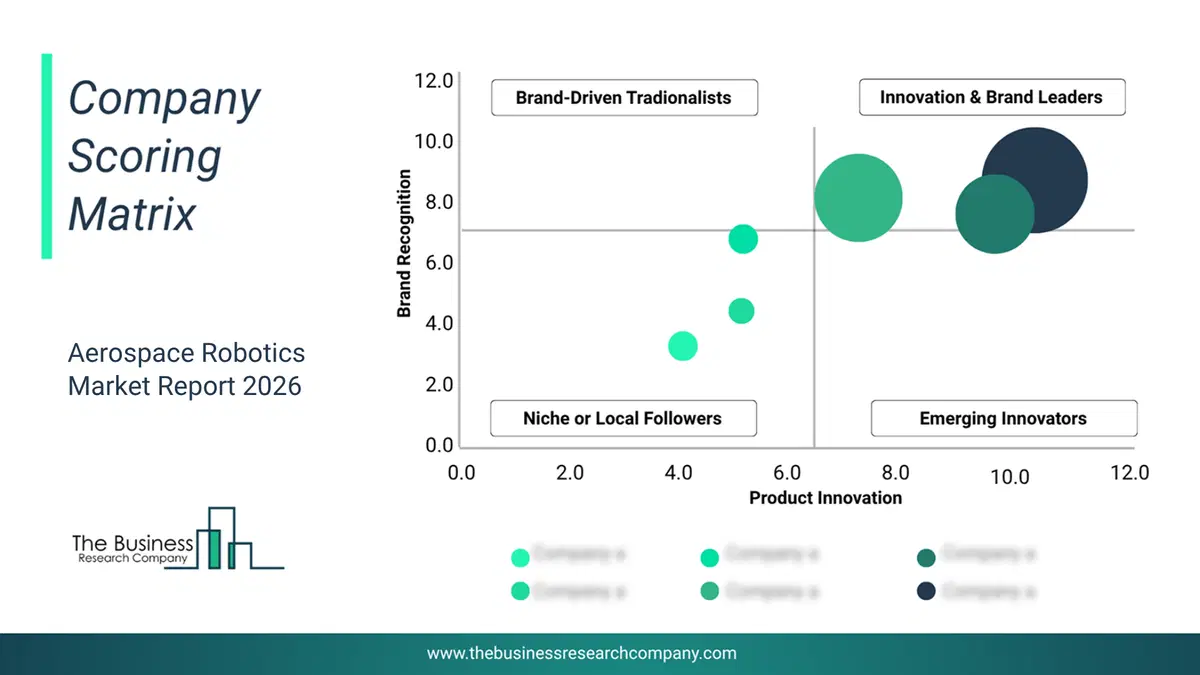
This chart maps companies by product innovation and brand strength, with bubble size indicating relative revenue, helping identify market leaders, challengers, and niche players. This is an illustrative chart; the full report provides a complete and accurate competitive analysis.
Global Aerospace Robotics Market Trends and Insights
Major companies in the aerospace robotics sector are advancing innovative solutions, such as worm-inspired robots, to enhance maintenance and inspection processes. Worm-inspired robots are robotic systems typically soft-bodied, highly flexible, and capable of maneuvering through tight or confined spaces. For instance, in September 2023, GE Aerospace, a US-based aerospace company launched Sensiworm. Sensiworm is a worm-inspired robot designed for on-wing inspections of jet engines. This robot, resembling an inchworm, utilizes untethered soft robotics technology to navigate the intricate interior of jet engines, detecting defects and measuring the thickness of thermal barrier coatings. It is equipped to transmit live video and data back to operators, enhancing the inspection process by providing immediate feedback on engine conditions. The Sensiworm can maneuver through tight spaces and complex geometries within engine components.What Are Latest Mergers And Acquisitions In The Aerospace Robotics Market? Rockwell Automation Acquires Clearpath Robotics To Expand Autonomous Mobile Robotics Capabilities
In September 2023, Rockwell Automation Inc., a US-based industrial automation company acquired Clearpath Robotics Inc. including its industrial division OTTO Motors for an undisclosed amount. With this acquisition, Rockwell Automation Inc. aims to enhance its industrial automation portfolio and meet the growing demand for autonomous mobile robots (AMRs), and integrate advanced robotics for production logistics in manufacturing environments. Clearpath Robotics Inc. is a Canada-based robotics company that develops robots for various applications including aerospace.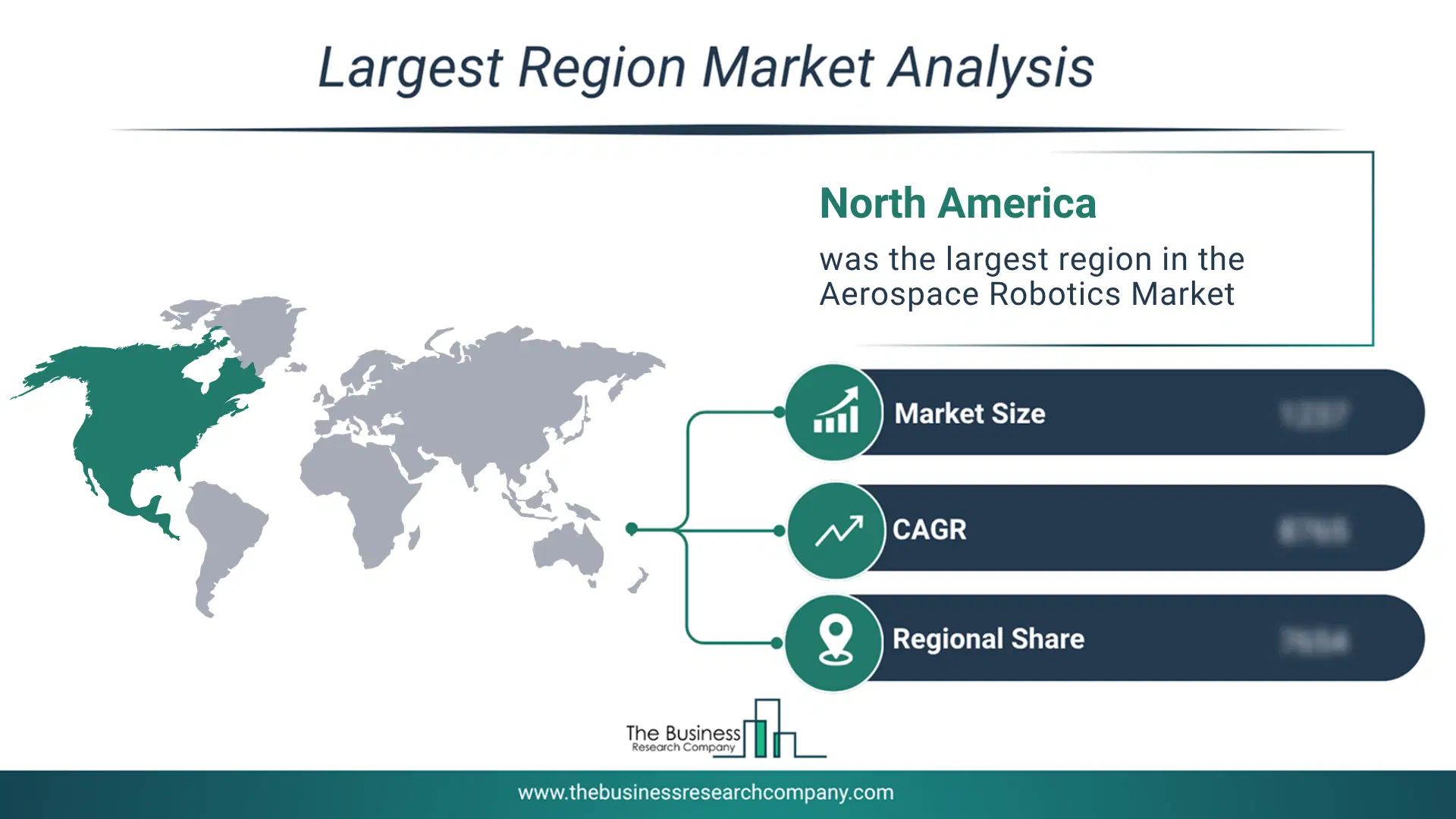
Regional Insights
North America was the largest region in the aerospace robotics market in 2025. Asia-Pacific is expected to be the fastest-growing region in the aerospace robotics market share during the forecast period. The regions covered in this market report are Asia-Pacific, South East Asia, Western Europe, Eastern Europe, North America, South America, Middle East, Africa. The countries covered in this market report are Australia, Brazil, China, France, Germany, India, Indonesia, Japan, Taiwan, Russia, South Korea, UK, USA, Canada, Italy, SpainWhat Defines the Aerospace Robotics Market?
The aerospace robotics market consists of sales of robots to aid in aerospace operations such as manufacturing, and inspection. Values in this market are ‘factory gate’ values, that is the value of goods sold by the manufacturers or creators of the goods, whether to other entities (including downstream manufacturers, wholesalers, distributors, and retailers) or directly to end customers. The value of goods in this market includes related services sold by the creators of the goods.How is Market Value Defined and Measured?
The market value is defined as the revenues that enterprises gain from the sale of goods and/or services within the specified market and geography through sales, grants, or donations in terms of the currency (in USD unless otherwise specified). The revenues for a specified geography are consumption values that are revenues generated by organizations in the specified geography within the market, irrespective of where they are produced. It does not include revenues from resales along the supply chain, either further along the supply chain or as part of other products.
This chart presents market attractiveness based on a quantitative evaluation of growth, competition, strategic alignment, and risk, offering a clear view of opportunity areas for decision-making. This chart is for illustrative purposes; the full report contains the complete analysis.

This chart highlights the Total Addressable Market (TAM) by estimating the maximum revenue opportunity using an assumption-driven approach, supporting strategic planning and opportunity sizing across markets. The chart is illustrative; the full report provides a more comprehensive analysis.
What Key Data and Analysis Are Included in the Aerospace Robotics Market Report 2026?
The aerospace robotics market research report is one of a series of new reports from The Business Research Company that provides market statistics, including industry global market size, regional shares, competitors with the market share, detailed market segments, market trends and opportunities, and any further data you may need to thrive in the aerospace robotics industry. The market research report delivers a complete perspective of everything you need, with an in-depth analysis of the current and future state of the industry.Aerospace Robotics Market Report Forecast Analysis
| Report Attribute | Details |
|---|---|
| Market Size Value In 2026 | $5.79 billion |
| Revenue Forecast In 2030 | $8.77 billion |
| Growth Rate | CAGR of 10.9% from 2026 to 2030 |
| Base Year For Estimation | 2025 |
| Actual Estimates/Historical Data | 2020-2025 |
| Forecast Period | 2026 - 2030 |
| Market Representation | Revenue in USD Billion and CAGR from 2026 to 2030 |
| Segments Covered | Type, Technology, Component, Payload, Application |
| Regional Scope | Asia-Pacific, Western Europe, Eastern Europe, North America, South America, Middle East, Africa |
| Country Scope | The countries covered in the aerospace robotics market report are Australia, Brazil, China, France, Germany, India, Indonesia, Japan, Taiwan, Russia, South Korea, UK, USA, Canada, Italy, Spain |
| Key Companies Profiled | KUKA Aktiengesellschaft, ABB Group, FANUC Corporation, Yaskawa Electric Corporation, Kawasaki Heavy Industries Ltd., Apex Automation and Robotics, Nachi-Fujikoshi Corp., Stäubli International AG, Omron Adept Technologies Inc., Mitsubishi Electric Corporation, JH Robotics Inc., M Torres Olvega Industrial S.A., Comau S.p.A., MTM Robotics LLC, Güdel Group AG, Electroimpact Inc., Honeybee Robotics Ltd., Oliver Crispin Robotics Ltd., Northrop Grumman Corporation, Aethon |
| Customization Scope | Request for Customization |
| Pricing And Purchase Options | Explore Purchase Options |