
Aerospace Simulation Software Market Report 2026
Global Outlook – By Software Type (Modeling Software, Simulation Software, Analysis Software, Integration Software), By Platform (Aircraft, Spacecraft, Satellites, Unmanned Aerial Vehicles, Advanced Air Mobility Vehicles), By Deployment Type (On Premise, Cloud Based), By Application (Flight Simulation, Training Simulation, Aircraft Design, Mission Planning, Maintenance Simulation), By End Use (Civil Aviation, Military Aviation, Space Exploration, Unmanned Aerial Vehicles) – Market Size, Trends, Strategies, and Forecast to 2030
Aerospace Simulation Software Market Overview
• Aerospace Simulation Software market size has reached to $5.03 billion in 2025 • Expected to grow to $7.14 billion in 2030 at a compound annual growth rate (CAGR) of 7.2% • Growth Driver: Increasing Military Modernization Programs Driving The Market Growth Due To Escalating Geopolitical Tensions And Security Threats • Market Trend: Advanced Computational Fluid Dynamics Frameworks Enhance Aerodynamic Analysis And Mission Planning • North America was the largest region in 2025 and Asia-Pacific is the fastest growing region.What Is Covered Under Aerospace Simulation Software Market?
Aerospace simulation software refers to specialized computer programs used to model, analyze, and simulate the behavior, performance, and operation of aircraft, spacecraft, and related aerospace systems in virtual environments. It enables engineers and researchers to test designs, predict system performance, optimize operations, and evaluate safety and mission scenarios while reducing the need for costly physical prototypes and real-world testing. The main software types of aerospace simulation software include modeling software, simulation software, analysis software, and integration software. Modeling software refers to specialized software used to create digital representations of aerospace systems, enabling design validation, performance evaluation, and engineering analysis. These solutions support platforms including aircraft, spacecraft, satellites, unmanned aerial vehicles, and advanced air mobility vehicles and are deployed through on premise and cloud based models. The various applications involved are flight simulation, training simulation, aircraft design, mission planning, and maintenance simulation, and they are used by several end uses such as civil aviation, military aviation, space exploration, unmanned aerial vehicles, and commercial aircraft.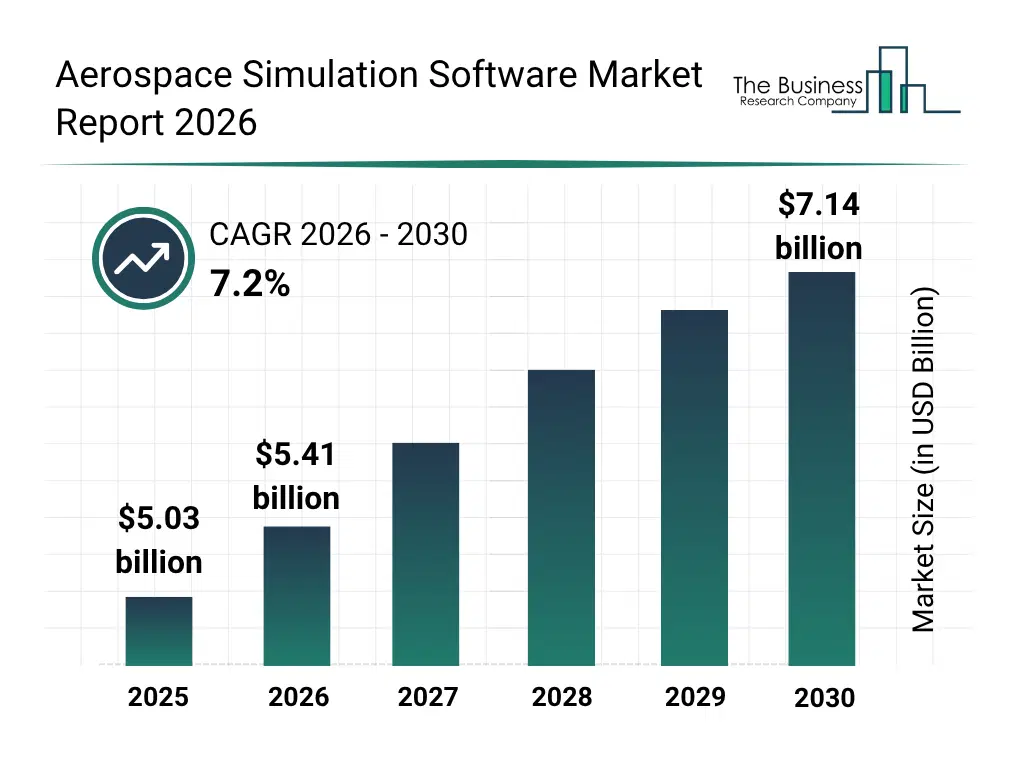
What Is The Aerospace Simulation Software Market Size and Share 2026?
The aerospace simulation software market size has grown strongly in recent years. It will grow from $5.03 billion in 2025 to $5.41 billion in 2026 at a compound annual growth rate (CAGR) of 7.6%. The growth in the historic period can be attributed to increasing aircraft development programs, growing investments in defense modernization, rising demand for virtual testing environments, expansion of commercial aviation activities, increasing adoption of computer aided engineering tools.What Is The Aerospace Simulation Software Market Growth Forecast?
The aerospace simulation software market size is expected to see strong growth in the next few years. It will grow to $7.14 billion in 2030 at a compound annual growth rate (CAGR) of 7.2%. The growth in the forecast period can be attributed to growing investments in advanced air mobility development, increasing space exploration missions, rising adoption of digital twin enabled simulation platforms, expanding demand for unmanned aerial vehicle simulation, growing need for predictive maintenance simulation solutions. Major trends in the forecast period include rising adoption of physics based simulation for aerospace system validation, increasing use of digital mission planning and operational testing software, growing demand for multi domain simulation platforms, expansion of cloud based collaborative aerospace simulation environments, rising focus on virtual prototyping to reduce product development costs.
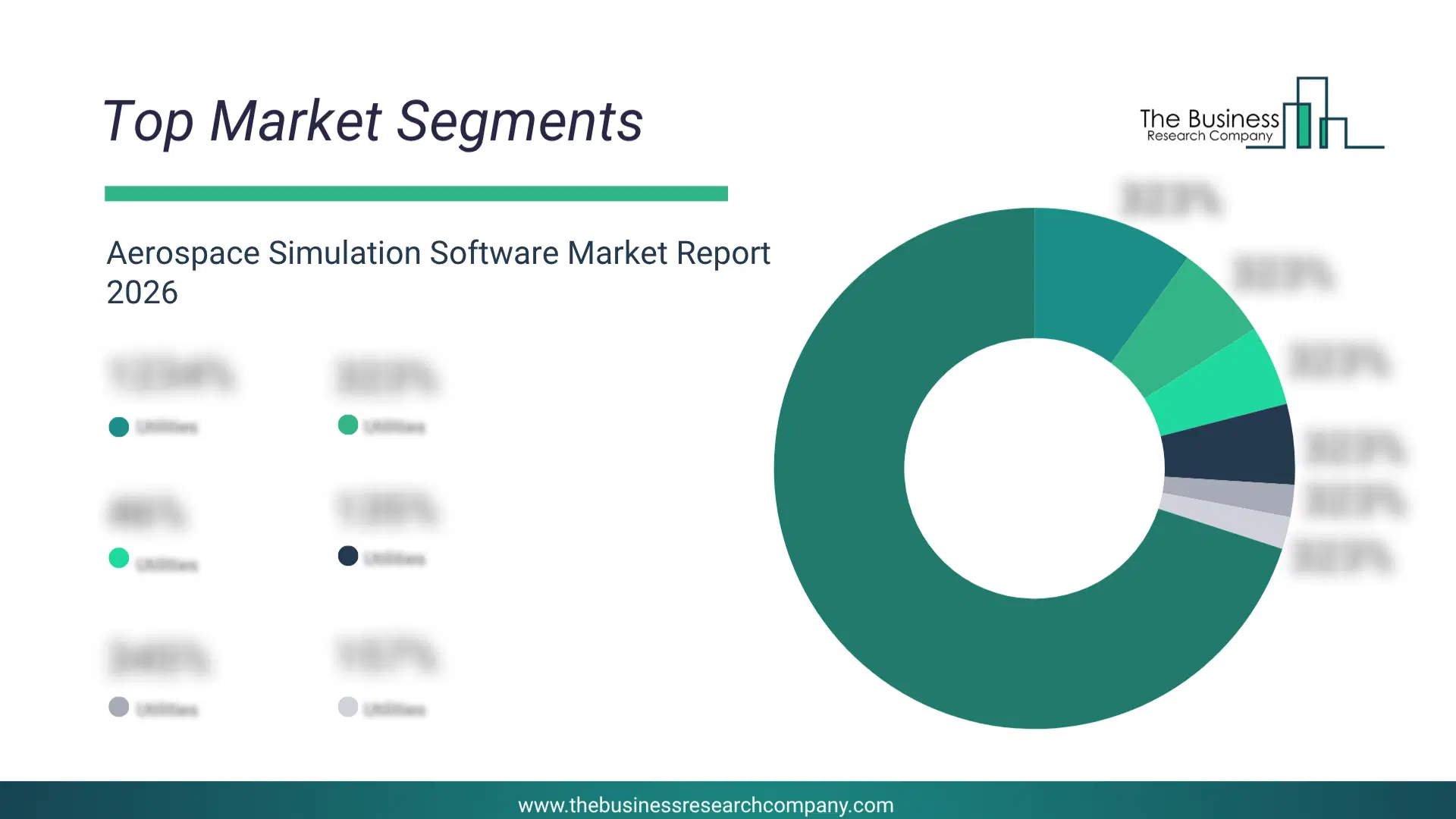
Global Aerospace Simulation Software Market Segmentation
2) By Platform: Aircraft, Spacecraft, Satellites, Unmanned Aerial Vehicles, Advanced Air Mobility Vehicles 3) By Deployment Type: On Premise, Cloud Based 4) By Application: Flight Simulation, Training Simulation, Aircraft Design, Mission Planning, Maintenance Simulation 5) By End Use: Civil Aviation, Military Aviation, Space Exploration, Unmanned Aerial Vehicles Subsegments: 1) By Modeling Software: Parametric Modeling Tools, Geometric Modeling Tools, Surface Modeling Tools, Computational Modeling Tools 2) By Simulation Software: Physics Based Simulation Tools, Real Time Simulation Tools, Multi Domain Simulation Tools, Scenario Simulation Tools 3) By Analysis Software: Structural Analysis Tools, Fluid Dynamics Analysis Tools, Thermal Analysis Tools, Data Analysis And Visualization Tools 4) By Integration Software: System Integration Platforms, Model Integration Tools, Data Integration Middleware, Application Programming Interface Integration ToolsWhat Is The Driver Of The Aerospace Simulation Software Market?
The increasing military modernization programs is expected to propel the growth of the aerospace simulation software market going forward. Military modernization programs are comprehensive initiatives by armed forces to upgrade and enhance their defense capabilities through advanced weapons systems and technologies. The rising military modernization programs is due to escalating geopolitical tensions and security threats to national sovereignty and regional stability, as nations seek to enhance their defense capabilities, deter potential adversaries, and safeguard their strategic interests. Increasing military modernization programs are driving the adoption of aerospace simulation software by enabling defense organizations to virtually design, test, and optimize advanced aircraft, unmanned systems, and mission capabilities while reducing development costs and accelerating deployment timelines. For instance, in March 2023, according to the European Security and Defence College, a Belgium-based autonomous institution, in 2030, the ongoing US Army modernization program is set to field 35 new future force systems, forming the core of more than 500 development, acquisition, or upgrade initiatives underway. Therefore, the increasing military modernization programs is driving the growth of the aerospace simulation software industry.Key Players In The Global Aerospace Simulation Software Market
Major companies operating in the aerospace simulation software market are Siemens AG, Cadence Design Systems Inc., Dassault Systèmes SE, The MathWorks Inc., Altair Engineering Inc., PTC Inc., RTX Corporation, Airbus SE, Lockheed Martin Corporation, Northrop Grumman Corporation, BAE Systems plc, Thales S.A., L3Harris Technologies Inc., CAE Inc., Kratos Defense And Security Solutions Inc., COMSOL AB, NVIDIA Corporation, Epic Games Inc., OPAL-RT Technologies Inc., Applied Intuition Inc., SimScale GmbH, Alsim Simulateurs SARL, Advanced Rotorcraft Technology Inc.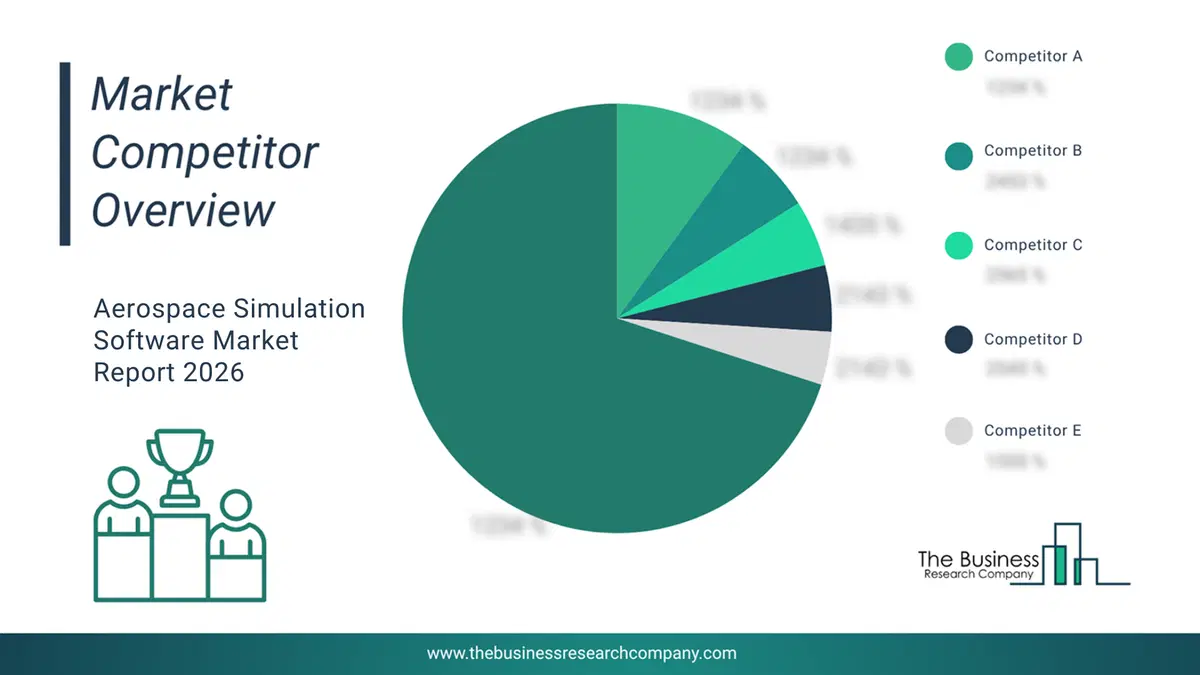
This chart is for illustrative purposes; the full report includes a detailed competitor analysis and comprehensive overview of the top 10 companies in the market.
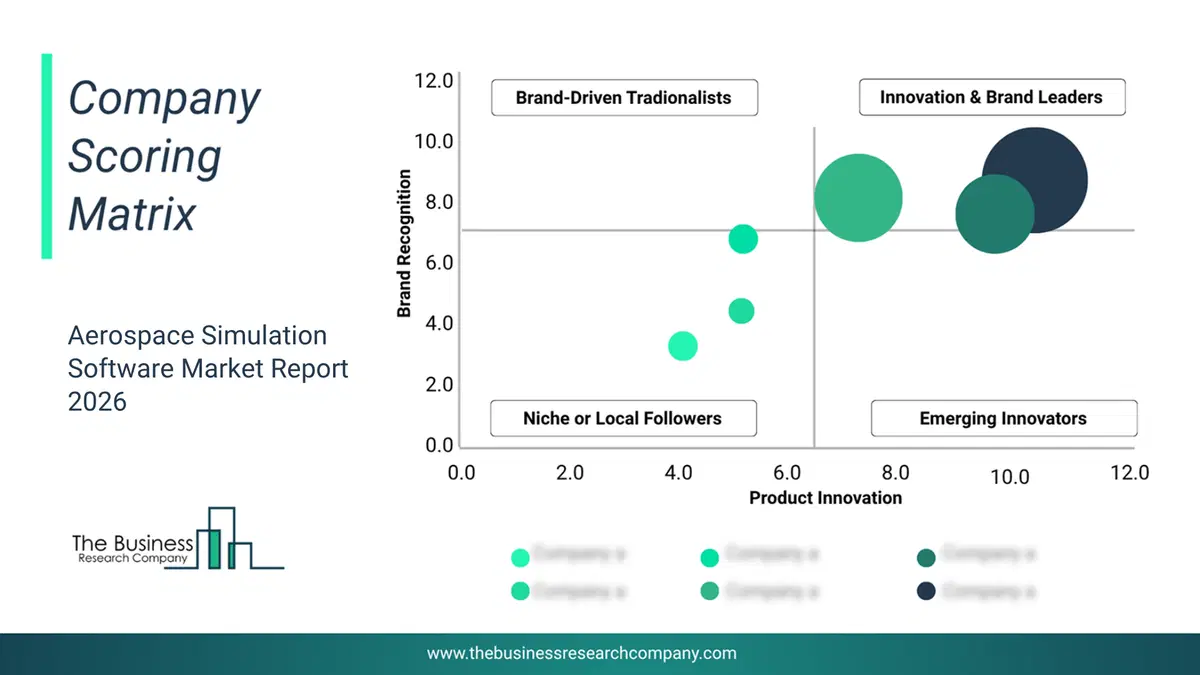
This chart maps companies by product innovation and brand strength, with bubble size indicating relative revenue, helping identify market leaders, challengers, and niche players. This is an illustrative chart; the full report provides a complete and accurate competitive analysis.
Global Aerospace Simulation Software Market Trends and Insights
Major companies operating in the aerospace simulation software market are focusing on developing innovative solutions, such as computational fluid dynamics (CFD) simulation frameworks, to enhance aerodynamic analysis, reduce design risks, and improve mission planning and vehicle performance. Computational fluid dynamics simulation frameworks are advanced software platforms that use numerical methods and high-performance computing to model and predict airflow, pressure, heat transfer, and fluid interactions around aircraft, rockets, and spacecraft, providing significantly greater accuracy and flexibility than traditional wind-tunnel testing and analytical calculations alone. For instance, in April 2026, the National Aeronautics and Space Administration (NASA), a US-based government space and aeronautics agency, released its Launch, Ascent, and Vehicle Aerodynamics (LAVA) framework to the broader aerospace community. The computational fluid dynamics software package was developed to simulate complex airflow interactions around rockets, aircraft, and spacecraft with high precision. The platform supports applications including launch analysis, spacecraft re-entry simulations, aircraft wing performance assessment, and prediction of exhaust plume interactions with air, water, and launch infrastructure. By leveraging NASA’s aerospace expertise and advanced simulation capabilities, LAVA enables engineers and researchers to improve vehicle performance, increase mission reliability, and advance next-generation aerospace system design.What Are Latest Mergers And Acquisitions In The Aerospace Simulation Software Market?
In July 2025, Synopsys, Inc., a US-based software company, acquired Ansys Inc. for $35 billion. With this acquisition, Synopsys aims to create a comprehensive silicon-to-systems design and simulation platform by combining semiconductor design automation with advanced multiphysics simulation capabilities, thereby accelerating innovation in industries such as semiconductors, automotive, aerospace, and industrial manufacturing. Ansys Inc. is a US-based company that provides aerospace simulation software and delivers comprehensive digital engineering solutions for the aerospace industry.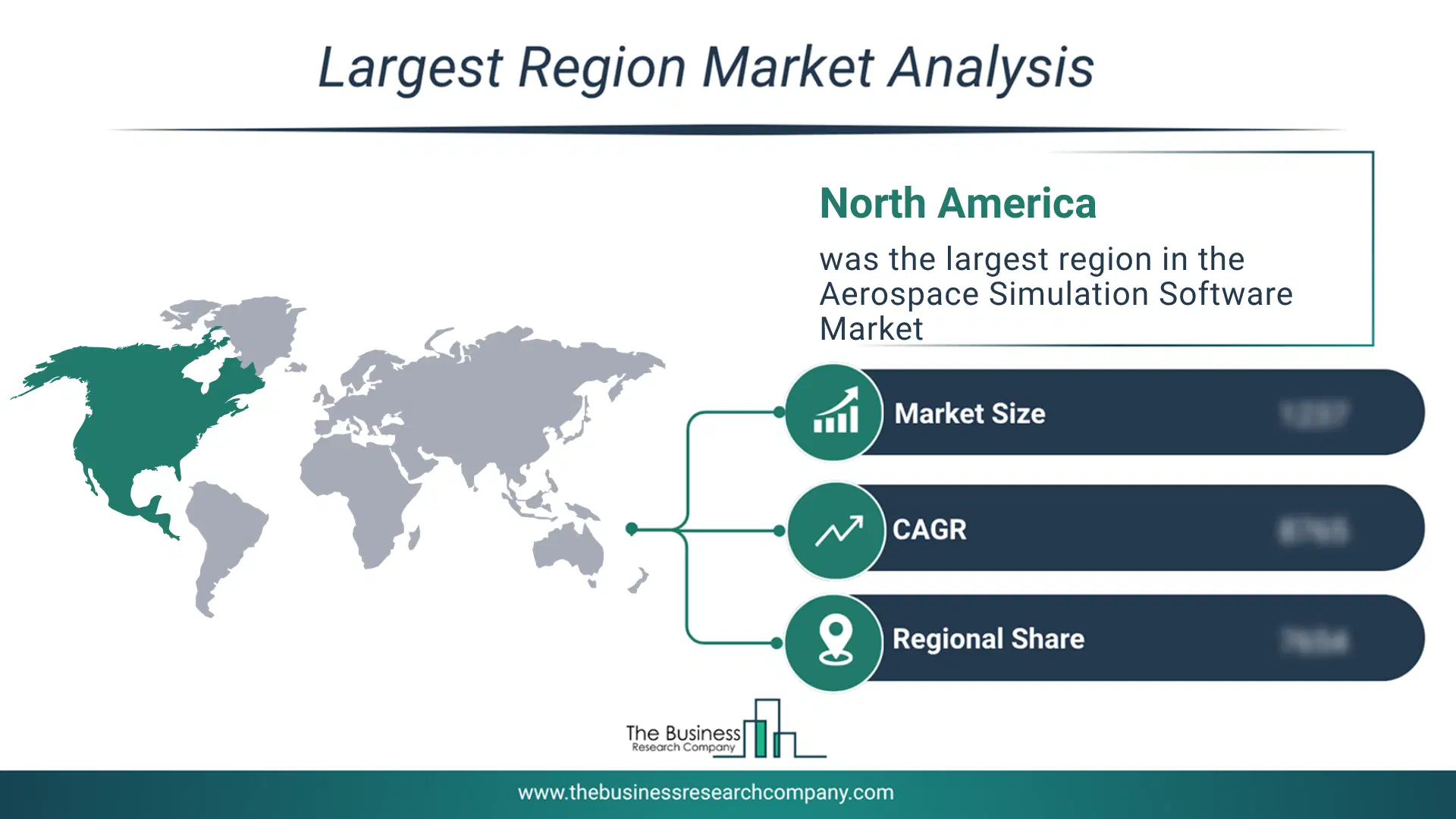
Regional Outlook/Insights
North America was the largest region in the aerospace simulation software market in 2025. Asia-Pacific is expected to be the fastest-growing region in the forecast period. The regions covered in this market report are Asia-Pacific, South East Asia, Western Europe, Eastern Europe, North America, South America, Middle East, Africa. The countries covered in this market report are Australia, Brazil, China, France, Germany, India, Indonesia, Japan, Taiwan, Russia, South Korea, UK, USA, Canada, Italy, Spain.What Defines the Aerospace Simulation Software Market?
The aerospace simulation software market includes revenues earned by entities by providing services such as structural and stress analysis services, avionics and embedded systems simulation service, air traffic and airspace modeling services, and propulsion system simulation services. The market value includes the value of related goods sold by the service provider or included within the service offering. Only goods and services traded between entities or sold to end consumers are included.How is Market Value Defined and Measured?
The market value is defined as the revenues that enterprises gain from the sale of goods and/or services within the specified market and geography through sales, grants, or donations in terms of the currency (in USD unless otherwise specified). The revenues for a specified geography are consumption values that are revenues generated by organizations in the specified geography within the market, irrespective of where they are produced. It does not include revenues from resales along the supply chain, either further along the supply chain or as part of other products.
This chart presents market attractiveness based on a quantitative evaluation of growth, competition, strategic alignment, and risk, offering a clear view of opportunity areas for decision-making. This chart is for illustrative purposes; the full report contains the complete analysis.

This chart highlights the Total Addressable Market (TAM) by estimating the maximum revenue opportunity using an assumption-driven approach, supporting strategic planning and opportunity sizing across markets. The chart is illustrative; the full report provides a more comprehensive analysis.
What Key Data and Analysis Are Included in the Aerospace Simulation Software Market Report 2026?
The aerospace simulation software market research report is one of a series of new reports from The Business Research Company that provides aerospace simulation software market statistics, including aerospace simulation software industry global market size, regional shares, competitors with a aerospace simulation software market share, detailed aerospace simulation software market segments, market trends and opportunities, and any further data you may need to thrive in the aerospace simulation software industry. This aerospace simulation software market research report delivers a complete perspective of everything you need, with an in-depth analysis of the current and future scenario of the industry.Aerospace Simulation Software Market Report Forecast Analysis
| Report Attribute | Details |
|---|---|
| Market Size Value In 2026 | $5.41 billion |
| Revenue Forecast In 2030 | $7.14 billion |
| Growth Rate | CAGR of 7.2% from 2026 to 2030 |
| Base Year For Estimation | 2025 |
| Actual Estimates/Historical Data | 2020-2025 |
| Forecast Period | 2026 - 2030 |
| Market Representation | Revenue in USD Billion and CAGR from 2026 to 2030 |
| Segments Covered | Software Type, Platform, Deployment Type, Application, End Use |
| Regional Scope | Asia-Pacific, Western Europe, Eastern Europe, North America, South America, Middle East, Africa |
| Country Scope | The countries covered in the report are Australia, Brazil, China, France, Germany, India, Indonesia, Japan, Taiwan, Russia, South Korea, UK, USA, Canada, Italy, Spain. |
| Key Companies Profiled | Siemens AG, Cadence Design Systems Inc., Dassault Systèmes SE, The MathWorks Inc., Altair Engineering Inc., PTC Inc., RTX Corporation, Airbus SE, Lockheed Martin Corporation, Northrop Grumman Corporation, BAE Systems plc, Thales S.A., L3Harris Technologies Inc., CAE Inc., Kratos Defense And Security Solutions Inc., COMSOL AB, NVIDIA Corporation, Epic Games Inc., OPAL-RT Technologies Inc., Applied Intuition Inc., SimScale GmbH, Alsim Simulateurs SARL, Advanced Rotorcraft Technology Inc. |
| Customization Scope | Request for Customization |
| Pricing And Purchase Options | Explore Purchase Options |