
Aerospace Testing Market Report 2026
Global Outlook – By Testing Type (Material Testing, Environmental Testing, Structural Or Component Testing, Electromagnetic Compatibility Testing, Software Testing, Other Testing Types), By Aviation Type (Commercial Aviation, Military Aviation, Space Exploration, Other Aviation Types), By Application (Aircraft Structures, Propulsion Systems, Interiors, Space Systems, Avionics And Electronics), By End User (Original Equipment Manufacturers, Maintenance Repair And Overhaul Providers, Defense Organizations, Space Agencies, Component Suppliers) – Market Size, Trends, Strategies, and Forecast to 2030
Aerospace Testing Market Overview
• Aerospace Testing market size has reached to $5.65 billion in 2025 • Expected to grow to $7.79 billion in 2030 at a compound annual growth rate (CAGR) of 6.5% • Growth Driver: Surge In Aircraft Production Rates Fueling Market Growth Due To Rising Air Travel Demand And Faster Aircraft Manufacturing Needs • Market Trend: Advanced Aerospace Testing Infrastructure Enhances System Validation And Performance Evaluation Capabilities • North America was the largest region in 2025 and Asia-Pacific is the fastest growing region.What Is Covered Under Aerospace Testing Market?
Aerospace testing is the process of assessing aircraft, spacecraft, and related components to ensure they meet performance, safety, and reliability requirements. It involves controlled evaluations under conditions such as extreme temperatures, pressure changes, vibration, and aerodynamic stress. Aerospace testing validates structural strength, system performance, and compliance with industry and regulatory standards before operational use. The main testing types of aerospace testing include material testing, environmental testing, structural or component testing, electromagnetic compatibility testing, software testing, and other testing types. Material testing refers to the evaluation of aerospace materials to determine their mechanical, thermal, chemical, and durability characteristics under specified operating conditions. These testing services are performed across commercial aviation, military aviation, space exploration, and other aviation types. The key applications invoved are aircraft structures, propulsion systems, interiors, space systems, avionics and electronics, while the end-users original equipment manufacturers, maintenance repair and overhaul providers, defense organizations, space agencies, and component suppliers.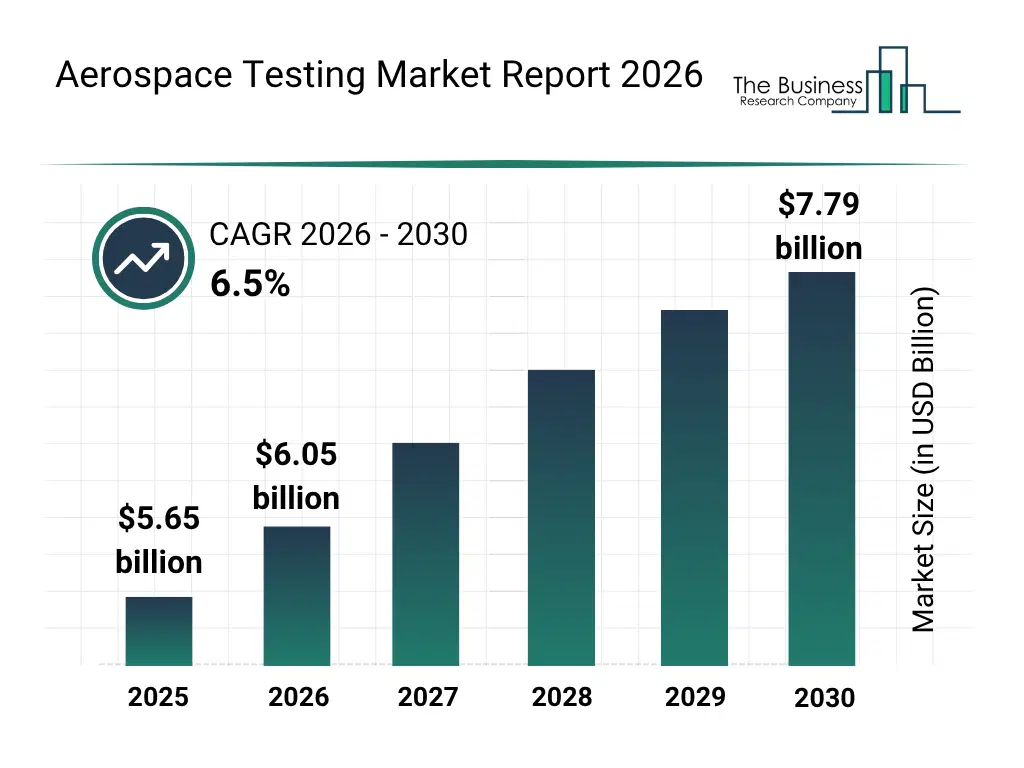
What Is The Aerospace Testing Market Size and Share 2026?
The aerospace testing market size has grown strongly in recent years. It will grow from $5.65 billion in 2025 to $6.05 billion in 2026 at a compound annual growth rate (CAGR) of 7.0%. The growth in the historic period can be attributed to increasing commercial aircraft production, rising global defense modernization programs, growing investments in aerospace research and development, expanding regulatory compliance requirements, increasing demand for aircraft safety validation.What Is The Aerospace Testing Market Growth Forecast?
The aerospace testing market size is expected to see strong growth in the next few years. It will grow to $7.79 billion in 2030 at a compound annual growth rate (CAGR) of 6.5%. The growth in the forecast period can be attributed to growing development of advanced air mobility platforms, increasing investments in space exploration missions, rising production of unmanned aerial vehicles, expanding demand for next generation propulsion systems, growing emphasis on predictive testing and reliability assessment. Major trends in the forecast period include rising adoption of advanced environmental testing for aerospace systems, increasing demand for structural integrity and fatigue testing, growing use of hardware in loop testing for aerospace validation, expansion of thermal vacuum testing for space applications, rising focus on qualification and certification testing for aerospace components.
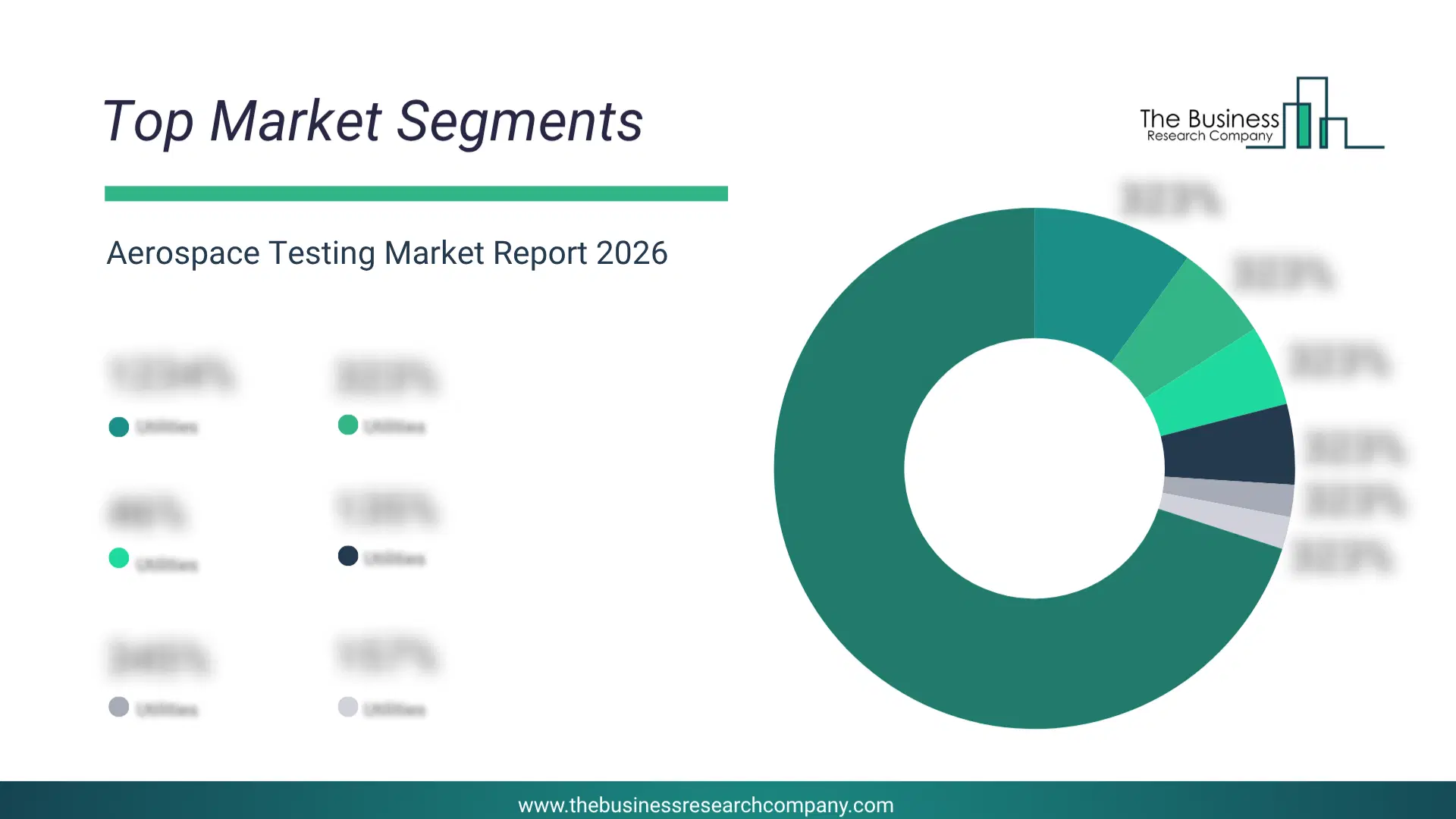
Global Aerospace Testing Market Segmentation
2) By Aviation Type: Commercial Aviation, Military Aviation, Space Exploration, Other Aviation Types 3) By Application: Aircraft Structures, Propulsion Systems, Interiors, Space Systems, Avionics And Electronics 4) By End User: Original Equipment Manufacturers, Maintenance Repair And Overhaul Providers, Defense Organizations, Space Agencies, Component Suppliers Subsegments: 1) By Material Testing: Tensile Testing, Fatigue Testing, Fracture Toughness Testing, Hardness Testing, Creep Testing, Corrosion Testing, Chemical Composition Analysis, Microstructure Analysis, Thermal Analysis, Impact Resistance Testing 2) By Environmental Testing: Temperature Testing, Humidity Testing, Altitude Simulation Testing, Thermal Vacuum Testing, Salt Spray Testing, Rain Ingress Testing, Dust Ingress Testing, Pressure Testing, Climate Chamber Testing 3) By Structural Or Component Testing: Static Load Testing, Dynamic Load Testing, Fatigue Structural Testing, Vibration Testing, Shock Testing, Load Bearing Testing, Buckling Testing, Structural Integrity Testing, Component Stress Testing 4) By Electromagnetic Compatibility Testing: Radiated Emissions Testing, Conducted Emissions Testing, Radiated Immunity Testing, Conducted Immunity Testing, Electrostatic Discharge Testing, Radio Frequency Compatibility Testing, Power Line Interference Testing, Electromagnetic Susceptibility Testing 5) By Software Testing: Simulation Testing, Flight Software Verification Testing, Hardware In Loop Testing, Software Integration Testing, Regression Testing, Real Time System Testing, Validation Testing, System Acceptance Simulation Testing 6) By Other Testing Types: Qualification Testing, Certification Testing, Acceptance Testing, Reliability Testing, Maintainability Testing, Safety Assurance Testing, Endurance Testing, Operational Readiness TestingWhat Is The Driver Of The Aerospace Testing Market?
The increasing aircraft production rates are expected to propel the growth of the aerospace testing market going forward. Aircraft production rates refer to the number of aircraft manufactured and completed within a specific time period, typically measured annually or monthly. The increase in aircraft production rates is driven by rising global air travel demand, as expanding passenger traffic pushes manufacturers to produce more aircraft to meet airline fleet expansion needs. Aerospace testing helps aircraft production rates by ensuring design safety and regulatory compliance early in the development process, thereby reducing rework, accelerating certification, and enabling faster, more reliable mass production. For instance, in January 2024, according to Airbus SE, a Netherlands-based manufacturer and developer of aerospace services, solutions, and products, in 2023, the business delivered 735 commercial aircraft to 87 customers worldwide, representing an 11% rise compared to 2022. Therefore, the increasing aircraft production rates are driving the growth of the aerospace testing industry.Key Players In The Global Aerospace Testing Market
Major companies operating in the aerospace testing market are The Boeing Company, Airbus SE, Lockheed Martin Corporation, Northrop Grumman Corporation, Safran S.A., BAE Systems plc, Rolls-Royce plc, Thales S.A., Leonardo S.p.A., SGS Société Générale de Surveillance SA, Embraer S.A., Bureau Veritas SA, Intertek Group plc, DEKRA SE, TÜV SÜD AG, QinetiQ Group plc, Element Materials Technology Group Ltd., Southwest Research Institute, MISTRAS Group Inc., Dayton T. Brown Inc., TÜV Rheinland AG, Rohde & Schwarz GmbH & Co. KG, Eurofins Scientific SE, TÜV NORD AG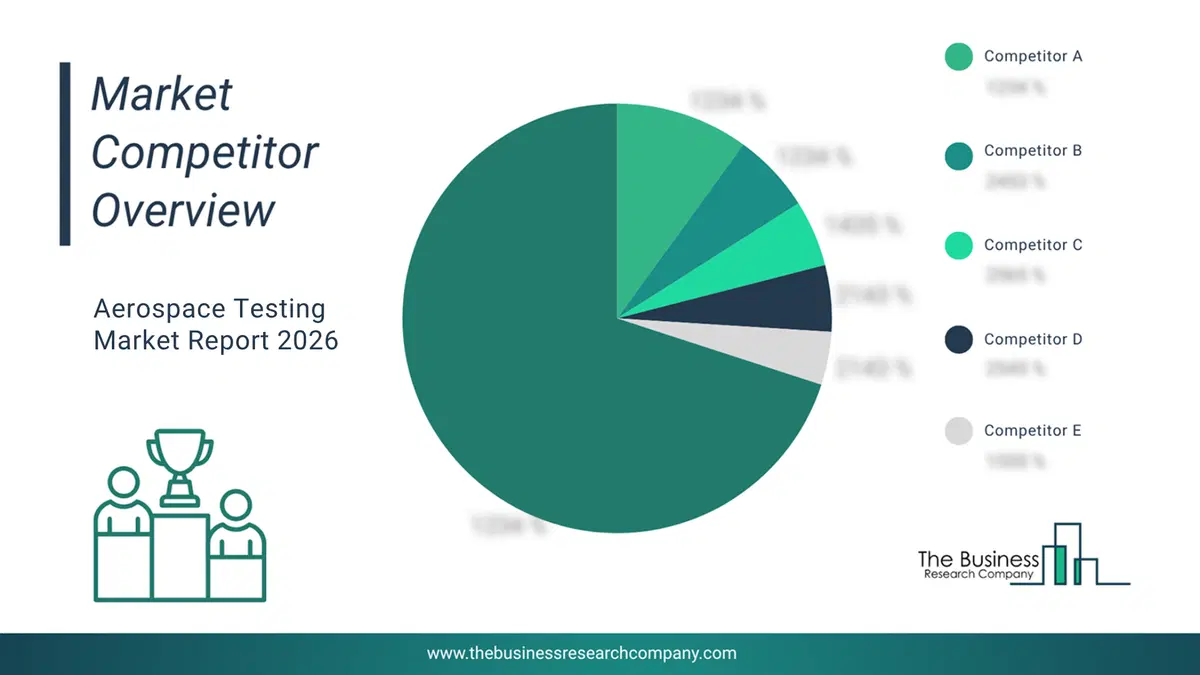
This chart is for illustrative purposes; the full report includes a detailed competitor analysis and comprehensive overview of the top 10 companies in the market.
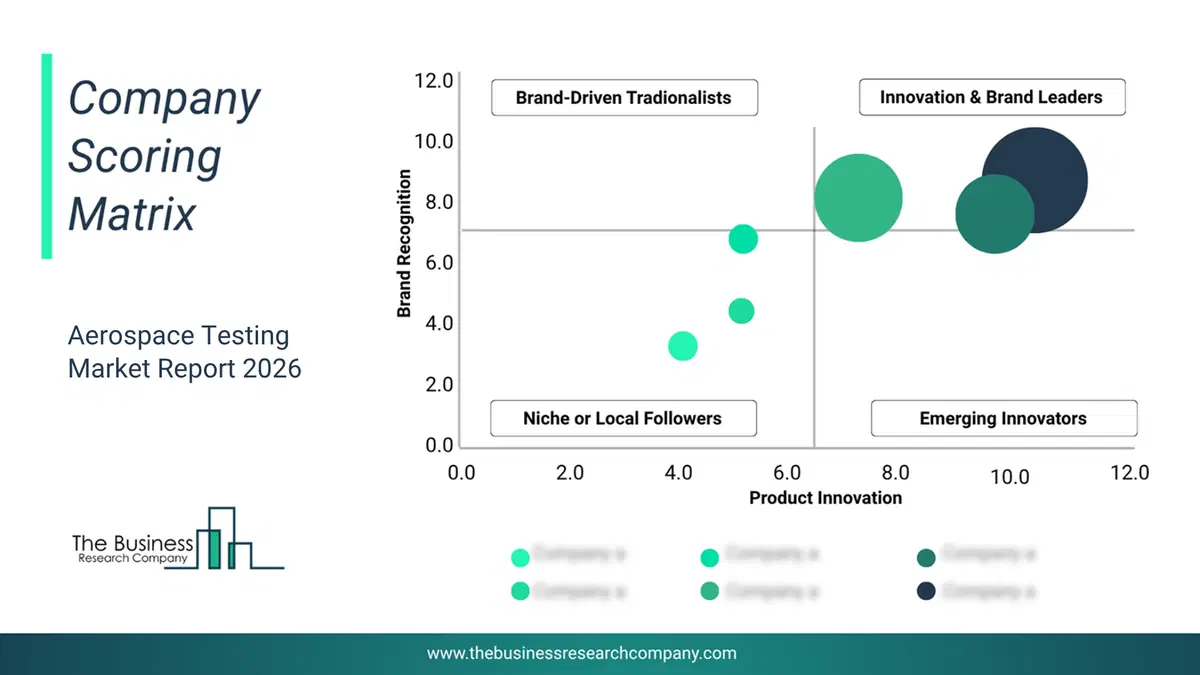
This chart maps companies by product innovation and brand strength, with bubble size indicating relative revenue, helping identify market leaders, challengers, and niche players. This is an illustrative chart; the full report provides a complete and accurate competitive analysis.
Global Aerospace Testing Market Trends and Insights
Major companies operating in the aerospace testing market are focusing on developing advanced aerospace testing infrastructure and defense validation solutions to enhance system reliability, improve performance validation, and support the development of advanced aerospace and defense platforms. Aerospace testing infrastructure and defense validation solutions enable comprehensive evaluation of aerospace and defense systems to ensure performance, reliability, safety, and compliance with mission requirements. For instance, in November 2023, EDGE Group, a UAE-based advanced technology and defense company, launched X RANGE, a new testing facility designed to support advanced aerospace and defense system evaluation. It is designed to support improved testing efficiency and mission validation capabilities. The facility enables comprehensive system performance assessment, enhanced simulation of operational environments, and faster development cycles for aerospace technologies, strengthening modern aerospace testing and evaluation infrastructure.What Are Latest Mergers And Acquisitions In The Aerospace Testing Market?
In December 2024, DEKRA Sweden, a Sweden-based testing, inspection, certification, and consulting company, acquired FORCE Aerospace Testing AB for an undisclosed amount. Through this acquisition, DEKRA aims to strengthen its position in the aerospace sector by expanding its capabilities in non-destructive testing (NDT) and aircraft inspection services across key Nordic aviation hubs, including Arlanda, Copenhagen, and Billund airports. FORCE Aerospace Testing AB is a Sweden-based aerospace inspection and testing company.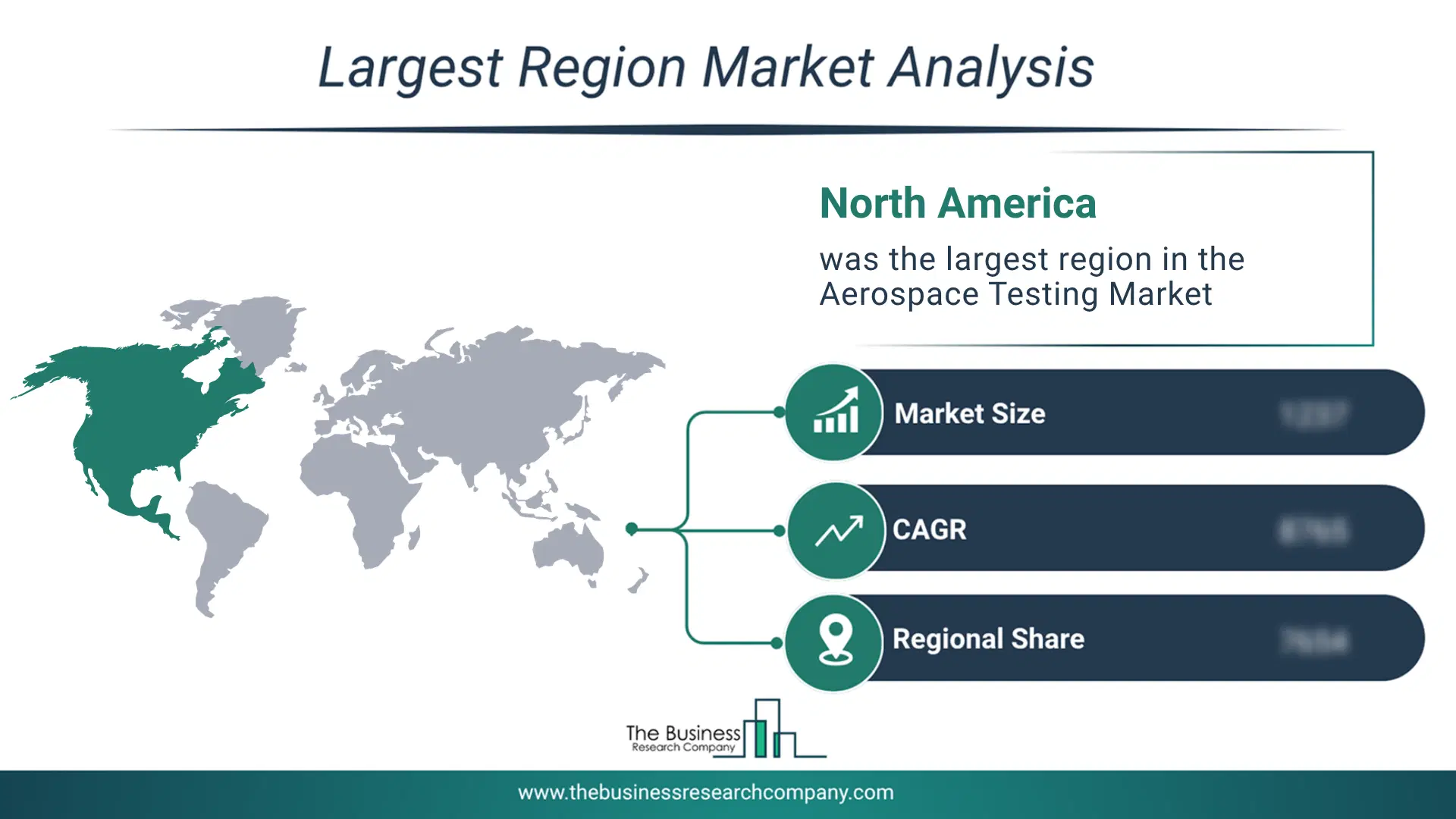
Regional Outlook/Insights
North America was the largest region in the aerospace testing market in 2025. Asia-Pacific is expected to be the fastest-growing region in the forecast period. The regions covered in this market report are Asia-Pacific, South East Asia, Western Europe, Eastern Europe, North America, South America, Middle East, Africa. The countries covered in this market report are Australia, Brazil, China, France, Germany, India, Indonesia, Japan, Taiwan, Russia, South Korea, UK, USA, Canada, Italy, Spain.What Defines the Aerospace Testing Market?
The aerospace testing market includes revenues earned by entities by providing services such as non-destructive testing, materials characterization, software verification and validation, certification and compliance testing, failure analysis and investigation,. The market value includes the value of related goods sold by the service provider or included within the service offering. Only goods and services traded between entities or sold to end consumers are included.How is Market Value Defined and Measured?
The market value is defined as the revenues that enterprises gain from the sale of goods and/or services within the specified market and geography through sales, grants, or donations in terms of the currency (in USD unless otherwise specified). The revenues for a specified geography are consumption values that are revenues generated by organizations in the specified geography within the market, irrespective of where they are produced. It does not include revenues from resales along the supply chain, either further along the supply chain or as part of other products.
This chart presents market attractiveness based on a quantitative evaluation of growth, competition, strategic alignment, and risk, offering a clear view of opportunity areas for decision-making. This chart is for illustrative purposes; the full report contains the complete analysis.

This chart highlights the Total Addressable Market (TAM) by estimating the maximum revenue opportunity using an assumption-driven approach, supporting strategic planning and opportunity sizing across markets. The chart is illustrative; the full report provides a more comprehensive analysis.
What Key Data and Analysis Are Included in the Aerospace Testing Market Report 2026?
The aerospace testing market research report is one of a series of new reports from The Business Research Company that provides aerospace testing market statistics, including aerospace testing industry global market size, regional shares, competitors with a aerospace testing market share, detailed aerospace testing market segments, market trends and opportunities, and any further data you may need to thrive in the aerospace testing industry. This aerospace testing market research report delivers a complete perspective of everything you need, with an in-depth analysis of the current and future scenario of the industry.Aerospace Testing Market Report Forecast Analysis
| Report Attribute | Details |
|---|---|
| Market Size Value In 2026 | $6.05 billion |
| Revenue Forecast In 2030 | $7.79 billion |
| Growth Rate | CAGR of 6.5% from 2026 to 2030 |
| Base Year For Estimation | 2025 |
| Actual Estimates/Historical Data | 2020-2025 |
| Forecast Period | 2026 - 2030 |
| Market Representation | Revenue in USD Billion and CAGR from 2026 to 2030 |
| Segments Covered | Testing Type, Aviation Type, Application, End User |
| Regional Scope | Asia-Pacific, Western Europe, Eastern Europe, North America, South America, Middle East, Africa |
| Country Scope | The countries covered in the report are Australia, Brazil, China, France, Germany, India, Indonesia, Japan, Taiwan, Russia, South Korea, UK, USA, Canada, Italy, Spain. |
| Key Companies Profiled | The Boeing Company, Airbus SE, Lockheed Martin Corporation, Northrop Grumman Corporation, Safran S.A., BAE Systems plc, Rolls-Royce plc, Thales S.A., Leonardo S.p.A., SGS Société Générale de Surveillance SA, Embraer S.A., Bureau Veritas SA, Intertek Group plc, DEKRA SE, TÜV SÜD AG, QinetiQ Group plc, Element Materials Technology Group Ltd., Southwest Research Institute, MISTRAS Group Inc., Dayton T. Brown Inc., TÜV Rheinland AG, Rohde & Schwarz GmbH & Co. KG, Eurofins Scientific SE, TÜV NORD AG |
| Customization Scope | Request for Customization |
| Pricing And Purchase Options | Explore Purchase Options |