
Agentic AI In Scientific Discovery And Research Market Report 2026
Global Outlook – By Component (Software, Services), By Deployment Mode (On-Premises, Cloud-Based), By Industry Type (Healthcare And Pharmaceuticals, Information Technology And Telecom, Manufacturing, Other Industries) – Market Size, Trends, Strategies, and Forecast to 2030
Agentic AI In Scientific Discovery And Research Market Overview
• Agentic AI In Scientific Discovery And Research market size has reached to $0.26 billion in 2025 • Expected to grow to $2.4 billion in 2030 at a compound annual growth rate (CAGR) of 56.5% • Growth Driver: Rising Automation Driving The Growth Of The Market Due To Increasing Efficiency And Data Processing Capabilities • Market Trend: Advancements In Agentic AI For Scientific Discovery: Multi-Agent Systems And Collaborative Innovation • North America was the largest region in 2025.What Is Covered Under Agentic AI In Scientific Discovery And Research Market?
Agentic artificial intelligence (AI) in scientific discovery and research describes AI systems capable of independently initiating, planning, and carrying out intricate tasks that are traditionally part of the scientific process. These systems operate with goal-oriented behavior, respond dynamically to new data, and make informed decisions with little to no human guidance. The main agentic AI in scientific discovery and research components includes software and services. Software refers to the agentic AI platforms, frameworks, or tools that researchers use to build, deploy, or manage AI agents in scientific workflows. It can be deployed both on-premises and in the cloud and is used by various industries such as healthcare and pharmaceuticals, information technology and telecom, manufacturing, and others.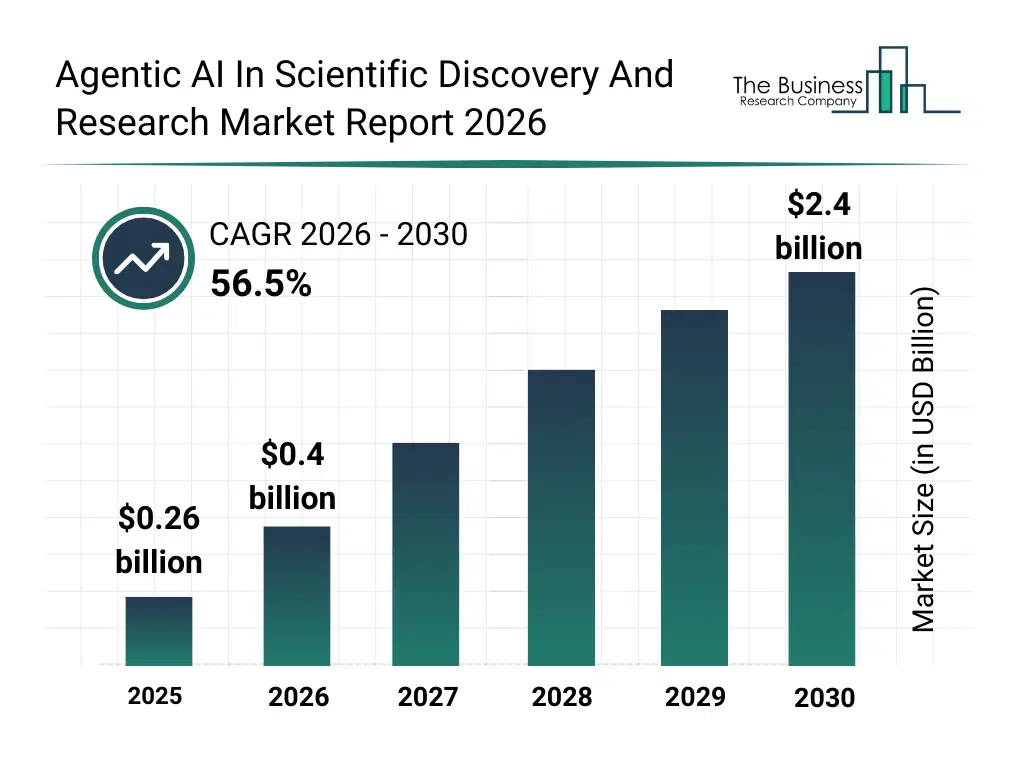
What Is The Agentic AI In Scientific Discovery And Research Market Size and Share 2026?
The agentic AI in scientific discovery and research market size has grown exponentially in recent years. It will grow from $0.26 billion in 2025 to $0.4 billion in 2026 at a compound annual growth rate (CAGR) of 57.0%. The growth in the historic period can be attributed to early adoption of data analytics in research, growth of machine learning platforms, expansion of digital research databases, increasing research complexity, demand for faster discovery cycles.What Is The Agentic AI In Scientific Discovery And Research Market Growth Forecast?
The agentic AI in scientific discovery and research market size is expected to see exponential growth in the next few years. It will grow to $2.4 billion in 2030 at a compound annual growth rate (CAGR) of 56.5%. The growth in the forecast period can be attributed to advancement of agentic AI models, growth of autonomous laboratories, rising investment in AI research tools, demand for accelerated innovation, integration of AI with scientific infrastructure. Major trends in the forecast period include autonomous research workflow execution, AI driven hypothesis generation, self directed experimental design, continuous learning research agents, cross domain scientific reasoning.
Global Agentic AI In Scientific Discovery And Research Market Segmentation
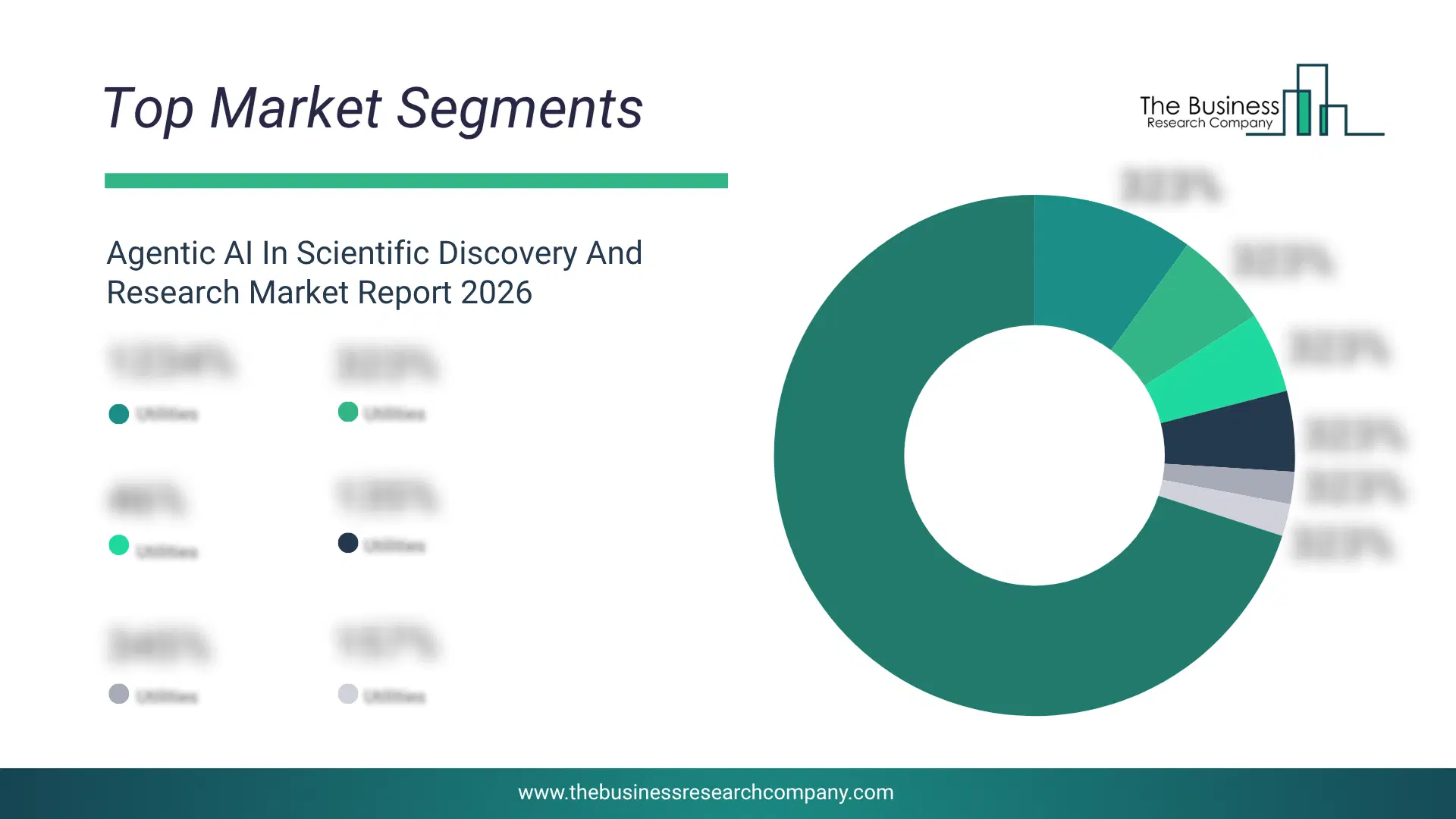
1) By Component: Software, Services 2) By Deployment Mode: On-Premises, Cloud-Based 3) By Industry Type: Healthcare And Pharmaceuticals, Information Technology And Telecom, Manufacturing, Other Industries Subsegments: 1) By Software: Research And Development Software, Data Analytics Software, Machine Learning Platforms, Natural Language Processing (NLP) Software, Predictive Analytics Software 2) By Services: Consulting Services, Integration Services, Managed Services, Training And Support ServicesWhat Is The Driver Of The Agentic AI In Scientific Discovery And Research Market?
The increasing demand for automation is anticipated to propel the growth of the agentic AI in the scientific discovery and research market going forward. Automation involves utilizing technology to carry out tasks or processes with little to no human involvement. Automation is rising because it significantly enhances efficiency, enabling businesses to complete repetitive tasks more quickly and accurately, thereby minimizing human error and lowering operational costs. Agentic AI accelerates scientific discovery and research in automation by autonomously generating hypotheses, designing experiments, and optimizing processes with minimal human intervention.For instance, in September 2024, according to the International Federation of Robotics (IFR), a Germany-based non-profit organization, the World Robotics report recorded 4,281,585 robots in operation globally, a 10% increase, with annual installations exceeding half a million units for the third consecutive year. In 2023, 70% of new robots were deployed in Asia, 17% in Europe, and 10% in the Americas. Therefore, the increasing demand for automation will boost the growth of the agentic AI in the scientific discovery and research market.Key Players In The Global Agentic AI In Scientific Discovery And Research Market
Major companies operating in the agentic AI in scientific discovery and research market are Microsoft Corporation, Amazon Web Services Inc., Intel Corporation, IBM Corporation, NVIDIA Corporation, OpenAI LLC, DeepMind Technologies Limited, UiPath Inc., DataRobot Inc., Insilico Medicine Inc., Recursion Pharmaceuticals Inc., Cohere Inc., Causaly Ltd, Nimbus Therapeutics LLC, PostEra Inc., Beam AI Inc., Auransa Inc., Extensity AI Inc., Inquisite Innovations Private Limited, Valence Labs Private Limited.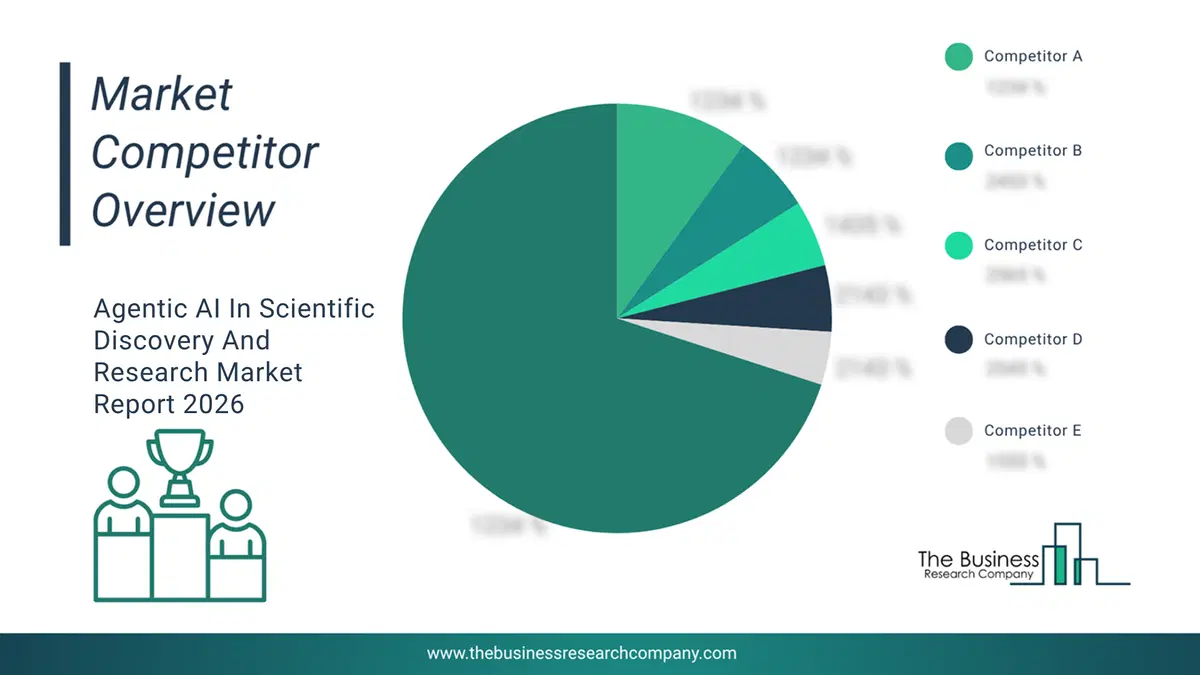
This chart is for illustrative purposes; the full report includes a detailed competitor analysis and comprehensive overview of the top 10 companies in the market.
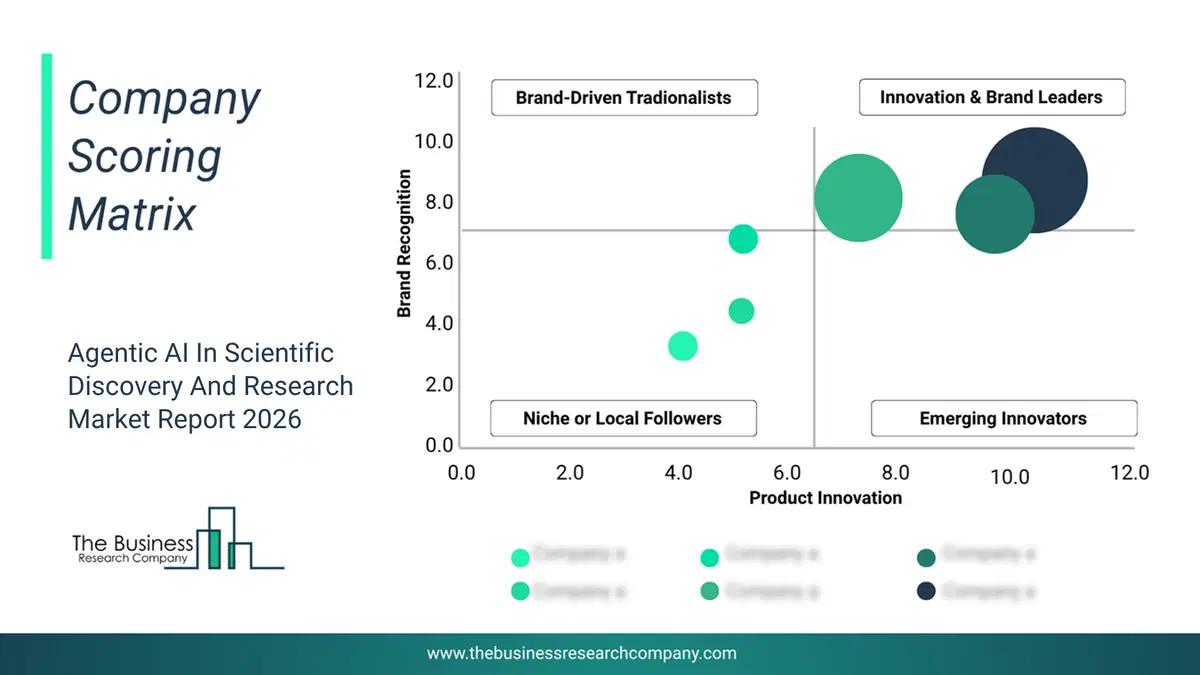
This chart maps companies by product innovation and brand strength, with bubble size indicating relative revenue, helping identify market leaders, challengers, and niche players. This is an illustrative chart; the full report provides a complete and accurate competitive analysis.
Global Agentic AI In Scientific Discovery And Research Market Trends and Insights
Major companies operating in the agentic AI in scientific discovery and research market are focusing on developing technologically advanced solutions, such as multi-agent systems, to enhance robustness and fault tolerance. A multi-agent system (MAS) is a network of autonomous agents that interact and collaborate to achieve common or individual goals, often used to solve complex problems through coordination and communication. For instance, in February 2025, Google LLC, a US-based IT corporation, launched an Agentic AI Co-Scientist. Built on Google’s Gemini 2.0 model, this Agentic AI Co-Scientist is capable of generating novel hypotheses, designing experiments, and replicating complex scientific findings in a fraction of the time it takes human researchers. Its unique strength lies in its ability to scale test-time compute, dedicating significant computational resources during inference for deeper reasoning. The system follows a generate, debate, and evolve approach, where hypotheses are tested in simulated debates and refined through iterative feedback. This self-improving cycle enhances the quality and accuracy of research hypotheses over time.What Are Latest Mergers And Acquisitions In The Agentic AI In Scientific Discovery And Research Market?
In February 2025, DataRobot Inc., a US-based software company, acquired Agnostiq Inc. for an undisclosed amount. Through this acquisition, DataRobot seeks to speed up the adoption of agentic AI by incorporating Agnostiq’s open-source Covalent platform. This integration is designed to simplify compute orchestration across multi-cloud and hybrid setups, helping to lower costs and reduce operational complexity. Agnostiq Inc. is a Canada-based provider of agentic AI in scientific discovery and research.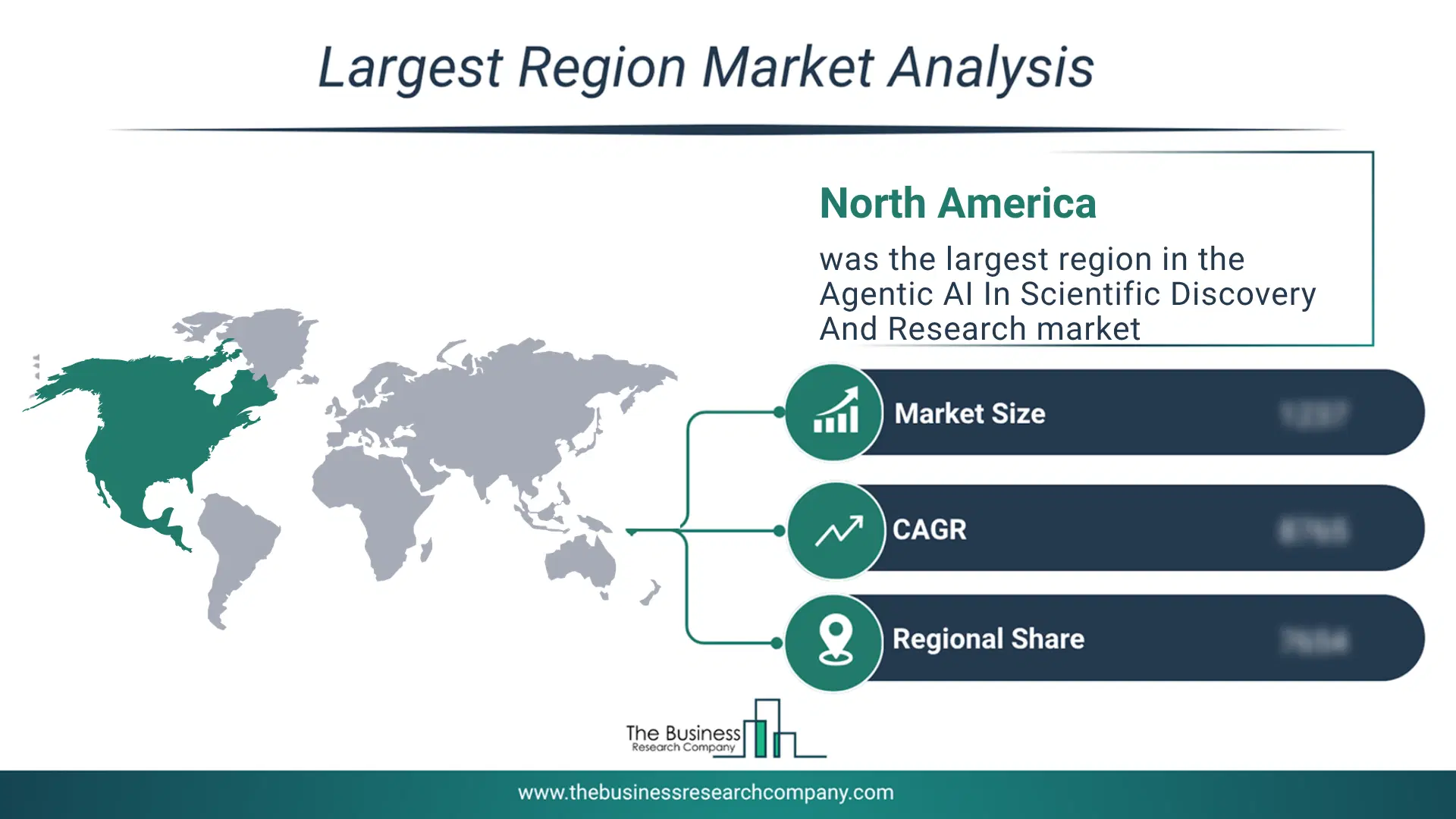
Regional Insights
North America was the largest region in the agentic AI in scientific discovery and research market in 2025. The regions covered in this market report are Asia-Pacific, South East Asia, Western Europe, Eastern Europe, North America, South America, Middle East, Africa. The countries covered in this market report are Australia, Brazil, China, France, Germany, India, Indonesia, Japan, Taiwan, Russia, South Korea, UK, USA, Canada, Italy, Spain.What Defines the Agentic AI In Scientific Discovery And Research Market?
The agentic AI in scientific discovery and research market consists of revenues earned by entities by providing services such as autonomous hypothesis generation, automated experimental design, data collection and analysis, simulation and modeling. The market value includes the value of related goods sold by the service provider or included within the service offering. The agentic AI in scientific discovery and research market also includes sales of autonomous laboratory systems, scientific discovery agents, knowledge mining, and insight engines. Values in this market are ‘factory gate’ values, that is the value of goods sold by the manufacturers or creators of the goods, whether to other entities (including downstream manufacturers, wholesalers, distributors and retailers) or directly to end customers. The value of goods in this market includes related services sold by the creators of the goods.How is Market Value Defined and Measured?
The market value is defined as the revenues that enterprises gain from the sale of goods and/or services within the specified market and geography through sales, grants, or donations in terms of the currency (in USD unless otherwise specified). The revenues for a specified geography are consumption values that are revenues generated by organizations in the specified geography within the market, irrespective of where they are produced. It does not include revenues from resales along the supply chain, either further along the supply chain or as part of other products.
This chart presents market attractiveness based on a quantitative evaluation of growth, competition, strategic alignment, and risk, offering a clear view of opportunity areas for decision-making. This chart is for illustrative purposes; the full report contains the complete analysis.

This chart highlights the Total Addressable Market (TAM) by estimating the maximum revenue opportunity using an assumption-driven approach, supporting strategic planning and opportunity sizing across markets. The chart is illustrative; the full report provides a more comprehensive analysis.
What Key Data and Analysis Are Included in the Agentic AI In Scientific Discovery And Research Market Report 2026?
The agentic ai in scientific discovery and research market research report is one of a series of new reports from The Business Research Company that provides market statistics, including industry global market size, regional shares, competitors with the market share, detailed market segments, market trends and opportunities, and any further data you may need to thrive in the agentic ai in scientific discovery and research industry. The market research report delivers a complete perspective of everything you need, with an in-depth analysis of the current and future state of the industry.Agentic AI In Scientific Discovery And Research Market Report Forecast Analysis
| Report Attribute | Details |
|---|---|
| Market Size Value In 2026 | $0.4 billion |
| Revenue Forecast In 2030 | $2.4 billion |
| Growth Rate | CAGR of 56.5% from 2026 to 2030 |
| Base Year For Estimation | 2025 |
| Actual Estimates/Historical Data | 2020-2025 |
| Forecast Period | 2026 - 2030 |
| Market Representation | Revenue in USD Billion and CAGR from 2026 to 2030 |
| Segments Covered | Component, Deployment Mode, Industry Type |
| Regional Scope | Asia-Pacific, Western Europe, Eastern Europe, North America, South America, Middle East, Africa |
| Country Scope | The Countries Covered In This Market Report Are Australia, Brazil, China, France, Germany, India, Indonesia, Japan, Taiwan, Russia, South Korea, Uk, Usa, Canada, Italy, Spain. |
| Key Companies Profiled | Microsoft Corporation, Amazon Web Services Inc., Intel Corporation, IBM Corporation, NVIDIA Corporation, OpenAI LLC, DeepMind Technologies Limited, UiPath Inc., DataRobot Inc., Insilico Medicine Inc., Recursion Pharmaceuticals Inc., Cohere Inc., Causaly Ltd, Nimbus Therapeutics LLC, PostEra Inc., Beam AI Inc., Auransa Inc., Extensity AI Inc., Inquisite Innovations Private Limited, Valence Labs Private Limited. |
| Customization Scope | Request for Customization |
| Pricing And Purchase Options | Explore Purchase Options |