

Agentic Artificial Intelligence (AI) Orchestration And Memory Systems Market Report 2026
Global Outlook – By Solution Type (Orchestration Frameworks, Memory Layers Or Vector Databases (DBs), Workflow Engines, Context-Management Software Development Kits (SDKs), Observability, Testing Tools), By Deployment Mode (Cloud, On-Premises Or Self-Hosted), By Organization Size (Large Enterprises, Small And Medium Enterprises (SME)), By Application (Autonomous Task Execution, Collaborative Multi-Agent Research, Stateful Customer Interaction, Predictive Industrial – Market Size, Trends, Strategies, and Forecast to 2030
Agentic Artificial Intelligence (AI) Orchestration And Memory Systems Market Overview
• Agentic Artificial Intelligence (AI) Orchestration And Memory Systems market size has reached to $6.49 billion in 2025 • Expected to grow to $33.54 billion in 2030 at a compound annual growth rate (CAGR) of 38.9% • Growth Driver: Surge In Autonomous System Adoption Fueling The Growth Of The Market Due To Enhanced Efficiency And Independent Decision-Making • Market Trend: Enterprise-Grade Multi-Agent Orchestration Platforms Advancing Agentic AI Workflows And Memory Systems • North America was the largest region in 2025 and Asia-Pacific is the fastest growing region.Market Gains By 2030 – Top Opportunities By Segment
Market Gain identifies the most promising market opportunities by highlighting the segments or products expected to generate the highest incremental revenue growth over the next five years.
What Is Covered Under Agentic Artificial Intelligence (AI) Orchestration And Memory Systems Market?
Agentic artificial intelligence (AI) orchestration and memory systems are frameworks that coordinate autonomous AI agents for task planning, execution, and adaptation using integrated reasoning and multi-agent collaboration. They feature layered memory short-term, long-term, and episodic to enable stateful operations, self-improvement, and cohesive workflows in dynamic environments. The main solution types of agentic artificial intelligence (AI) orchestration and memory systems include orchestration frameworks, memory layers or vector databases (DBs), workflow engines, context-management software development kits (SDKs), observability, and testing tools. Orchestration frameworks refer to platforms that coordinate and manage the interactions, tasks, and memory usage of multiple AI agents to enable autonomous, intelligent, and context-aware operations. These solutions can be deployed through cloud or on-premises/self-hosted modes. The adoption spans organizations of different sizes, including large enterprises and small and medium enterprises. The various applications involved include autonomous task execution, collaborative multi-agent research, stateful customer interaction, predictive industrial adaptation, and dynamic supply chain coordination, utilized by end users such as information technology and telecom, banking, financial services and insurance, healthcare and life sciences, retail and electronic commerce, manufacturing, and other end users.
What Is The Agentic Artificial Intelligence (AI) Orchestration And Memory Systems Market Size and Share 2026?
The agentic artificial intelligence (AI) orchestration and memory systems market size has grown exponentially in recent years. It will grow from $6.49 billion in 2025 to $9 billion in 2026 at a compound annual growth rate (CAGR) of 38.7%. The growth in the historic period can be attributed to advances in autonomous agents, early adoption of workflow automation, growth of AI research platforms, need for stateful AI systems, expansion of cloud AI tools.What Is The Agentic Artificial Intelligence (AI) Orchestration And Memory Systems Market Growth Forecast?
The agentic artificial intelligence (AI) orchestration and memory systems market size is expected to see exponential growth in the next few years. It will grow to $33.54 billion in 2030 at a compound annual growth rate (CAGR) of 38.9%. The growth in the forecast period can be attributed to enterprise agent deployment, demand for long term memory systems, AI workforce automation, predictive industrial adaptation, real time decision automation. Major trends in the forecast period include multi-agent task orchestration, persistent contextual memory layers, autonomous workflow coordination, agent observability and control, human-in-the-loop integration.
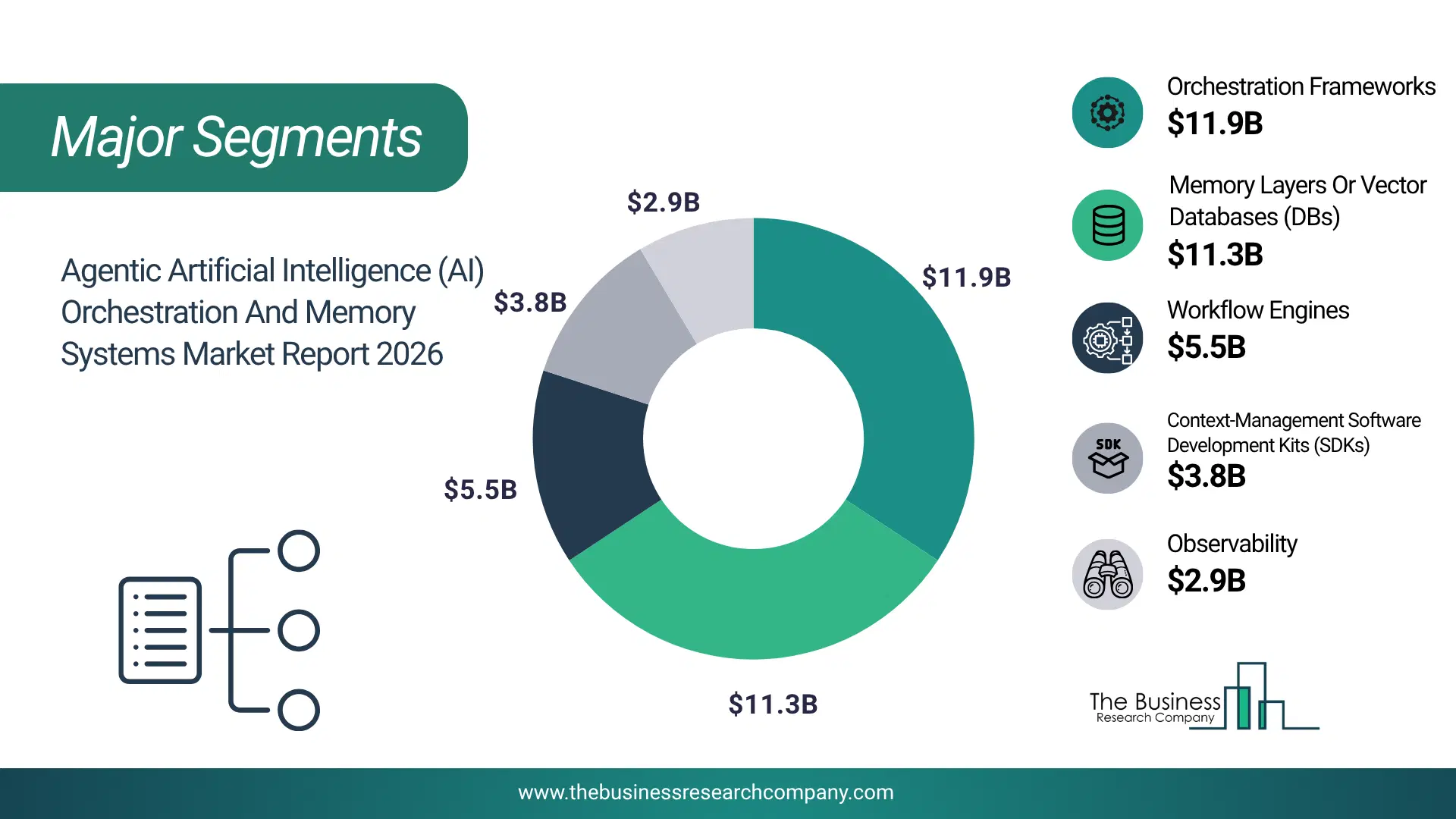
Global Agentic Artificial Intelligence (AI) Orchestration And Memory Systems Market Segmentation
1) By Solution Type: Orchestration Frameworks, Memory Layers Or Vector Databases (DBs), Workflow Engines, Context-Management Software Development Kits (SDKs), Observability, Testing Tools 2) By Deployment Mode: Cloud, On-Premises Or Self-Hosted 3) By Organization Size: Large Enterprises, Small And Medium Enterprises (SME) 4) By Application: Autonomous Task Execution, Collaborative Multi-Agent Research, Stateful Customer Interaction, Predictive Industrial Adaptation, Dynamic Supply Chain Coordination 5) By End-User Industry: Information Technology And Telecom, Banking, Financial Services, And Insurance (BFSI), Healthcare And Life Sciences, Retail And Electronic Commerce (E-Commerce), Manufacturing, Other End-Users Subsegments: 1) By Orchestration Frameworks: Multi Agent Coordination Platforms, Autonomous Task Planners, Agent Swarm Management Systems, Adaptive Prompt Engineers 2) By Memory Layers/Vector DBs: High Dimensional Vector Databases, Long Term Episodic Memory Systems, Semantic Knowledge Graphs, Distributed Metadata Storage 3) By Workflow Engines: Event Driven Logic Sequencers, Dynamic Computational Graph Managers, Human In The Loop Integration Modules, Deterministic State Machines 4) By Context-Management SDKs: Real Time Session State Managers, Intelligent Context Window Optimizers, Cross Application Data Synchronizers, Dynamic Retrieval Augmented Generation Controllers 5) By Observability: Agentic Reasoning Trace Analytics, Real Time Performance Monitoring Dashboards, Token Consumption And Cost Trackers, Behavior Anomaly Detection Systems 6) By Testing Tools: Automated Scenario Simulation Environments, Adversarial Evaluation Frameworks, Agentic Output Validation Suites, Benchmarking And Performance Stress Testers The top segments in the agentic artificial intelligence (ai) orchestration and memory systems market will be: • Orchestration Frameworks will reach $11.85 billion by 2030. • Memory Layers Or Vector Databases (DBs) will reach $11.22 billion by 2030. • Workflow Engines will reach $5.42 billion by 2030. • Context-Management Software Development Kits (SDKs) will reach $3.72 billion by 2030. • Observability will reach $2.86 billion by 2030.What Is The Driver Of The Agentic Artificial Intelligence (AI) Orchestration And Memory Systems Market?
The increasing adoption of autonomous systems is expected to propel the growth of the agentic AI orchestration and memory systems market going forward. Autonomous systems are technologies that can independently perceive their environment, make decisions, and take actions to achieve defined goals with minimal or no human intervention, adapting dynamically to changing conditions. The rise in adoption of autonomous systems is due to improved operational efficiency, as they can perform complex tasks independently with minimal human intervention, reducing errors and accelerating decision-making processes. Agentic AI orchestration and memory systems help autonomous systems by enabling coordinated decision-making, long-term contextual memory, and adaptive action execution, allowing them to operate independently, learn from past interactions, and respond intelligently to dynamic environments. For instance, in October 2024, according to the Department for Science, Innovation & Technology, a UK-based government agency, in 2023, companies primarily involved in autonomous systems accounted for 8% of all firms, up from 6% in 2022. Therefore, the increasing adoption of autonomous systems is driving the growth of the agentic AI orchestration and memory systems market.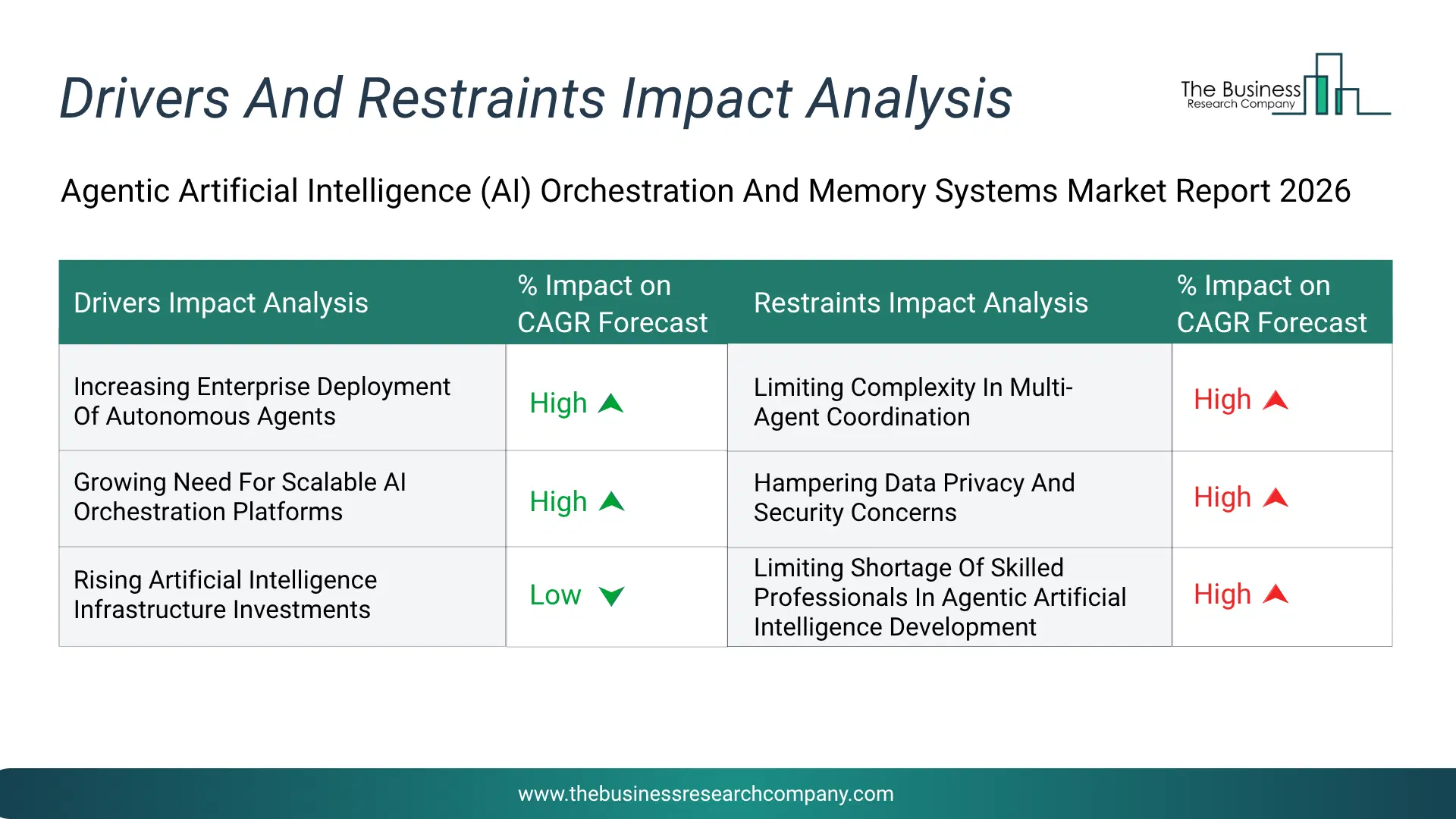
Infographic Chart Showing Key Market Drivers Analysis And Restraints For Agentic Artificial Intelligence (Ai) Orchestration And Memory Systems Market
The chart presents an impact analysis of key drivers and restraints, quantifying their relative influence on the market's growth rate and helping assess the balance between growth enablers and limiting factors. This chart offers a high-level perspective; the full report contains more detailed insights.
How Will The Drivers Impact Growth In The Global Agentic Artificial Intelligence (AI) Orchestration And Memory Systems Market?
• Increasing Enterprise Deployment Of Autonomous Agents (High) – During the forecast period, the increasing enterprise deployment of autonomous agents is expected to become a key growth driver for the agentic artificial intelligence (ai) orchestration and memory systems market by 2030. Organizations are rapidly adopting ai agents to automate complex workflows, reduce operational costs, and enhance productivity across business functions. These agents require robust orchestration systems and persistent memory capabilities to function effectively in dynamic environments. Enterprises are therefore investing in advanced frameworks that enable coordination, contextual awareness, and continuous learning among agents. This widespread adoption is reinforcing strong market expansion. • Growing Need For Scalable AI Orchestration Platforms (High) – During the forecast period, the growing need for scalable ai orchestration platforms is expected to emerge as a major factor driving the expansion of the agentic artificial intelligence (ai) orchestration and memory systems market by 2030. As organizations deploy multiple ai agents across distributed environments, the demand for platforms that can efficiently manage, monitor, and scale these systems is increasing. Orchestration platforms enable seamless integration of agents, data pipelines, and enterprise systems while ensuring reliability and performance. This scalability requirement is particularly critical for large enterprises handling high volumes of real-time tasks. • Rising Artificial Intelligence Infrastructure Investments (Low) – During the forecast period, the rising artificial intelligence infrastructure investments are expected to act as a key growth catalyst for the agentic artificial intelligence (ai) orchestration and memory systems market by 2030. Enterprises and cloud providers are significantly increasing spending on ai infrastructure, including high-performance computing, data storage, and vector databases, to support advanced ai workloads. These investments enable the development of sophisticated memory systems and orchestration tools that enhance agent performance and contextual intelligence. Additionally, the expansion of ai infrastructure supports faster deployment and scaling of agentic systems across industries.How Will The Restraints Impact Growth In The Global Agentic Artificial Intelligence (AI) Orchestration And Memory Systems Market?
• Limiting Complexity In Multi-Agent Coordination (High) – During the forecast period, the limiting complexity in multi-agent coordination acts as a key restraint for the market because coordinating multiple autonomous agents in dynamic environments is inherently challenging. As the number of agents and tasks grows, the orchestration platforms may struggle to manage dependencies, avoid conflicts, and maintain stateful memory efficiently. This technical complexity can slow enterprise adoption, as organizations may hesitate to implement systems that require high levels of expertise and careful tuning. The difficulty in handling complex multi-agent interactions restrains the pace of market expansion and limits large-scale deployment of agentic ai solutions. • Hampering Data Privacy And Security Concerns (High) – During the forecast period, the hampering data privacy and security concerns restrains market growth because agentic ai orchestration and memory systems often store, process, and share sensitive organizational data across multiple agents and memory layers. Concerns about unauthorized access, persistent memory leaks, and regulatory compliance can delay adoption, especially in sectors like finance, healthcare, and government. Enterprises may avoid implementing these systems until robust privacy, encryption, and access-control mechanisms are proven. Consequently, market growth is slowed as vendors must invest heavily in security features to gain trust. • Limiting Shortage Of Skilled Professionals In Agentic Artificial Intelligence Development (High) – During the forecast period, the limiting shortage of skilled professionals in agentic artificial intelligence development acts as a major restraint because designing, implementing, and maintaining agentic ai orchestration systems requires specialized expertise in ai, multi-agent coordination, and memory management. The lack of trained professionals makes it difficult for organizations to adopt these systems at scale, slowing integration and deployment timelines. Additionally, the scarcity of talent can increase development and customization costs, further restraining market growth. This talent bottleneck remains a significant barrier to widespread commercialization and enterprise-level adoption.Key Players In The Global Agentic Artificial Intelligence (AI) Orchestration And Memory Systems Market
Major companies operating in the agentic artificial intelligence (AI) orchestration and memory systems market are Amazon Web Services Inc., Google LLC, Microsoft Corporation, International Business Machines Corporation, Salesforce Inc., OpenAI LLC, ServiceNow Inc., Pegasystems Inc., UiPath Inc., Anthropic PBC, Celonis SE, Appian Corporation, Zapier Inc., Temporal Technologies Inc., LangChain Technologies Ltd., Pinecone Systems Inc., Cognition AI Inc., Orq.ai BV, CrewAI Labs Inc., Dust Labs Inc., Fixie AI Inc., Qdrant Technologies GmbH, Relevance AI Pty Ltd.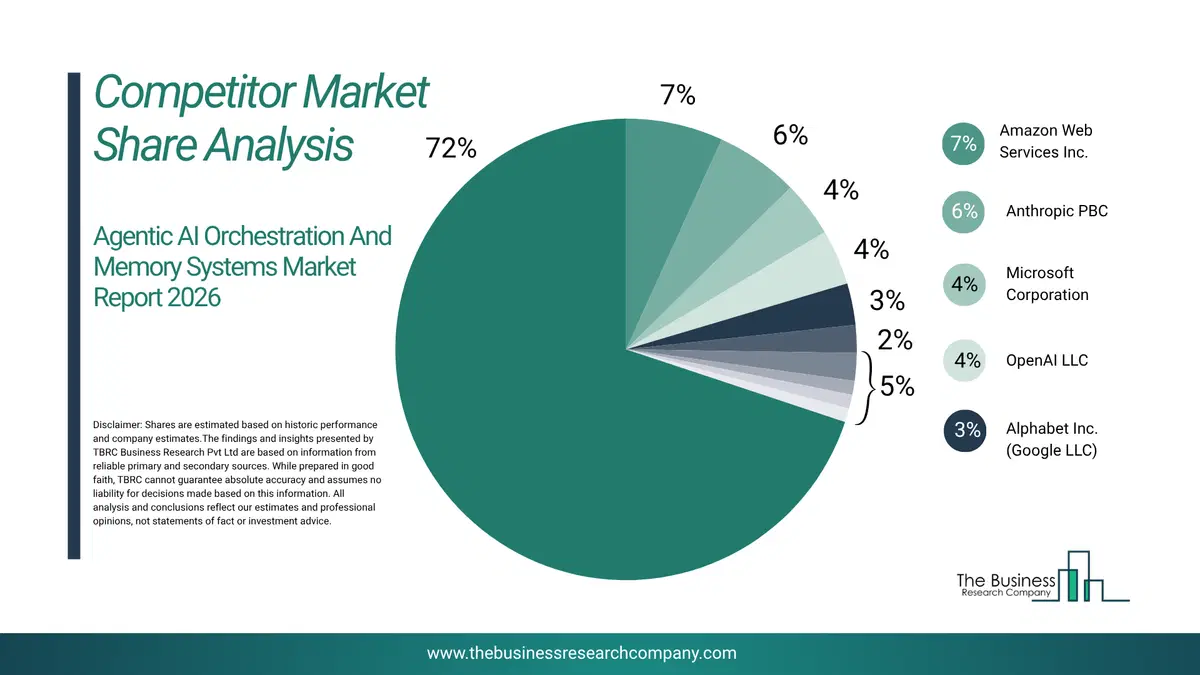
This chart is for illustrative purposes; the full report includes a detailed competitor analysis and comprehensive overview of the top 10 companies in the market.
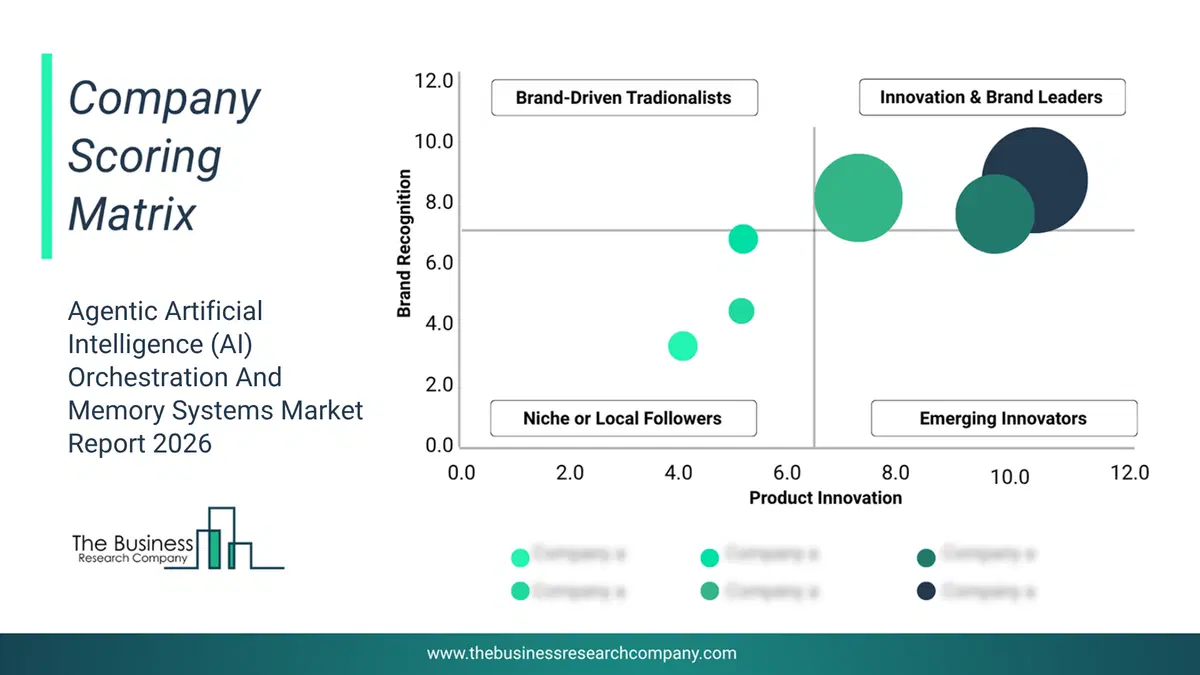
This chart maps companies by product innovation and brand strength, with bubble size indicating relative revenue, helping identify market leaders, challengers, and niche players. This is an illustrative chart; the full report provides a complete and accurate competitive analysis.
Global Agentic Artificial Intelligence (AI) Orchestration And Memory Systems Market Trends and Insights
Major companies operating in the agentic AI orchestration and memory systems market are focusing on developing innovative solutions, such as enterprise-grade multi-agent orchestration platforms, to enable autonomous task execution, coordinated decision-making, and scalable integration across complex enterprise workflows. Multi-agent orchestration platforms unify numerous intelligent agents, each capable of specialized tasks, into a coordinated system that manages workflows, memory stores (for stateful interactions), and context retention far beyond traditional single-AI models or rule-based automation tools, offering dynamic task assignment, persistent memory, and seamless interoperability across enterprise systems. For instance, in March 2025, Kore.AI Inc., a US-based provider of advanced AI technology, launched the Kore.ai Agent Platform, an innovative agentic AI orchestration platform designed for building, deploying, and managing sophisticated agentic applications at scale in enterprise environments. This platform features advanced multi-agent orchestration that enables seamless coordination between agents with varying autonomy levels, integrates enterprise and user context via 100+ prebuilt connectors and graph-RAG-powered search, and supports both no-code and pro-code development tools for rapid AI application creation. It is an end-to-end unified platform with an agent marketplace, robust memory management for contextual interactions, a flexible autonomy spectrum from guided to fully autonomous agents, and cross-platform interoperability supported by a standardized agent communication API.What Are Latest Mergers And Acquisitions In The Agentic Artificial Intelligence (AI) Orchestration And Memory Systems Market?
In March 2025, UiPath Inc., a US-based technology company, acquired Peak for an undisclosed amount. With this acquisition, UiPath aims to enhance its Agentic Automation Platform by embedding vertically specialized, decision-intelligent AI agents that combine automation with advanced predictive and prescriptive analytics, enabling enterprises to drive more context-aware, industry-specific outcomes. Peak AI Ltd is a UK-based company that provides agentic AI orchestration and memory systems designed for inventory-intensive businesses.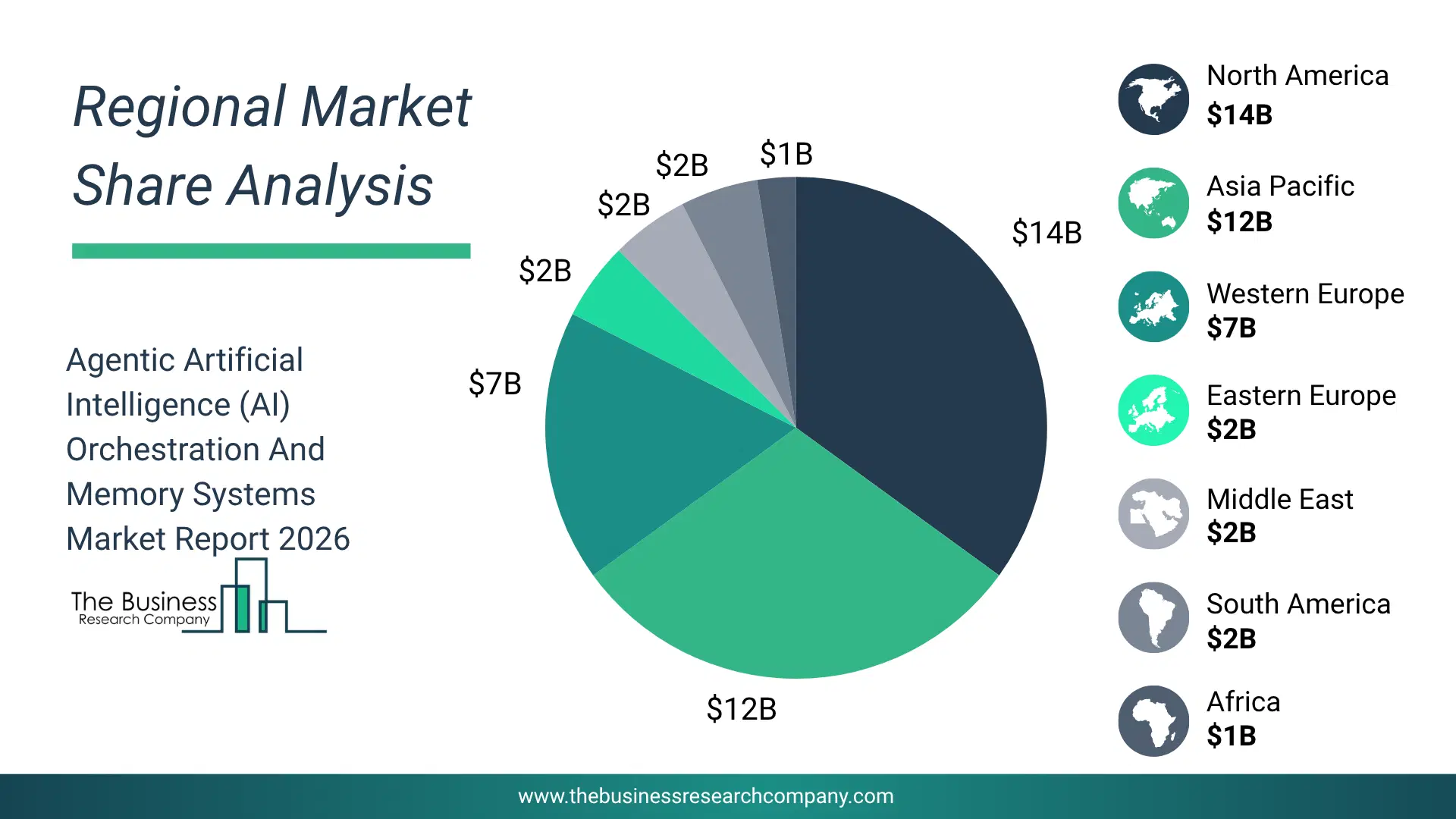
Regional Outlook
North America was the largest region in the agentic AI orchestration and memory systemss market in 2025. Asia-Pacific is expected to be the fastest-growing region in the forecast period. The regions covered in this market report are Asia-Pacific, South East Asia, Western Europe, Eastern Europe, North America, South America, Middle East, Africa. The countries covered in this market report are Australia, Brazil, China, France, Germany, India, Indonesia, Japan, Taiwan, Russia, South Korea, UK, USA, Canada, Italy, Spain.What Defines the Agentic Artificial Intelligence (AI) Orchestration And Memory Systems Market?
The agentic artificial intelligence orchestration and memory systems market consists of sales of agent orchestration software platforms, artificial intelligence memory management systems, multi-agent coordination frameworks, context retention and retrieval solutions, workflow automation engines, and integration tools. Values in this market are ‘factory gate’ values, that is, the value of goods sold by the manufacturers or creators of the goods, whether to other entities (including downstream manufacturers, wholesalers, distributors, and retailers) or directly to end customers. The value of goods in this market includes related services sold by the creators of the goods.How is Market Value Defined and Measured?
The market value is defined as the revenues that enterprises gain from the sale of goods and/or services within the specified market and geography through sales, grants, or donations in terms of the currency (in USD unless otherwise specified). The revenues for a specified geography are consumption values that are revenues generated by organizations in the specified geography within the market, irrespective of where they are produced. It does not include revenues from resales along the supply chain, either further along the supply chain or as part of other products.
This chart presents market attractiveness based on a quantitative evaluation of growth, competition, strategic alignment, and risk, offering a clear view of opportunity areas for decision-making. This chart is for illustrative purposes; the full report contains the complete analysis.

This chart highlights the Total Addressable Market (TAM) by estimating the maximum revenue opportunity using an assumption-driven approach, supporting strategic planning and opportunity sizing across markets. The chart is illustrative; the full report provides a more comprehensive analysis.
What Key Data and Analysis Are Included in the Agentic Artificial Intelligence (AI) Orchestration And Memory Systems Market Report 2026?
The agentic artificial intelligence (ai) orchestration and memory systems market research report is one of a series of new reports from The Business Research Company that provides market statistics, including industry global market size, regional shares, competitors with the market share, detailed market segments, market trends and opportunities, and any further data you may need to thrive in the agentic artificial intelligence (ai) orchestration and memory systems industry. The market research report delivers a complete perspective of everything you need, with an in-depth analysis of the current and future state of the industry.Agentic Artificial Intelligence (AI) Orchestration And Memory Systems Market Report Forecast Analysis
| Report Attribute | Details |
|---|---|
| Market Size Value In 2026 | $9 billion |
| Revenue Forecast In 2030 | $33.54 billion |
| Growth Rate | CAGR of 38.9% from 2026 to 2030 |
| Base Year For Estimation | 2025 |
| Actual Estimates/Historical Data | 2020-2025 |
| Forecast Period | 2026 - 2030 |
| Market Representation | Revenue in USD Billion and CAGR from 2026 to 2030 |
| Segments Covered | Solution Type, Deployment Mode, Organization Size, Application, End-User Industry |
| Regional Scope | Asia-Pacific, Western Europe, Eastern Europe, North America, South America, Middle East, Africa |
| Country Scope | The countries covered in the report are Australia, Brazil, China, France, Germany, India, ... |
| Key Companies Profiled | Amazon Web Services Inc., Google LLC, Microsoft Corporation, International Business Machines Corporation, Salesforce Inc., OpenAI LLC, ServiceNow Inc., Pegasystems Inc., UiPath Inc., Anthropic PBC, Celonis SE, Appian Corporation, Zapier Inc., Temporal Technologies Inc., LangChain Technologies Ltd., Pinecone Systems Inc., Cognition AI Inc., Orq.ai BV, CrewAI Labs Inc., Dust Labs Inc., Fixie AI Inc., Qdrant Technologies GmbH, Relevance AI Pty Ltd. |
| Customization Scope | Request for Customization |
| Pricing And Purchase Options | Explore Purchase Options |