
Agricultural Chelates Market Report 2026
Global Outlook – By Type (EDTA (Ethylenediaminetetraacetic Acid), EDDHA (Ethylenediamine-N,N′-bis (2-Hydroxyphenylacetic Acid), DTPA (Diethylenetriamine Pentaacetate), IDHA (Imidodisuccinic Acid), Other Types), By Crop Type (Cereals And Grains, Oilseeds And Pulses, Fruits And Vegetable, Other Crop Types), By Application (Soil, Foliar, Hydroponics, Other Applications) – Market Size, Trends, Strategies, and Forecast to 2030
Agricultural Chelates Market Overview
• Agricultural Chelates market size has reached to $1.32 billion in 2025 • Expected to grow to $1.94 billion in 2030 at a compound annual growth rate (CAGR) of 8% • Growth Driver: Increasing Crop Production Fuels Growth In Agricultural Chelates Market • Market Trend: Focus On Sustainable And Bioactive Chelation Technologies To Enhance Crop Nutrition Efficiency • Asia-Pacific was the largest region in 2025 and Europe is the fastest growing region.What Is Covered Under Agricultural Chelates Market?
Agricultural chelates are fertilizers that contain micronutrients such as iron, zInc., manganese, and copper, which are vital for plant growth and productivity. The application of chelated micronutrients has been shown to be an effective way to increase crop yields and their quality. The main types of agricultural chelates are EDTA (ethylenediaminetetraacetic acid), EDDHA (ethylenediamine-'-bis (2-hydroxyphenyl acetic acid), DTPA (diethylenetriamine pentaacetate), IDHA (imidodisuccinic acid), and other types. EDTA refers to fertilizers containing ethylenediaminetetraacetic acid, a chelating agent that assists in enhancing the efficiency of nutrient absorption in plants. The various crop types include cereals and grains, oilseeds and pulses, fruits and vegetables, and other crop types. These are used in various applications such as soil, foliar, hydroponics, and others applications.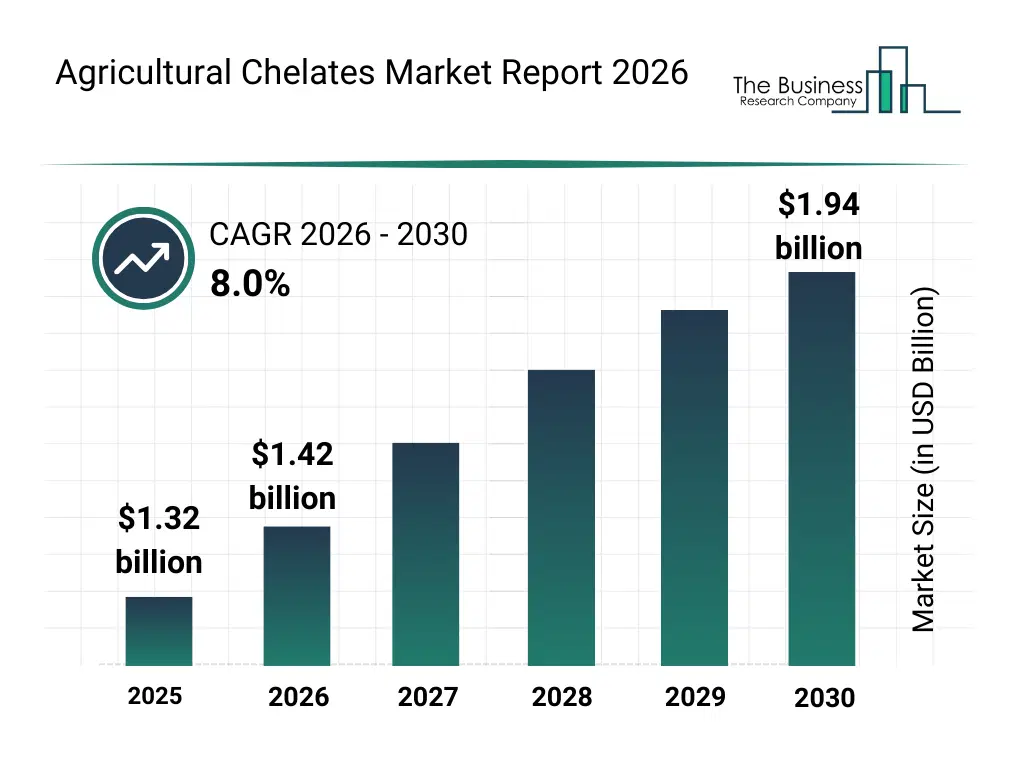
What Is The Agricultural Chelates Market Size and Share 2026?
The agricultural chelates market size has grown strongly in recent years. It will grow from $1.32 billion in 2025 to $1.42 billion in 2026 at a compound annual growth rate (CAGR) of 7.8%. The growth in the historic period can be attributed to need for enhanced micronutrient uptake, widespread soil micronutrient deficiencies, rise in intensive farming practices, increasing adoption of edta-based fertilizers, demand for improved crop quality.What Is The Agricultural Chelates Market Growth Forecast?
The agricultural chelates market size is expected to see strong growth in the next few years. It will grow to $1.94 billion in 2030 at a compound annual growth rate (CAGR) of 8.0%. The growth in the forecast period can be attributed to shift toward sustainable nutrient management, rising use of biodegradable chelates, growth in high-value crop cultivation, expansion of hydroponic and controlled-environment farming, increasing focus on efficient nutrient delivery systems. Major trends in the forecast period include rising adoption of chelated micronutrients for yield enhancement, increasing preference for iron-, zinc-, and calcium-based chelates, expansion of foliar and hydroponic application methods, growing use of chelates in high-value horticulture, development of eco-friendly and biodegradable chelate formulations.
Global Agricultural Chelates Market Segmentation
1) By Type: EDTA (Ethylenediaminetetraacetic Acid), EDDHA (Ethylenediamine-N,N'-bis (2-Hydroxyphenylacetic Acid), DTPA (Diethylenetriamine Pentaacetate), IDHA (Imidodisuccinic Acid), Other Types 2) By Crop Type: Cereals And Grains, Oilseeds And Pulses, Fruits And Vegetable, Other Crop Types 3) By Application: Soil, Foliar, Hydroponics, Other Applications Subsegments: 1) By EDTA (Ethylenediaminetetraacetic Acid): EDTA Calcium, EDTA Magnesium, EDTA Iron, EDTA Zinc 2) By EDDHA (Ethylenediamine-N,N'-bis (2-Hydroxyphenylacetic Acid)): EDDHA Iron, EDDHA Calcium 3) By DTPA (Diethylenetriamine Pentaacetate): DTPA Iron, DTPA Calcium 4) By IDHA (Imidodisuccinic Acid): IDHA Iron, IDHA Calcium 5) By Other Types: Organic Chelates, Synthetic ChelatesWhat Is Driver Of The Agricultural Chelates Market?
Increasing crop production is expected to drive the growth of the agricultural chelates market going forward. Crop production refers to the growing and harvesting of plants for food, fiber, and various agricultural products. Increasing crop production is driven by several factors, including population growth, food security, and economic development. Coatings designed for gradual nutrient release ensure that plants receive essential elements like nitrogen, phosphorus, and potassium throughout their growth cycle, maximizing nutrient uptake and reducing waste, which contributes to better crop growth. Chelates enhance photosynthesis by supplying iron and other essential micronutrients crucial for chlorophyll production, which directly contributes to increased plant growth and crop yield. For instance, in June 2024, according to the Department for Environment Food & Rural Affairs a UK-based government Department, In 2023, the largest value increase in a crop item was in potatoes, which saw an increase of £237 million ($296.25 million), or 30.8%, from 2022, bringing the total to £1,005 million ($1.26 billion) in 2023. Therefore, increasing crop production is driving the growth of the agricultural chelates industry.Key Players In The Global Agricultural Chelates Market
Major companies operating in the agricultural chelates market are Yara International ASA, Haifa Group, Nouryon Holding B.V., BASF SE, The Andersons Inc., Dow Inc., Nufarm Limited, ICL Group Ltd., Syngenta Group Co. Ltd., Aries Agro Limited, Akzo Nobel N.V., Valagro S.p.A., Deretil Agronutritional S.L., ATP Nutrition Ltd., Manvert S.L., BMS-Micronutrients NV, Mitsubishi Chemical Corporation, Innospec Inc., Shandong Iro Chelating Chemical Co. Ltd., Ava Chemicals Private Limited, Agmin Chelates, COMPO EXPERT GmbH, LidoChem Inc., Andersons Plant Nutrient Group, CHS Inc., Wilbur-Ellis Holdings Inc., Van Iperen International B.V., ADOB Haifa Ltd, Aquapharm Chemical Pvt. Ltd.
This chart is for illustrative purposes; the full report includes a detailed competitor analysis and comprehensive overview of the top 10 companies in the market.
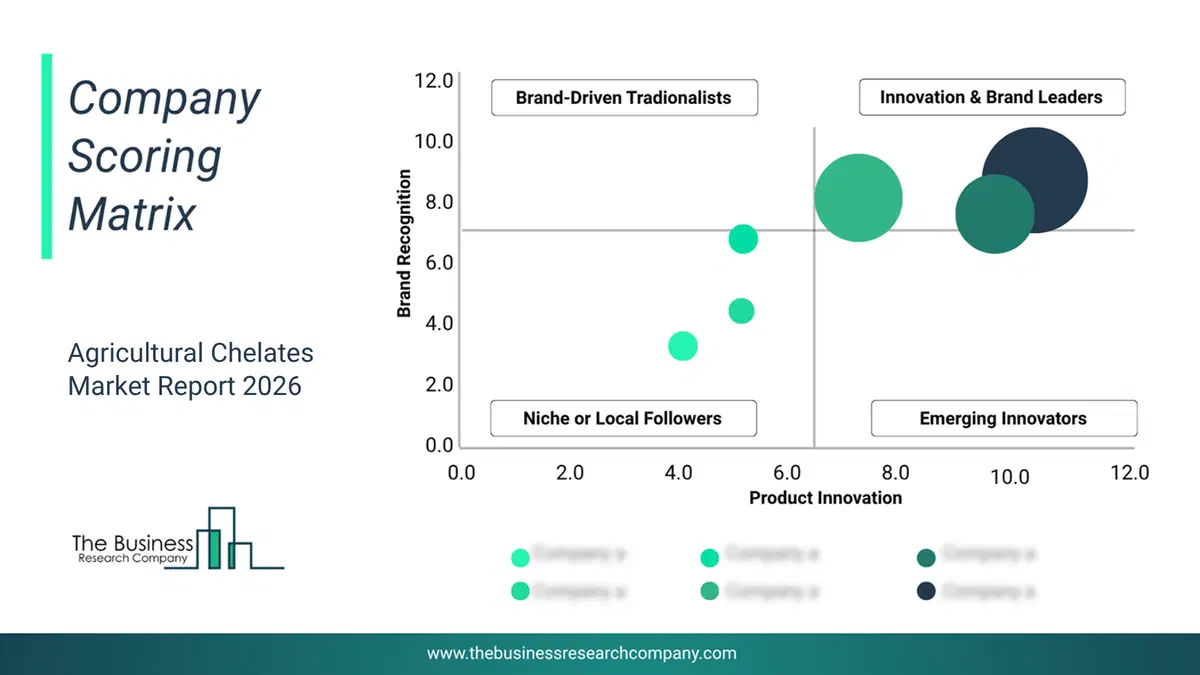
This chart maps companies by product innovation and brand strength, with bubble size indicating relative revenue, helping identify market leaders, challengers, and niche players. This is an illustrative chart; the full report provides a complete and accurate competitive analysis.
Global Agricultural Chelates Market Trends and Insights
Major companies operating in the agricultural chelates market are focusing on developing innovative solutions such as bioactive micronutrient chelates to enhance nutrient uptake efficiency, promote plant growth, and improve soil sustainability. Bioactive micronutrient chelate refers to a chelated compound that combines essential trace elements with bioactive molecules to improve nutrient availability, uptake, and utilization efficiency in plants while supporting soil and environmental health. For instance, in June 2023, ICL Group, an Israel-based specialty minerals company, launched an innovative chelate product that is both proven bioactive and biodegradable in soil. It enhances nutrient uptake and crop yields while naturally breaking down in soil, reducing environmental impact. It supports sustainable farming by improving nutrient efficiency and minimizing pollution from synthetic chelates. This product is designed to optimize crop nutrition precisely, benefiting both farmers and the ecosystem.What Are Latest Mergers And Acquisitions In The Agricultural Chelates Market? HGS Bioscience Acquires Nutriag To Strengthen North American Crop Nutrition Platform
In October 2025, HGS BioScience, a U.S.-based provider of biological and nutrient-based soil health solutions, acquired NutriAg for an undisclosed amount. With this acquisition, HGS BioScience aims to establish a comprehensive North American platform, enhancing its portfolio of crop nutrition technologies and expanding its distribution network across key agricultural markets. NutriAg is a Canada-based crop-technology company that offers agricultural chelates.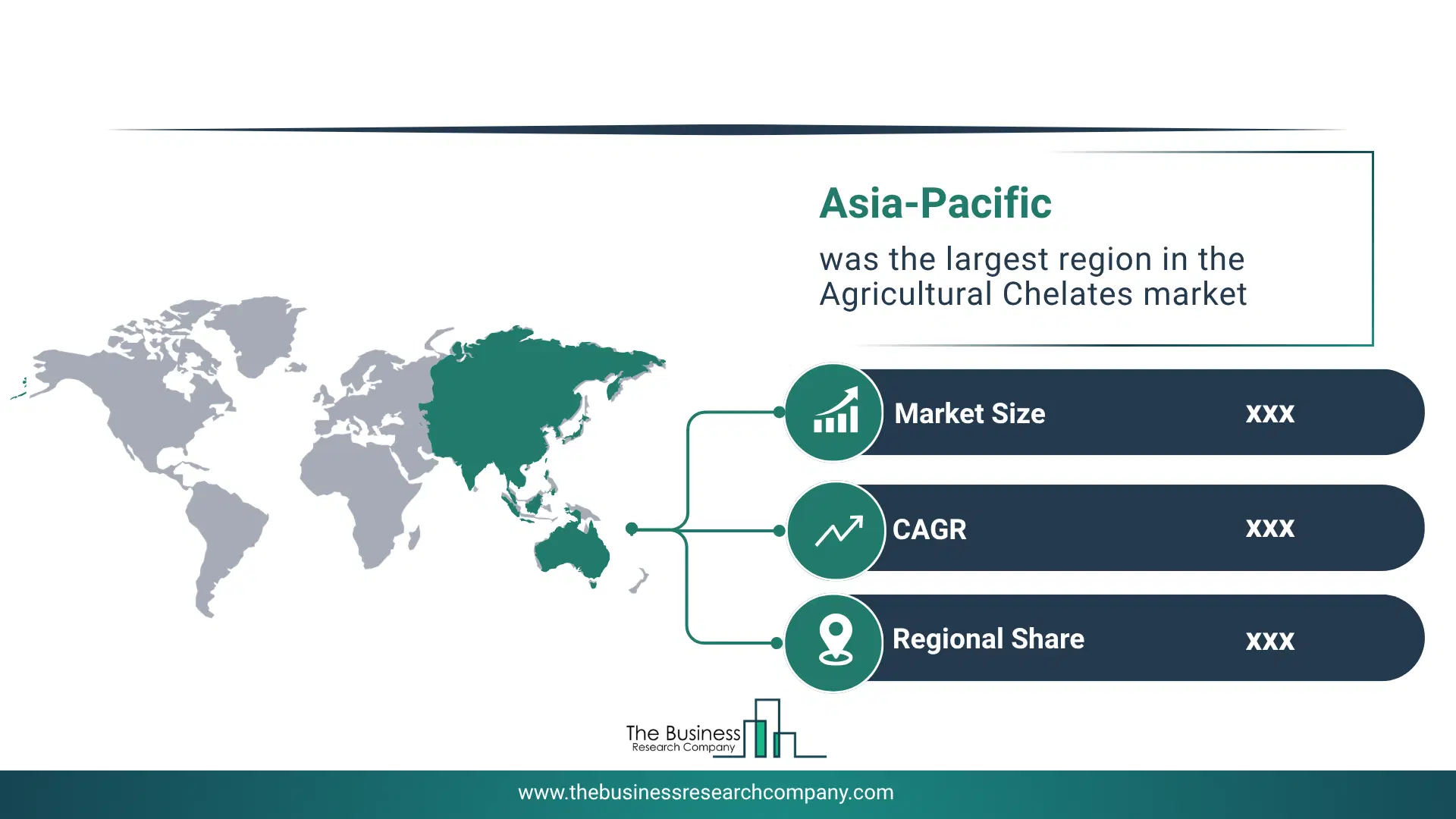
Regional Outlook
Asia-Pacific was the largest region in the agricultural chelates market in 2025.Europe is expected to be the fastest-growing region in the global agriculture chelates market report during the forecast period. The regions covered in this market report are Asia-Pacific, South East Asia, Western Europe, Eastern Europe, North America, South America, Middle East, Africa. The countries covered in this market report are Australia, Brazil, China, France, Germany, India, Indonesia, Japan, Taiwan, Russia, South Korea, UK, USA, Canada, Italy, SpainWhat Defines the Agricultural Chelates Market?
The agricultural chelates market consists of sales of chelated fertilizers containing micronutrients. Values in this market are ‘factory gate’ values, that is the value of goods sold by the manufacturers or creators of the goods, whether to other entities (including downstream manufacturers, wholesalers, distributors, and retailers) or directly to end customers. The value of goods in this market includes related services sold by the creators of the goods.How is Market Value Defined and Measured?
The market value is defined as the revenues that enterprises gain from the sale of goods and/or services within the specified market and geography through sales, grants, or donations in terms of the currency (in USD unless otherwise specified). The revenues for a specified geography are consumption values that are revenues generated by organizations in the specified geography within the market, irrespective of where they are produced. It does not include revenues from resales along the supply chain, either further along the supply chain or as part of other products.
This chart presents market attractiveness based on a quantitative evaluation of growth, competition, strategic alignment, and risk, offering a clear view of opportunity areas for decision-making. This chart is for illustrative purposes; the full report contains the complete analysis.

This chart highlights the Total Addressable Market (TAM) by estimating the maximum revenue opportunity using an assumption-driven approach, supporting strategic planning and opportunity sizing across markets. The chart is illustrative; the full report provides a more comprehensive analysis.
What Key Data and Analysis Are Included in the Agricultural Chelates Market Report 2026?
The agricultural chelates market research report is one of a series of new reports from The Business Research Company that provides market statistics, including industry global market size, regional shares, competitors with the market share, detailed market segments, market trends and opportunities, and any further data you may need to thrive in the agricultural chelates industry. The market research report delivers a complete perspective of everything you need, with an in-depth analysis of the current and future state of the industry.Agricultural Chelates Market Report Forecast Analysis
| Report Attribute | Details |
|---|---|
| Market Size Value In 2026 | $1.42 billion |
| Revenue Forecast In 2030 | $1.94 billion |
| Growth Rate | CAGR of 8% from 2026 to 2030 |
| Base Year For Estimation | 2025 |
| Actual Estimates/Historical Data | 2020-2025 |
| Forecast Period | 2026 - 2030 |
| Market Representation | Revenue in USD Billion and CAGR from 2026 to 2030 |
| Segments Covered | Type, Crop Type, Application |
| Regional Scope | Asia-Pacific, Western Europe, Eastern Europe, North America, South America, Middle East, Africa |
| Country Scope | The countries covered in the report are Australia, Brazil, China, France, Germany, India, Indonesia, Japan, Taiwan, Russia, South Korea, UK, USA, Canada, Italy, Spain |
| Key Companies Profiled | Yara International ASA, Haifa Group, Nouryon Holding B.V., BASF SE, The Andersons Inc., Dow Inc., Nufarm Limited, ICL Group Ltd., Syngenta Group Co. Ltd., Aries Agro Limited, Akzo Nobel N.V., Valagro S.p.A., Deretil Agronutritional S.L., ATP Nutrition Ltd., Manvert S.L., BMS-Micronutrients NV, Mitsubishi Chemical Corporation, Innospec Inc., Shandong Iro Chelating Chemical Co. Ltd., Ava Chemicals Private Limited, Agmin Chelates, COMPO EXPERT GmbH, LidoChem Inc., Andersons Plant Nutrient Group, CHS Inc., Wilbur-Ellis Holdings Inc., Van Iperen International B.V., ADOB Haifa Ltd, Aquapharm Chemical Pvt. Ltd. |
| Customization Scope | Request for Customization |
| Pricing And Purchase Options | Explore Purchase Options |