
Agricultural Nanotechnology Market Report 2026
Global Outlook – By Type (Nano-Pesticides, Nano-Herbicides, Nanomaterials, Nano-Fertilizers, Nano-Biosensors), By Formulation (Liquid Nanomaterials, Solid Nanomaterials, Powder Nanomaterials, Granules, Suspensions And Emulsions), By Application (Crop Protection, Soil Management, Water Treatment, Plant Breeding, Animal Health), By Distribution Channel (Direct Sales, Online Sales, Distributors Or Wholesalers, Retailers, Consulting Services), By End-User (Farmers, Agricultural Enterprises, Research Institutions, Government Agencies, Agrochemical Companies) – Market Size, Trends, Strategies, and Forecast to 2030
Agricultural Nanotechnology Market Overview
• Agricultural Nanotechnology market size has reached to $370.55 billion in 2025 • Expected to grow to $647.49 billion in 2030 at a compound annual growth rate (CAGR) of 11.8% • Growth Driver: Increase In Crop Production Fueling The Growth Of The Market Due To Rising Demand For Efficient And Precise Farming Solutions • Market Trend: Advancements In Liquid Fertilizer Technology Enhancing Nutrient Efficiency Through Nanoparticle Innovation • North America was the largest region in 2025 and Asia-Pacific is the fastest growing region.What Is Covered Under Agricultural Nanotechnology Market?
Agricultural nanotechnology refers to the use of nanoscale science and engineering to enhance various processes within agriculture. It involves the development and application of materials and tools with structures measured in nanometers to improve efficiency, sustainability, and productivity across agricultural systems. The main types of agricultural nanotechnology include nano-pesticides, nano-herbicides, nanomaterials, nano-fertilizers, and nano-biosensors. Nano-pesticides are pesticides formulated using nanotechnology to enhance their effectiveness, reduce environmental impact, and enable controlled release of active ingredients. These products can be formulated as liquid nanomaterials, solid nanomaterials, powder nanomaterials, granules, and suspensions and emulsions. It is applied for crop protection, soil management, water treatment, plant breeding, and animal health and is distributed through direct sales, online sales, distributors or wholesalers, retailers, and consulting services. It is used by various end-users such as farmers, agricultural enterprises, research institutions, government agencies, and agrochemical companies.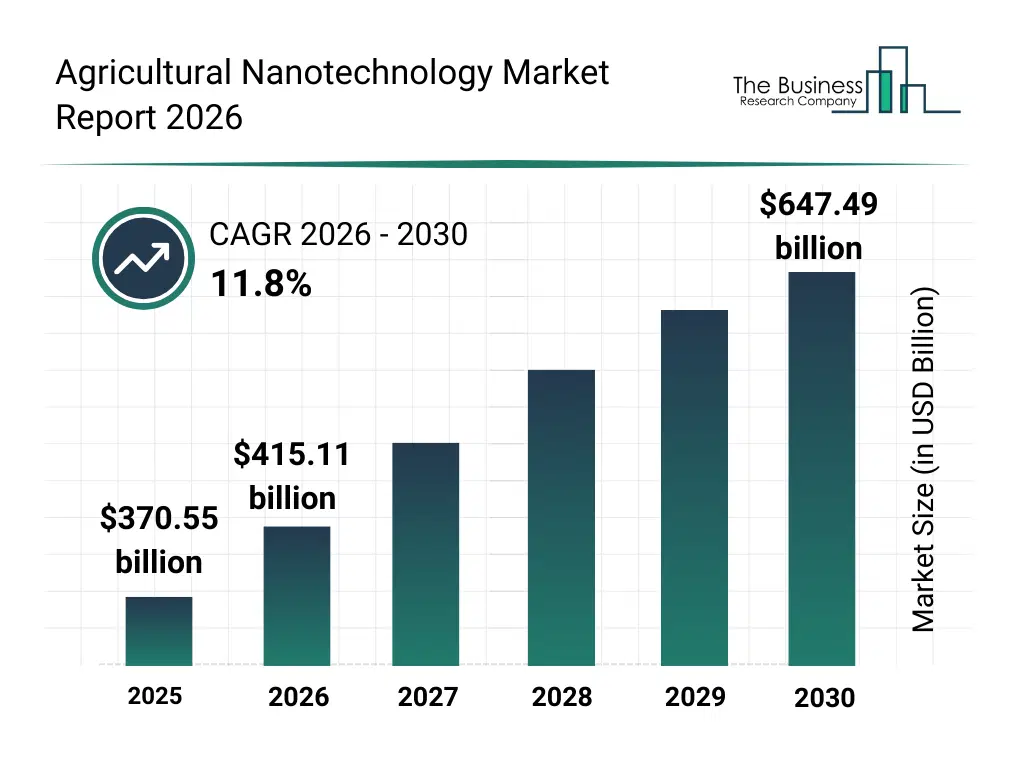
What Is The Agricultural Nanotechnology Market Size and Share 2026?
The agricultural nanotechnology market size has grown rapidly in recent years. It will grow from $370.55 billion in 2025 to $415.11 billion in 2026 at a compound annual growth rate (CAGR) of 12.0%. The growth in the historic period can be attributed to rise in agricultural input innovation, early adoption of nano-enabled fertilizers, increasing research in nanomaterials, demand for higher crop productivity, growth in precision farming practices.What Is The Agricultural Nanotechnology Market Growth Forecast?
The agricultural nanotechnology market size is expected to see rapid growth in the next few years. It will grow to $647.49 billion in 2030 at a compound annual growth rate (CAGR) of 11.8%. The growth in the forecast period can be attributed to expansion of nano-enabled crop protection, rising focus on sustainable farming solutions, advancements in biosensing technologies, increasing investment in nano-formulation r&d, growth of controlled-environment agriculture. Major trends in the forecast period include increasing use of nano-fertilizers to improve nutrient efficiency, growing adoption of nano-pesticides for targeted crop protection, rising interest in nano-biosensors for real-time field monitoring, expansion of nanomaterials in soil and water treatment, development of controlled-release nanotechnology products.
Global Agricultural Nanotechnology Market Segmentation
1) By Type: Nano-Pesticides, Nano-Herbicides, Nanomaterials, Nano-Fertilizers, Nano-Biosensors 2) By Formulation: Liquid Nanomaterials, Solid Nanomaterials, Powder Nanomaterials, Granules, Suspensions And Emulsions 3) By Application: Crop Protection, Soil Management, Water Treatment, Plant Breeding, Animal Health 4) By Distribution Channel: Direct Sales, Online Sales, Distributors Or Wholesalers, Retailers, Consulting Services 5) By End-User: Farmers, Agricultural Enterprises, Research Institutions, Government Agencies, Agrochemical Companies Subsegments: 1) By Nano-Pesticides: Nano-Encapsulated Pesticides, Nano-Emulsified Pesticides, Nano-Carriers For Pesticides 2) By Nano-Herbicides: Controlled Release Nano-Herbicides, Targeted Delivery Nano-Herbicides, Nano-Formulated Herbicides 3) By Nanomaterials: Carbon-Based Nanomaterials, Metal And Metal Oxide Nanoparticles, Polymer-Based Nanomaterials 4) By Nano-Fertilizers: Nano Nitrogen Fertilizers, Nano Phosphorus Fertilizers, Nano Potassium Fertilizers, Multi-Nutrient Nano Fertilizers 5) By Nano-Biosensors: Soil Nutrient Biosensors, Crop Health Biosensors, Pest And Disease Detection Biosensors, Water Quality BiosensorsWhat Is Driver Of The Agricultural Nanotechnology Market?
The increasing crop production is anticipated to propel the growth of the agricultural nanotechnology market in the coming years. Crop production is the process of cultivating plants for food, fiber, and other agricultural purposes through practices such as soil preparation, planting, growing, and harvesting. Crop production is rising due to the adoption of high-yielding crop varieties, which are scientifically developed to produce greater outputs and withstand environmental stresses, thereby boosting overall agricultural productivity. Expanding crop production supports the demand for agricultural nanotechnology, as larger-scale farming requires more efficient and precise resource management, which nanotechnology can provide by enhancing input delivery and minimizing waste. For instance, in November 2024, according to the European Commission, a Belgium-based executive arm of the European Union (EU), cereal production across the EU, including rice, was estimated at 271.6 million tonnes in 2023. Moreover, France contributed 64.2 million tons to this total, accounting for 23.7% of the EU’s overall cereal harvest. Therefore, the increasing crop production will boost the growth of the agricultural nanotechnology industry.Key Players In The Global Agricultural Nanotechnology Market
Major companies operating in the agricultural nanotechnology market are EuroChem Group AG, Bruker Corporation, Nanophase Technologies Corporation, Vive Crop Protection Inc., Zyvex Labs LLC, Geolife Agritech India Pvt. Ltd., Chasm Advanced Materials Inc., Nanosys Inc., Hybrid Plastics Inc., Nanocyl SA, AG CHEMI Group s.r.o., eSpin Technologies Inc., Aqua-Yield Operations LLC, Nanoshell LLC, Brite Solar Technologies, Vantage AG, Nanomnia S.r.l., QuantumSphere Inc., Strigiformes Sp. z o.o., Krilltech Nanobiotecnologia Ltda, Qumir Nano SRL, Unibaio S.A.
This chart is for illustrative purposes; the full report includes a detailed competitor analysis and comprehensive overview of the top 10 companies in the market.
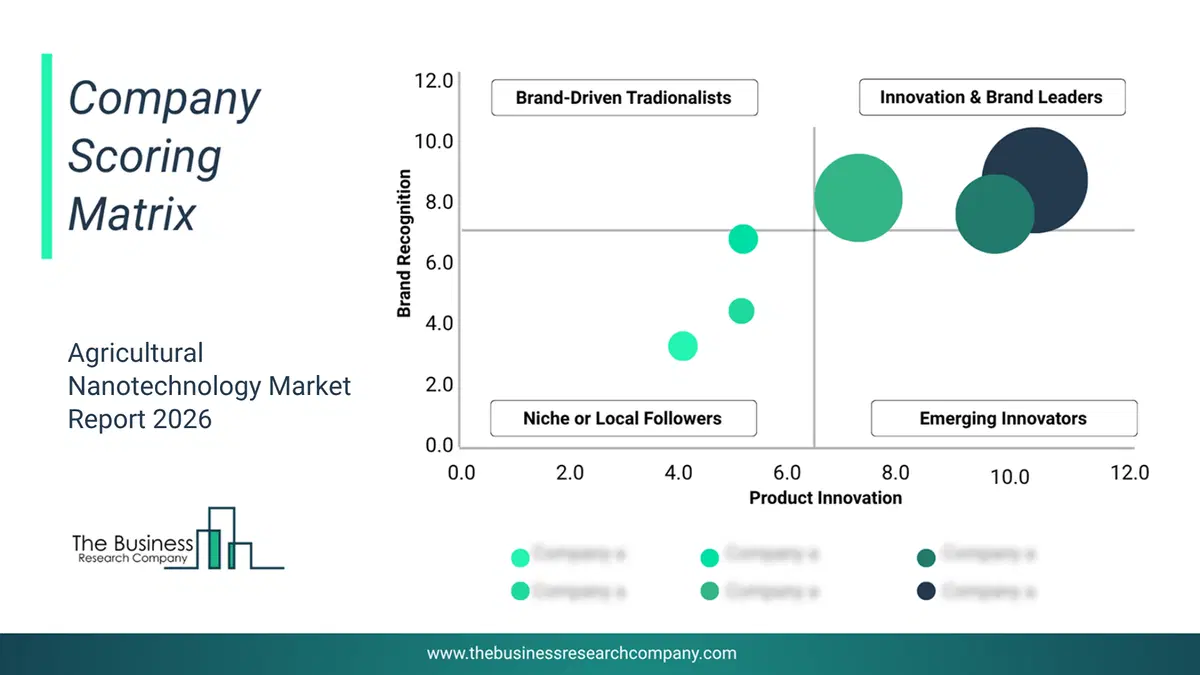
This chart maps companies by product innovation and brand strength, with bubble size indicating relative revenue, helping identify market leaders, challengers, and niche players. This is an illustrative chart; the full report provides a complete and accurate competitive analysis.
Global Agricultural Nanotechnology Market Trends and Insights
Major companies operating in the agricultural nanotechnology market are focusing on developing advanced solutions, such as liquid fertilizers, to enable uniform and efficient nutrient distribution. Liquid fertilizer is a nutrient-rich solution applied to plants or soil to promote growth and improve crop yields. For instance, in February 2023, Vantage AG, a Germany-based manufacturer of liquid fertilizers, launched a liquid sulfur fertilizer developed using its proprietary nanotechnology platform, featuring sulfur particles less than a nanometer in size. This advanced nanoparticle formulation is designed to efficiently cover and penetrate plant tissue, making the nutrient highly bioavailable, which results in faster absorption, improved plant metabolism, and up to 30% more nutrient uptake even at lower application rates.What Are Latest Mergers And Acquisitions In The Agricultural Nanotechnology Market? Strategic Partnership To Advance Nano Urea Fertilizer Production For Enhanced Agricultural Efficiency And Sustainability
In June 2024, Hindustan Urvarak & Rasayan Limited (HURL), an India-based fertilizer company, partnered with Ray Nano Science & Research Centre to expand its reach into nano urea fertilizers. Through this partnership, HURL aims to harness Ray Nano Science's cutting-edge nanotechnology to develop and scale the production of Nano Urea fertilizers, with the goal of improving nutrient efficiency, boosting agricultural yields, and advancing environmentally sustainable farming practices across India. Ray Nano Science & Research Centre is an India-based company that develops and manufactures innovative nano-fertilizers, particularly Nano Urea, to improve agricultural efficiency and sustainability.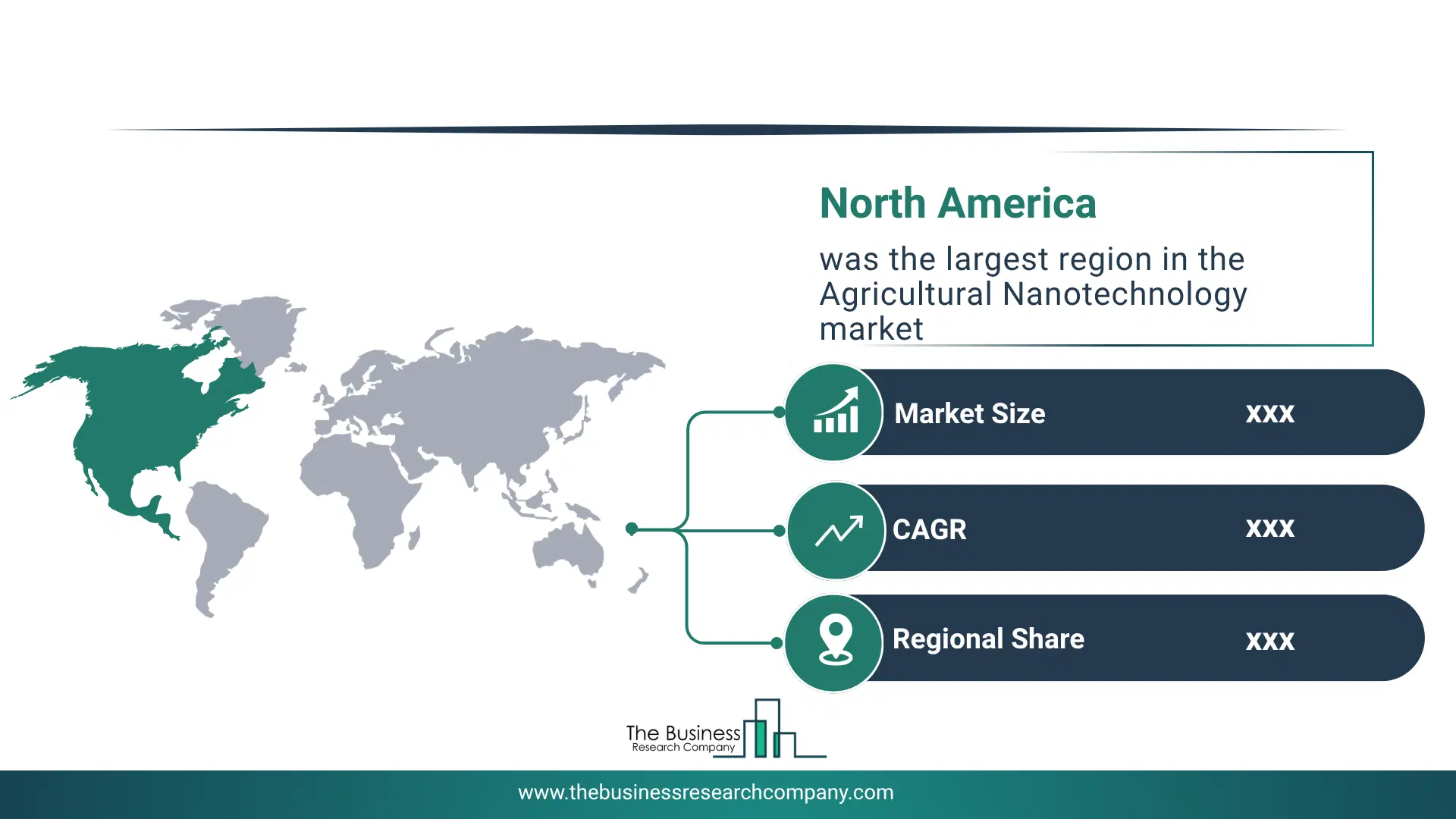
Regional Outlook
North America was the largest region in the agricultural nanotechnology market in 2025. Asia-Pacific is expected to be the fastest-growing region in the forecast period. The regions covered in this market report are Asia-Pacific, South East Asia, Western Europe, Eastern Europe, North America, South America, Middle East, Africa. The countries covered in this market report are Australia, Brazil, China, France, Germany, India, Indonesia, Japan, Taiwan, Russia, South Korea, UK, USA, Canada, Italy, SpainWhat Defines the Agricultural Nanotechnology Market?
The agricultural nanotechnology market consists of revenues earned by entities by providing services such as soil and crop monitoring services, precision agriculture consulting, nano-formulation and testing services, and post-harvest quality monitoring. The market value includes the value of related goods sold by the service provider or included within the service offering. The agricultural nanotechnology market also includes sales of nanosensors, nano-enabled delivery systems, nano-coating applicators, and nano-filtration systems. Values in this market are ‘factory gate’ values, that is, the value of goods sold by the manufacturers or creators of the goods, whether to other entities (including downstream manufacturers, wholesalers, distributors, and retailers) or directly to end customers. The value of goods in this market includes related services sold by the creators of the goods.How is Market Value Defined and Measured?
The market value is defined as the revenues that enterprises gain from the sale of goods and/or services within the specified market and geography through sales, grants, or donations in terms of the currency (in USD unless otherwise specified). The revenues for a specified geography are consumption values that are revenues generated by organizations in the specified geography within the market, irrespective of where they are produced. It does not include revenues from resales along the supply chain, either further along the supply chain or as part of other products.
This chart presents market attractiveness based on a quantitative evaluation of growth, competition, strategic alignment, and risk, offering a clear view of opportunity areas for decision-making. This chart is for illustrative purposes; the full report contains the complete analysis.

This chart highlights the Total Addressable Market (TAM) by estimating the maximum revenue opportunity using an assumption-driven approach, supporting strategic planning and opportunity sizing across markets. The chart is illustrative; the full report provides a more comprehensive analysis.
What Key Data and Analysis Are Included in the Agricultural Nanotechnology Market Report 2026?
The agricultural nanotechnology market research report is one of a series of new reports from The Business Research Company that provides market statistics, including industry global market size, regional shares, competitors with the market share, detailed market segments, market trends and opportunities, and any further data you may need to thrive in the agricultural nanotechnology industry. The market research report delivers a complete perspective of everything you need, with an in-depth analysis of the current and future state of the industry.Agricultural Nanotechnology Market Report Forecast Analysis
| Report Attribute | Details |
|---|---|
| Market Size Value In 2026 | $415.11 billion |
| Revenue Forecast In 2030 | $647.49 billion |
| Growth Rate | CAGR of 11.8% from 2026 to 2030 |
| Base Year For Estimation | 2025 |
| Actual Estimates/Historical Data | 2020-2025 |
| Forecast Period | 2026 - 2030 |
| Market Representation | Revenue in USD Billion and CAGR from 2026 to 2030 |
| Segments Covered | Type, Formulation, Application, Distribution Channel, End-User |
| Regional Scope | Asia-Pacific, Western Europe, Eastern Europe, North America, South America, Middle East, Africa |
| Country Scope | The countries covered in the report are Australia, Brazil, China, France, Germany, India, Indonesia, Japan, Taiwan, Russia, South Korea, UK, USA, Canada, Italy, Spain |
| Key Companies Profiled | EuroChem Group AG, Bruker Corporation, Nanophase Technologies Corporation, Vive Crop Protection Inc., Zyvex Labs LLC, Geolife Agritech India Pvt. Ltd., Chasm Advanced Materials Inc., Nanosys Inc., Hybrid Plastics Inc., Nanocyl SA, AG CHEMI Group s.r.o., eSpin Technologies Inc., Aqua-Yield Operations LLC, Nanoshell LLC, Brite Solar Technologies, Vantage AG, Nanomnia S.r.l., QuantumSphere Inc., Strigiformes Sp. z o.o., Krilltech Nanobiotecnologia Ltda, Qumir Nano SRL, Unibaio S.A. |
| Customization Scope | Request for Customization |
| Pricing And Purchase Options | Explore Purchase Options |