
Agricultural Textiles Market Report 2026
Global Outlook – By Product (Fishing Nets, Anti-Hail Nets, Bird Protection Nets, Mulch-Mats, Shade Nets, Other Products), By Fabric Structure (Weaving And Woven, Nonwoven), By Fiber Material (Nylon, Polyethylene, Polypropylene, Polyester, Natural Fibers, Biodegradable Synthetic Fibers, Other Fiber Materials), By Application (Agriculture, Horticulture And Floriculture, Aquaculture, Other Applications) – Market Size, Trends, Strategies, and Forecast to 2030
Agricultural Textiles Market Overview
• Agricultural Textiles market size has reached to $13.8 billion in 2025 • Expected to grow to $20.7 billion in 2030 at a compound annual growth rate (CAGR) of 8.4% • Growth Driver: Rise In Demand For Agricultural Products Drive The Agricultural Textiles Market • Market Trend: Biodegradable Insect Nets To Protect Plants From Insect Infestations • Asia-Pacific was the largest region in 2025.What Is Covered Under Agricultural Textiles Market?
Agricultural textiles refer to the woven, nonwoven, and knit materials known for bio-degradability, UV resistance, and toxicity resistance, employed in horticultural and agricultural applications. The agricultural textiles are used in agriculture, horticulture, and floriculture to cover animals, provide shade, weeds, and insect control, and lengthen the growing season for agricultural and also in the fishing industry. The main types of agricultural textiles market products are fishing nets, anti-hail nets, bird protection nets, mulch mats, shade nets, and other products. Fishing nets are used to catch fish. Fishing nets refer to the meshes that are created by knotting a relatively thin thread. The types are weaving and woven, and nonwoven. The various fiber materials used are nylon, polyethylene, polypropylene, polyester, natural fibers, biodegradable synthetic fibers, and other fiber materials. The applications are agriculture, horticulture and floriculture, aquaculture, other applications.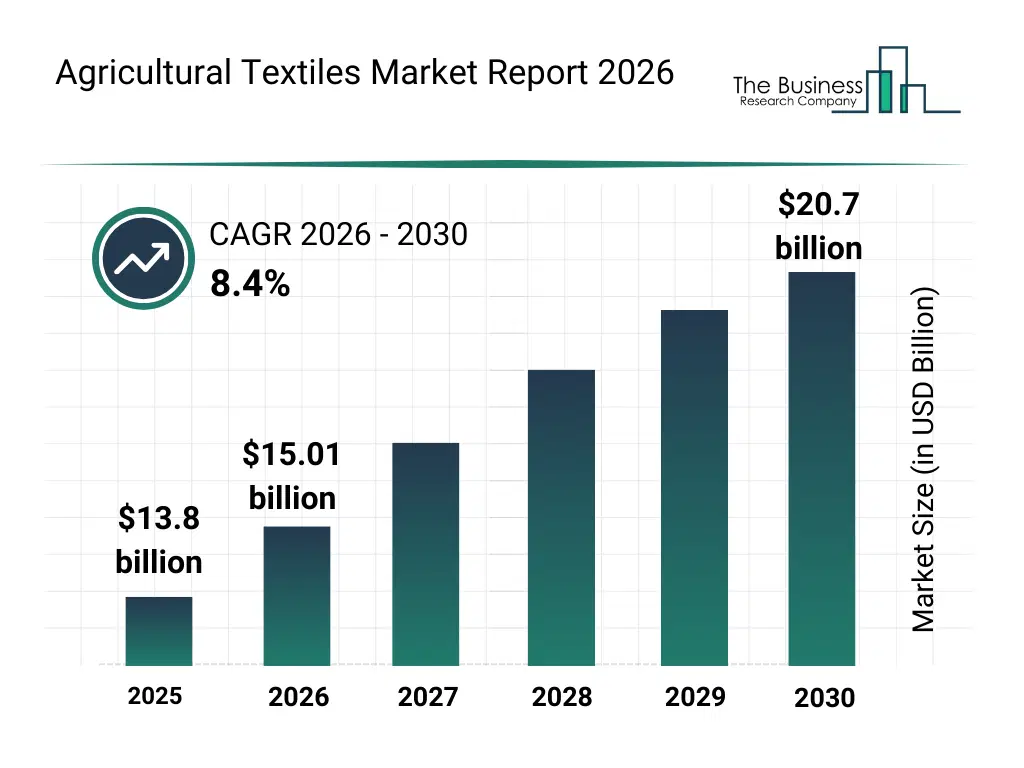
What Is The Agricultural Textiles Market Size and Share 2026?
The agricultural textiles market size has grown strongly in recent years. It will grow from $13.8 billion in 2025 to $15.01 billion in 2026 at a compound annual growth rate (CAGR) of 8.8%. The growth in the historic period can be attributed to expansion of horticulture and floriculture activities, rising need for crop protection materials, growth in aquaculture operations, adoption of synthetic textile solutions, increasing use of protective farming infrastructure.What Is The Agricultural Textiles Market Growth Forecast?
The agricultural textiles market size is expected to see strong growth in the next few years. It will grow to $20.7 billion in 2030 at a compound annual growth rate (CAGR) of 8.4%. The growth in the forecast period can be attributed to growing demand for sustainable agricultural textiles, rising adoption of biodegradable fibers, expansion of precision farming applications, increasing climate variability impacts on agriculture, growth of high-value crop production. Major trends in the forecast period include increasing adoption of uv-stabilized textile products, rising use of biodegradable agricultural fabrics, growing demand for shade and protection nets, expansion of crop and livestock covering solutions, enhanced focus on climate-resilient farming.
Global Agricultural Textiles Market Segmentation
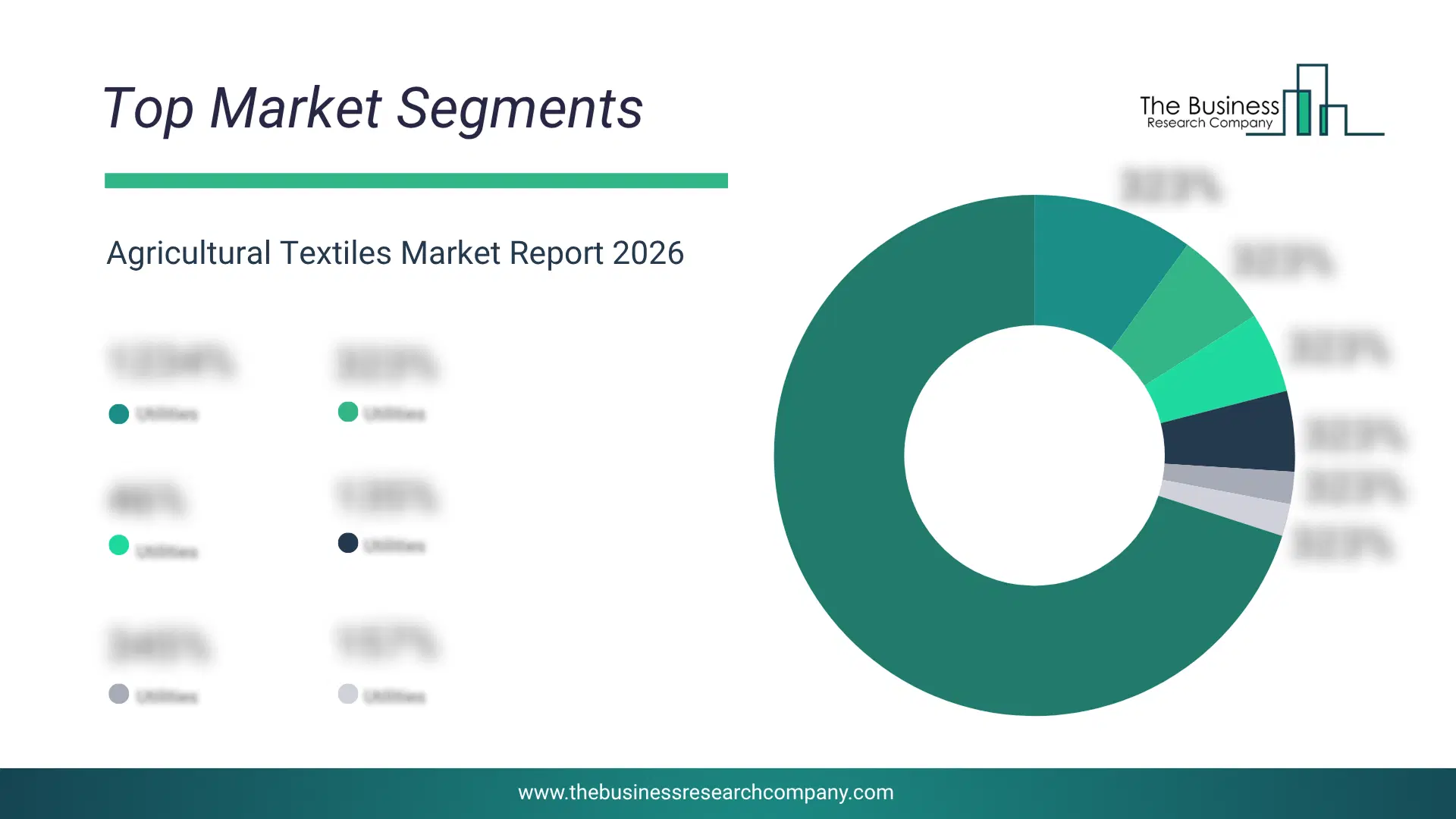
1) By Product: Fishing Nets, Anti-Hail Nets, Bird Protection Nets, Mulch-Mats, Shade Nets, Other Products 2) By Fabric Structure: Weaving And Woven, Nonwoven 3) By Fiber Material: Nylon, Polyethylene, Polypropylene, Polyester, Natural Fibers, Biodegradable Synthetic Fibers, Other Fiber Materials 4) By Application: Agriculture, Horticulture And Floriculture, Aquaculture, Other Applications Subsegments: 1) By Fishing Nets: Monofilament Fishing Nets, Multifilament Fishing Nets, Knitted Fishing Nets 2) By Anti-Hail Nets: Knitted Anti-Hail Nets, Woven Anti-Hail Nets, Shade Cloth Anti-Hail Nets 3) By Bird Protection Nets: Lightweight Bird Protection Nets, Heavy-Duty Bird Protection Nets 4) By Mulch-Mats: Biodegradable Mulch Mats, Non-Biodegradable Mulch Mats 5) By Shade Nets: UV Stabilized Shade Nets, Knitted Shade Nets, Woven Shade Nets 6) By Other Products: Insect Mesh Nets, Ground Covers, Plant Support FabricsWhat Is The Driver Of The Agricultural Textiles Market?
The rise in demand for agricultural products is expected to propel the growth of the agricultural textiles market going forward. Agricultural products refer to any agricultural commodity or product, whether raw or processed, that includes any commodity or product that is derived from livestock. Agricultural textiles are used to protect agricultural products from birds and insects, and they also help give shade to plants, which helps to increase their yield. For instance, in February 2025, according to the US Department of Agriculture (USDA), a US-based federal agency, the value of U.S. agricultural exports in 2024 rose to about US$?176.0?billion, a 1% increase over 2023. Therefore, the rise in demand for agricultural products is driving the growth of the agricultural textiles industry.Key Players In The Global Agricultural Textiles Market
Major companies operating in the agricultural textiles market are Garware Technical Fibres, Tama Plastic Industry, Polysack Plastic Industries, Belton Industries, Beaulieu Technical Textiles, HUESKER Synthetic, Koninklijke Ten Cate, Bonar Technical Fabrics, Shandong Rainbow Shading Technology, Shandong Jinrui Textile, Shandong Laizhou Zhongshi Plastic Products, Xinyi Plastic Industrial, Alnet Sp. z o.o., Windmill Polytex, Tuflex India, Neo Corp International, Capatex, Visaka Industries Limited, Meyabond, UPM Raflatac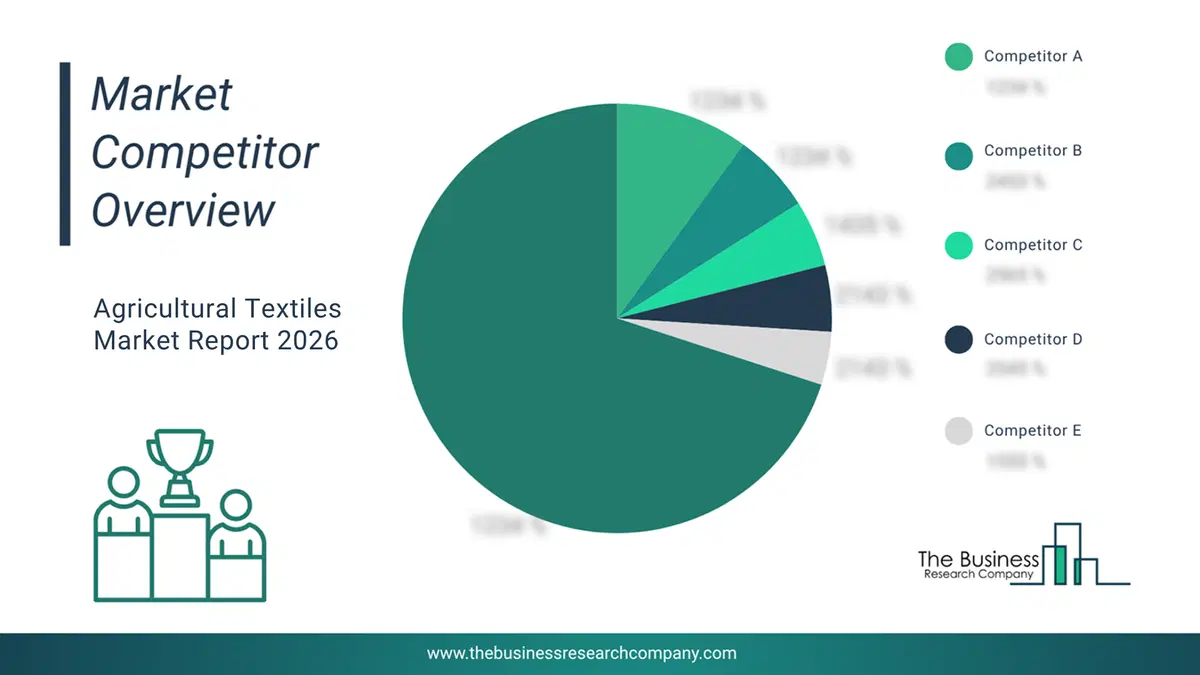
This chart is for illustrative purposes; the full report includes a detailed competitor analysis and comprehensive overview of the top 10 companies in the market.
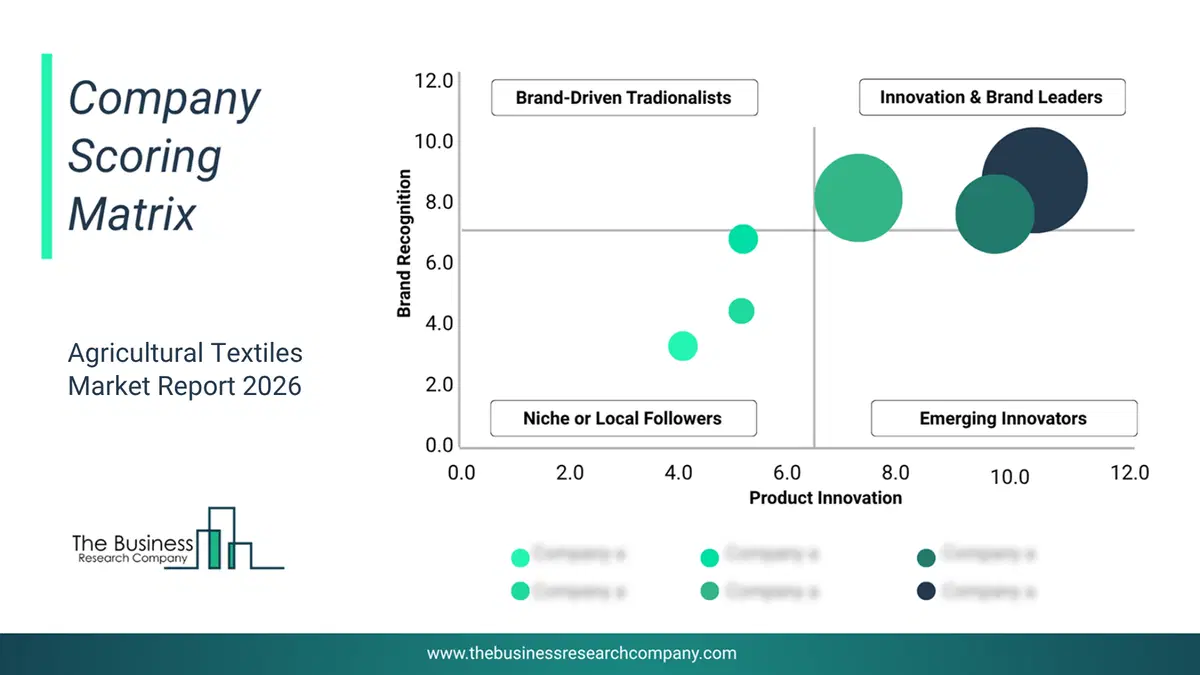
This chart maps companies by product innovation and brand strength, with bubble size indicating relative revenue, helping identify market leaders, challengers, and niche players. This is an illustrative chart; the full report provides a complete and accurate competitive analysis.
Global Agricultural Textiles Market Trends and Insights
Major companies operating in the agricultural textiles market are focusing on developing innovative solutions, such as biodegradable insect nets, to enhance sustainable crop protection and reduce environmental impact. Biodegradable insect nets are specialized mesh structures used in agriculture and horticulture to protect plants from insect infestations. They are made from materials that naturally decompose over time through biological processes such as microbial action and exposure to environmental conditions. For instance, in January 2023, Andermatt Home and Garden, a Switzerland-based company specializing in biological solutions using microorganisms for pest control, launched InsectoNet. This plastic-free, biodegradable insect net is made entirely from cornstarch, a renewable food-based material, allowing it to degrade naturally after use. InsectoNet provides effective plant protection while supporting sustainable and eco-friendly gardening and farming practices.What Are Latest Mergers And Acquisitions In The Agricultural Textiles Market?
In September 2024, Freudenberg Performance Materials, a Germany-based provider of nonwoven fabrics, coated technical textiles, and other specialty textile solutions, acquired major parts of Heytex Group for an undisclosed amount. With this acquisition, Freudenberg aims to enhance its technology platform, expand market exposure and R&D capabilities, and gain access to new technical-textile segments, strengthening its position in the global technical and agricultural textiles value chain. Heytex Bramsche GmbH is a Germany-based manufacturer of high-quality functional and coated technical textiles.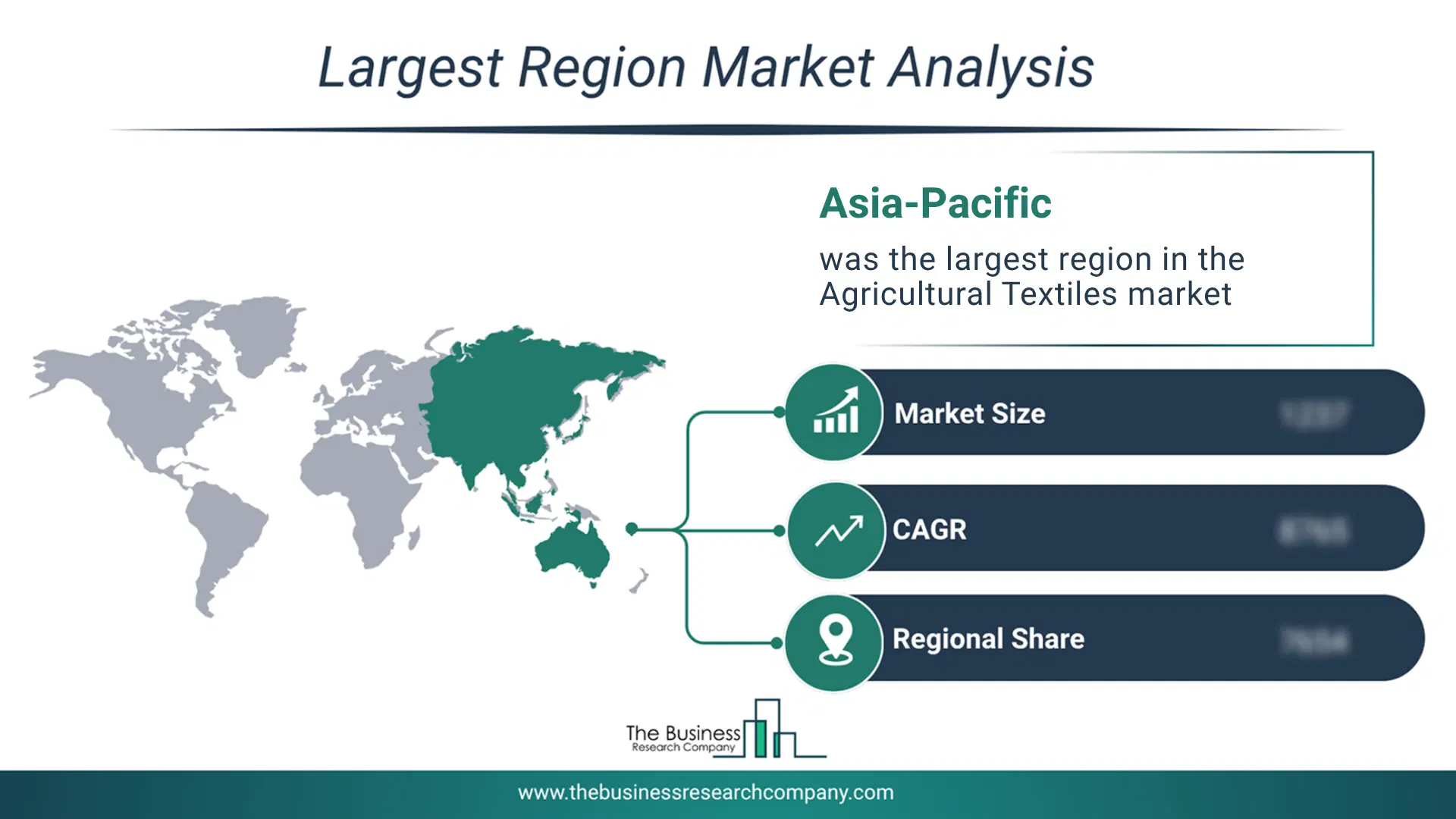
Regional Outlook
Asia-Pacific was the largest region in the agricultural textiles market in 2025. The regions covered in this market report are Asia-Pacific, South East Asia, Western Europe, Eastern Europe, North America, South America, Middle East, Africa. The countries covered in this market report are Australia, Brazil, China, France, Germany, India, Indonesia, Japan, Taiwan, Russia, South Korea, UK, USA, Canada, Italy, Spain.What Defines the Agricultural Textiles Market?
The agricultural textiles market consists of sales of plant nets, sunscreens, windshields, and harvesting nets. Values in this market are ‘factory gate’ values, that is the value of goods sold by the manufacturers or creators of the goods, whether to other entities (including downstream manufacturers, wholesalers, distributors and retailers) or directly to end customers. The value of goods in this market includes related services sold by the creators of the goods.How is Market Value Defined and Measured?
The market value is defined as the revenues that enterprises gain from the sale of goods and/or services within the specified market and geography through sales, grants, or donations in terms of the currency (in USD unless otherwise specified). The revenues for a specified geography are consumption values that are revenues generated by organizations in the specified geography within the market, irrespective of where they are produced. It does not include revenues from resales along the supply chain, either further along the supply chain or as part of other products.
This chart presents market attractiveness based on a quantitative evaluation of growth, competition, strategic alignment, and risk, offering a clear view of opportunity areas for decision-making. This chart is for illustrative purposes; the full report contains the complete analysis.

This chart highlights the Total Addressable Market (TAM) by estimating the maximum revenue opportunity using an assumption-driven approach, supporting strategic planning and opportunity sizing across markets. The chart is illustrative; the full report provides a more comprehensive analysis.
What Key Data and Analysis Are Included in the Agricultural Textiles Market Report 2026?
The agricultural textiles market research report is one of a series of new reports from The Business Research Company that provides market statistics, including Market Report 2026?global market size, regional shares, competitors with the market share, detailed market segments, market trends and opportunities, and any further data you may need to thrive in the agricultural textiles Market Report 2026? The market research report delivers a complete perspective of everything you need, with an in-depth analysis of the current and future state of the Market Report 2026?Agricultural Textiles Market Report Forecast Analysis
| Report Attribute | Details |
|---|---|
| Market Size Value In 2026 | $15.01 billion |
| Revenue Forecast In 2030 | $20.7 billion |
| Growth Rate | CAGR of 8.8% from 2026 to 2030 |
| Base Year For Estimation | 2025 |
| Actual Estimates/Historical Data | 2020-2025 |
| Forecast Period | 2026 - 2030 |
| Market Representation | Revenue in USD Billion and CAGR from 2026 to 2030 |
| Segments Covered | Product, Fabric Structure, Fiber Material, Application |
| Regional Scope | Asia-Pacific, Western Europe, Eastern Europe, North America, South America, Middle East, Africa |
| Country Scope | The countries covered in the report are Australia, Brazil, China, France, Germany, India, Indonesia, Japan, Taiwan, Russia, South Korea, UK, USA, Canada, Italy, Spain. |
| Key Companies Profiled | Garware Technical Fibres, Tama Plastic Industry, Polysack Plastic Industries, Belton Industries, Beaulieu Technical Textiles, HUESKER Synthetic, Koninklijke Ten Cate, Bonar Technical Fabrics, Shandong Rainbow Shading Technology, Shandong Jinrui Textile, Shandong Laizhou Zhongshi Plastic Products, Xinyi Plastic Industrial, Alnet Sp. z o.o., Windmill Polytex, Tuflex India, Neo Corp International, Capatex, Visaka Industries Limited, Meyabond, UPM Raflatac |
| Customization Scope | Request for Customization |
| Pricing And Purchase Options | Explore Purchase Options |