
Agriculture Unmanned Aerial Vehicle (UAV) Market Report 2026
Global Outlook – By Type (Fixed Wing Unmanned Aerial Vehicle, Rotary Wing Unmanned Aerial Vehicle, Hybrid Unmanned Aerial Vehicle, Nano Unmanned Aerial Vehicle, Micro Unmanned Aerial Vehicle), By Payload (Cameras, Multispectral Sensors, Hyperspectral Sensors, Thermal Sensors, Light Detection And Ranging Sensors, Spraying Systems, Other Payloads), By Application (Crop Monitoring, Soil Analysis, Irrigation Management, Crop Spraying, Planting And Seeding), By End User (Agricultural Research Institutes, Agricultural Service Providers, Government Agencies, Agri Business Companies) – Market Size, Trends, Strategies, and Forecast to 2035
Agriculture Unmanned Aerial Vehicle (UAV) Market Overview
• Agriculture Unmanned Aerial Vehicle (UAV) market size has reached to $2.51 billion in 2025 • Expected to grow to $5.46 billion in 2030 at a compound annual growth rate (CAGR) of 16.7% • Growth Driver: Surge In Precision Agriculture Adoption Fueling The Growth Of The Market Due To Increasing Demand For Precision Farming • Market Trend: Innovations In Unmanned Aerial Vehicle (UAV) Technology Enhance Precision Farming Efficiency And Operational Performance • Asia-Pacific was the largest region and fastest growing region.What Is Covered Under Agriculture Unmanned Aerial Vehicle (UAV) Market?
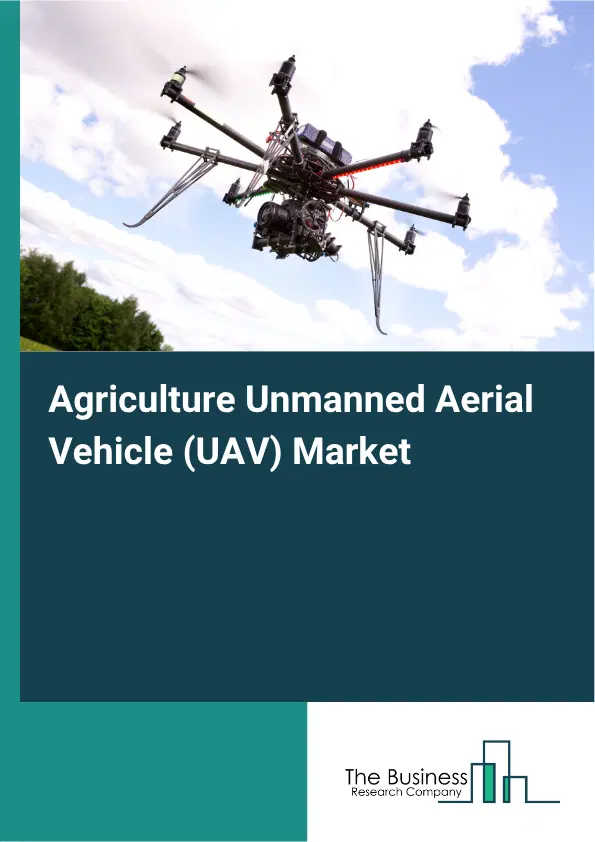
Agricultural unmanned aerial vehicles (UAVs), also known as agricultural drones, are remotely operated or autonomous aircraft used for precision farming applications. They can carry cameras, sensors, spraying systems, and other payloads to monitor crop health, assess field conditions, apply agricultural inputs, and collect field data. The main types of agriculture unmanned aerial vehicles (UAV) include fixed wing unmanned aerial vehicles, rotary wing unmanned aerial vehicles, hybrid unmanned aerial vehicles, nano unmanned aerial vehicles, and micro unmanned aerial vehicles. Fixed wing unmanned aerial vehicles refer to aircraft with fixed wings that use aerodynamic lift to fly and are designed to cover large agricultural areas efficiently. These UAVs consists of various payloads such as cameras, multispectral sensors, hyperspectral sensors, thermal sensors, light detection and ranging sensors, spraying systems, and other payloads. The various applications involved are crop monitoring, soil analysis, irrigation management, crop spraying, and planting and seeding and they are utilized by end users including agricultural research institutes, agricultural service providers, government agencies, and agri business companies.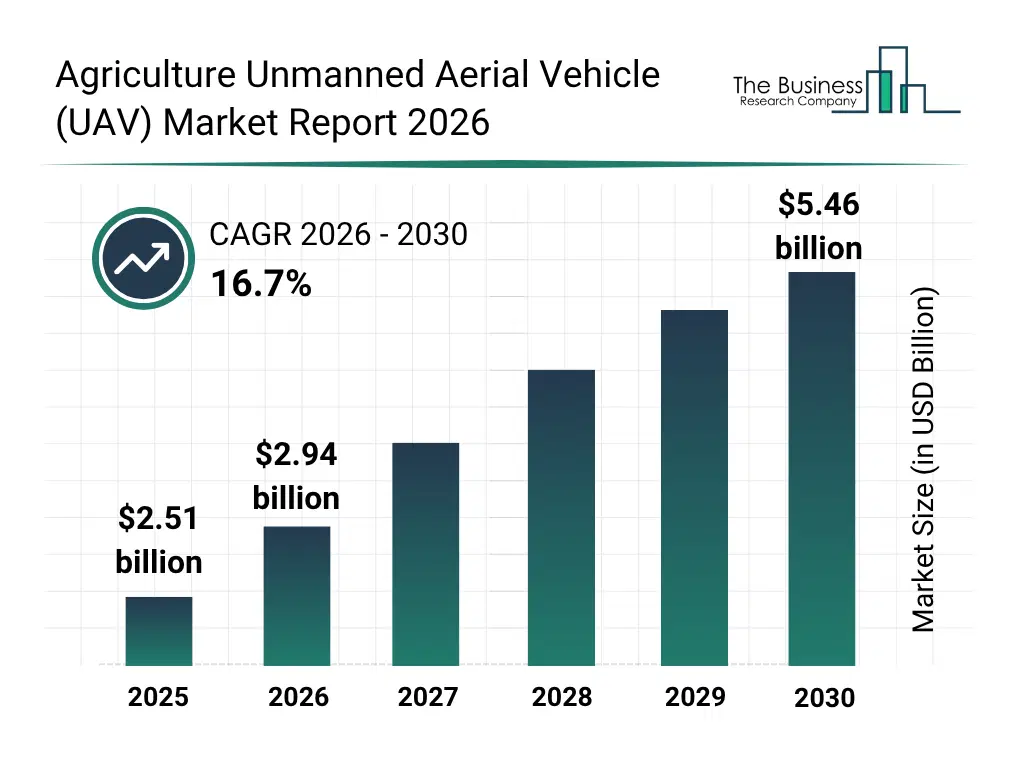
What Is The Agriculture Unmanned Aerial Vehicle (UAV) Market Size and Share 2026?
The agriculture unmanned aerial vehicle (UAV) market size has grown rapidly in recent years. It will grow from $2.51 billion in 2025 to $2.94 billion in 2026 at a compound annual growth rate (CAGR) of 17.1%. The growth in the historic period can be attributed to increasing demand for precision agriculture, rising labor costs in farming operations, growing adoption of drone-based crop monitoring, expanding use of aerial imaging for agricultural field assessment, increasing need for efficient pesticide and fertilizer application.What Is The Agriculture Unmanned Aerial Vehicle (UAV) Market Growth Forecast?
The agriculture unmanned aerial vehicle (uav) market size is expected to see rapid growth in the next few years. It will grow to $5.46 billion in 2030 at a compound annual growth rate (CAGR) of 16.7%. The growth in the forecast period can be attributed to increasing demand for autonomous agricultural drone operations, rising adoption of multispectral and hyperspectral imaging, growing deployment of drone-based precision spraying, expanding use of real-time agricultural data collection, increasing demand for unmanned aerial vehicles in large-scale commercial farming. Major trends in the forecast period include increasing adoption of agricultural drones for precision crop monitoring, rising demand for drone-based crop spraying and pesticide application, growing use of multispectral and hyperspectral sensors for crop health assessment, expanding deployment of agricultural drones for field mapping and soil analysis, increasing demand for high-capacity spraying systems for large agricultural fields.Tariff Impact On Agriculture Unmanned Aerial Vehicle (UAV) Market
Tariffs are impacting the agriculture unmanned aerial vehicles (UAV) market by increasing the cost of imported drone components, cameras, sensors, batteries, navigation systems, and spraying equipment required for agricultural applications. This is raising production and procurement costs for agricultural drones, particularly in regions dependent on imported components such as Asia-Pacific and Latin America. Hardware-intensive segments such as multispectral sensors, thermal sensors, spraying systems, and rotary wing unmanned aerial vehicles are most affected due to global supply chain dependencies. However, tariffs are also encouraging local component manufacturing, regional supplier diversification, and increased investment in domestic agricultural drone production, supporting long-term supply chain resilience.
Global Agriculture Unmanned Aerial Vehicle (UAV) Market Segmentation
2) By Payload: Cameras, Multispectral Sensors, Hyperspectral Sensors, Thermal Sensors, Light Detection And Ranging Sensors, Spraying Systems, Other Payloads 3) By Application: Crop Monitoring, Soil Analysis, Irrigation Management, Crop Spraying, Planting And Seeding 4) By End User: Agricultural Research Institutes, Agricultural Service Providers, Government Agencies, Agri Business Companies Subsegments: 1) By Fixed Wing Unmanned Aerial Vehicle: Conventional Fixed Wing Unmanned Aerial Vehicle, Vertical Takeoff Fixed Wing Unmanned Aerial Vehicle, Catapult Launched Fixed Wing Unmanned Aerial Vehicle, Hand Launched Fixed Wing Unmanned Aerial Vehicle 2) By Rotary Wing Unmanned Aerial Vehicle: Single Rotor Unmanned Aerial Vehicle, Multi Rotor Unmanned Aerial Vehicle, Coaxial Rotor Unmanned Aerial Vehicle, Tandem Rotor Unmanned Aerial Vehicle 3) By Hybrid Unmanned Aerial Vehicle: Tilt Rotor Hybrid Unmanned Aerial Vehicle, Tilt Wing Hybrid Unmanned Aerial Vehicle, Lift And Cruise Hybrid Unmanned Aerial Vehicle, Tail Sitter Hybrid Unmanned Aerial Vehicle 4) By Nano Unmanned Aerial Vehicle: Indoor Nano Unmanned Aerial Vehicle, Outdoor Nano Unmanned Aerial Vehicle 5) By Micro Unmanned Aerial Vehicle: Fixed Wing Micro Unmanned Aerial Vehicle, Rotary Wing Micro Unmanned Aerial Vehicle, Hybrid Micro Unmanned Aerial VehicleWhat Is The Driver Of The Agriculture Unmanned Aerial Vehicle (UAV) Market?
The increasing adoption of precision agriculture is expected to drive the growth of the agriculture unmanned aerial vehicle (UAV) market going forward. Precision agriculture refers to a farming approach that integrates digital technologies, data analytics, and site-specific management practices to optimize crop production, improve resource efficiency, and enhance overall agricultural productivity. The increasing adoption of precision agriculture is driven by the growing need to maximize crop yields through data-driven farming practices that improve field-level decision-making and resource efficiency. The expanding use of precision agriculture increases the demand for agriculture unmanned aerial vehicles by supporting aerial crop monitoring, crop health analysis, precision spraying, and real-time field data collection, enabling farmers to improve operational efficiency, optimize resource utilization, and increase crop yields. For instance, in 2026, according to the Food and Agriculture Organization of the United Nations (FAO), an Italy-based specialized United Nations agency, organic agriculture was practiced across more than 180 countries, with nearly 99 million hectares of agricultural land managed organically by at least 4.8 million farmers worldwide. Therefore, the increasing adoption of precision agriculture is driving the growth of the agriculture unmanned aerial vehicle market.Key Players In The Global Agriculture Unmanned Aerial Vehicle (UAV) Market
Major companies operating in the agriculture unmanned aerial vehicle (uav) market are SZ DJI Technology Co. Ltd., Yamaha Motor Co. Ltd., XAG Co. Ltd., Trimble Inc., Quantum-Systems GmbH, Parrot Drones SAS, Autel Robotics Co. Ltd., AeroVironment Inc., Garuda Aerospace Private Limited, EAVISION Robotic Technologies Co. Ltd., Wingtra AG, Pix4D SA, Delair SAS, MicroMultiCopter Aero Technology Co. Ltd., JOUAV Automation Tech Co. Ltd., Hylio Inc., AgEagle Aerial Systems Inc., Drone Volt SA, ABZ Innovation Kft., Draganfly Inc., Harris Aerial LLC, TopXGun Robotics Co. Ltd., FlyDragon Drone Technology Co. Ltd.
This chart is for illustrative purposes; the full report includes a detailed competitor analysis and comprehensive overview of the top 10 companies in the market.
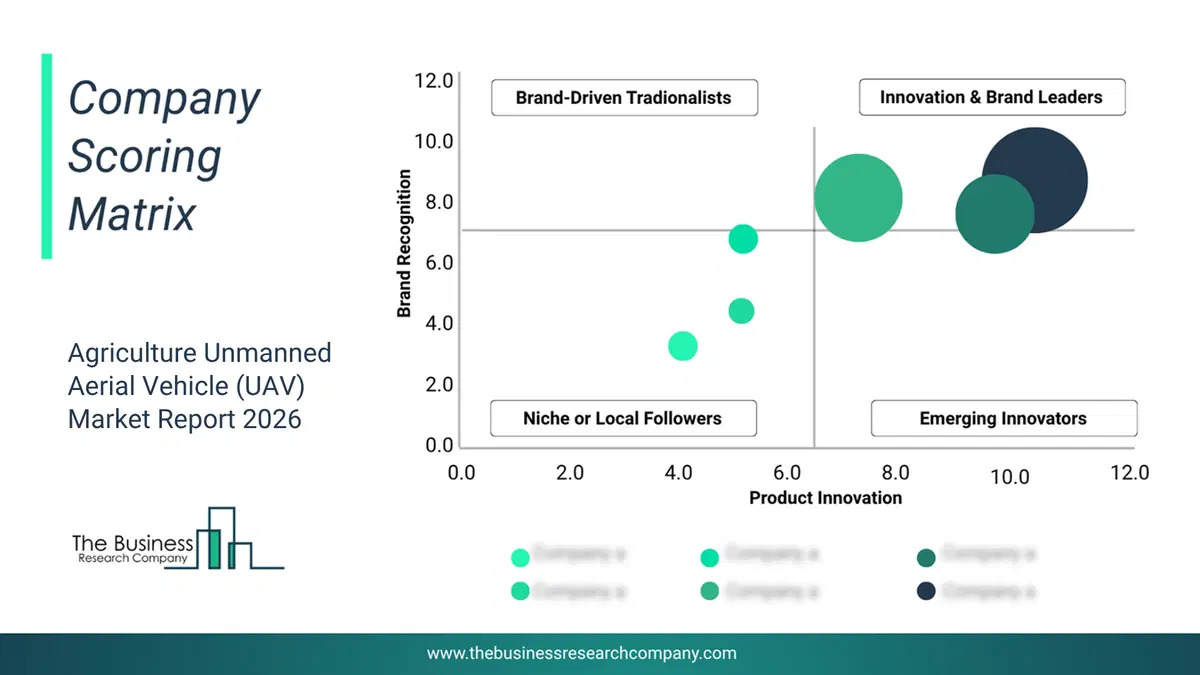
This chart maps companies by product innovation and brand strength, with bubble size indicating relative revenue, helping identify market leaders, challengers, and niche players. This is an illustrative chart; the full report provides a complete and accurate competitive analysis.
Global Agriculture Unmanned Aerial Vehicle (UAV) Market Trends and Insights
Major companies operating in the agriculture unmanned aerial vehicle (UAV) market are focusing on developing advanced agricultural drones with dual battery spraying systems to improve operational efficiency, enhance precision farming, and support large-scale crop management. A dual battery spraying system refers to an agricultural drone configuration that uses two intelligent batteries to extend flight endurance, increase payload efficiency, and enable continuous spraying operations over larger farming areas. For instance, in July 2026, DJI Agriculture, a China-based agricultural drone manufacturer, launched the DJI Agras T55 and DJI Agras T100 Dual Battery Spraying System. The new agriculture UAVs feature higher payload capacities, millimeter-wave radar, quad vision obstacle detection, and intelligent spraying and spreading systems to improve operational efficiency. These capabilities enable safer, more precise crop protection and efficient field management across a wide range of agricultural environments.What Are Latest Mergers And Acquisitions In The Agriculture Unmanned Aerial Vehicle (UAV) Market?
In July 2026, Multicopter Warehouse LLC, a US-based agricultural drone distributor and service provider, acquired the assets of Foundation AG for an undisclosed amount. Through this acquisition, Multicopter Warehouse aims to expand its agricultural unmanned aerial vehicle (UAV) distribution network, strengthen its precision agriculture capabilities, and enhance its sales, training, service, and support for agricultural spray drone solutions across the U.S. Midwest. Foundation AG is a US-based agricultural technology company that specializes in agricultural spray drones and provides precision agriculture solutions.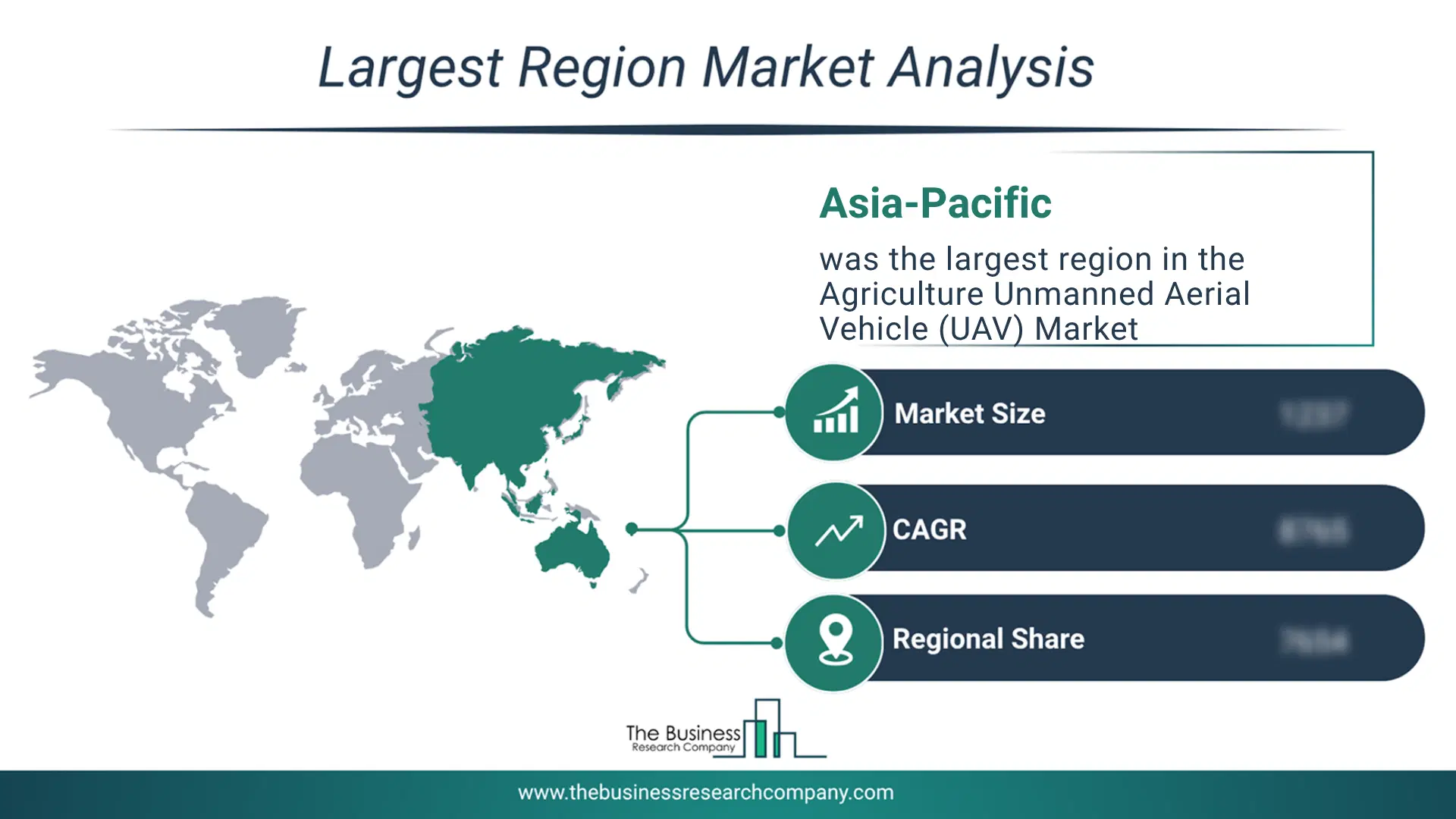
Regional Outlook/Insights
Asia-Pacific was the largest region in the agriculture unmanned aerial vehicle (UAV) market in 2025. Asia-Pacific is expected to be the fastest-growing region in the forecast period. The regions covered in this market report are Asia-Pacific, South East Asia, Western Europe, Eastern Europe, North America, South America, Middle East, Africa. The countries covered in this market report are Australia, Brazil, China, France, Germany, India, Indonesia, Japan, Taiwan, Russia, South Korea, UK, USA, Canada, Italy, Spain.What Defines the Agriculture Unmanned Aerial Vehicle (UAV) Market?
The agriculture unmanned aerial vehicle (UAV) market consists of sales of crop-monitoring UAVs, agricultural spraying UAVs, crop-mapping UAVs, precision-agriculture UAVs, and autonomous agricultural UAVs. Values in this market are ‘factory gate’ values, that is, the value of goods sold by the manufacturers or creators of the goods, whether to other entities (including downstream manufacturers, wholesalers, distributors, and retailers) or directly to end customers. The value of goods in this market includes related services sold by the creators of the goods.How is Market Value Defined and Measured?
The market value is defined as the revenues that enterprises gain from the sale of goods and/or services within the specified market and geography through sales, grants, or donations in terms of the currency (in USD unless otherwise specified). The revenues for a specified geography are consumption values that are revenues generated by organizations in the specified geography within the market, irrespective of where they are produced. It does not include revenues from resales along the supply chain, either further along the supply chain or as part of other products.
This chart presents market attractiveness based on a quantitative evaluation of growth, competition, strategic alignment, and risk, offering a clear view of opportunity areas for decision-making. This chart is for illustrative purposes; the full report contains the complete analysis.

This chart highlights the Total Addressable Market (TAM) by estimating the maximum revenue opportunity using an assumption-driven approach, supporting strategic planning and opportunity sizing across markets. The chart is illustrative; the full report provides a more comprehensive analysis.
What Key Data and Analysis Are Included in the Agriculture Unmanned Aerial Vehicle (UAV) Market Report 2026?
The agriculture unmanned aerial vehicle (uav) market research report is one of a series of new reports from The Business Research Company that provides market statistics, including industry global market size, regional shares, competitors with the market share, detailed market segments, market trends and opportunities, and any further data you may need to thrive in the agriculture unmanned aerial vehicle (uav) industry. The market research report delivers a complete perspective of everything you need, with an in-depth analysis of the current and future state of the industry.Agriculture Unmanned Aerial Vehicle (UAV) Market Report Forecast Analysis
| Report Attribute | Details |
|---|---|
| Market Size Value In 2026 | $2.94 billion |
| Revenue Forecast In 2030 | $5.46 billion |
| Growth Rate | CAGR of 16.7% from 2026 to 2035 |
| Base Year For Estimation | 2025 |
| Actual Estimates/Historical Data | 2020-2025 |
| Forecast Period | 2026 - 2030 |
| Market Representation | Revenue in USD Billion and CAGR from 2026 to 2030 |
| Segments Covered | Type, Payload, Application, End User |
| Regional Scope | Asia-Pacific, Western Europe, Eastern Europe, North America, South America, Middle East, Africa |
| Country Scope | The countries covered in the report are Australia, Brazil, China, France, Germany, India, Indonesia, Japan, Taiwan, Russia, South Korea, UK, USA, Canada, Italy, Spain. |
| Customization Scope | Request for Customization |
| Pricing And Purchase Options | Explore Purchase Options |