

AI Accelerator Market Report 2026
Global Outlook – By Type (Graphics Processing Units (GPUs), Tensor Processing Units (TPUs), Application-Specific Integrated Circuits (ASICs), Central Processing Units (CPUs), Field-Programmable Gate Arrays (FPGAs)), By Technology (Cloud-Based AI Accelerators, Edge AI Accelerators), By End User (Information Technology And Telecom, Healthcare, Automotive, Finance, Retails, Other End Users) – Market Size, Trends, Strategies, and Forecast to 2030
AI Accelerator Market Overview
• AI Accelerator market size has reached to $20.91 billion in 2025 • Expected to grow to $68.38 billion in 2030 at a compound annual growth rate (CAGR) of 26.9% • Growth Driver: Increasing Deployment Of IoT Devices Fueling The Growth Of The AI Accelerator Market Amid Rising Demand For Automation And Real-Time Data Processing • Market Trend: Enhancing Performance With 5 nm Node Process Technology • North America was the largest region in 2025.Market Gains By 2030 – Top Opportunities By Segment
Market Gain identifies the most promising market opportunities by highlighting the segments or products expected to generate the highest incremental revenue growth over the next five years.
What Is Covered Under AI Accelerator Market?
AI accelerators refer to specialized hardware or software designed to speed up and optimize artificial intelligence computations. It offers a wide range of uses and benefits for developers, businesses, cloud service providers, and other stakeholders in the AI technology ecosystem. The main types of AI accelerators are graphics processing units (GPUs), tensor processing units (TPUs), application-specific integrated circuits (ASICs), central processing units (CPUs), and field-programmable gate arrays (FPGAs). Graphics processing units are specialized electronic circuits designed to accelerate the processing of images and calculations in parallel. The various technologies include cloud-based AI accelerators and edge AI accelerators. These are used by various end users including information technology and telecom, healthcare, automotive, finance, retail, and other end users.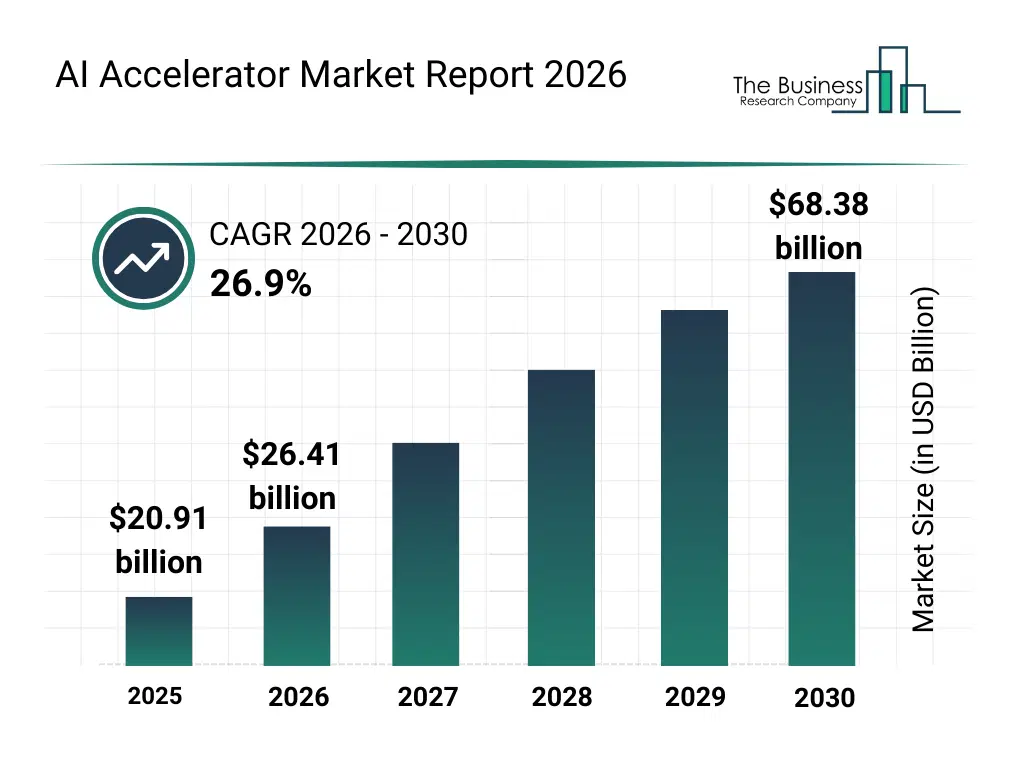
What Is The AI Accelerator Market Size and Share 2026?
The AI accelerator market size has grown exponentially in recent years. It will grow from $20.91 billion in 2025 to $26.41 billion in 2026 at a compound annual growth rate (CAGR) of 26.3%. The growth in the historic period can be attributed to growth of AI workloads, limitations of general purpose processors, expansion of cloud computing, rise of deep learning models, demand for faster inference.What Is The AI Accelerator Market Growth Forecast?
The AI accelerator market size is expected to see exponential growth in the next few years. It will grow to $68.38 billion in 2030 at a compound annual growth rate (CAGR) of 26.9%. The growth in the forecast period can be attributed to increasing AI adoption across industries, growth of edge computing, demand for low power AI hardware, expansion of hyperscale data centers, advances in semiconductor design. Major trends in the forecast period include growth of edge AI accelerators, custom AI chip development, energy efficient AI processing, cloud based AI acceleration, AI accelerator integration in data centers.
Global AI Accelerator Market Segmentation
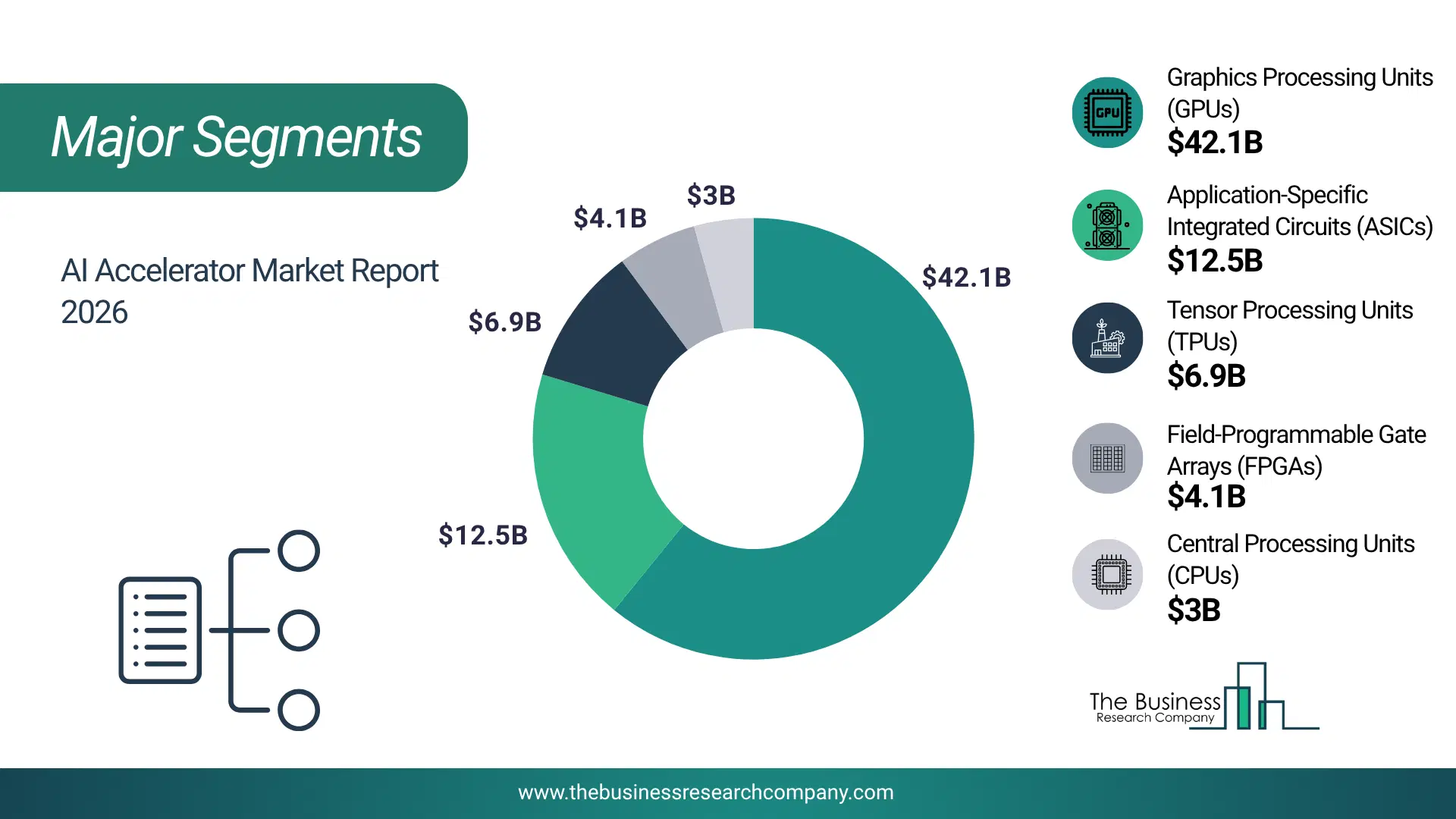
1) By Type: Graphics Processing Units (GPUs), Tensor Processing Units (TPUs), Application-Specific Integrated Circuits (ASICs), Central Processing Units (CPUs), Field-Programmable Gate Arrays (FPGAs) 2) By Technology: Cloud-Based AI Accelerators, Edge AI Accelerators 3) By End User: Information Technology And Telecom, Healthcare, Automotive, Finance, Retails, Other End Users Subsegments: 1) By Graphics Processing Units (GPUs): AI Training GPUs, AI Inference GPUs, Cloud-Based AI GPUs, Edge AI GPUs, High-Performance Computing (HPC) GPUs 2) By Tensor Processing Units (TPUs): Cloud TPUs, Edge TPUs, AI Model Training TPUs, AI Model Inference TPUs, Energy-Efficient TPUs 3) By Application-Specific Integrated Circuits (ASICs): Deep Learning ASICs, Speech And Language Processing ASICs, Computer Vision ASICs, Edge AI ASICs, Low-Power AI ASICs 4) By Central Processing Units (CPUs): AI-Optimized Multi-Core CPUs, Cloud AI CPUs, Edge AI CPUs, Real-Time AI Processing CPUs, High-Performance AI Workstation CPUs 5) By Field-Programmable Gate Arrays (FPGAs): AI Model Customization FPGAs, Low-Latency AI Processing FPGAs, Edge AI FPGAs, Reconfigurable AI Hardware FPGAs, High-Throughput AI Computing FPGAs The top segments in the ai accelerator market will be: • Graphics Processing Units (GPUs) will reach $42.09 billion by 2030. • Application-Specific Integrated Circuits (ASICs) will reach $12.42 billion by 2030. • Tensor Processing Units (TPUs) will reach $6.81 billion by 2030. • Field-Programmable Gate Arrays (FPGAs) will reach $4.09 billion by 2030. • Central Processing Units (CPUs) will reach $2.97 billion by 2030.What Is The Driver Of The AI Accelerator Market?
The increasing deployment of IoT devices is expected to propel the growth of the AI accelerator market going forward. IoT devices refer to physical objects embedded with sensors, software, and connectivity features that enable them to collect, exchange, and process data over the internet. The increasing deployment of IoT devices is driven by factors such as the growing demand for automation, improved connectivity, and the rising consumer adoption of smart devices. AI accelerators enable IoT devices to process data locally, reducing the need for cloud transmission, which results in faster decision-making, lower latency, and reduced bandwidth consumption, enhancing efficiency in real-time applications like smart homes, industrial automation, and healthcare. For instance, in April 2024, according to a report published by Ericsson, a Sweden-based telecommunications company, the global IoT connections reached 15.7 billion connections in 2023 and are expected to increase by 16% to 38.8 billion connections by 2029. Therefore, the increased deployment of IoT devices is driving the growth of the AI accelerator industry.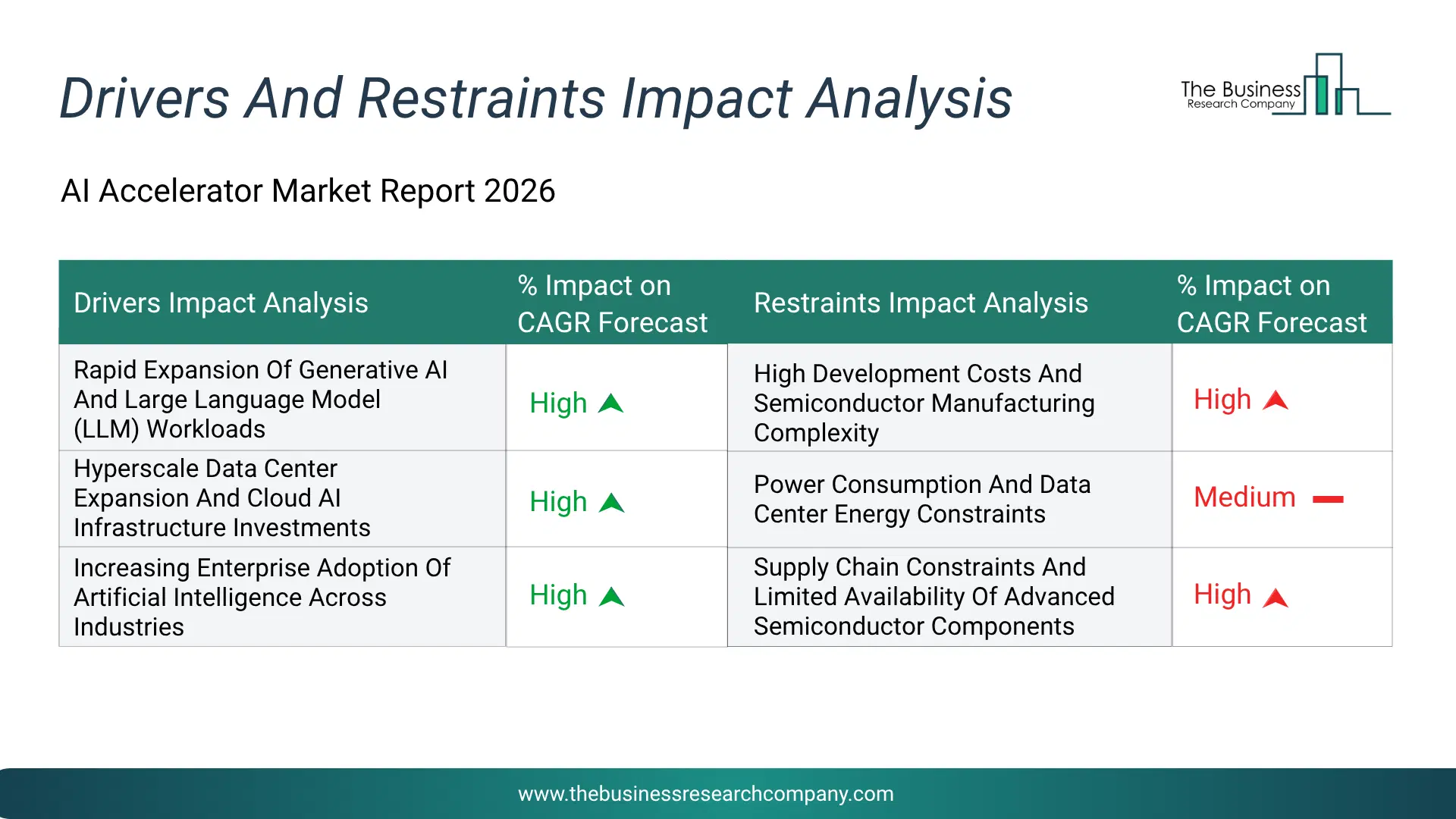
Infographic Chart Showing Key Market Drivers Analysis And Restraints For Ai Accelerator Market
The chart presents an impact analysis of key drivers and restraints, quantifying their relative influence on the market's growth rate and helping assess the balance between growth enablers and limiting factors. This chart offers a high-level perspective; the full report contains more detailed insights.
How Will The Drivers Impact Growth In The Global AI Accelerator Market?
• Rapid Expansion Of Generative AI And Large Language Model (LLM) Workloads (High) – During the forecast period, the rapid expansion of generative artificial intelligence and large language model workloads is expected to become a major growth driver for the ai accelerator market by 2030. Organizations are increasingly developing and deploying large -scale ai models for applications such as natural language processing, image generation, recommendation systems, and intelligent automation. Training and inference of these models require massive parallel processing capabilities and extremely high memory bandwidth, which specialized ai accelerators are designed to provide. Technology companies and research institutions are therefore investing heavily in high -performance gpus, tpus, and asic -based accelerators to support complex ai workloads. This rapid proliferation of generative ai applications is significantly strengthening demand for advanced accelerator hardware. • Hyperscale Data Center Expansion And Cloud AI Infrastructure Investments (High) – During the forecast period, the hyperscale data centers and cloud ai infrastructure investments are expected to emerge as a major factor driving the growth of the ai accelerator market by 2030. Global cloud service providers are rapidly expanding data center capacity to support ai training, machine learning platforms, and high-performance analytics services. Ai accelerators enable faster model training, improved computational efficiency, and scalable performance for complex workloads across distributed cloud environments. As enterprises increasingly rely on cloud-based ai services, hyperscale operators are deploying large clusters of accelerators within data-center architectures. Continuous investments in advanced computing infrastructure are therefore accelerating demand for ai accelerator hardware. • Increasing Enterprise Adoption Of Artificial Intelligence Across Industries (High) – During the forecast period, the increasing enterprise adoption of artificial intelligence across industries is expected to act as a key growth catalyst for the ai accelerator market by 2030. Organizations in sectors such as healthcare, finance, manufacturing, retail, and transportation are integrating ai technologies to enhance operational efficiency, automate decision-making, and improve customer experiences. Ai-driven applications including predictive analytics, fraud detection, computer vision, and intelligent process automation require accelerated computing capabilities to process large volumes of data in real time. Enterprises are therefore investing in ai infrastructure equipped with specialized accelerator processors to support these advanced workloads. As digital transformation initiatives expand globally, demand for ai hardware platforms is expected to rise steadily.How Will The Restraints Impact Growth In The Global AI Accelerator Market?
• High Development Costs And Semiconductor Manufacturing Complexity (High) – During the forecast period, the designing and manufacturing ai accelerator chips requires advanced semiconductor fabrication technologies, complex chip architectures, and significant capital investment. Leading-edge nodes such as 3nm and 5nm demand highly sophisticated manufacturing facilities and specialized expertise, limiting the number of companies capable of producing advanced accelerators. The high research, development, and fabrication costs increase entry barriers and restrict competition. These factors can slow innovation cycles and limit broader market participation. • Power Consumption And Data Center Energy Constraints (Medium) – During the forecast period, the ai accelerators deliver exceptional computing performance but often consume large amounts of power, especially when deployed at scale in hyperscale data centers. Training large ai models can require thousands of accelerators operating simultaneously, significantly increasing electricity demand and cooling requirements. Rising energy costs and sustainability concerns are prompting operators to carefully evaluate power efficiency before expanding ai infrastructure. These energy constraints may limit rapid deployment of ai hardware in certain regions and facilities. • Supply Chain Constraints And Limited Availability Of Advanced Semiconductor Components (High) – During the forecast period, the supply chain constraints and limited availability of advanced semiconductor components act as a restraint for the ai accelerator market by disrupting the timely production and delivery of high-performance chips. Dependence on a small number of foundries for advanced nodes creates bottlenecks, especially during periods of high demand or geopolitical uncertainty. Shortages of critical materials such as high-purity silicon wafers and specialized packaging components further exacerbate delays. These challenges increase lead times and production costs for manufacturers. As a result, overall market expansion and rapid scaling of ai infrastructure are hindered.Key Players In The Global AI Accelerator Market
Major companies operating in the AI accelerator market are Samsung Electronics Co. Ltd., Huawei Technologies Co. Ltd., Taiwan Semiconductor Manufacturing Company, Intel Corporation, Cisco Systems Inc., Qualcomm Technologies Inc., Broadcom Inc., NVIDIA Corporation, Advanced Micro Devices Inc. (AMD), Baidu Inc., NXP Semiconductors N.V., Microchip Technology Incorporated, Synopsys Inc., Marvell Technology Inc., Arista Networks Inc., Xilinx Inc., Hailo Ltd., Rebellions.ai, Furiosa AI Inc., Graphcore Limited, BrainChip Holdings Ltd., LeapMind Inc.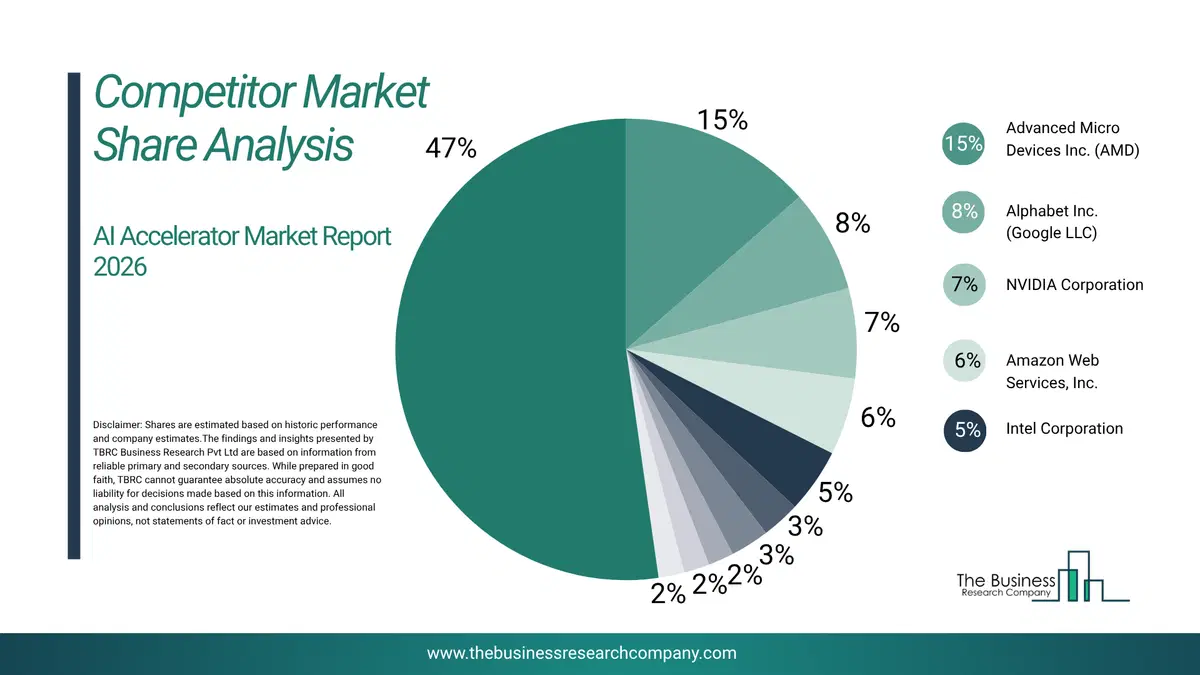
This chart is for illustrative purposes; the full report includes a detailed competitor analysis and comprehensive overview of the top 10 companies in the market.
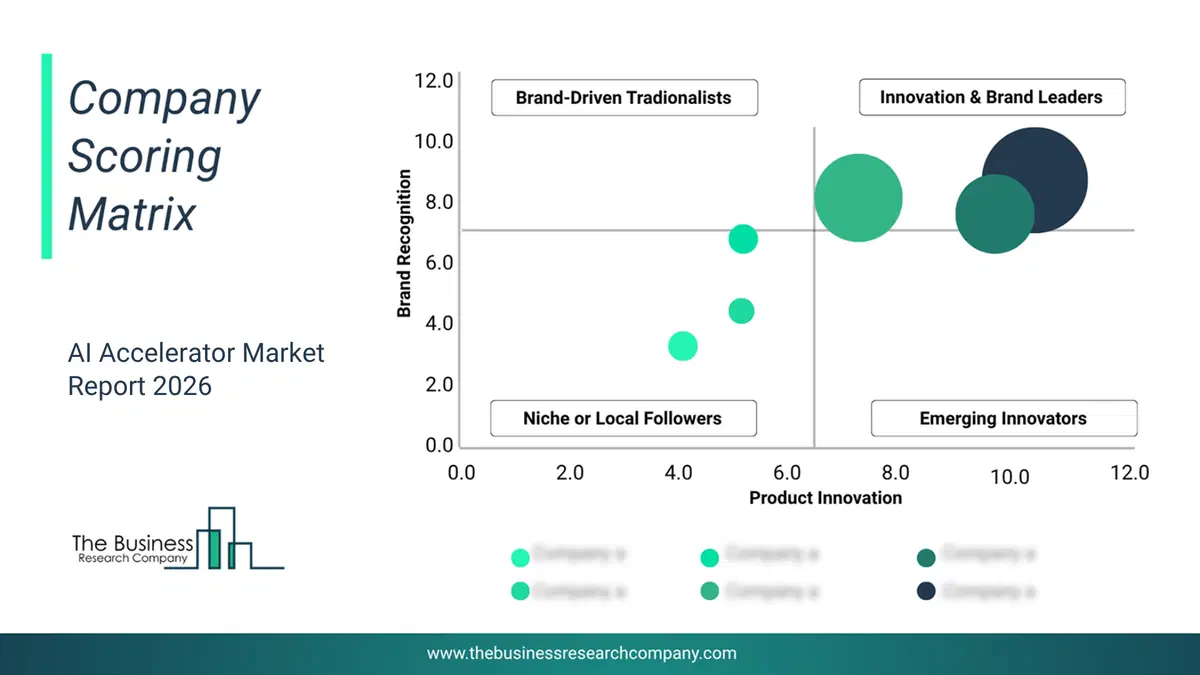
This chart maps companies by product innovation and brand strength, with bubble size indicating relative revenue, helping identify market leaders, challengers, and niche players. This is an illustrative chart; the full report provides a complete and accurate competitive analysis.
Global AI Accelerator Market Trends and Insights
Major companies operating in the AI accelerator market are focusing on developing advanced technologies such as 5 nm node process technology to enhance performance, improve energy efficiency, and support the increasing demands of AI workloads. 5 nm node process technology refers to a semiconductor manufacturing process where the transistors are only 5 nanometers in size, allowing for improved performance, reduced power consumption, and more compact chip designs. For instance, in August 2024, IBM, a US-based technology company, launched the Spyre accelerator chip, an advanced AI processing unit designed for IBM Z systems. It is equipped with 32 cores and 25.6 billion transistors, utilizing 5nm node process technology to deliver both high performance and energy efficiency. This is mounted on PCIe cards that can be clustered together to boost processing power and facilitates large-scale AI inferencing and supports complex applications, such as fraud detection and generative AI for automating business processes and modernizing code. Its architecture is optimized to handle AI workloads, allowing businesses to deploy AI models securely and efficiently on-premises.What Are Latest Mergers And Acquisitions In The AI Accelerator Market?
In April 2024, IBM, a US-based company that offers technology, partnered with Intel Corporation for an undisclosed amount. With this partnership, IBM and Intel aims to provide scalable, cost-effective, and secure AI solutions that enhance performance and support enterprise AI workloads across hybrid cloud environments. Intel Corporation is a US-based technology company specializing in AI accelerators.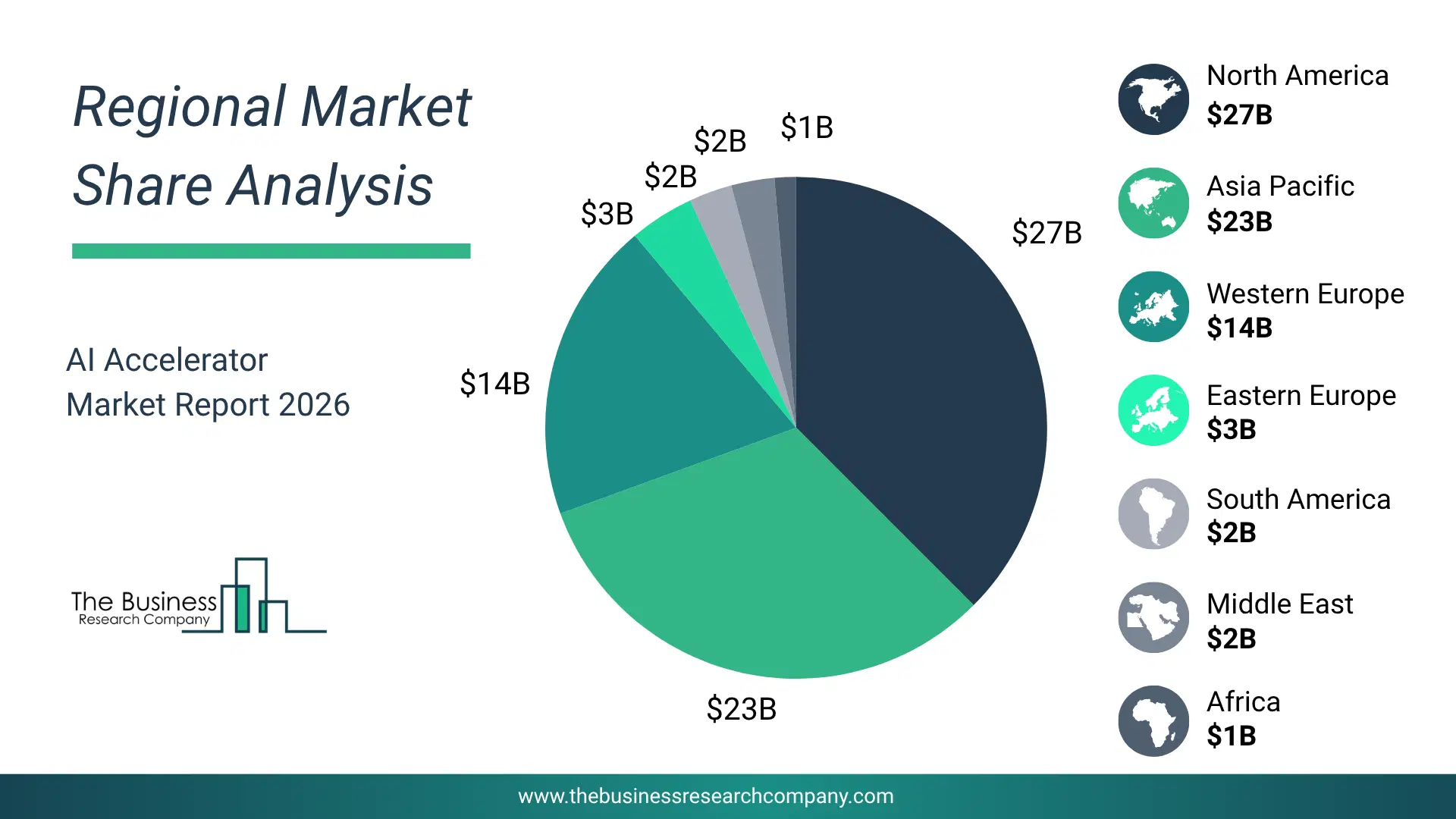
Regional Insights
North America was the largest region in the AI accelerator market in 2025. The regions covered in this market report are Asia-Pacific, South East Asia, Western Europe, Eastern Europe, North America, South America, Middle East, Africa. The countries covered in this market report are Australia, Brazil, China, France, Germany, India, Indonesia, Japan, Taiwan, Russia, South Korea, UK, USA, Canada, Italy, Spain.What Defines the AI Accelerator Market?
The AI accelerator market consists of revenues earned by entities providing services such as AI model development and training, data preparation, and processing. The market value includes the value of related goods sold by the service provider or included within the service offering. The AI Accelerator market also includes sales of AI chips, hardware accelerators, and AI software development kits. Values in this market are ‘factory gate’ values, that is the value of goods sold by the manufacturers or creators of the goods, whether to other entities (including downstream manufacturers, wholesalers, distributors and retailers) or directly to end customers. The value of goods in this market includes related services sold by the creators of the goods.How is Market Value Defined and Measured?
The market value is defined as the revenues that enterprises gain from the sale of goods and/or services within the specified market and geography through sales, grants, or donations in terms of the currency (in USD unless otherwise specified). The revenues for a specified geography are consumption values that are revenues generated by organizations in the specified geography within the market, irrespective of where they are produced. It does not include revenues from resales along the supply chain, either further along the supply chain or as part of other products.
This chart presents market attractiveness based on a quantitative evaluation of growth, competition, strategic alignment, and risk, offering a clear view of opportunity areas for decision-making. This chart is for illustrative purposes; the full report contains the complete analysis.

This chart highlights the Total Addressable Market (TAM) by estimating the maximum revenue opportunity using an assumption-driven approach, supporting strategic planning and opportunity sizing across markets. The chart is illustrative; the full report provides a more comprehensive analysis.
What Key Data and Analysis Are Included in the AI Accelerator Market Report 2026?
The ai accelerator market research report is one of a series of new reports from The Business Research Company that provides market statistics, including industry global market size, regional shares, competitors with the market share, detailed market segments, market trends and opportunities, and any further data you may need to thrive in the ai accelerator industry. The market research report delivers a complete perspective of everything you need, with an in-depth analysis of the current and future state of the industry.AI Accelerator Market Report Forecast Analysis
| Report Attribute | Details |
|---|---|
| Market Size Value In 2026 | $26.41 billion |
| Revenue Forecast In 2030 | $68.38 billion |
| Growth Rate | CAGR of 26.9% from 2026 to 2030 |
| Base Year For Estimation | 2025 |
| Actual Estimates/Historical Data | 2020-2025 |
| Forecast Period | 2026 - 2030 |
| Market Representation | Revenue in USD Billion and CAGR from 2026 to 2030 |
| Segments Covered | Type, Technology, End User |
| Regional Scope | Asia-Pacific, Western Europe, Eastern Europe, North America, South America, Middle East, Africa |
| Country Scope | The countries covered in the report are Australia, Brazil, China, France, Germany, India, ... |
| Key Companies Profiled | Samsung Electronics Co. Ltd., Huawei Technologies Co. Ltd., Taiwan Semiconductor Manufacturing Company, Intel Corporation, Cisco Systems Inc., Qualcomm Technologies Inc., Broadcom Inc., NVIDIA Corporation, Advanced Micro Devices Inc. (AMD), Baidu Inc., NXP Semiconductors N.V., Microchip Technology Incorporated, Synopsys Inc., Marvell Technology Inc., Arista Networks Inc., Xilinx Inc., Hailo Ltd., Rebellions.ai, Furiosa AI Inc., Graphcore Limited, BrainChip Holdings Ltd., LeapMind Inc. |
| Customization Scope | Request for Customization |
| Pricing And Purchase Options | Explore Purchase Options |