
AI For Public Security And Safety Global Market Opportunities And Strategies To 2035
By Component (Solution, Services), By Deployment Model (On-Premises, Cloud-Based), By Application (Preventative Policing, Criminal Investigation, Combating Terrorism, Emergency Response, Disaster Management, Other Applications), By End User (Law Enforcement Agencies, Federal Intelligence And Security, Other End Users), And By Region, Opportunities And Strategies – Global Forecast To 2035
AI For Public Security And Safety Market Definition
AI for Public Security and Safety refers to the use of artificial intelligence technologies, including machine learning, computer vision, natural language processing, predictive analytics and automated decision-support systems, to enhance public safety, security operations and threat management activities. These technologies are used by government agencies, law enforcement organizations, intelligence and security agencies, emergency management authorities and public sector institutions to improve situational awareness, detect threats, analyze large volumes of data and support decision-making processes. The AI for public security and safety market consist of sales by entities (organizations, sole traders and partnerships) through the sale of AI-powered software platforms, analytics solutions, security applications and related services designed to improve public protection, crime prevention and emergency management outcomes.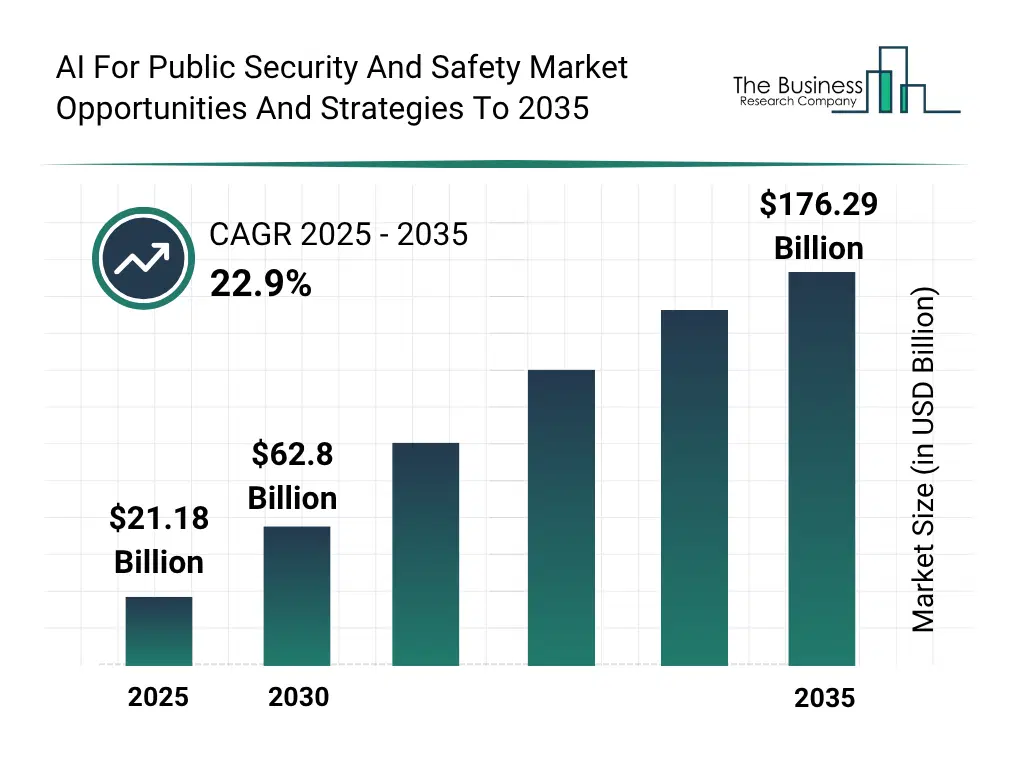
AI For Public Security And Safety Market Size
The global AI for public security and safety market reached a value of nearly $21,184.7 million in 2025, having grown at a compound annual growth rate (CAGR) of 27.3% since 2020. The market is expected to grow from $21,184.7 million in 2025 to $62,803.6 million in 2030 at a rate of 24.3%. The market is then expected to grow at a CAGR of 22.9% from 2030 and reach $176,286.4 million in 2035. Growth in the historic period resulted from increasing adoption of smart city initiatives, increasing cyber threats, rising focus on border security and national security modernization and increasing use of drones and autonomous monitoring systems. Factors that negatively affected growth in the historic period were risk of data quality and availability issues and increasing concerns about misuse of personal and sensitive data. Going forward, growing concerns about terrorism, increasing regulatory emphasis on public safety preparedness and resilience, increasing government funding for AI and growing adoption of AI-powered biometric identification systems will drive the growth. Factors that could hinder the growth of the AI for public security and safety market in the future include privacy and civil liberties concerns, regulatory and compliance requirements, integration challenges with legacy public safety systems and impact of trade wars and tariffs.
AI For Public Security And Safety Market Segmentation
The AI for public security and safety market is segmented by component, by deployment model, by application and by end users.By Component –
The AI for public security and safety market is segmented by component into:
- a) Solutions
- b) Services
By Deployment Model –
The AI for public security and safety market is segmented by deployment model into:
- a) Cloud-Based
- b) On-Premises
By Application –
The AI for public security and safety market is segmented by application into:
- a) Preventative Policing
- b) Criminal Investigation
- c) Emergency Response
- d) Combating Terrorism
- e) Disaster Management
- f) Other Applications
By End User –
The AI for public security and safety market is segmented by end user into:
- a) Law Enforcement Agencies
- b) Federal Intelligence And Security
- c) Other End Users
By Geography - The AI for public security and safety market is segmented by geography into:
- China
- India
- Japan
- Australia
- Taiwan
- South Korea
- Indonesia
- USA
- Canada
- Brazil
- France
- Germany
- UK
- Italy
- Spain
- Russia
-
o Asia Pacific
o Africa