
AI In Oil And Gas Market Report 2026
Global Outlook – By Type (Hardware, Software, Hybrid), By Function (Predictive Maintenance And Machinery Inspection, Material Movement, Production Planning, Field Services, Quality Control, Reclamation), By Process (Reservoir Optimization, Drilling Optimization, Production Optimization, Safety Management, Other Processes), By Technology (Internet Of Things (IoT), Advance Analytics, Robotics, Cloud Computing, Mobility, Other Technologies) – Market Size, Trends, Strategies, and Forecast to 2030
AI In Oil And Gas Market Overview
• AI In Oil And Gas market size has reached to $4.04 billion in 2025 • Expected to grow to $7.51 billion in 2030 at a compound annual growth rate (CAGR) of 13.3% • Growth Driver: Surging Oil And Gas Exploration Fuels Market • Market Trend: Advancements in AI Technology for Enhanced Exploration in the Oil and Gas Industry • North America was the largest region and fastest growing region.Market Gains By 2030 – Top Opportunities By Segment
Market Gain identifies the most promising market opportunities by highlighting the segments or products expected to generate the highest incremental revenue growth over the next five years.
What Is Covered Under AI In Oil And Gas Market?
AI in oil and gas is used for upstream operations, customized drilling, and optimization of downstream operations. Emulating human intelligence in machines created to act and think like people is known as artificial intelligence (AI). The main types of AI in oil and gas are hardware, software, and hybrids. Hardware refers to the computer's tangible components or delivery systems that store and run the written instructions provided by the software. The various functions are predictive maintenance and machinery inspection, material movement, production planning, field services, quality control, and reclamation, and the different processes used are reservoir optimization, drilling optimization, production optimization, safety management, and other processes. The technologies used are IoT, advanced analytics, robotics, cloud computing, mobility, and other technologies. The various applications are upstream, downstream, and midstream.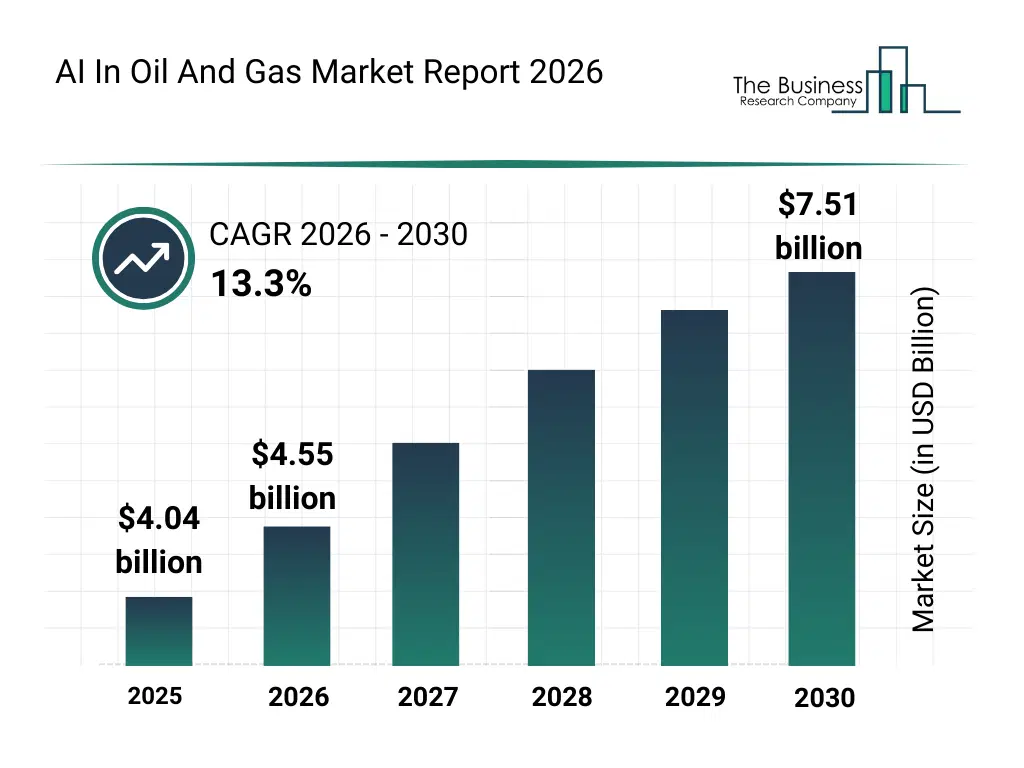
What Is The AI In Oil And Gas Market Size and Share 2026?
The ai in oil and gas market size has grown rapidly in recent years. It will grow from $4.04 billion in 2025 to $4.55 billion in 2026 at a compound annual growth rate (CAGR) of 12.8%. The growth in the historic period can be attributed to need for operational efficiency, volatility in oil prices, growth in digital oilfield initiatives, rising offshore exploration complexity, availability of large operational data sets.What Is The AI In Oil And Gas Market Growth Forecast?
The ai in oil and gas market size is expected to see rapid growth in the next few years. It will grow to $7.51 billion in 2030 at a compound annual growth rate (CAGR) of 13.3%. The growth in the forecast period can be attributed to focus on cost reduction, demand for real time decision making, increasing safety regulations, expansion of smart oilfields, advancements in ai software platforms. Major trends in the forecast period include increased use of predictive maintenance solutions, rising adoption of drilling optimization algorithms, integration of ai with iot oilfield systems, growing deployment of robotics and drones, expansion of data driven reservoir management.
Global AI In Oil And Gas Market Segmentation
1) By Type: Hardware, Software, Hybrid 2) By Function: Predictive Maintenance And Machinery Inspection, Material Movement, Production Planning, Field Services, Quality Control, Reclamation 3) By Process: Reservoir Optimization, Drilling Optimization, Production Optimization, Safety Management, Other Processes 4) By Technology: Internet Of Things (IoT), Advance Analytics, Robotics, Cloud Computing, Mobility, Other Technologies Subsegments: 1) By Hardware: AI-Powered Sensors, Edge Computing Devices, Robotics And Drones 2) By Software: Machine Learning Platforms, Data Analytics Software, Predictive Maintenance Solutions, Visualization Tools 3) By Hybrid: Integrated AI Systems, Cloud-Based AI Solutions, IoT And AI Combined Platforms The top segments in the ai in oil and gas market will be: • Software will reach $3.74 Billion by 2030. • Hybrid will reach $2.15 Billion by 2030. • Hardware will reach $1.58 Billion by 2030.What Is The Driver Of The AI In Oil And Gas Market?
Rising oil and gas exploration activities are expected to propel the growth of AI in the oil and gas market going forward. Oil and gas exploration activities refer to the systematic process of searching for underground or underwater deposits of crude oil and natural gas, including geological surveys, seismic studies, and exploratory drilling to locate commercially viable resources. The rise in oil and gas exploration activities is driven by the growing global energy demand requiring more production. The AI in the oil and gas market supports oil and gas exploration activities by providing efficient, automated, and data-driven solutions that optimize exploration and reduce operational risks. For instance, in June 2025, according to the U.S. Energy Information Administration (EIA), a US-based government organization, domestic crude oil production reached 13.2 million barrels per day in 2024, marking a 2% increase over the previous record set in 2023. Therefore, rising oil and gas exploration activities is driving the growth of AI in the oil and gas market.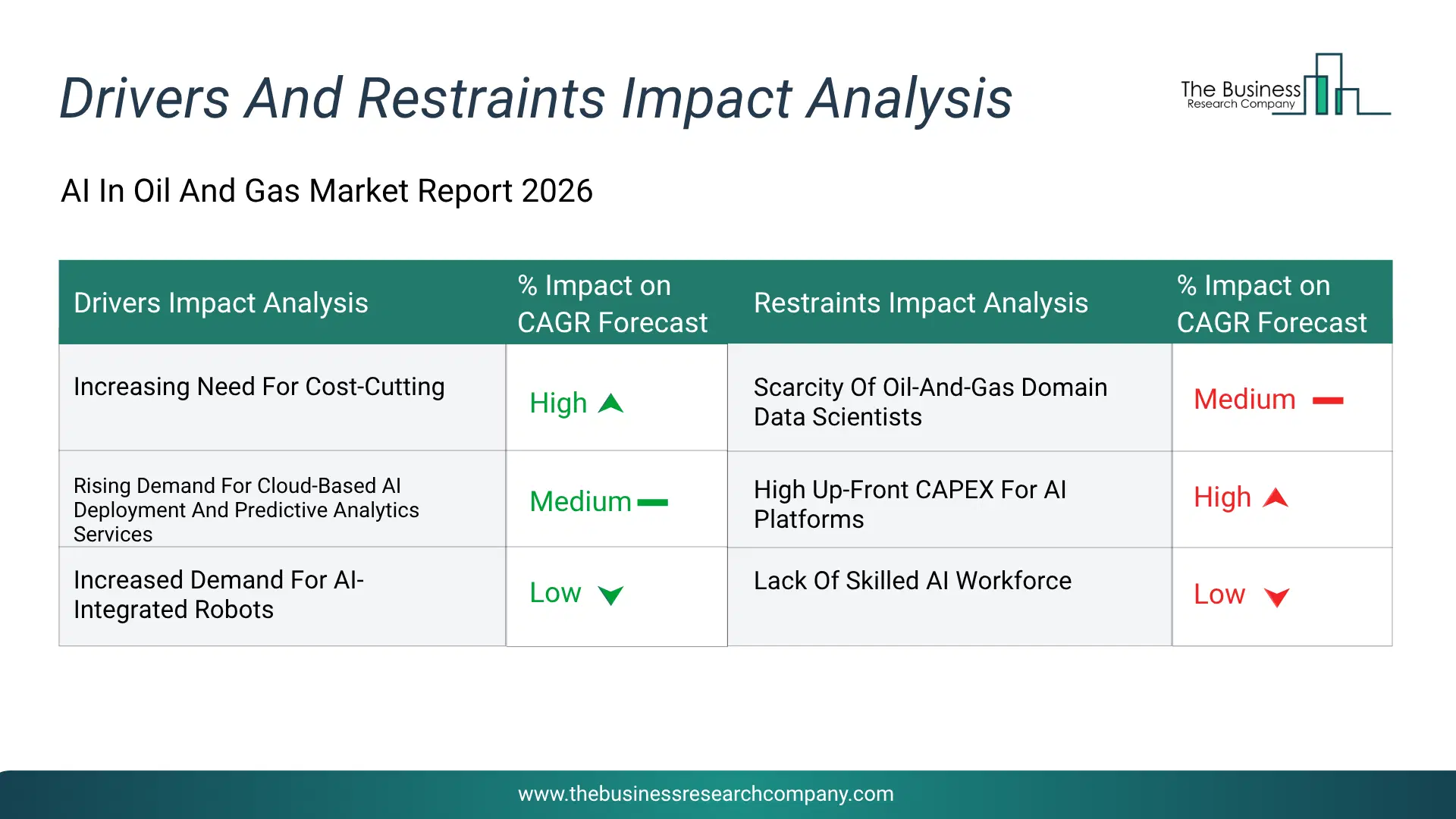
Infographic Chart Showing Key Market Drivers Analysis And Restraints For Ai In Oil And Gas Market
The chart presents an impact analysis of key drivers and restraints, quantifying their relative influence on the market's growth rate and helping assess the balance between growth enablers and limiting factors. This chart offers a high-level perspective; the full report contains more detailed insights.
How Will The Drivers Impact Growth In The Global AI In Oil And Gas Market?
• Increasing Need For Cost-Cutting (High) – During the forecast period, the increasing need for cost-cutting is expected to become a key growth driver for the AI in oil and gas market by 2030. Oil and gas companies are increasingly deploying AI solutions to minimize operational expenditures across exploration, drilling, and production activities. AI-driven automation reduces reliance on manual intervention, optimizes resource allocation, and enhances equipment utilization, thereby lowering overall costs. Companies are also leveraging AI to streamline supply chain operations and reduce inefficiencies in logistics and inventory management. This growing focus on operational cost efficiency is accelerating the adoption of intelligent technologies across the value chain. • Rising Demand For Cloud-Based AI Deployment And Predictive Analytics Services (Medium) – During the forecast period, the rising demand for cloud-based AI deployment and predictive analytics services is expected to emerge as a major factor driving the expansion of the AI in oil and gas market by 2030. The adoption of cloud infrastructure enables seamless data integration, remote accessibility, and scalable AI model deployment across geographically dispersed oilfields. Predictive analytics solutions are being widely used to forecast equipment failures, optimize production schedules, and enhance reservoir performance. The flexibility and cost advantages offered by cloud platforms are encouraging companies to transition from traditional IT systems to AI-enabled digital ecosystems. • Increased Demand For AI-Integrated Robots (Low) – During the forecast period, the increased demand for AI-integrated robots is expected to act as a key growth catalyst for the AI in oil and gas market by 2030. The industry is increasingly adopting robotic systems for hazardous and complex operations such as pipeline inspection, offshore platform maintenance, and subsea exploration. AI-enabled robots improve operational accuracy, reduce human exposure to dangerous environments, and enable continuous monitoring of critical infrastructure. These systems are also enhancing inspection capabilities through advanced imaging and real-time data analysis. As automation becomes a priority in high-risk environments, the adoption of AI-integrated robotics is expected to rise significantly.How Will The Restraints Impact Growth In The Global AI In Oil And Gas Market?
• Scarcity Of Oil-And-Gas Domain Data Scientists (High) – During the forecast period, scarcity of oil-and-gas domain data scientists acts as a significant restraint for the AI in oil and gas market because successful AI implementation requires a combination of data science expertise and deep industry knowledge. Professionals must understand geological data, drilling processes, and operational workflows alongside advanced analytics, which limits the available talent pool. This shortage slows down the development, customization, and deployment of AI models tailored to specific oilfield conditions. Companies often face delays in extracting actionable insights from complex datasets due to this expertise gap. Additionally, reliance on external consultants increases operational costs and reduces in-house capabilities. The lack of domain-specific data scientists also affects the accuracy and reliability of predictive models. As a result, organizations struggle to fully leverage AI potential, hindering overall market growth. • High Up-Front CAPEX For AI Platforms (Medium) – During the forecast period, high up-front CAPEX for AI platforms serves as a major restraint for the AI in oil and gas market as organizations must invest heavily in infrastructure, software, and integration processes. Implementing AI solutions often requires advanced computing systems, data storage facilities, and specialized tools, leading to substantial initial expenditures. These high capital requirements can be a barrier, especially for small and mid-sized operators with limited budgets. Additionally, integrating AI platforms with legacy systems further increases costs and complexity. The uncertainty regarding return on investment (ROI) also makes companies cautious about large-scale adoption. Long deployment cycles and ongoing maintenance expenses add to the financial burden. Consequently, high initial capital investment slows down the widespread adoption of AI technologies in the industry. • Lack Of Skilled AI Workforce (Low) – During the forecast period, lack of skilled AI workforce acts as a critical restraint for the AI in oil and gas market as the adoption of advanced technologies depends heavily on qualified professionals. AI systems require experts in machine learning, data engineering, and automation to design, implement, and maintain solutions effectively. However, there is a global shortage of such talent, particularly with experience in industrial applications like oil and gas. This skill gap leads to inefficiencies in deployment and limits the scalability of AI initiatives. Companies may struggle to train existing employees due to the complexity of AI technologies and the time required for upskilling. Moreover, competition for skilled professionals increases hiring costs and employee turnover risks. As a result, the shortage of AI talent restricts innovation and slows market expansion.Key Players In The Global AI In Oil And Gas Market
Major companies operating in the ai in oil and gas market are IBM Corporation, Microsoft Corporation, Accenture PLC, Google LLC, Intel Corporation, Schlumberger Limited, Halliburton Company, Baker Hughes Company, National Oilwell Varco Inc., Weatherford International PLC, TechnipFMC PLC, Wood PLC, ABB Ltd, Siemens AG, Honeywell International Inc., Emerson Electric Co., General Electric Company, Rockwell Automation Inc., Schneider Electric SE, Yokogawa Electric Corporation, Mitsubishi Electric Corporation, Toshiba Corporation, Hitachi Ltd., NEC Corporation, Fujitsu Limited, Oracle Corporation, Numenta Corporation, Sentient Technologies Inc.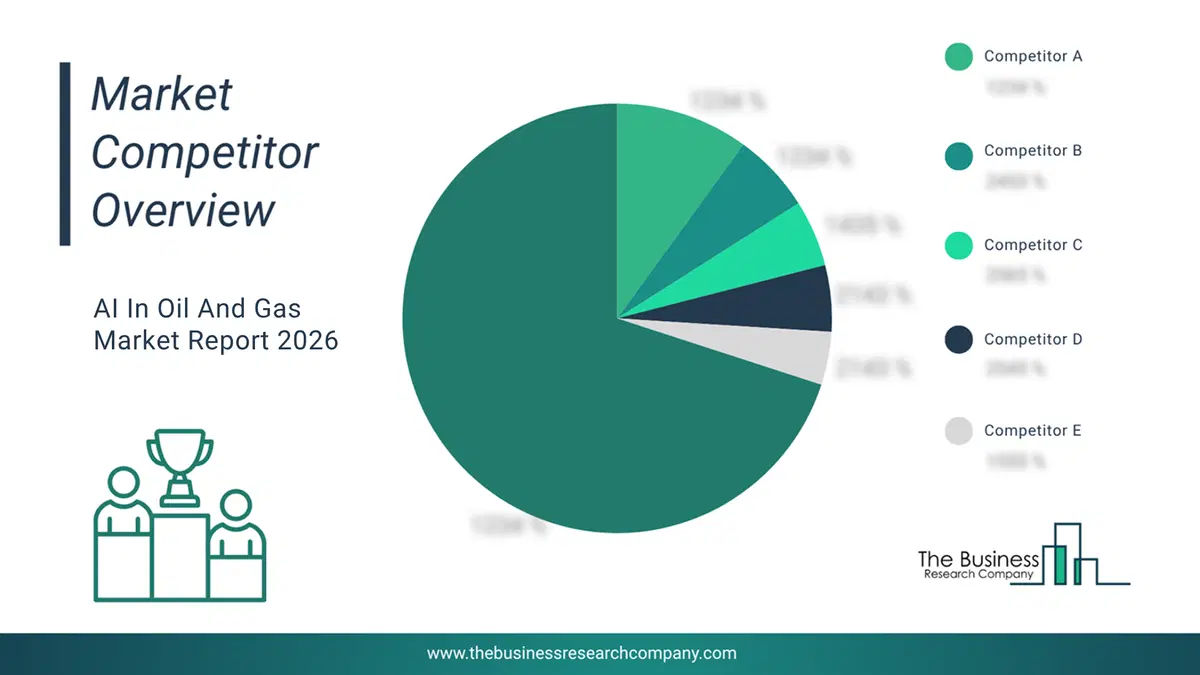
This chart is for illustrative purposes; the full report includes a detailed competitor analysis and comprehensive overview of the top 10 companies in the market.
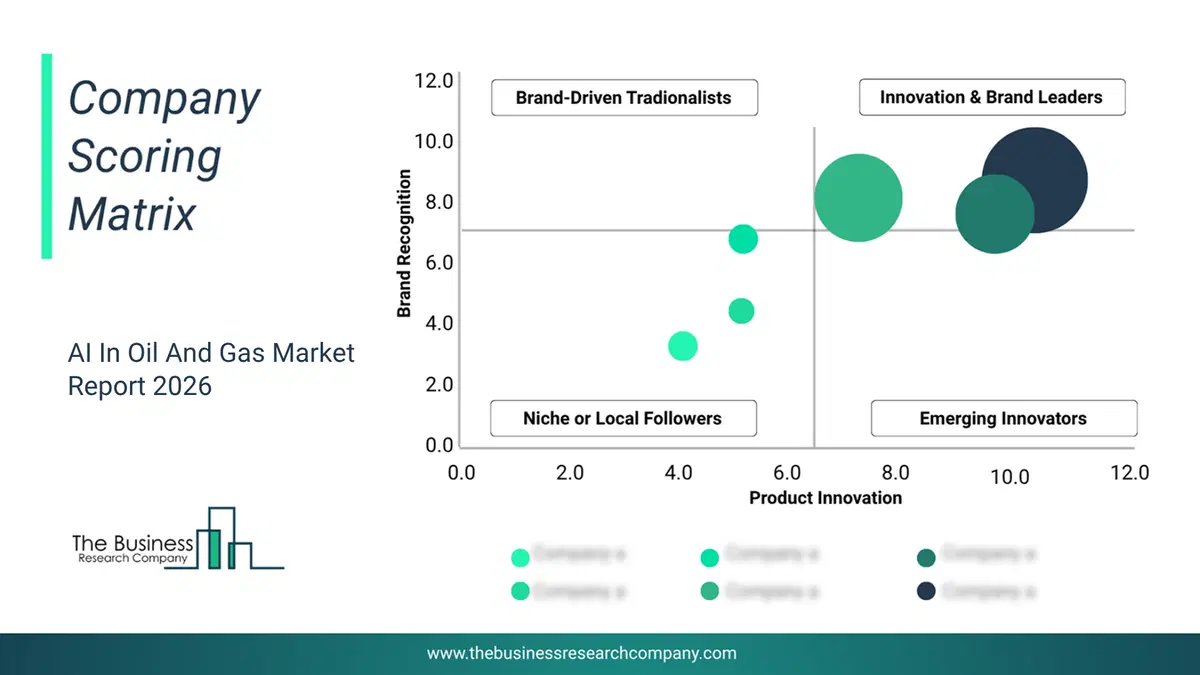
This chart maps companies by product innovation and brand strength, with bubble size indicating relative revenue, helping identify market leaders, challengers, and niche players. This is an illustrative chart; the full report provides a complete and accurate competitive analysis.
Global AI In Oil And Gas Market Trends and Insights
Major companies operating in the AI in the oil and gas market are focusing on developing technologically advanced solutions, such as AI tools to optimize operations, enhance predictive maintenance, and improve safety and efficiency. AI tools refer to advanced software and algorithms that analyze data to streamline processes, forecast equipment failures, and enhance decision-making in oil and gas operations. For instance, in July 2024, Indosat, an Indonesia-based Internet service provider company, launched a suite of AI-powered, cloud-based solutions. This solution enhances operational efficiency by automating tasks and optimizing resource allocation, leading to significant cost savings. Additionally, they enable data-driven decision-making through rapid analysis of large datasets, improving productivity across the organization.What Are Latest Mergers And Acquisitions In The AI In Oil And Gas Market?
In March 2023, Accenture plc, an Ireland-based multinational professional services company, acquired Flutura Decision Sciences and Analytics for an undisclosed amount. Through this acquisition, Accenture aims to enhance its digital capabilities, expand its service offerings, and drive innovation for its clients in an increasin gly competitive market. Flutura Business Solutions LLC, is an India-based data analytics and artificial intelligence company.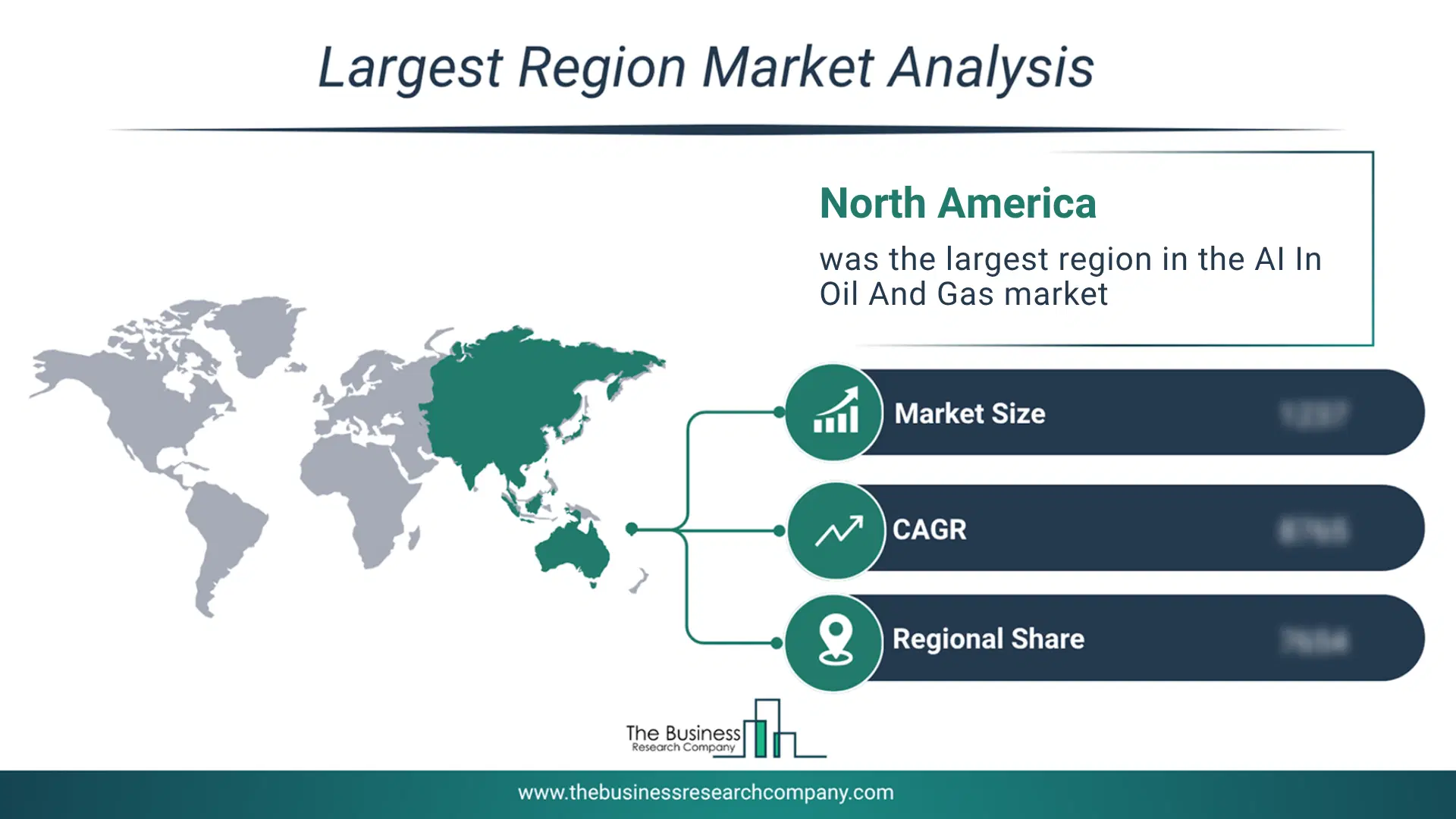
Regional Outlook
North America was the largest region in the AI in oil and gas market in 2025 and is expected to be the fastest-growing region in the forecast period. The regions covered in this market report are Asia-Pacific, South East Asia, Western Europe, Eastern Europe, North America, South America, Middle East, Africa. The countries covered in this market report are Australia, Brazil, China, France, Germany, India, Indonesia, Japan, Taiwan, Russia, South Korea, UK, USA, Canada, Italy, SpainWhat Defines the AI In Oil And Gas Market?
The AI in oil and gas market consists of revenues earned by entities by professional services, managed services, installation, training and support and maintenance. The market value includes the value of related goods sold by the service provider or included within the service offering. The AI in oil and gas market also includes sales of hardware and software used in providing AI in oil and gas services. Values in this market are ‘factory gate’ values, that is the value of goods sold by the manufacturers or creators of the goods, whether to other entities (including downstream manufacturers, wholesalers, distributors and retailers) or directly to end customers. The value of goods in this market includes related services sold by the creators of the goods.How is Market Value Defined and Measured?
The market value is defined as the revenues that enterprises gain from the sale of goods and/or services within the specified market and geography through sales, grants, or donations in terms of the currency (in USD unless otherwise specified). The revenues for a specified geography are consumption values that are revenues generated by organizations in the specified geography within the market, irrespective of where they are produced. It does not include revenues from resales along the supply chain, either further along the supply chain or as part of other products.
This chart presents market attractiveness based on a quantitative evaluation of growth, competition, strategic alignment, and risk, offering a clear view of opportunity areas for decision-making. This chart is for illustrative purposes; the full report contains the complete analysis.

This chart highlights the Total Addressable Market (TAM) by estimating the maximum revenue opportunity using an assumption-driven approach, supporting strategic planning and opportunity sizing across markets. The chart is illustrative; the full report provides a more comprehensive analysis.
What Key Data and Analysis Are Included in the AI In Oil And Gas Market Report 2026?
The ai in oil and gas market research report is one of a series of new reports from The Business Research Company that provides market statistics, including industry global market size, regional shares, competitors with the market share, detailed market segments, market trends and opportunities, and any further data you may need to thrive in the ai in oil and gas industry. The market research report delivers a complete perspective of everything you need, with an in-depth analysis of the current and future state of the industry.AI In Oil And Gas Market Report Forecast Analysis
| Report Attribute | Details |
|---|---|
| Market Size Value In 2026 | $4.55 billion |
| Revenue Forecast In 2030 | $7.51 billion |
| Growth Rate | CAGR of 13.3% from 2026 to 2030 |
| Base Year For Estimation | 2025 |
| Actual Estimates/Historical Data | 2020-2025 |
| Forecast Period | 2026 - 2030 |
| Market Representation | Revenue in USD Billion and CAGR from 2026 to 2030 |
| Segments Covered | Type, Function, Process, Technology |
| Regional Scope | Asia-Pacific, Western Europe, Eastern Europe, North America, South America, Middle East, Africa |
| Country Scope | The countries covered in the report are Australia, Brazil, China, France, Germany, India, Indonesia, Japan, Taiwan, Russia, South Korea, UK, USA, Canada, Italy, Spain. |
| Key Companies Profiled | IBM Corporation, Microsoft Corporation, Accenture PLC, Google LLC, Intel Corporation, Schlumberger Limited, Halliburton Company, Baker Hughes Company, National Oilwell Varco Inc., Weatherford International PLC, TechnipFMC PLC, Wood PLC, ABB Ltd, Siemens AG, Honeywell International Inc., Emerson Electric Co., General Electric Company, Rockwell Automation Inc., Schneider Electric SE, Yokogawa Electric Corporation, Mitsubishi Electric Corporation, Toshiba Corporation, Hitachi Ltd., NEC Corporation, Fujitsu Limited, Oracle Corporation, Numenta Corporation, Sentient Technologies Inc. |
| Customization Scope | Request for Customization |
| Pricing And Purchase Options | Explore Purchase Options |