
AI In Virtual Reality And Augmented Reality Market Report 2026
Global Outlook – By Type (Artificial Intelligence-Powered Virtual Reality (VR), Artificial Intelligence-Enhanced Augmented Reality (AR)), By Technology (Natural Language Processing (NLP), Computer Vision, Machine Learning, Deep Learning, Gesture Recognition, Speech Recognition, Simulated Environments), By Platform (Mobile Devices, Head-Mounted Displays (HMDs), Projectors And Smart Glasses, Wearables And Body Tracking Devices, Desktop Computers And Consoles), By Application (Gaming And Entertainment, Education And Training, Healthcare And Medical, Retail And E-commerce, Real Estate And Architecture, Automotive And Transportation, Tourism And Travel, Industrial And Manufacturing, Military And Defense) – Market Size, Trends, Strategies, and Forecast to 2030
AI In Virtual Reality And Augmented Reality Market Overview
• AI In Virtual Reality And Augmented Reality market size has reached to $83.72 billion in 2025 • Expected to grow to $450.48 billion in 2030 at a compound annual growth rate (CAGR) of 38.5% • Growth Driver: Surging Number Of IoT Devices Fuels Growth In The AI In Virtual Reality And Augmented Reality Market • Market Trend: Innovative Assisted Reality Glasses • North America was the largest region in 2025.What Is Covered Under AI In Virtual Reality And Augmented Reality Market?
AI in virtual reality (VR) and augmented reality (AR) refers to the integration of artificial intelligence techniques and algorithms within VR and AR systems to enhance user experiences, enable intelligent interactions, and generate dynamic virtual content in real-time. The use of AI and immersive technologies aims to create more realistic, personalized, and interactive VR and AR environments for various applications. The main types of AI in virtual reality and augmented reality are artificial intelligence-powered virtual reality (VR) and artificial intelligence-enhanced augmented reality (AR). AI-powered virtual reality (VR) refers to virtual reality experiences enhanced and personalized through the integration of artificial intelligence algorithms. The various technologies including natural language processing (NLP), computer vision, machine learning, deep learning, gesture recognition, speech recognition, and simulated environments are used in mobile devices, head-mounted displays (HMDs), projectors and smart glasses, wearables and body tracking devices, and desktop computers and consoles platforms. These are used in gaming and entertainment, education and training, healthcare and medical, retail and e-commerce, real estate and architecture, automotive and transportation, tourism and travel, social media and communication, industrial and manufacturing, and military and defense applications.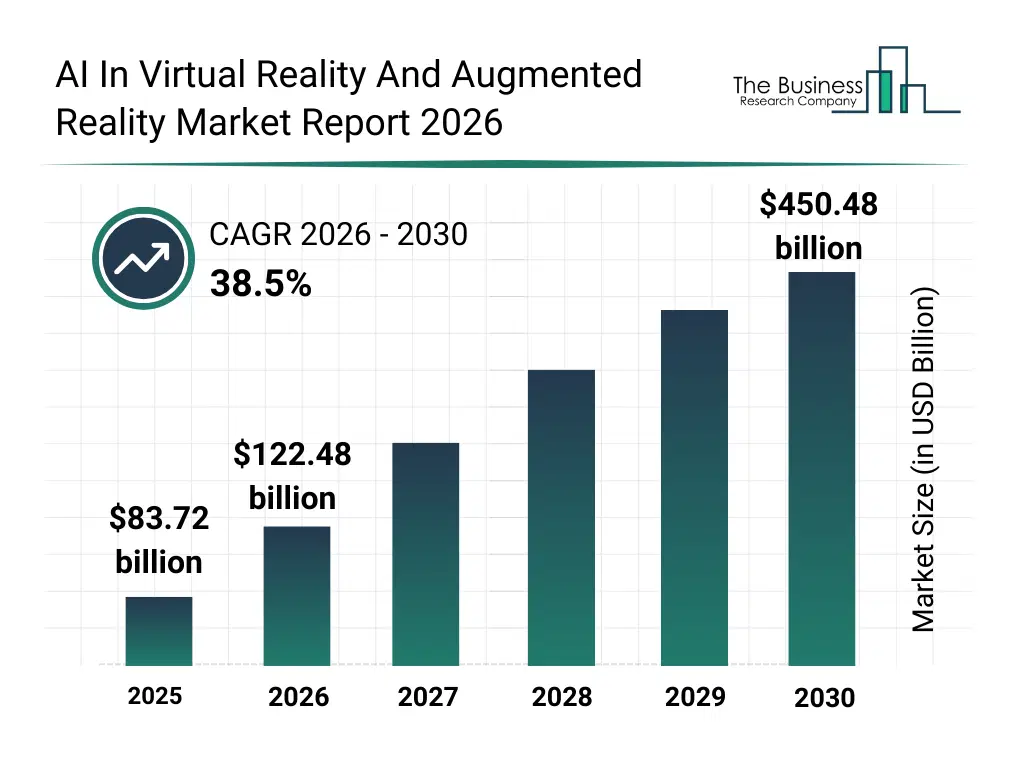
What Is The AI In Virtual Reality And Augmented Reality Market Size and Share 2026?
The AI in virtual reality and augmented reality market size has grown exponentially in recent years. It will grow from $83.72 billion in 2025 to $122.48 billion in 2026 at a compound annual growth rate (CAGR) of 46.3%. The growth in the historic period can be attributed to limited adoption of immersive technologies, high cost of vr/ar devices, lack of AI integration in early vr/ar systems, slow content creation processes, low awareness of immersive applications.What Is The AI In Virtual Reality And Augmented Reality Market Growth Forecast?
The AI in virtual reality and augmented reality market size is expected to see exponential growth in the next few years. It will grow to $450.48 billion in 2030 at a compound annual growth rate (CAGR) of 38.5%. The growth in the forecast period can be attributed to advancements in AI algorithms for vr/ar, increasing investment in immersive content, growing demand for personalized experiences, expansion of enterprise applications in education and healthcare, adoption of mobile and wearable vr/ar platforms. Major trends in the forecast period include ai-driven vr content creation, personalized vr experiences, ai-powered object recognition in ar, real-time AI interaction in vr, ai-driven ar navigation and mapping.
Global AI In Virtual Reality And Augmented Reality Market Segmentation
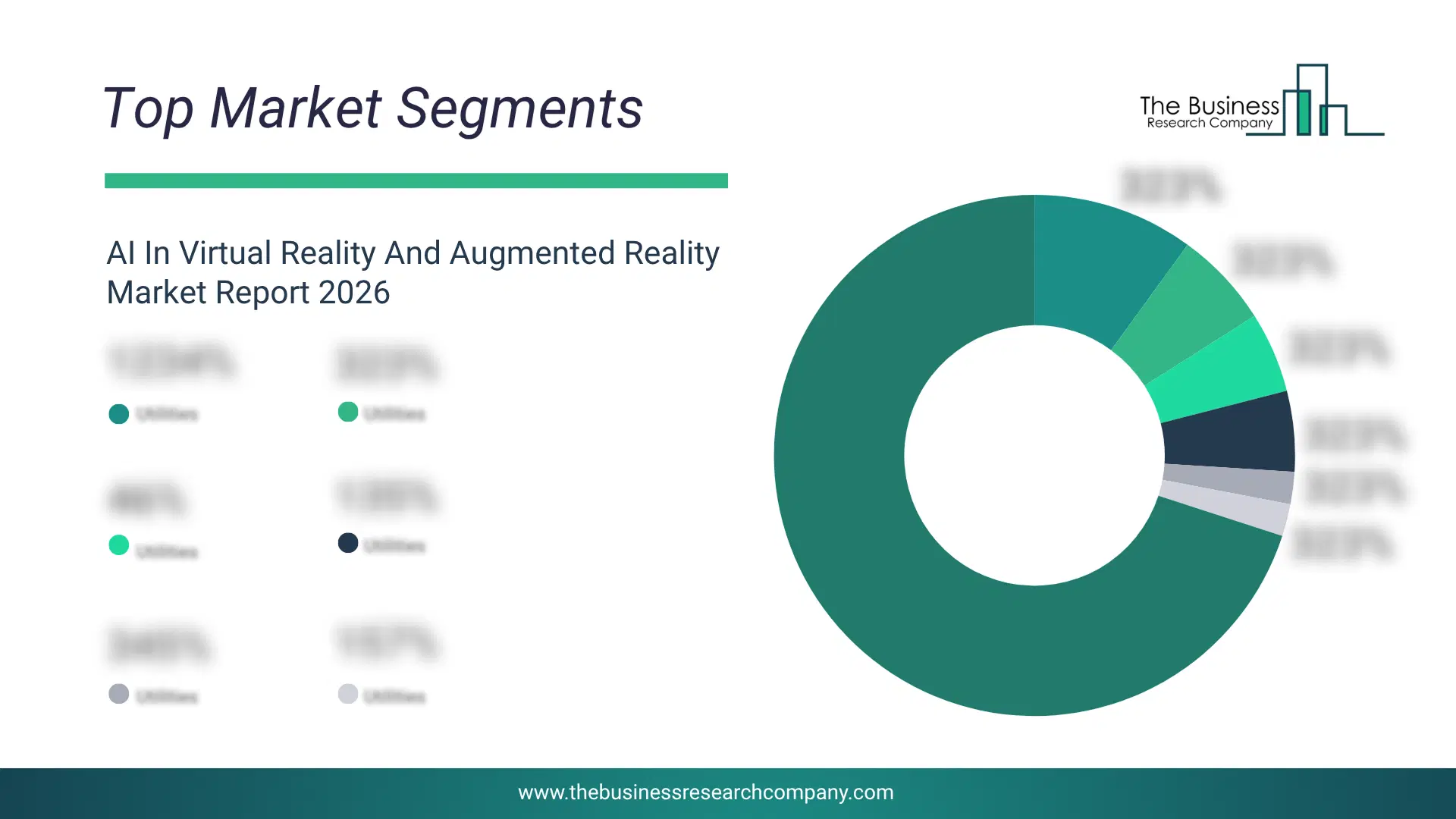
1) By Type: Artificial Intelligence-Powered Virtual Reality (VR), Artificial Intelligence-Enhanced Augmented Reality (AR) 2) By Technology: Natural Language Processing (NLP), Computer Vision, Machine Learning, Deep Learning, Gesture Recognition, Speech Recognition, Simulated Environments 3) By Platform: Mobile Devices, Head-Mounted Displays (HMDs), Projectors And Smart Glasses, Wearables And Body Tracking Devices, Desktop Computers And Consoles 4) By Application: Gaming And Entertainment, Education And Training, Healthcare And Medical, Retail And E-commerce, Real Estate And Architecture, Automotive And Transportation, Tourism And Travel, Social Media And Communication, Industrial And Manufacturing, Military And Defense Subsegments: 1) By Artificial Intelligence-Powered Virtual Reality (VR): AI-Driven VR Content Creation, Personalized VR Experiences, AI In VR Training And Simulation, Real-Time AI Interaction In VR 2) By Artificial Intelligence-Enhanced Augmented Reality (AR): AI-Powered Object Recognition, AI-Driven AR Navigation And Mapping, Real-Time AI Data Overlay, AI In AR Retail And Shopping ExperiencesWhat Is The Driver Of The AI In Virtual Reality And Augmented Reality Market?
The increasing number of IoT (Internet of Things) devices is expected to propel the growth of AI in the virtual reality and augmented reality market going forward. IoT devices refer to physical objects embedded with sensors, software, and connectivity technologies that enable them to collect and exchange data with other devices or systems over the internet. The number of IoT devices is increasing due to expanding digital ecosystems, advancements in 5G connectivity, and growing demand for automation and smart infrastructure across industries. The AI in the virtual reality and augmented reality market supports this growth by enhancing IoT capabilities through immersive visualization, real-time analytics, predictive maintenance, and context-aware interaction, thereby improving operational efficiency and user experience. For instance, in March 2023, according to the GSMA (GSM Association), a UK-based non-profit mobile industry organization, the total number of IoT connections reached approximately 15.1 billion globally, and this number is projected to continue increasing significantly through the decade. Therefore, the increasing number of IoT devices is driving the growth of AI in the virtual reality and augmented reality market.Key Players In The Global AI In Virtual Reality And Augmented Reality Market
Major companies operating in the AI in virtual reality and augmented reality market are Apple Inc.; Alphabet Inc.; Samsung Electronics Co. Ltd.; Microsoft Corporation; Meta Platforms Inc.; Sony Corporation; Lenovo Group Limited; Intel Corporation; Qualcomm Incorporated; NVIDIA Corporation; Dassault Systemes SE; PTC Inc.; Sixense Enterprises Inc.; Magic Leap Inc.; HTC Corporation; EON Reality Inc.; Daqri LLC; Zappar Ltd.; Scope AR; Vuzix Corporation; Upskill; Avegant Corporation; Atheer Inc.; Cognixion; Marxent Labs LLC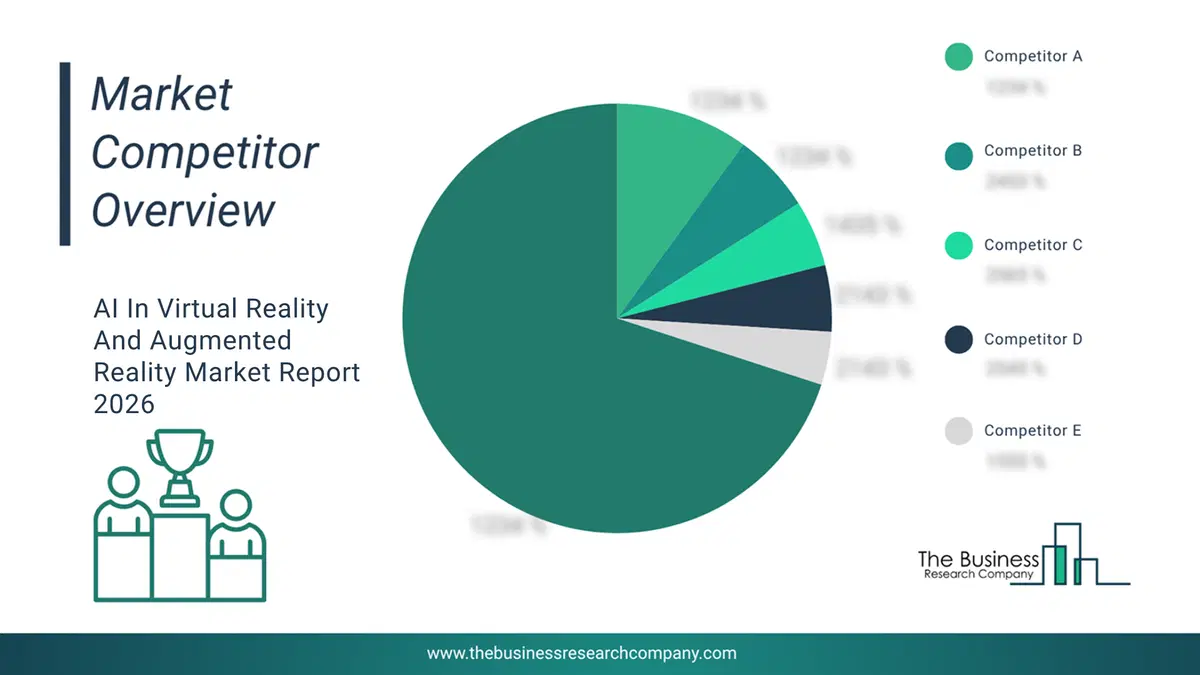
This chart is for illustrative purposes; the full report includes a detailed competitor analysis and comprehensive overview of the top 10 companies in the market.
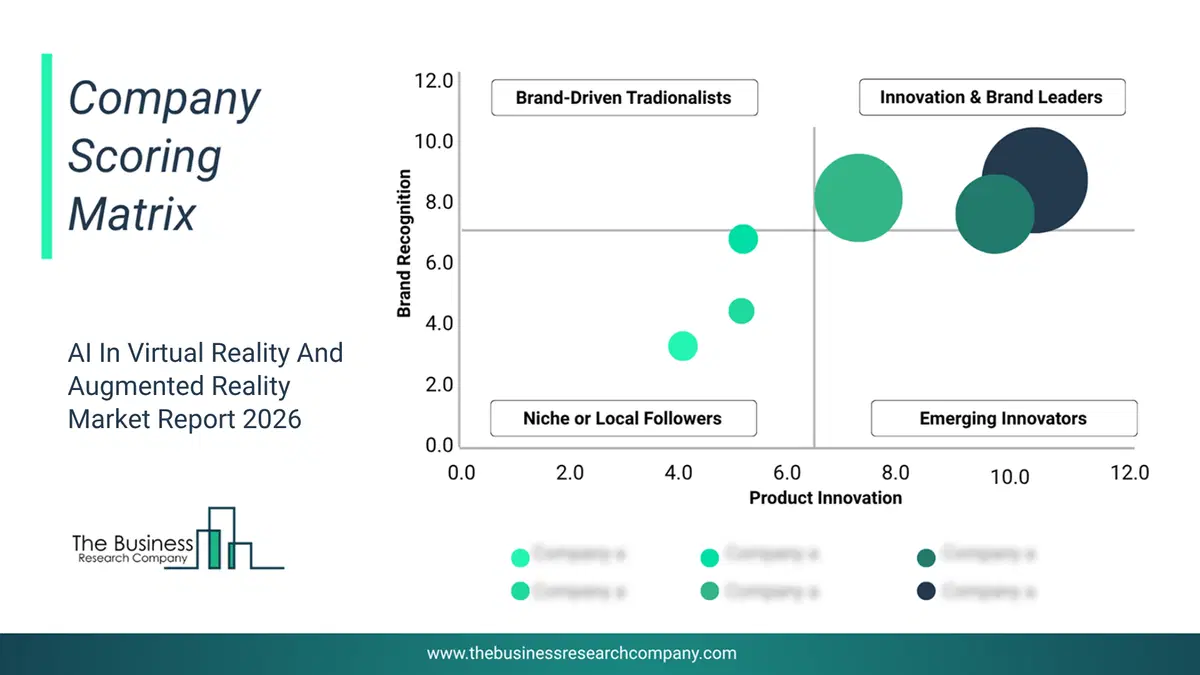
This chart maps companies by product innovation and brand strength, with bubble size indicating relative revenue, helping identify market leaders, challengers, and niche players. This is an illustrative chart; the full report provides a complete and accurate competitive analysis.
Global AI In Virtual Reality And Augmented Reality Market Trends and Insights
Major companies operating in the AI in virtual and augmented reality market are focusing on developing innovative products, such as assisted reality glasses, to enhance user interaction, accessibility, and real-world engagement through artificial intelligence integration. Assisted reality glasses, also known as smart glasses, are wearable devices that overlay digital information, graphics, or visuals onto the wearer’s field of view, thereby augmenting real-world perception with contextual data and interactive content. For instance, in February 2024, OPPO Guangdong Mobile Communications Co., Ltd., a China-based consumer electronics company, unveiled the OPPO Air Glass 3, a pair of assisted reality glasses designed to deliver real-time digital information through full-color lenses. The device integrates a voice assistant powered by Oppo’s large language model (LLM) called AndesGPT, enabling users to access AI-assisted functionalities such as messaging, navigation, and contextual information overlays. The Air Glass 3 connects seamlessly to Oppo smartphones and is operated through touch sensors embedded on the frame, providing an intuitive interface for daily use. This innovation represents a major step in merging AI capabilities with wearable technology to create more personalized, hands-free, and immersive digital experiences.What Are Latest Mergers And Acquisitions In The AI In Virtual Reality And Augmented Reality Market?
In October 2023, FittingBox, a France-based provider of augmented reality and virtual try-on solutions for eyewear retailers, acquired Ditto, Luna’s virtual try-on business, for an undisclosed amount. With this acquisition, FittingBox aims to enhance its technological capabilities and expand its virtual try-on offerings to provide more immersive and accurate online eyewear experiences. Ditto is a US-based provider of AI-driven virtual try-on technology and 3D facial scanning solutions for eyewear.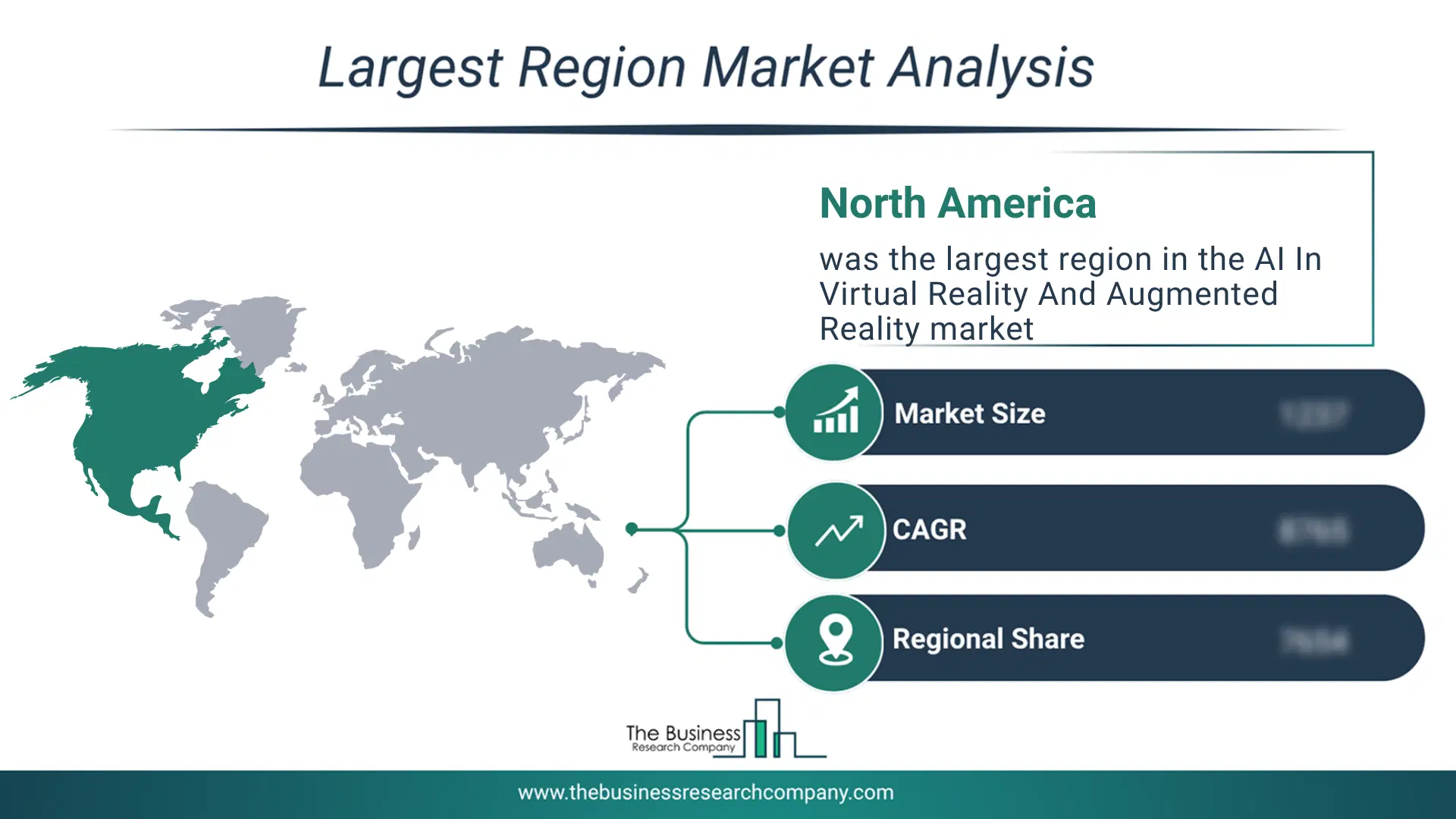
Regional Insights
North America was the largest region in the AI in virtual reality and augmented reality market in 2025. The regions covered in this market report are Asia-Pacific, South East Asia, Western Europe, Eastern Europe, North America, South America, Middle East, Africa. The countries covered in this market report are Australia, Brazil, China, France, Germany, India, Indonesia, Japan, Taiwan, Russia, South Korea, UK, USA, Canada, Italy, SpainWhat Defines the AI In Virtual Reality And Augmented Reality Market?
The AI in virtual reality and augmented reality market consists of revenues earned by entities by providing services such as consulting and development, training services, content creation, integration and customization, and designing services. The market value includes the value of related goods sold by the service provider or included within the service offering. The AI in virtual reality and augmented reality market also includes sales of head-mounted displays, sensors, cameras, processors, and input devices. Values in this market are ‘factory gate’ values, that is the value of goods sold by the manufacturers or creators of the goods, whether to other entities (including downstream manufacturers, wholesalers, distributors and retailers) or directly to end customers. The value of goods in this market includes related services sold by the creators of the goods.How is Market Value Defined and Measured?
The market value is defined as the revenues that enterprises gain from the sale of goods and/or services within the specified market and geography through sales, grants, or donations in terms of the currency (in USD unless otherwise specified). The revenues for a specified geography are consumption values that are revenues generated by organizations in the specified geography within the market, irrespective of where they are produced. It does not include revenues from resales along the supply chain, either further along the supply chain or as part of other products.
This chart presents market attractiveness based on a quantitative evaluation of growth, competition, strategic alignment, and risk, offering a clear view of opportunity areas for decision-making. This chart is for illustrative purposes; the full report contains the complete analysis.

This chart highlights the Total Addressable Market (TAM) by estimating the maximum revenue opportunity using an assumption-driven approach, supporting strategic planning and opportunity sizing across markets. The chart is illustrative; the full report provides a more comprehensive analysis.
What Key Data and Analysis Are Included in the AI In Virtual Reality And Augmented Reality Market Report 2026?
The ai in virtual reality and augmented reality market research report is one of a series of new reports from The Business Research Company that provides market statistics, including industry global market size, regional shares, competitors with the market share, detailed market segments, market trends and opportunities, and any further data you may need to thrive in the ai in virtual reality and augmented reality industry. The market research report delivers a complete perspective of everything you need, with an in-depth analysis of the current and future state of the industry.AI In Virtual Reality And Augmented Reality Market Report Forecast Analysis
| Report Attribute | Details |
|---|---|
| Market Size Value In 2026 | $122.48 billion |
| Revenue Forecast In 2030 | $450.48 billion |
| Growth Rate | CAGR of 38.5% from 2026 to 2030 |
| Base Year For Estimation | 2025 |
| Actual Estimates/Historical Data | 2020-2025 |
| Forecast Period | 2026 - 2030 |
| Market Representation | Revenue in USD Billion and CAGR from 2026 to 2030 |
| Segments Covered | Type, Technology, Platform, Application |
| Regional Scope | Asia-Pacific, Western Europe, Eastern Europe, North America, South America, Middle East, Africa |
| Country Scope | The Countries Covered In This Market Report Are Australia, Brazil, China, France, Germany, India, Indonesia, Japan, Taiwan, Russia, South Korea, Uk, Usa, Canada, Italy, Spain. |
| Key Companies Profiled | Apple Inc., Alphabet Inc., Samsung Electronics Co. Ltd., Microsoft Corporation, Meta Platforms Inc., Sony Corporation, Lenovo Group Limited, Intel Corporation, Qualcomm Incorporated, NVIDIA Corporation, Dassault Systemes SE, PTC Inc., Sixense Enterprises Inc., Magic Leap Inc., HTC Corporation, EON Reality Inc., Daqri LLC, Zappar Ltd., Scope AR, Vuzix Corporation, Upskill, Avegant Corporation, Atheer Inc., Cognixion, Marxent Labs LLC |
| Customization Scope | Request for Customization |
| Pricing And Purchase Options | Explore Purchase Options |