
AI-Powered Simulation And Digital Twins Market 2026
By Component (Solution, Services), By Type Of Digital Twin (Product Digital Twin, Process Digital Twin, System Digital Twin, Human Digital Twin, City And Infrastructure Digital Twin, Other Types Of Digital Twin), By Deployment Model (Cloud-Based Digital Twin, On-Premises Digital Twin), By Industry Vertical (Manufacturing And Industrial Automation, Healthcare And Pharmaceuticals, Automotive And Transportation, Aerospace And Defense, Energy And Utilities, Retail And E-Commerce, Other Industry Verticals), And By Region, Opportunities And Strategies – Global Forecast To 2035
AI-Powered Simulation And Digital Twins Market Definition
AI-powered simulation and digital twin refer to advanced computational models that replicate the behavior, performance, and operation of physical systems, products, or processes in a virtual environment. It integrates artificial intelligence, machine learning, and real-time data from sensors. This digital twin can predict outcomes, optimize designs, and support decision-making across industries. The primary purpose of AI-powered simulation and digital twin is to improve efficiency, reduce costs, and enhance performance by enabling real-time monitoring, predictive analysis, and scenario testing. The AI-powered simulation and digital twin market consists of sales, by entities (organizations, sole traders, or partnerships), of solutions and services that create virtual replicas of physical assets, processes, or systems, leveraging artificial intelligence to enhance simulation accuracy and predictive capabilities. These technologies enable users to model real-world scenarios, test changes, and optimize operations digitally, reducing risks and costs associated with physical experimentation.
AI-Powered Simulation And Digital Twins Market Size
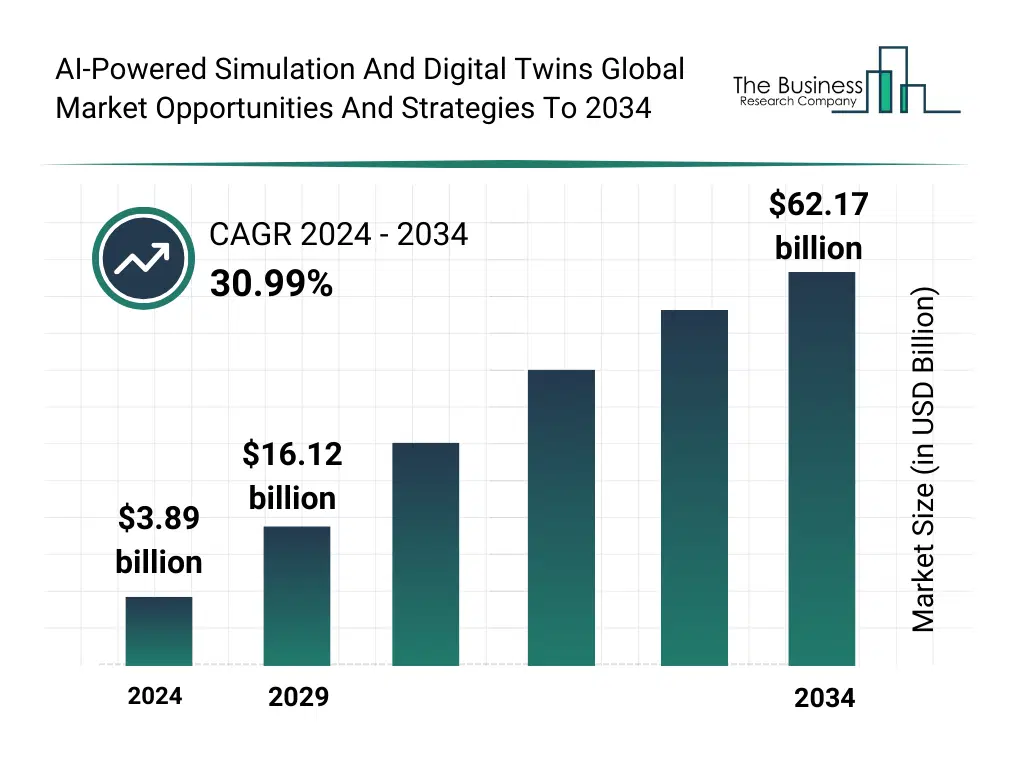
The global AI-powered simulation and digital twins market reached a value of nearly $3,888.43 million in 2024, having grown at a compound annual growth rate (CAGR) of 35.32% since 2019. The market is expected to grow from $3,888.43 million in 2024 to $16,122.79 million in 2029 at a rate of 32.90%. The market is then expected to grow at a CAGR of 30.99% from 2029 and reach $62,167.45 million in 2034. Growth in the historic period resulted from expansion of digital transformation strategies, growing 5g and advanced connectivity, rising adoption of IoT and connected devices and growing in smart city infrastructure development. Factors that negatively affected growth in the historic period were data privacy and security concerns and lack of skilled workforce. Going forward, growing demand for predictive maintenance, rising integration of cloud and edge computing, government initiatives and funding and rising implementation of smart manufacturing will drive the growth. Factors that could hinder the growth of the AI-powered simulation and digital twins market in the future include high implementation and integration costs, interoperability and standardization challenges and impact of trade war and tariff.AI-Powered Simulation And Digital Twins Market Drivers
The key drivers of the AI-powered simulation and digital twins market include: Growing Demand for Predictive Maintenance The growing demand for predictive maintenance is expected to be a major driver of growth in the AI-powered simulation and digital twin market during the forecast period. By helping industries anticipate equipment failures and optimize maintenance schedules, these technologies reduce downtime, lower operational costs, and enhance overall efficiency. This drives increased adoption of AI-powered simulation and digital twins for real-time monitoring, analysis, and performance prediction of assets. Moreover, it supports continuous improvements in asset reliability and contributes to sustainability efforts by minimizing resource waste. The integration of real-time sensor data with AI models further strengthens operational intelligence across industrial processes. The growing demand for predictive maintenance growth contribution during the forecast period in 2024 is 1.50%.AI-Powered Simulation And Digital Twins Market Restraints
The key restraints on the AI-powered simulation and digital twins market include: High Implementation and Integration Costs High implementation and integration costs are expected to restrain the growth of the AI-powered simulation and digital twin market during the forecast period. Deploying these solutions often requires substantial upfront investments in advanced hardware, software, sensor networks, and robust data infrastructure, which can be prohibitive for small and medium-sized enterprises. Furthermore, integrating digital twin systems with existing enterprise platforms and operational technologies often demands specialized customization and engineering, increasing both time and resource commitments. These financial and technical challenges may hinder widespread adoption and limit the scalability of digital twin initiatives beyond initial pilot phases. Growth affected by high implementation and integration costs during the forecast period in 2024 is -2.75%.AI-Powered Simulation And Digital Twins Market Trends
Major trends shaping the AI-powered simulation and digital twins market include: Development Of AI-Driven Predictive Analytics Platforms For Digital Twins Major companies in the artificial intelligence (AI)-powered simulation and digital twin market are increasingly developing and launching platforms that combine AI, machine learning, and statistics to enable predictive analytics on digital twin data. These platforms allow organizations to forecast equipment failures, optimize process flows, simulate alternate scenarios and prioritize maintenance or resource allocation based on predicted outcomes rather than just reactive data. This greatly reduces downtime, lowers operational costs, and improves performance and quality in industrial, manufacturing, energy, and infrastructure operations. For example, in September 2025, AVEVA, a UK-based leading industrial software company, announced the deployment of its AVEVA Advanced Analytics, powered by TwinThread, across multiple enterprises in the manufacturing and consumer goods sectors. This no-code, cloud-native predictive analytics solution transforms raw industrial data into actionable insights in real time. It has delivered improvements in equipment uptime, product quality, and energy efficiency when integrated with AVEVA’s industrial intelligence platforms. Integration Of AI/ML In Advanced Wireless Simulation Platforms Major companies in the market are focusing on integrating AI/ML into advanced wireless simulation platforms to enhance real-time analysis, predictive modeling, and automation capabilities. This integration enables more accurate and dynamic digital twin models, optimizing system performance and reducing development time. AI-driven simulations can adapt to evolving network conditions, improving decision-making and resource management. As a result, these advancements are accelerating the growth of the AI-powered simulation and digital twins market across industries like telecom, automotive, and manufacturing. For example, in September 2025, Keysight Technologies Inc, a US-based company that manufactures electronics test and measurement equipment and software, launched WirelessPro 3GPP AI Simulation Platform (WirelessPro), a next-generation software platform designed to meet the evolving needs of wireless communication system engineers. The new solution delivers a unified environment for modeling, prototyping, and validating advanced wireless technologies, with deep integration of AI/ML capabilities and alignment with the latest third-generation partnership project (3GPP) specifications.Opportunities And Recommendations In The AI-Powered Simulation And Digital Twins Market
Opportunities – The top opportunities in the AI-powered simulation and digital twins market segmented by component will arise in the solution segment, which will gain $8,030.80 million of global annual sales by 2029. The top opportunities in the AI-powered simulation and digital twins market segmented by type of digital twin will arise in the product digital twins segment, which will gain $4,698.18 million of global annual sales by 2029. The top opportunities in the AI-powered simulation and digital twins market segmented by deployment model will arise in the cloud-based digital twins segment, which will gain $8,042.00 million of global annual sales by 2029. The top opportunities in the AI-powered simulation and digital twins market segmented by industry vertical will arise in the manufacturing and industrial automation segment, which will gain $3,885.66 million of global annual sales by 2029. The AI-powered simulation and digital twins market size will gain the most in the USA at $3,910.85 million. Recommendations- To take advantage of the opportunities, The Business Research Company recommends the AI-powered simulation and digital twins companies to focus on integrated predictive analytics expansion, focus on AI-driven wireless simulation advancement, focus on AI-enhanced cybersecurity simulation capability, focus on dynamic cybersecurity twin development, focus on edge-AI convergence for real time twin performance, focus on scalable cloud-native twin platforms, focus on comprehensive consult-to-operate service models, focus on sustainability-driven twin applications, focus on personalized medical twin innovation, focus on accelerating growth in the services segment, focus on capturing rapid growth in the system digital twins segment, focus on expanding cloud-based deployment to capture the highest growth, expand in emerging markets, focus on expanding integrated distribution networks, focus on building disciplined and flexible pricing models, focus on strengthening targeted market communication, focus on expanding partner-driven promotional reach and focus on accelerating growth in the healthcare and pharmaceuticals segment.AI-Powered Simulation And Digital Twins Market Segmentation
The AI-powered simulation and digital twins market is segmented by component, by type of digital twin, by deployment model and by industry vertical.By Component –
The AI-powered simulation and digital twins market is segmented by component into:
- a) Solution
- b) Services
By Type Of Digital Twin –
The AI-powered simulation and digital twins market is segmented by type of digital twin into:
- a) Product Digital Twin
- b) Process Digital Twin
- c) System Digital Twin
- d) Human Digital Twin
- e) City And Infrastructure Digital Twin
- f) Other Types Of Digital Twin
By Deployment Model –
The AI-powered simulation and digital twins market is segmented by deployment model into:
- a) Cloud-Based Digital Twin
- b) On-Premises Digital Twin
By Industry Vertical –
The AI-powered simulation and digital twins market is segmented by Industry Vertical into:
- a) Manufacturing And Industrial Automation
- b) Healthcare And Pharmaceuticals
- c) Automotive And Transportation
- d) Aerospace And Defense
- e) Energy And Utilities
- f) Retail And E-Commerce
- g) Other Industry Verticals
By Geography - The AI-powered simulation and digital twins market is segmented by geography into:
- • China
- • India
- • Japan
- • Australia
- • Indonesia
- • South Korea
- • USA
- • Canada
- • Brazil
- • France
- • Germany
- • UK
- • Italy
- • Spain
- • Russia
-
o Asia Pacific
o Africa