

Air-Fluidized Beds Market Report 2026
Global Outlook – By Type (Static Air Fluidized Beds, Dynamic Air Fluidized Beds), By Distribution Channel (Direct Sales, Distributors And Dealers, Online Sales, Medical Equipment Rental Providers), By Application (Pressure Ulcer Treatment, Burn Care, Post Surgical Recovery, Chronic Wound Management, Long Term Patient Care), By End User (Hospitals, Specialty Clinics, Long Term Care Centers, Home Healthcare Settings, Rehabilitation Centers) – Market Size, Trends, Strategies, and Forecast to 2030
Air-Fluidized Beds Market Overview
• Air-Fluidized Beds market size has reached to $1.15 billion in 2025 • Expected to grow to $1.7 billion in 2030 at a compound annual growth rate (CAGR) of 8.2% • Growth Driver: Rising Chronic Wound Burden Driving Demand For The Market Due To Increasing Diabetes-Related Complications And Impaired Wound Healing Outcomes • North America was the largest region in 2025 and Asia-Pacific is the fastest growing region.What Is Covered Under Air-Fluidized Beds Market?
Air-fluidized beds are advanced therapeutic support systems that use warm, pressurized air to circulate fine ceramic or silicone-coated beads, forming a fluid-like surface that evenly redistributes body weight. These beds are designed to minimize pressure, friction, and moisture on the skin, supporting the prevention and treatment. Air-fluidized beds are widely utilized to improve patient comfort, accelerate wound healing, and reduce tissue damage during prolonged immobility. The main types of air-fluidized beds include static air fluidized beds, and dynamic air fluidized beds. Static air fluidized beds refer to specialized therapeutic support surfaces that use fine particles suspended by airflow to reduce pressure on the skin and promote wound healing. These beds are distributed through direct sales, distributors and dealers, online sales, and medical equipment rental providers. They find application in pressure ulcer treatment, burn care, post surgical recovery, chronic wound management, and long term patient care, serving end users including hospitals, specialty clinics, long term care centers, home healthcare settings, and rehabilitation centers.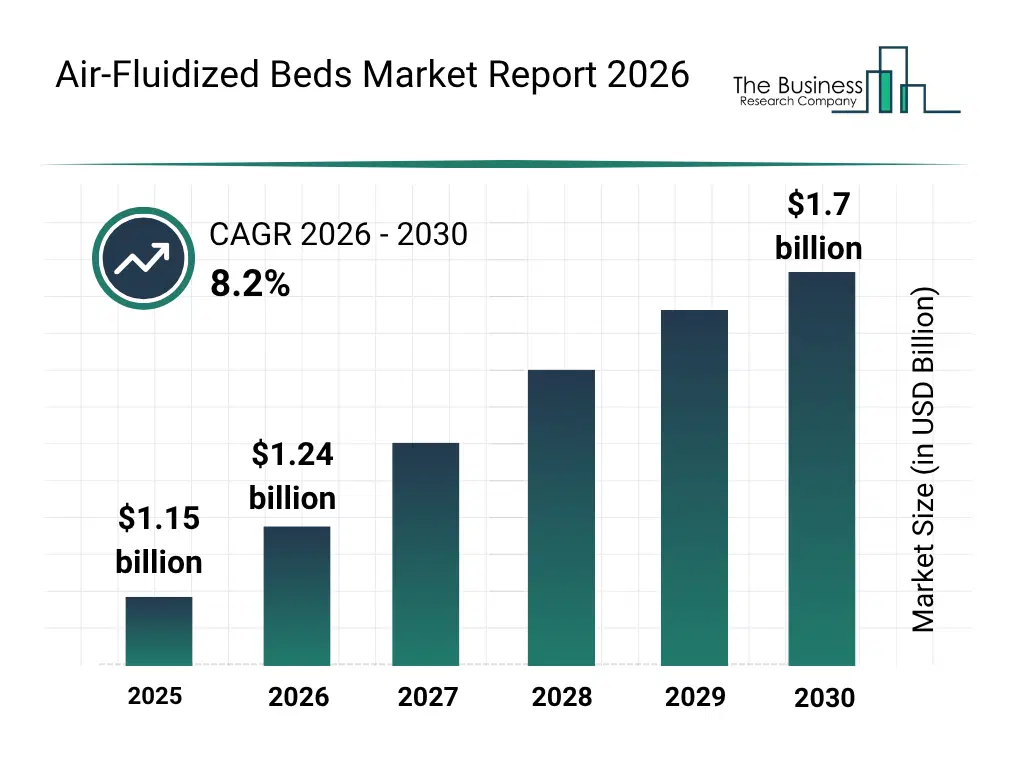
What Is The Air-Fluidized Beds Market Size and Share 2026?
The air-fluidized beds market size has grown strongly in recent years. It will grow from $1.15 billion in 2025 to $1.24 billion in 2026 at a compound annual growth rate (CAGR) of 8.0%. The growth in the historic period can be attributed to rising prevalence of pressure ulcers in immobile patients, increasing hospital admissions and long-term care requirements, growing awareness of advanced wound care therapies, expansion of critical care and intensive care infrastructure, increasing adoption of specialty hospital beds in developed healthcare systems.What Is The Air-Fluidized Beds Market Growth Forecast?
The air-fluidized beds market size is expected to see strong growth in the next few years. It will grow to $1.7 billion in 2030 at a compound annual growth rate (CAGR) of 8.2%. The growth in the forecast period can be attributed to increasing integration of smart sensor based therapeutic bed systems, rising demand for advanced wound healing and infection prevention solutions, growth in aging population requiring long term care support, expansion of home healthcare and remote patient monitoring, increasing healthcare investment in critical care infrastructure modernization. Major trends in the forecast period include AI-assisted patient pressure injury monitoring systems, increasing adoption of smart therapeutic support surface beds, growth in hospital intensive care pressure redistribution solutions, rising demand for moisture and temperature controlled wound care systems, integration of sensor-based adaptive airflow medical beds.
Global Air-Fluidized Beds Market Segmentation
1) By Type: Static Air Fluidized Beds; Dynamic Air Fluidized Beds 2) By Distribution Channel: Direct Sales; Distributors And Dealers; Online Sales; Medical Equipment Rental Providers 3) By Application: Pressure Ulcer Treatment; Burn Care; Post Surgical Recovery; Chronic Wound Management; Long Term Patient Care 4) By End User: Hospitals; Specialty Clinics; Long Term Care Centers; Home Healthcare Settings; Rehabilitation Centers Subsegments: 1) By Static Air Fluidized Beds: Non Powered Air Fluidized Support Systems; Fixed Air Flow Fluidized Bead Beds; Passive Pressure Redistribution Beds 2) By Dynamic Air Fluidized Beds: Alternating Airflow Fluidized Beds; Cyclic Pressure Modulation Fluidized Systems; Sensor Controlled Adaptive Airflow BedsWhat Are The Drivers Of The Air-Fluidized Beds Market?
The rising prevalence of chronic wounds is expected to propel the growth of the air-fluidized beds market going forward. Chronic wounds are persistent skin or tissue injuries that do not heal through the normal recovery process within several weeks due to underlying medical conditions or poor blood circulation. Chronic wounds are increasing primarily due to the growing prevalence of diabetes, which affects blood flow and nerve function, thereby delaying the body’s natural healing ability. Air-fluidized beds support chronic wound patients by utilizing fine beads suspended by warm air to evenly distribute body weight, reduce pressure on wounds, enhance blood circulation, and maintain an optimal moisture and temperature environment that promotes faster healing. For instance, in July 2025, according to National Seniors Australia, an Australia-based nonprofit organization, more than 450,000 Australians are affected by chronic wounds, placing an annual burden exceeding $6 billion on the healthcare system. Therefore, the rising prevalence of chronic wounds is driving the growth of the air-fluidized beds industry. The rising healthcare expenditure is expected to propel the growth of the air-fluidized beds market going forward. Healthcare expenditure is the total amount of money spent on healthcare services, goods, and systems by individuals, governments, and organizations within a given period. Healthcare expenditure is increasing mainly due to the aging population, which leads to higher demand for frequent, long-term, and complex medical care. Higher healthcare expenditure supports air-fluidized beds by enabling hospitals and care facilities to invest in advanced, high-cost wound care equipment that improves treatment outcomes for severe pressure injuries. For instance, in November 2023, according to the Canadian Institute for Health Information, a Canada-based institute for health information, in 2023, total health spending in Canada reached $344 billion, equating to $8,740 per person. This marks a 2.8% increase compared to the previous year, which saw only a 1.5% growth in health spending in 2022, indicating a notable rebound in healthcare investment. Therefore, the rising healthcare expenditure is driving the growth of the air-fluidized beds industry. The increasing number of hospital-acquired infections is expected to propel the growth of the air-fluidized beds market going forward. Hospital-acquired infections (HAIs) are infections that patients develop during treatment in a hospital or healthcare facility that were not present at the time of admission. Hospital-acquired infections are increasing mainly due to the rising use of invasive devices such as catheters and ventilators, which can allow pathogens to enter the body and cause infections. Air-fluidized beds help reduce hospital-acquired infections by minimizing pressure on the skin and promoting a cleaner, drier, and low-contact surface environment that limits bacterial growth and cross-contamination risk. For instance, in September 2024, according to the UK Health Security Agency, a UK-based government agency, in the fiscal year 2022–2023, the total count of hospital-onset healthcare-associated (HOHA) E. coli infections increased from 6,525 to 7,881 cases. Therefore, the increasing number of hospital-acquired infections is driving the growth of the air-fluidized beds industry.Key Players In The Global Air-Fluidized Beds Market
Major companies operating in the air-fluidized beds market are Envella Air Fluidized Therapy Bed (Baxter / Hillrom); PEARLS Full-Body Air-Fluidized Therapy System (Arjo); Ethos Therapy Solutions Inc.; AIRUS A210 Air Fluidized Therapy Unit (Blue Chip Medical Products); HydroAire Generation II Air Fluidized Therapy Bed (Aurora Manufacturing)Regional Outlook
North America was the largest region in the air-fluidized beds market in 2025. Asia-Pacific is expected to be the fastest-growing region in the forecast period. The regions covered in this market report are Asia-Pacific, South East Asia, Western Europe, Eastern Europe, North America, South America, Middle East, Africa. The countries covered in this market report are Australia, Brazil, China, France, Germany, India, Indonesia, Japan, Taiwan, Russia, South Korea, UK, USA, Canada, Italy, Spain.What Defines the Air-Fluidized Beds Market?
The air-fluidized bed market consists of sales of pulsating air-fluidized beds, continuous flow air-fluidized beds, and modular air-fluidized bed systems. Values in this market are ‘factory gate’ values, that is, the value of goods sold by the manufacturers or creators of the goods, whether to other entities (including downstream manufacturers, wholesalers, distributors, and retailers) or directly to end customers. The value of goods in this market includes related services sold by the creators of the goods.How is Market Value Defined and Measured?
The market value is defined as the revenues that enterprises gain from the sale of goods and/or services within the specified market and geography through sales, grants, or donations in terms of the currency (in USD unless otherwise specified). The revenues for a specified geography are consumption values that are revenues generated by organizations in the specified geography within the market, irrespective of where they are produced. It does not include revenues from resales along the supply chain, either further along the supply chain or as part of other products.What Key Data and Analysis Are Included in the Air-Fluidized Beds Market Report 2026?
The air-fluidized beds market research report is one of a series of new reports from The Business Research Company that provides market statistics, including industry global market size, regional shares, competitors with the market share, detailed market segments, market trends and opportunities, and any further data you may need to thrive in the air-fluidized beds industry. The market research report delivers a complete perspective of everything you need, with an in-depth analysis of the current and future state of the industry.Air-Fluidized Beds Market Report Forecast Analysis
| Report Attribute | Details |
|---|---|
| Market Size Value In 2026 | $1.24 billion |
| Revenue Forecast In 2030 | $1.7 billion |
| Growth Rate | CAGR of 8.2% from 2026 to 2030 |
| Base Year For Estimation | 2025 |
| Actual Estimates/Historical Data | 2020-2025 |
| Forecast Period | 2026 - 2030 |
| Market Representation | Revenue in USD Billion and CAGR from 2026 to 2030 |
| Segments Covered | Type, Distribution Channel, Application, End User |
| Regional Scope | Asia-Pacific, Western Europe, Eastern Europe, North America, South America, Middle East, Africa |
| Country Scope | The countries covered in the report are Australia, Brazil, China, France, Germany, India, ... |
| Key Companies Profiled | Envella Air Fluidized Therapy Bed (Baxter / Hillrom); PEARLS Full-Body Air-Fluidized Therapy System (Arjo); Ethos Therapy Solutions Inc.; AIRUS A210 Air Fluidized Therapy Unit (Blue Chip Medical Products); HydroAire Generation II Air Fluidized Therapy Bed (Aurora Manufacturing) |
| Customization Scope | Request for Customization |
| Pricing And Purchase Options | Explore Purchase Options |